
On this page
Start here
Quick answer
First identify whether the stove is electric or gas, then separate normal high-setting behavior from a burner that will not respond to the control. Official electric-range guidance says coil and radiant elements can cycle on and off even on HI to maintain heat, so visible cycling alone is not a stuck-high fault. A gas burner should respond to the model's control between high and low; a flame that remains high when turned down, or will not go out at OFF, should be taken out of service. Turn the controls off, stop using a burner that continues producing heat or flame, and arrange model-specific service. Do not remove controls, adjust a gas valve, or open the appliance.
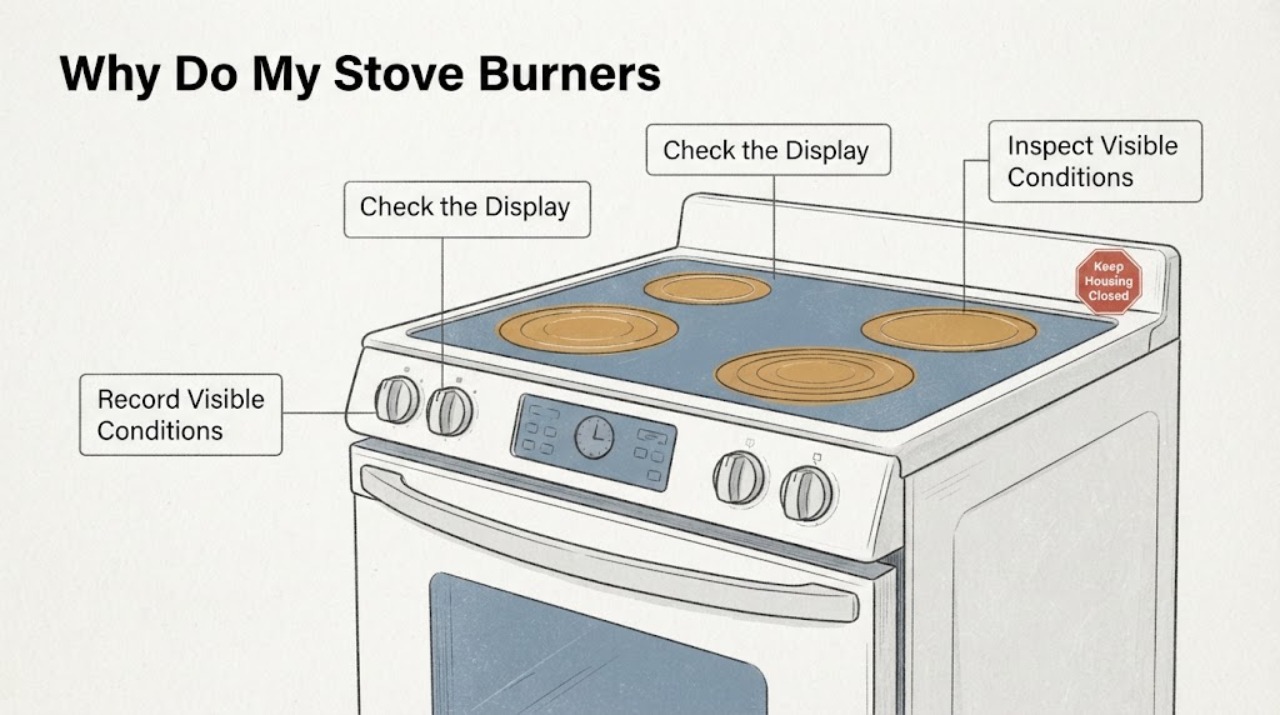
Work through in order
Diagnostic checks
Use only checks that match the exact appliance or system and its official guide.
-
Check 1
With the controls off and the surface cool enough to inspect safely, identify the burner type from outside: a visible flame indicates a gas burner, while a coil or a radiant element beneath a glass surface indicates an electric cooktop. Record the brand and complete model number before using any manual.
Expected result: The appliance has a gas flame, an electric coil or radiant element, or the burner type and model cannot be identified.
Next step: Follow only the matching branch below. If the type or model remains unknown, keep the appliance out of service when the heat is abnormal and obtain the model information for a qualified technician.
Why this matters
Why: Gas flame behavior and electric-element cycling follow different control systems, and the official guidance is family-specific. An unresolved type or model means a universal diagnosis would be unreliable.
-
Check 2
For an electric coil or radiant element, set one burner to HI only while the cookware and area are safe, and observe whether it cycles on and off as it heats. Do not touch the element or lift a glass cooktop; turn the control off after the observation.
Expected result: The element cycles on and off while set to HI, or it remains continuously energized/visibly hot when set lower or turned OFF.
Next step: If it cycles normally, use the manufacturer's manual for cookware and heat-setting guidance. If it continues heating at a lower setting or OFF, stop using that burner, keep the controls off, and arrange model-specific service without opening the appliance.
Why this matters
Why: LG and GE identify cycling on HI as normal electric temperature control. Continuous heat that does not follow the control is outside that normal behavior and does not identify a particular switch or control part.
-
Check 3
For a gas burner, with the burner attended, turn the control from the documented lighting position toward a lower setting and then to OFF as described by the exact owner manual. Watch the flame only; do not remove the knob or attempt to turn a valve adjustment screw.
Expected result: The flame follows the control from high toward low and goes out at OFF, or it stays high, will not reduce, or remains lit at OFF.
Next step: If the flame responds normally, use the exact manual for that model. If it stays high or will not shut off, turn the control off, stop using the stove, and contact qualified gas-appliance service; do not adjust gas pressure, the valve stem, or the conversion settings.
Why this matters
Why: GE documents model-dependent gas control travel between high and low and says valve adjustment is for a qualified gas technician. A flame that does not follow the control is an abnormal gas-control or installation symptom, not a basis for a DIY adjustment.
-
Check 4
After the control is turned off, check only for visible signs that change the safety decision: continuing heat or flame, a damaged knob or control area, an unstable or abnormal gas flame, smoke, or a burning smell. Keep hands away from hot surfaces and do not remove panels or controls.
Expected result: Heat or flame continues after OFF, the flame is abnormal, there is smoke or a burning smell, or the burner cools normally with no visible damage.
Next step: For continuing heat/flame, smoke, burning odor, or visible damage, leave the appliance out of service and arrange qualified service; if there is an immediate fire or gas emergency, leave the area and contact local emergency or utility services. If it cools normally, document the model, fuel type, control position, and exact behavior before contacting support.
Why this matters
Why: Continuing heat/flame or visible damage means the burner is not safe to retest. Whirlpool identifies abnormal gas flames as a service issue and its gas guidance does not establish a cross-brand internal repair.
Use your observations
Decision map
Find the observation that best matches what you see, then follow the next safe action.
-
PATH 01Next step
What you see
The stove is electric and the element cycles on and off while set to HI, then stops heating when the control is turned OFF.
Do this next
Use the exact owner manual for cookware and settings. Request service only if the element stops responding to the control, stays energized at OFF, or shows damage.
Why this path and its safety boundary
Why it matters: LG and GE describe this cycling as normal electric temperature regulation, including on HI.
-
PATH 02Next step
What you see
The stove is electric and the element remains continuously hot or glowing at a lower setting or after OFF.
Do this next
Stop using that burner, leave the controls off, keep clear of the hot surface, and arrange model-specific appliance service. Do not open the control area or test live wiring.
Why this path and its safety boundary
Why it matters: That observation is different from the documented electric cycling behavior and does not prove which control component is faulty.
-
PATH 03Next step
What you see
The stove is gas and the flame remains high when turned down, remains lit at OFF, or has an abnormal height or appearance.
Do this next
Turn the control off, stop using the appliance, and call qualified gas-appliance service. Do not remove controls, adjust a valve, change gas conversion settings, or continue testing.
Why this path and its safety boundary
Why it matters: The flame is not following the model's control behavior. GE and Whirlpool describe gas flame and control differences by model and route technician-level adjustment or unresolved flame problems to qualified service.
-
PATH 04Next step
What you see
The fuel type, model, or exact symptom cannot be confirmed, or the burner produces smoke, burning odor, continuing heat, or continuing flame after the control is OFF.
Do this next
Keep the stove out of service and arrange qualified service using the complete model and fuel type. For an immediate fire or gas emergency, leave the area and contact local emergency or utility services.
Why this path and its safety boundary
Why it matters: The available generic guidance cannot safely distinguish a normal cycle from an abnormal control or gas condition, and continued operation adds a heat or fire risk.
Helpful context
Understand the symptom
“On high” can describe two different symptoms
A glowing electric element that cycles while the control is set to HI can be normal. LG says the element cycles on and off to maintain the preset heat, even on HI, and GE describes the same behavior for coil and radiant electric burners. A gas flame that does not reduce when the control is moved away from HI is a different problem; it must be evaluated using gas-specific model instructions. The task does not identify the stove's fuel type, so do not apply gas-flame checks to an electric element or electric-cycling expectations to a gas flame.
Use only external observations before service
The safe decision is based on the control position and what the burner does, not on a guessed switch, infinite-control, valve, or regulator failure. A normal electric cycle can be observed without opening the appliance. For gas, GE says control and valve adjustment arrangements vary by model and identifies technician-only adjustment; Whirlpool's gas guidance also points to the exact owner literature for the appliance. If heat or flame continues at an OFF or lower setting, leave the controls off and stop using that burner until qualified service identifies the model-specific cause.
When checks do not resolve it
Need a professional?
Arrange qualified appliance service when an electric element stays energized at a lower setting or OFF, a gas flame remains high or lit at OFF, the type/model cannot be confirmed, or there is smoke, burning odor, visible damage, or any other continuing heat hazard.
Common questions
FAQ
Is an electric burner cycling on HI always a fault?
No. LG and GE both describe electric coil or radiant elements cycling on and off, including at HI, as normal temperature control. It becomes a service symptom when the element does not respond to the setting or remains energized after OFF.
Can I adjust a gas burner that stays too high?
Do not make a gas-valve or conversion adjustment from this symptom. GE says gas control arrangements vary by model and identifies valve adjustment as technician work; Whirlpool directs abnormal flame concerns to model-specific guidance and service. Turn the control off and stop using the burner until it is checked.
What information should I give the technician?
Provide the complete model number, whether the stove is electric or gas, which burner is affected, the control position when it stays high, whether an electric element cycles, whether a gas flame changes height, and whether the burner goes out at OFF. Do not open the appliance to collect more information.
Read the exact guide
Official sources
- Gas Burner Flame Level IncorrectWhirlpool Product Help · Opened official Whirlpool gas-cooktop guidance. Used only for the external abnormal-flame observations and service boundary; no Whirlpool model or internal part is assigned to this topic.
- Gas Range & Cooktop - Degree Rotation and Adjustment of Gas Burner ControlsGE Appliances · Opened official GE gas-control guidance. Used to keep gas observations separate from electric cycling and to support the model-dependent/qualified-technician boundary; it does not identify a specific gas stove or authorize a user valve adjustment.
- Electric burners cycling on/offLG USA Support · Opened official LG support guidance for electric coil/radiant burner cycling. Used only to explain that cycling can be normal even on HI; it does not identify the assigned stove's brand, model, or an internal failure.
- Electric Range & Cooktop - Surface Burners Cycle On and OffGE Appliances · Opened official GE support guidance for electric coil and radiant burners. Used for the normal cycling branch only; it does not establish the fuel type or model of the assigned stove.
Community feedback
Share a repair observation
Share a plain-text repair observation. Accepted observations are published automatically; this page may take a moment to update.