
On this page
Start here
Quick answer
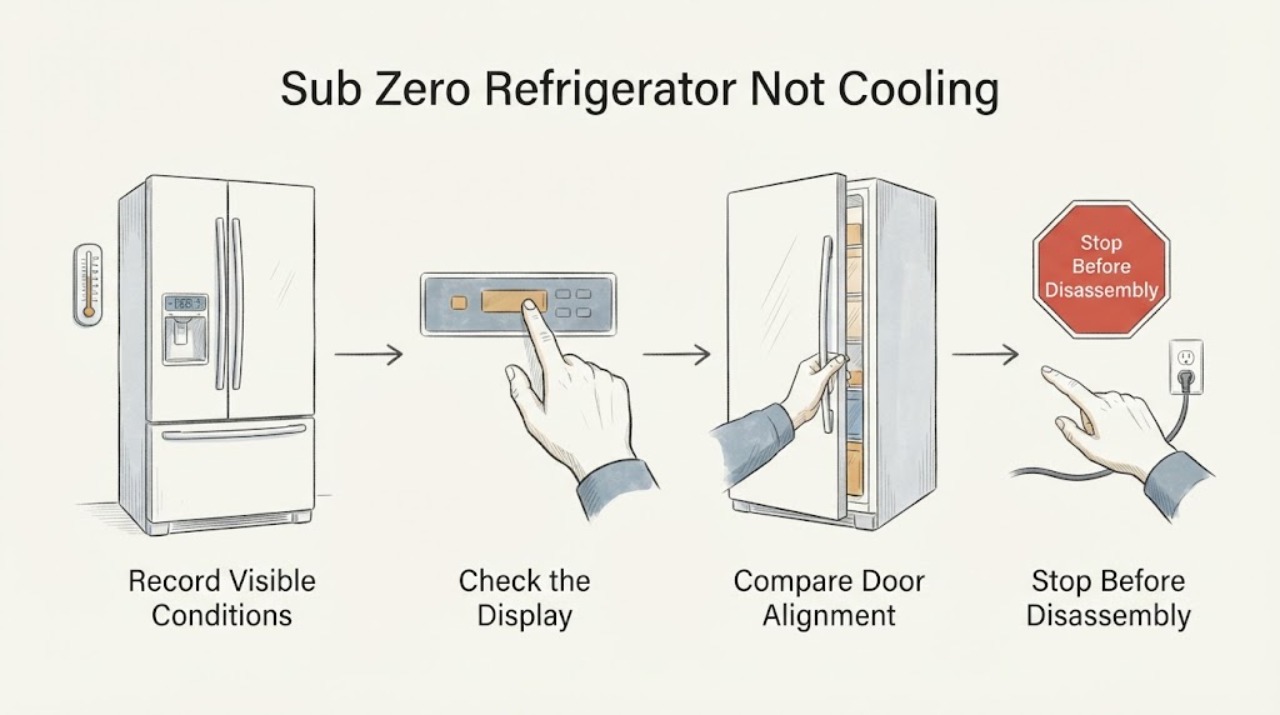
If a Sub-Zero refrigerator is not cooling, first identify whether the refrigerator section, freezer section, or all sections are warm and record the exact model from the serial tag. Confirm the unit is running, the control is set for the intended section, the doors close fully, nothing blocks the door or visible airflow path, and the door gasket is not damaged. A new installation, recently added warm food, a changed setting, or a long-open door can require the documented recovery period. If the control panel is unresponsive, check the exact model guidance for Sabbath Mode; if the refrigerator is warm while the freezer works and the lights are off, verify that the refrigerator section was not disabled. Clean a condenser only with the exact model procedure and only when its maintenance interval calls for it. If the temperature remains warm after these checks, a service indication returns, or there is smoke, burning odor, damaged wiring, or leaking water near electrical parts, stop using the unit and contact Sub-Zero Factory Certified Service.
Work through in order
Diagnostic checks
Use only checks that match the exact appliance or system and its official guide.
-
Check 1
Record the complete model and serial information from the Sub-Zero serial tag, then identify the affected area: refrigerator section only, freezer section only, both sections, or an undercounter refrigerator configuration. Note whether the display, interior lights, alarms, or controls are also abnormal.
Expected result: Only the refrigerator section is warm, only the freezer is warm, all sections are warm, or the model and affected section cannot be identified safely.
Next step: Keep the exact model and pattern for the remaining checks. If the model cannot be identified, use only the general checks below and do not follow a series-specific reset or panel procedure from another product.
Why this matters
Why: Sub-Zero says that distinguishing one section from all sections is useful for service, and its published causes include fans, temperature controls or sensors, compressors, evaporators, condensers, and door seals. The pattern narrows the service description but does not prove which component failed.
-
Check 2
Check the refrigerator and freezer control displays or dials from the front. Confirm the unit is on and the affected section has its intended setpoint; use the exact model instructions for a numbered dial or electronic control. If a display or control panel does not respond, check the exact model guidance for Sabbath Mode before trying any other control sequence.
Expected result: The unit is off, a section is set warmer than intended, the setting was recently changed, the panel is unresponsive, or the settings and controls appear normal.
Next step: Restore a clearly incorrect setting only with the model procedure and allow the documented recovery period. For an unresponsive panel or an unclear operating mode, stop changing controls and use the model guide or request Factory Certified Service.
Why this matters
Why: Sub-Zero states that model families use different dial and electronic controls, that a new setting can take 24 hours to reach, and that an unresponsive panel can be associated with Sabbath Mode. A normal setting and responsive control do not rule out a cooling-system fault.
-
Check 3
Close each refrigerator and freezer door or drawer and check from outside that it reaches its normal closed position. Remove only an accessible container or package that prevents closure, and inspect the visible door gasket or rubber seal for a tear, gap, or displacement. Do not force a hinge or seal into position.
Expected result: A door was ajar, a package blocked closure, the gasket is visibly damaged or not contacting, or the doors close and the gasket appears intact.
Next step: Remove the accessible obstruction and close the door normally, or arrange service for a damaged or displaced gasket or hinge. After a safe correction, allow the official recovery period before deciding whether cooling has returned.
Why this matters
Why: Sub-Zero lists a long-open or obstructed door and a damaged door seal as causes of warm temperatures. Correcting a closure problem can allow recovery; an intact closure does not establish that the internal cooling system is working.
-
Check 4
Consider recent operating conditions: note whether the refrigerator was newly installed, a door remained open for a long time, or a large amount of warm food was added. Then leave the doors closed and allow the official recovery period before repeatedly opening the unit to test it.
Expected result: The symptom follows a new installation, a long-open door, or warm groceries, or it began during ordinary operation with no such event.
Next step: Keep the unit running and doors closed for the documented recovery period after a qualifying event. If the affected section remains warm afterward, record the model and section pattern and schedule Factory Certified Service.
Why this matters
Why: Sub-Zero says a new installation and a changed setting can require up to 24 hours to cool properly, and that new groceries or warm food raise temperatures for a time. Without one of those conditions, delayed recovery is less likely and a persistent cooling issue deserves service sooner.
-
Check 5
Measure food temperature rather than relying only on the display or a quick air reading: place a submersible thermometer in a glass of water in the middle of the refrigerator compartment, then allow the measurement to stabilize as Sub-Zero describes. Do not leave perishable food in a compartment that is not maintaining a safe temperature.
Expected result: The food temperature is consistent with the model setpoint, remains warm, or changes erratically compared with the setpoint shown on the control panel.
Next step: Record the measured result, setpoint, section, and elapsed time for service. If the result remains warm or erratic, stop repeated testing and contact Factory Certified Service.
Why this matters
Why: Sub-Zero explains that the control display shows a setpoint and that air temperature is not the proper cooling measurement; food temperature after the documented measurement period is more useful. Erratic or inconsistent temperature after the external checks leaves a sensor, fan, or cooling-system problem unresolved.
-
Check 6
Check the condenser-care history and the exact model's condenser instructions. If the model guide identifies an owner-accessible condenser and its maintenance interval is due, follow only that procedure; keep tools away from the aluminum fins and do not use condenser chemicals or degreaser. Do not open the cabinet or sealed-system area.
Expected result: The condenser has not been cleaned within the model's stated interval, the model-specific procedure is unclear or inaccessible, or the condenser was maintained and the refrigerator remains warm.
Next step: Use the exact model guide for any permitted condenser cleaning. If the procedure is unclear, the condenser is inaccessible, a service or vacuum-condenser indication returns, or temperatures remain warm after the documented period, arrange Factory Certified Service.
Why this matters
Why: Sub-Zero recommends condenser cleaning at a six-to-twelve-month interval, more often with pets, and provides different instructions by product line. It says not to bend the fins or use cleaning chemicals, and that temperatures not returning to setpoint within 24 hours after cleaning require Factory Certified Service.
Use your observations
Decision map
Find the observation that best matches what you see, then follow the next safe action.
-
PATH 01Next step
What you see
The refrigerator was newly installed, a setting was changed, a door was left open, or warm groceries were just added, and the doors now close normally.
Do this next
Leave the unit running with the doors closed for the documented recovery period. If the affected section is still warm afterward, arrange Factory Certified Service.
Why this path and its safety boundary
Why it matters: Delayed recovery is plausible under Sub-Zero's published guidance, so the symptom does not yet establish a failed cooling component.
-
PATH 02Next step
What you see
The refrigerator section is warm while the freezer works normally and the refrigerator lights are off, or the control panel does not respond.
Do this next
Use the serial-tag model instructions to verify the section and operating mode. If the section is enabled and the panel remains unresponsive, stop changing controls and request Factory Certified Service.
Why this path and its safety boundary
Why it matters: Sub-Zero says to check whether the refrigerator section was disabled or turned off, and to check the exact model's Sabbath Mode guidance when the controls do not respond. This pattern does not identify an internal part.
-
PATH 03Next step
What you see
A door will not close fully, a container blocks it, or the visible gasket is torn, displaced, or not sealing.
Do this next
Remove only an accessible obstruction and close the door normally. Arrange service for a damaged gasket, hinge, or door alignment, then allow recovery after the correction.
Why this path and its safety boundary
Why it matters: The door-seal path is a supported lead for warm temperatures, and continued air leakage can prevent recovery.
-
PATH 04Next step
What you see
All sections remain warm, or food temperature remains warm or erratic after the settings, door, recovery, and applicable condenser checks.
Do this next
Stop owner troubleshooting and schedule Factory Certified Service with the model and serial information, affected sections, setpoints, measured food temperature, recovery time, and any service indication.
Why this path and its safety boundary
Why it matters: The remaining possibilities include an internal fan, sensor or thermostat, compressor, evaporator, condenser, or sealed-system issue. Sub-Zero states that only Factory Certified Service can determine the exact cause.
-
PATH 05Next step
What you see
There is smoke, a burning odor, damaged or hot wiring, leaking water near electrical parts, an abnormal service indication, or a condenser warning that returns.
Do this next
Stop using the refrigerator. Disconnect power or water only from a safe accessible control when appropriate, keep clear of damaged parts, and obtain qualified appliance service; use Factory Certified Service for the refrigerator diagnosis.
Why this path and its safety boundary
Why it matters: This is outside routine owner checks and may involve an electrical, water, control, or cooling-system fault.
Helpful context
Understand the symptom
A warm Sub-Zero refrigerator can result from a setting or operating condition, a door that has not sealed, delayed recovery after loading, or a fan, sensor, compressor, evaporator, condenser, or sealed-system problem. The official warm-refrigerator guide does not identify an internal part from the symptom alone; it uses the section affected, door and gasket condition, control behavior, and recovery after a correction to decide when service is needed.
Sub-Zero has several refrigerator series and control layouts. Use the serial tag and the exact use-and-care guide for any model-specific button sequence, temperature range, section-disable state, or condenser access. The checks below stay at the accessible owner level and do not assume that an unlisted model has the same controls as another series.
When checks do not resolve it
Need a professional?
Factory Certified Service should diagnose persistent warm temperatures, an unresponsive control, a damaged door-seal path, recurring service or vacuum-condenser indication, or any suspected fan, sensor, compressor, evaporator, condenser, or sealed-system fault. Provide the exact model and serial information and the observed section pattern.
Common questions
FAQ
Why is my Sub-Zero refrigerator warm but the freezer is cold?
First verify that the refrigerator section was not disabled or turned off, check the door and gasket, and confirm the section's model-specific setting. If it remains warm after the documented recovery period, provide the one-section pattern to Factory Certified Service.
Does the temperature on a Sub-Zero display show the actual temperature?
Sub-Zero says an electronic control display shows the setpoint. Measure food temperature with a thermometer in water placed in the middle of the refrigerator compartment and allow the documented measurement time before judging the result.
Should I clean the condenser when my Sub-Zero refrigerator is not cooling?
Check the exact model's condenser instructions and maintenance history first. Sub-Zero gives different procedures by product line, advises against bending aluminum fins or using chemicals, and directs owners to service if temperature does not return to the setpoint within the documented period after cleaning.
Read the exact guide
Official sources
- Sub Zero Warm Refrigerator Troubleshooting | How to GuideSub-Zero · Sub-Zero refrigerator or freezer warm, not cooling, or not holding set temperature
- Sub Zero Refrigerator and Freezer Temperature SettingsSub-Zero · Sub-Zero refrigerator and freezer setpoints, control types, model-specific ranges, and recovery after adjustment
- Measure Temperature in Refrigeratoror Freezer | How to GuideSub-Zero · Measuring actual food temperature in a Sub-Zero refrigerator or freezer
- Sub Zero Condenser Cleaning Instructions | How to GuideSub-Zero · Sub-Zero refrigeration condenser cleaning and recurring Vacuum Condenser or Service indication
Community feedback
Share a repair observation
Share a plain-text repair observation. Accepted observations are published automatically; this page may take a moment to update.