
On this page
Start here
Quick answer
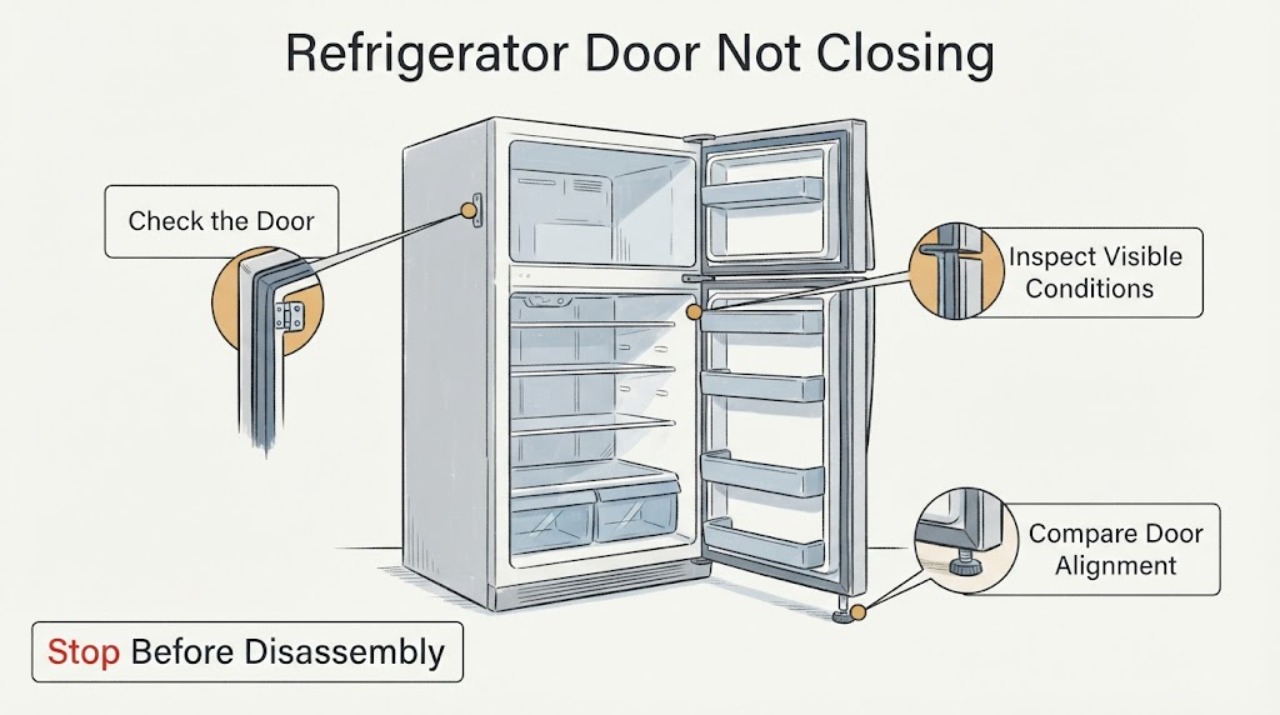
When a Summit refrigerator door will not close, first remove any food, shelf, or container that is contacting the door and check that shelves and bins are seated. Inspect the entire rubber gasket for dirt, tears, deformation, or a gap; Summit's troubleshooting guidance says to clean a dirty gasket with warm soapy water and ensure it seals tightly. Confirm the refrigerator is stable and level, because Summit lists an unlevel surface and broken door joints as causes of a door that does not close properly. Make only model-documented foot or hinge adjustments, then close the door slowly and check that the gasket contacts the cabinet all the way around. If the gasket is torn, the hinge is bent or loose, the cabinet is unstable, the door still will not seal, or the refrigerator has been damaged or leaks, stop forcing it and arrange authorized service. Do not order a replacement gasket or hinge without the exact Summit model and fit information.
Work through in order
Diagnostic checks
Use only checks that match the exact appliance or system and its official guide.
-
Check 1
Open the door only far enough to find the contact point, then remove or rearrange food packages, bottles, door bins, shelves, or drawers that touch the door or prevent it from reaching the cabinet. Check that removable shelves and bins sit in their intended positions.
Expected result: The door closes after one item is moved, it still springs open despite an empty contact path, or an interior shelf or bin is visibly out of position.
Next step: Leave enough clearance for the door to close without pressure and recheck the full seal. If the door still will not close, continue to the gasket and level checks instead of pushing harder.
Why this matters
Why: A change after rearranging confirms a physical obstruction rather than a hinge or gasket fault. An apparently clear path with the door still springing open shifts attention to the gasket, level, alignment, or hinge.
-
Check 2
Inspect the full door gasket with the door open: look for dirt, hardened or folded sections, tears, pulled-out corners, a gap between gasket and cabinet, or a gasket that is no longer seated in its channel. Wipe dirt with warm soapy water and dry it, following the model manual for materials and care.
Expected result: The gasket is dirty but intact, a section is folded or pulled out, the rubber is torn or deformed, or the gasket appears intact and contacts the cabinet.
Next step: Close the door slowly and verify contact around the perimeter. Do not glue, stretch aggressively, cut, or order a gasket by appearance; use the exact Summit model information if a replacement is required.
Why this matters
Why: Dirt or a displaced section can prevent a continuous seal and may be corrected by cleaning or gentle reseating. A tear, permanent deformation, or missing contact section means the seal cannot be restored by rearranging food alone; an intact gasket makes level and alignment more important.
-
Check 3
Check the appliance's stability and level from the front: observe whether it rocks, leans, or shifts when the door is opened, and compare the door gap at the top and bottom. Do not place fingers under the appliance or adjust a foot while the unit could fall.
Expected result: The cabinet rocks or leans, the door gap changes from top to bottom, or the refrigerator is stable and the door gap is even.
Next step: Use the owner's manual to adjust the accessible leveling feet safely, or have a technician level a heavy built-in unit. Recheck whether the door closes and seals without lifting or forcing it.
Why this matters
Why: Summit identifies an appliance that is not on a level surface as a door-closing cause. A changing gap or cabinet lean makes leveling or alignment more likely; a stable level cabinet shifts the investigation toward the gasket, hinge, or door distortion.
-
Check 4
Compare the door alignment and hinge side without removing hardware: look for a door that sits low, rubs the cabinet, has a loose-looking hinge cover, or has a gap that remains after the gasket and cabinet are level. If the door was recently reversed or transported, check the manual's alignment and gasket-reset instructions.
Expected result: The door is visibly low or shifted, a hinge or frame is bent or loose, the gasket has a perimeter gap after alignment, or no external alignment problem is visible.
Next step: Perform only the simple alignment or gasket reseating step explicitly described for the exact model. Do not loosen or remove hinges on a heavy door without support; arrange service for bent, loose, or damaged hardware.
Why this matters
Why: A shifted door or hinge can keep an otherwise good gasket from meeting the cabinet. Summit's alignment guidance says the door should close easily and form a tight seal, and that a gasket may need to be reset after door reversal; no visible alignment problem leaves hidden hinge wear or gasket damage unresolved.
-
Check 5
Test the seal after each safe correction: close the door slowly, inspect the gasket contact around the top, sides, and bottom, and verify that the door stays shut without being held. Check for a persistent cold-air gap, visible condensation, or a door alarm if the model has one.
Expected result: The gasket contacts the cabinet all around and the door stays closed, or a gap, spring-open action, condensation, or alarm remains.
Next step: Keep the door closed and monitor temperatures according to the model manual. If the gap or alarm returns, stop forcing the door and arrange authorized service for the gasket, hinge, or cabinet alignment.
Why this matters
Why: A continuous contact pattern and stable closed door support a resolved obstruction, level, or seating issue. A remaining gap means the seal or alignment is still defective and can make the refrigerator run poorly or allow moisture in.
-
Check 6
Find the exact Summit model and serial information before ordering parts or requesting service. Use the Summit support and manuals route to locate the product documentation, and record whether the problem began after moving, loading, cleaning, or reversing the door.
Expected result: The model and serial are available, or they are unreadable; the door problem follows a recent move or hinge change, or appeared without a known event.
Next step: Give the model, serial, photographs of the gap and gasket, and the result of the obstruction and level checks to authorized service. Do not substitute a visually similar part.
Why this matters
Why: Model identity determines the correct hinge, gasket, shelf, leveling, and door-reversal procedure. A recent move or hinge change makes alignment or gasket seating more plausible, while a spontaneous gap may indicate wear or damage requiring inspection.
-
Check 7
Apply the stop boundary: inspect for a torn gasket, broken hinge or door joint, cracked cabinet or glass, unstable installation, water leakage, or a door that requires force to stay shut. Do not continue operating a refrigerator that cannot maintain a safe closed seal.
Expected result: Damage, instability, leakage, food warming, or a persistent gap is present, or the door closes and seals normally after the documented correction.
Next step: For damage or a persistent gap, keep the door closed if possible, protect food as practical, and arrange authorized technician service. Never tape a heavy door shut or force a damaged hinge into alignment.
Why this matters
Why: Visible damage or a persistent seal failure is beyond a simple loading adjustment and can compromise cooling or create a mechanical hazard. A stable continuous seal indicates the immediate door symptom has cleared, but recurrence still needs service.
Use your observations
Decision map
Find the observation that best matches what you see, then follow the next safe action.
-
PATH 01Next step
What you see
The door closes after removing or rearranging one food package, shelf, or bin, and the gasket then touches the cabinet all around.
Do this next
Keep the items clear of the door path and monitor the seal. If the same contact problem returns with normal loading, inspect the level and gasket rather than continuing to compress the door.
Why this path and its safety boundary
Why it matters: The result makes a storage obstruction the most likely cause and makes a gasket or hinge replacement less likely at this time.
-
PATH 02Next step
What you see
The cabinet rocks or leans, the top and bottom door gaps differ, or the door improves after the documented leveling-foot adjustment.
Do this next
Set the appliance level using the exact manual or have a technician do it for a heavy or built-in unit, then repeat the seal check. Do not compensate with a non-approved shim or by forcing the hinge.
Why this path and its safety boundary
Why it matters: This pattern makes an unlevel installation or alignment issue more likely than a dirty gasket alone. A stable cabinet with the same gap would make gasket or hinge damage more likely.
-
PATH 03Next step
What you see
The door path is clear and the cabinet is stable, but the gasket has a tear, permanent deformation, a pulled-out corner, or a gap that remains after gentle reseating.
Do this next
Keep the door closed as much as possible and provide the exact model and photos to authorized service. Consider a gasket only after fitment is confirmed for that model.
Why this path and its safety boundary
Why it matters: The observed pattern makes a failed gasket or door alignment component more likely than a loading problem. A replacement cannot be selected safely from brand alone because Summit models use different parts and mounting arrangements.
-
PATH 04Next step
What you see
The hinge or door is bent, loose, cracked, or heavy enough to fall, the cabinet is unstable, there is leakage, or the door still will not seal after the external checks.
Do this next
Stop adjusting and arrange authorized Summit service. Do not remove a heavy door or hinge without the model-specific procedure, proper support, and a qualified person.
Why this path and its safety boundary
Why it matters: The symptom has crossed the user-adjustment boundary and may involve structural hardware, cabinet alignment, or a damaged seal. Continued force can worsen the door or cabinet.
Helpful context
Understand the symptom
A door that looks closed can still leak cold air if a container holds it open, a shelf or bin is out of position, the cabinet is not level, or the gasket does not contact the cabinet continuously. Start with the obstruction and seal rather than tightening a hinge immediately. The exact door construction varies across Summit refrigerators, so the owner's manual controls any hinge, foot, or gasket procedure.
Keep the door closed as much as possible while testing. A persistent gap can raise the temperature and cause condensation or food-safety concerns. Work from the front and sides of the appliance, and stop if the door is heavy, the hinge is distorted, the cabinet is unstable, or the gasket or frame is damaged.
Only after diagnosis
Potential parts
- refrigerator door gasket
Only consider this if the gasket is torn, permanently deformed, or still leaves a perimeter gap after cleaning, gentle reseating, correct loading, and documented alignment or leveling checks.
Confirm the exact Summit model and the manufacturer's fit information before ordering; a similar-looking gasket is not evidence of compatibility. - refrigerator door hinge or hinge hardware
Only consider hinge-related parts after a technician or model-specific procedure confirms a bent, worn, or damaged hinge is causing the persistent door gap or rubbing.
Confirm the exact model, door side, hinge arrangement, and fit information before ordering; do not infer compatibility from the Summit brand alone.
When checks do not resolve it
Need a professional?
An authorized technician may need to inspect the door hinge and pin, gasket channel, cabinet alignment, leveling system, door weight, or damaged frame. Provide the exact model and serial information, photos of the gasket and door gap, whether the issue followed moving or door reversal, and the results of the obstruction, gasket, level, and seal checks.
Common questions
FAQ
Why will my Summit refrigerator door not close all the way?
Summit identifies food or packaging, too much food, a damaged or dirty gasket, broken door joints, and an unlevel appliance as possible causes. Clear the door path, check the gasket, and verify the cabinet is level before considering hinge or gasket service.
How do I check a Summit refrigerator door gasket?
Inspect the entire rubber seal for dirt, tears, folded sections, pulled-out corners, or gaps. Summit advises cleaning a dirty gasket with warm soapy water and ensuring it seals tightly. Do not glue or stretch a damaged gasket; confirm the exact model before replacement.
Can leveling fix a Summit refrigerator door that will not close?
It can when the cabinet rocks, leans, or leaves an uneven top-to-bottom door gap. Summit lists an unlevel surface as a cause and directs owners to adjust the appliance's feet. Use the exact manual, and have a technician level a heavy or built-in model.
Should I adjust or remove the refrigerator hinge myself?
Use a hinge adjustment only when the exact Summit manual documents it and the door can be supported safely. A bent, loose, or heavy hinge, or a door that still will not seal, needs authorized service rather than force or an improvised shim.
What information does Summit service need for a door problem?
Provide the exact model and serial numbers, photographs of the door gap and gasket, whether the problem began after moving or reversing the door, and whether clearing items or leveling changed the result. Summit's service form requests model and serial information to help the service company prepare.
Read the exact guide
Official sources
- SUMMIT APPLIANCESummit Appliance · Use only for models covered by this manual; it supports the general seal observation but does not establish fit or hardware compatibility for an unspecified Summit refrigerator.
- 9 GENERAL TROUBLESHOOTINGSummit Appliance · Use for Summit refrigerator door-closing checks at the user level; the PDF covers a specific product manual family, so exact model instructions take precedence.
- REFRIGERATOR - FREEZERSummit Appliance · Use for symptom-level Summit refrigerator checks; the manual explicitly says to contact authorized service when the listed checks do not resolve the issue.
- Service & RepairSummit Appliance · Use when a persistent door, gasket, hinge, cabinet, or leveling problem needs authorized service.
- Service & SupportSummit Appliance · Use to locate model documentation and authorized service after safe external door checks; it is not itself a diagnosis or fitment source.
Community feedback
Share a repair observation
Share a plain-text repair observation. Accepted observations are published automatically; this page may take a moment to update.