
On this page
Start here
Quick answer
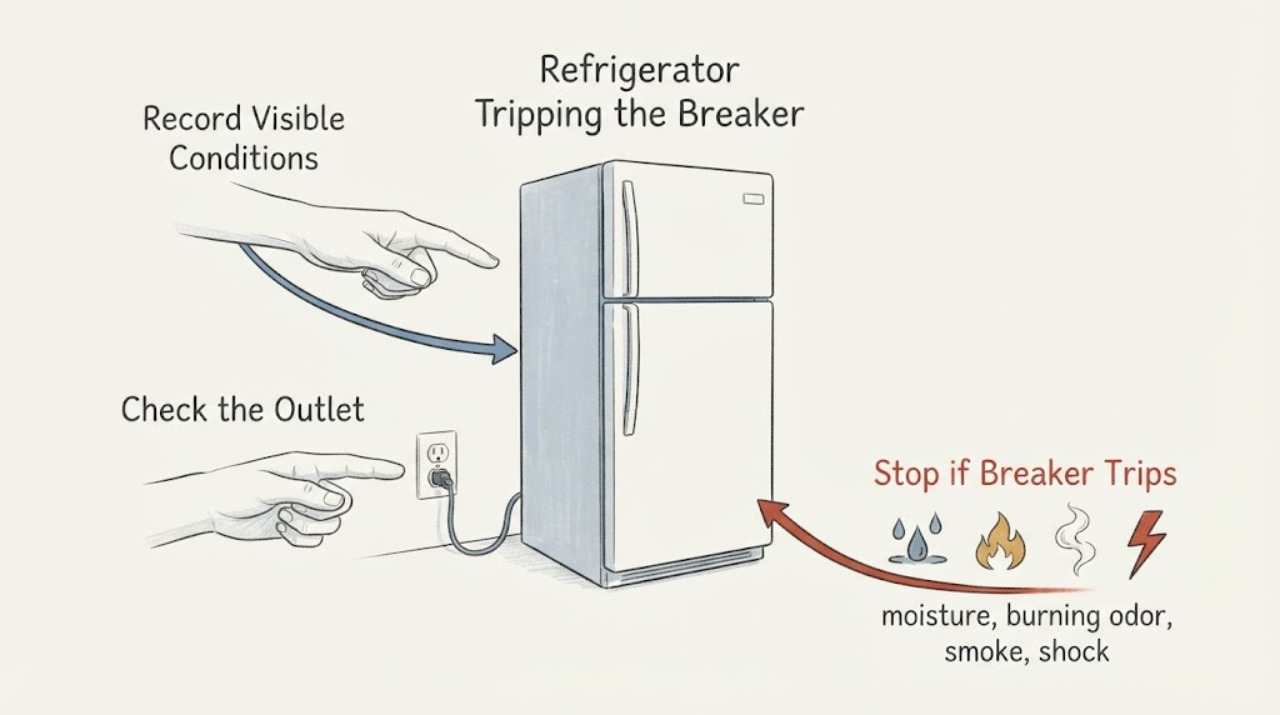
A Summit refrigerator that trips the breaker should be treated as an electrical protection event, not a normal cooling symptom. Record whether the breaker trips as soon as the refrigerator is connected, when the compressor starts, or only after the unit has run for a while. With the refrigerator disconnected and the area dry, verify the plug is fully seated in a grounded three-prong outlet and that no extension cord or adapter is involved. Reset the breaker only when the circuit and appliance show no heat, moisture, smoke, or damage, and do not keep resetting it if it trips again. A repeated or immediate trip, a damaged cord or outlet, an electric shock, or a trip that returns during operation requires qualified appliance and electrical service.
Work through in order
Diagnostic checks
Use only checks that match the exact appliance or system and its official guide.
-
Check 1
Record the exact trip pattern: whether the breaker trips when the Summit refrigerator is plugged in, when cooling starts, after a power interruption, or only after the refrigerator has run for some time. Note whether the interior light, controls, and cooling stop together.
Expected result: The breaker trips immediately, trips when the motor starts, trips after a delay, or does not trip again after one safe reset; other appliance functions are normal or also dead.
Next step: Use the matching branch below and keep the refrigerator disconnected while checking the visible connection. Do not repeatedly reconnect it to reproduce the trip.
Why this matters
Why: Immediate or start-up trips keep an energized cord, outlet, input circuit, or refrigerator electrical load in question. A delayed trip can involve a condition that appears during operation. A single event after an outage may be supply related, but the timing alone cannot prove a compressor, control, or wiring fault.
-
Check 2
With the refrigerator unplugged and the floor and outlet area dry, inspect the power cord, plug, receptacle face, and any visible scorch marks, looseness, cracking, moisture, or damaged insulation. Confirm the plug is fully seated in a grounded three-prong outlet and that an adapter, power strip, or extension cord is not being used.
Expected result: The cord or plug is damaged, the receptacle is hot or discolored, moisture is present, the connection uses an adapter or extension, or the connection appears intact and dry.
Next step: Do not plug the refrigerator into a damaged or wet connection. Have the outlet or house wiring checked by a qualified electrician, and use the Summit model manual for the required supply arrangement.
Why this matters
Why: Visible damage, heat, moisture, or an improper connection can create an electrical hazard and must be resolved before any reset. An intact connection only removes obvious external causes; it does not clear an internal refrigerator fault.
-
Check 3
If there is no visible damage, moisture, burning odor, smoke, shock, or active leak, reset the household breaker once and reconnect the refrigerator only as the matching Summit manual permits. Do not stand in a wet area or touch exposed conductors while doing this.
Expected result: The breaker stays set and the refrigerator resumes, the breaker trips immediately again, or the breaker trips when cooling starts.
Next step: If the breaker trips again, disconnect the refrigerator if that can be done safely and arrange qualified service. Preserve the trip timing and any display or sound that preceded it.
Why this matters
Why: A breaker that holds after one safe reset may have responded to a one-time supply interruption, but that does not prove the refrigerator is repaired. An immediate or start-up repeat is a persistent electrical fault or circuit problem and is not a cue for more reset attempts.
-
Check 4
If the breaker holds at first, observe the refrigerator without moving panels or touching wiring. Note whether the trip returns when the compressor starts, after a defrost or cooling period, when the door is opened, or when another appliance shares the circuit. Also record whether cooling, lights, and controls remain normal before the next trip.
Expected result: The refrigerator runs normally, the breaker trips only during a repeatable operating event, or another load on the same circuit changes the result.
Next step: Stop testing after the pattern is recorded. Have the circuit and refrigerator assessed by the appropriate qualified professional rather than swapping a compressor, relay, thermostat, or control from the symptom alone.
Why this matters
Why: A repeatable trip during operation keeps a refrigerator load, its supply circuit, or both under suspicion. A change when another load is removed points toward circuit capacity or wiring assessment, not proof that a refrigerator part is bad. Normal operation after the reset still warrants attention if the breaker trips again.
-
Check 5
If the trip followed a power loss or an attempted quick restart, leave the refrigerator closed and follow the restart delay in the exact Summit manual. Some Summit manuals document a several-minute delay before restarting after power loss or unplugging; do not impose one model's delay on another model.
Expected result: The refrigerator restarts after the documented delay without a new trip, or the breaker trips again after the delay.
Next step: Keep the unit disconnected after a repeat trip and arrange service. Do not bypass the breaker, substitute a larger fuse or breaker, or repeatedly cycle power.
Why this matters
Why: A restart-delay condition can explain a no-start immediately after power is restored, but it does not explain a breaker that repeatedly opens. A repeat trip after the documented delay remains an electrical fault boundary.
Use your observations
Decision map
Find the observation that best matches what you see, then follow the next safe action.
-
PATH 01Next step
What you see
The cord, plug, or receptacle is hot, scorched, wet, cracked, loose, or gives a shock, or there is smoke, a burning odor, or an active leak near the electrical connection.
Do this next
Leave the appliance disconnected if it is safe to do so, keep clear of the wet or damaged area, and call a qualified electrician or appliance technician. Do not use an adapter or extension cord as a workaround.
Why this path and its safety boundary
Why it matters: The visible connection itself is unsafe, so continuing to reset or reconnect the refrigerator could worsen an electrical hazard.
-
PATH 02Next step
What you see
The breaker trips immediately when the refrigerator is plugged in or trips again as soon as cooling starts, while the outlet and cord look intact.
Do this next
Do not reconnect it to reproduce the trip. Have the refrigerator and branch circuit evaluated, and give the technician the exact trip timing and model/serial information.
Why this path and its safety boundary
Why it matters: The fault remains under load or at the refrigerator's input; a visual check cannot distinguish the appliance from the circuit safely.
-
PATH 03Next step
What you see
The breaker holds after one safe reset, the refrigerator runs, and no trip returns during observation.
Do this next
Use the matching Summit manual for normal operation and monitor the unit. If the breaker opens again, stop resetting and arrange service rather than treating the second event as normal.
Why this path and its safety boundary
Why it matters: The event may have followed a one-time supply interruption or restart condition, but a held breaker is not proof that an electrical defect is gone.
-
PATH 04Next step
What you see
The trip returns only after the refrigerator has been running, or the result changes when another appliance shares the same circuit.
Do this next
Stop the test and have both the branch circuit and refrigerator checked by qualified professionals. Do not replace a breaker with a higher-rated device or order a refrigerator part from this symptom alone.
Why this path and its safety boundary
Why it matters: The timing points to a load or circuit condition that develops during operation; it does not establish a failed compressor, relay, or other part.
-
PATH 05Next step
What you see
The refrigerator will not restart immediately after power loss, but the breaker does not trip after the exact model's documented restart delay.
Do this next
Follow the exact manual's delay and keep the doors closed. If a breaker trip occurs at any later restart, return to the electrical-service branch.
Why this path and its safety boundary
Why it matters: The no-start may be the model's restart protection or compressor equalization behavior rather than the assigned repeated-breaker symptom.
Helpful context
Understand the symptom
The useful first distinction is when the breaker trips. A trip that occurs immediately after connection is different from one that appears when the compressor or another load starts, and both are different from a trip after hours of operation. This timing narrows the next safe step but does not identify a particular part.
Summit manuals call for a grounded three-prong receptacle, no adapter, and no extension cord. Disconnect power before servicing; do not open the cabinet or test live wiring to chase the cause of a breaker trip.
When checks do not resolve it
Need a professional?
Arrange qualified appliance and electrical service when the breaker trips again after one safe reset, trips immediately or at compressor start, the cord or outlet is damaged, or the refrigerator's operating load needs testing. Summit's support pages provide model manuals and authorized service pathways. The breaker-trip symptom alone does not justify selecting a compressor, start device, thermostat, control, or wiring part.
Common questions
FAQ
Can I reset the breaker for my Summit refrigerator?
Only once and only when the connection is dry and shows no heat, damage, smoke, odor, shock, or leak. If the breaker trips again, leave the refrigerator disconnected if safe and arrange qualified service instead of repeatedly resetting it.
Why does the breaker trip as soon as my Summit refrigerator starts?
The timing shows that the problem appears when an operating load is applied, but it cannot identify whether the refrigerator or branch circuit is responsible. Record the timing and have both evaluated; do not keep reconnecting the appliance or install a larger breaker.
Is a short delay before a Summit refrigerator restarts the same as a breaker trip?
No. Summit manuals document a several-minute restart delay for some models after unplugging or power loss. That can explain a temporary no-start, while a breaker that opens again is an electrical protection event that needs a separate diagnosis.
Can I use an extension cord or adapter after my refrigerator trips the breaker?
No. Summit's safety instructions call for a grounded three-prong outlet and say not to use an adapter or extension cord. Correct the connection and have the circuit checked rather than bypassing the protection.
Read the exact guide
Official sources
- INSTRUCTION MANUAL FF71 COMPACT REFRIGERATOR-FREEZERSummit Appliance · Summit FF71 compact refrigerator-freezer electrical safety, grounded outlet, no adapter or extension cord, restart delay, troubleshooting, and service boundary
- Service and SupportSummit Appliance · Summit owner manuals, troubleshooting resources, replacement parts information, and authorized service access
- SUMMIT APPLIANCESummit Appliance · Summit refrigerator use and care manual electrical shock warning, grounded three-prong outlet, breaker reset, power-loss restart guidance, and service information
- TroubleshootingSummit Appliance · Summit refrigerator troubleshooting causes for stopped operation, breaker or fuse reset, restart delay, grounding shock, and authorized service
Community feedback
Share a repair observation
Share a plain-text repair observation. Accepted observations are published automatically; this page may take a moment to update.