
On this page
Start here
Quick answer
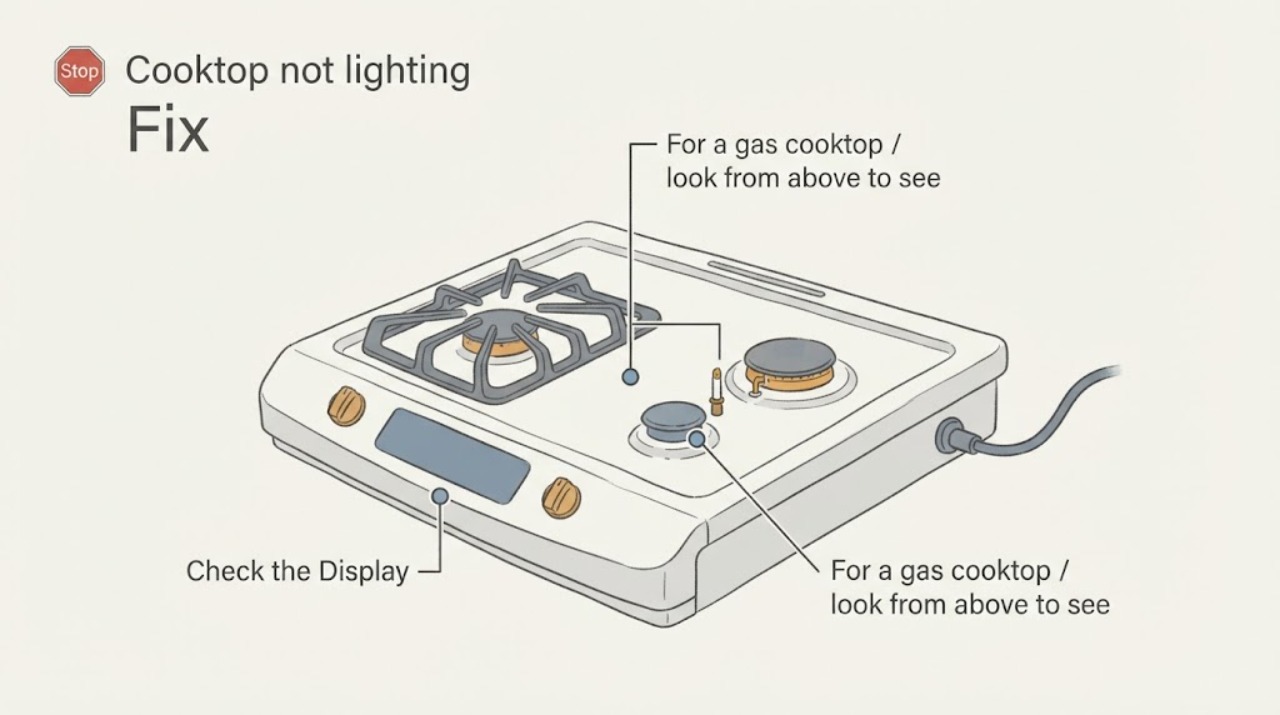
The word lighting applies to a Thermador gas cooktop, so first confirm that the appliance has gas burners rather than electric or induction zones. With the controls off and no gas odor, check that the gas supply and electrical supply are available, then look from above for a displaced burner cap or a damp or dirty igniter after the surface has cooled. The click pattern is a useful split: clicking with the knob ON but no flame points toward gas flow, burner position, or the igniter area; clicking while the knob is OFF or continuous sparking requires the controls off and professional help. If a gas smell does not disappear promptly, turn off the main gas supply if safe, leave the area, and contact the gas supplier or qualified service. Do not dismantle the cooktop or choose an igniter, cap, regulator, or control part from the symptom alone.
Work through in order
Diagnostic checks
Use only checks that match the exact appliance or system and its official guide.
-
Check 1
From a safe position with every control off, identify the cooktop technology from the visible burner or zone design and the owner's manual. For a gas unit, note whether one burner or all burners fail, whether any igniter clicks, and whether the display or other electrical controls work.
Expected result: The appliance has gas burners, or it is an electric/induction cooktop; one burner fails, or all burners fail.
Next step: Use the gas checks below only for a confirmed gas cooktop. For electric or induction, use the exact platform manual and do not try to create a flame.
Stop if: Stop immediately for a gas odor, smoke, arcing, cracked glass, visible damage, or unsafe heat.
Why this matters
Why: Only a gas burner has a lighting and ignition path. On a gas unit, one failed burner points toward that burner, cap, port, or igniter; all burners failing points first toward shared gas or electrical supply.
-
Check 2
For a gas Thermador cooktop, confirm from the normal user-accessible position that the main gas supply is available and that the unit is plugged in with its circuit breaker not tripped. Check only a normally accessible shut-off valve; do not remove panels or test gas pressure or wiring.
Expected result: All burners have no gas or no spark, one breaker is off, the unit has no power, or the other burners work normally.
Next step: Restore an obviously switched-off user-accessible supply only once when safe and make one normal test. If the breaker trips again, supply cannot be confirmed, or all burners still fail, leave the cooktop off and contact qualified electrical or gas-appliance service.
Stop if: Do not keep resetting a breaker, alter gas fittings or regulator settings, or use a flame to test for gas flow.
Why this matters
Why: Thermador lists the main gas supply and electrical supply as separate causes of burners not starting. If other burners work, a shared supply failure is less likely and the affected burner needs its own external checks.
-
Check 3
When the cooktop and burner are completely cool and the controls are OFF, look from above to see whether the affected burner cap is seated in its locating tabs and whether the visible igniter and burner ports are damp or blocked by obvious food residue. Clean or dry only the accessible exterior as the Thermador care guidance and model manual allow.
Expected result: The cap is misaligned, the igniter or ports are damp or dirty, or the visible parts appear correctly positioned and dry.
Next step: Correct only an obvious cap position and allow cleaned parts to dry fully, then make one normal ignition attempt. If the burner still does not light, record the result and arrange qualified gas-appliance service.
Stop if: Do not soak an igniter, gouge ports, remove gas jets, open the cooktop, or clean while the surface is hot.
Why this matters
Why: Thermador identifies cap position, damp or dirty igniters, and wet or clogged burner ports as causes of failed or intermittent ignition. A correctly positioned, dry burner that still fails needs more than a cosmetic cleaning check.
-
Check 4
With no gas odor and the burner area dry, make one normal ignition attempt according to the exact manual and listen for the click while the knob is in the ON or lighting position. Observe whether a stable flame appears, whether there is clicking with no flame, or whether the burner clicks while the knob is OFF.
Expected result: A stable flame appears, the burner clicks but does not light, there is no click, or it clicks with the control OFF.
Next step: If it lights, confirm the flame is stable and use the normal control. If it does not, or it sparks with the knob OFF, turn controls off and arrange qualified service; do not dismantle the ignition system.
Stop if: Do not keep attempting ignition when gas accumulates, relight after an un-cleared odor, or touch the burner during sparking.
Why this matters
Why: A stable flame after the external checks points to a corrected cap, moisture, or residue condition. Clicking without a flame leaves gas flow, burner position, or the igniter path unresolved; no click shifts attention toward power or ignition control. Clicking with OFF is abnormal and should not be repeatedly tested.
-
Check 5
If the burner still will not light, document the exact burner, whether other burners work, the click pattern, cap and igniter condition, gas-supply context, and any recent cleaning or spill. If a flame is present but unstable, too high, or uneven, turn the control off and do not continue cooking on it.
Expected result: The problem persists after one safe external check, the burner has an abnormal flame, clicking continues, or a gas odor remains.
Next step: For persistent no-lighting without odor, book qualified Thermador gas-appliance service. For a gas odor that does not clear, turn off the main gas supply if safe, avoid flames and electrical switches, leave the area, and contact the gas supplier or emergency service from a safe location.
Stop if: Do not use the cooktop, dismantle it, adjust the regulator, or keep relighting a burner while gas is present.
Why this matters
Why: Thermador directs unresolved ignition, abnormal flame, persistent clicking, and gas-odor problems to professional or gas-supply help. The symptom does not identify a compatible igniter, burner cap, regulator, valve, or control module.
Use your observations
Decision map
Find the observation that best matches what you see, then follow the next safe action.
-
PATH 01Next step
What you see
The cooktop is gas, and the cap or igniter was visibly displaced, damp, or dirty; after the cool-down and external correction, the burner lights with a stable flame.
Do this next
Keep the cap correctly seated and the igniter and ports dry. If the same burner fails again, arrange qualified service rather than repeatedly cleaning or replacing parts by guesswork.
Why this path and its safety boundary
Why it matters: This result is consistent with Thermador's documented cap, moisture, or residue causes and is different from a burner with a confirmed supply and ignition failure.
-
PATH 02Next step
What you see
The affected burner clicks with the knob ON but no flame appears, while other burners light normally.
Do this next
After the single cool, dry, external check, turn the burner off and book qualified gas-appliance service if it still will not light. Do not open the cooktop.
Why this path and its safety boundary
Why it matters: The shared supply is less likely; gas delivery at that burner, cap/port position, or its igniter path remains possible. Thermador's click behavior does not prove which internal part failed.
-
PATH 03Next step
What you see
No burner clicks or all burners fail, and the unit has no confirmed electrical or gas supply.
Do this next
Check only the normal user-accessible supply state once. If supply is absent or the breaker trips again, leave the cooktop off and contact a qualified electrician or gas-appliance technician.
Why this path and its safety boundary
Why it matters: A shared supply, power, or control issue is more likely than one dirty burner, but live wiring and gas pressure cannot be diagnosed safely by the user.
-
PATH 04Next step
What you see
The burner clicks when its knob is OFF, keeps sparking, has an abnormal flame, or a gas smell does not disappear after ignition.
Do this next
Turn controls OFF. If odor persists, turn off the main gas supply if safe, avoid flames and electrical switches, leave the area, and contact the gas supplier or emergency service from a safe location. Otherwise arrange qualified service; do not relight or dismantle the cooktop.
Why this path and its safety boundary
Why it matters: This is not a normal no-lighting branch. Thermador treats continuing click/spark and persistent gas odor as conditions needing the controls or gas supply turned off and professional help.
-
PATH 05Next step
What you see
The appliance is electric or induction rather than gas, so there is no burner flame or ignition click.
Do this next
Stop the gas-specific path and use the exact Thermador electric or induction manual and support guide. Do not apply a gas ignition part or procedure.
Why this path and its safety boundary
Why it matters: Not lighting is the wrong diagnostic identity for that platform. An electric element that stays cold or an induction zone that flashes needs its own supply, control, and cookware checks.
Helpful context
Understand the symptom
First confirm that lighting is the right symptom
Thermador uses separate support paths for gas, electric, and induction cooktops. A gas burner should produce an ignition spark and flame; an electric element heats rather than lights, and an induction zone detects compatible cookware. If the unit has no visible gas burner, do not apply gas-ignition checks. Use the exact model manual for the appropriate platform.
Why the click pattern matters
For a Thermador gas cooktop, whether the burner clicks when the knob is ON or when it is OFF changes the next safe step. Clicking with ON keeps the investigation around gas supply, burner position, and the igniter area. Clicking with OFF is not a normal way to keep testing; Thermador calls for checking the cap and igniter condition and professional attention when the problem continues. A gas odor that does not clear after ignition is a safety boundary, not a cleaning or replacement-parts question.
When checks do not resolve it
Need a professional?
Have this ready
- Provide the Thermador model and serial or product details, gas or electric/induction type, affected burner or zone, exact click pattern, whether other burners work, cap and igniter observations, recent cleaning or spill, and any breaker or gas-supply event.
Common questions
FAQ
Why does my Thermador burner click but not light?
Thermador lists gas supply, power, burner position, and a dirty or damp igniter among the possible causes. If one burner clicks while the others work, check only the cool, accessible cap and igniter area once; persistent failure needs qualified gas-appliance service.
What if the Thermador burner clicks when the knob is OFF?
Turn the control off and do not keep testing. Thermador calls for checking cap placement and igniter moisture or dirt, and directs continuing problems to a professional service visit. Do not dismantle the ignition system.
Can I keep trying to light a Thermador burner if I smell gas?
No. If the odor does not clear after ignition, turn the main gas supply off if safe, avoid flames and electrical switches, leave the area, and contact the gas supplier or emergency service from a safe location.
Read the exact guide
Official sources
- Induction Cooktops - TroubleshootingThermador · Official Thermador induction-cooktop page opened only to distinguish cookware detection and heat-setting behavior from gas ignition; it is not evidence for a gas burner fault.
- Electric Cooktops - TroubleshootingThermador · Official Thermador electric-cooktop page opened only to distinguish an electric element that does not heat from a gas burner that does not light; it is not evidence for gas ignition.
- Gas Cooktops & Rangetops - TroubleshootingThermador · Official Thermador gas-cooktop troubleshooting page opened for burners that do not start, clicking or intermittent sparking, abnormal flames, gas odor, and service escalation.
- Gas Cooktops & Rangetops - Cleaning & CareThermador · Official Thermador care page opened for the limited cool-surface, accessible cleaning and drying check; it does not establish an internal part diagnosis.
Community feedback
Share a repair observation
Share a plain-text repair observation. Accepted observations are published automatically; this page may take a moment to update.