
On this page
Start here
Quick answer
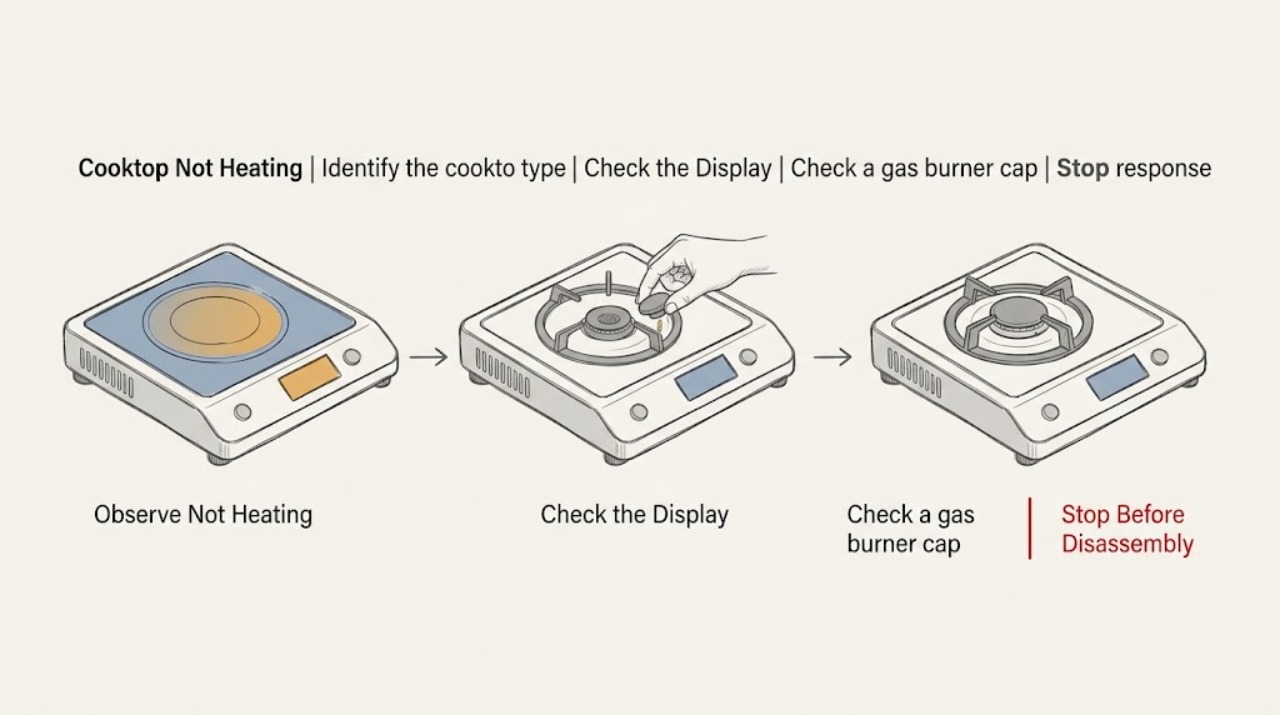
First identify whether the Thermador cooktop is gas, electric, or induction, because not heating has a different safe first check in each case. Confirm that the controls and household supply are on, then use only the matching low-risk check: a gas burner needs a correctly seated, dry cap and clear visible ports; an electric element needs the selected control and a stable supply; an induction zone needs a centered, induction-compatible pan of adequate size. A flashing fault, repeated breaker trip, gas odor, continuous sparking, electrical arcing, smoke, or cracked glass is a stop condition—turn controls off, keep clear of hot or energized parts, and arrange qualified service rather than opening the cooktop.
Work through in order
Diagnostic checks
Use only checks that match the exact appliance or system and its official guide.
-
Identify the cooktop type and the exact symptom
From a safe position with all controls off, identify whether the unit is gas, electric radiant, or induction using the visible burner or zone design and the owner's manual. Note whether every zone fails or only one, whether a display lights, whether an element glows, whether a gas flame appears, and whether a code or flashing setting is shown.
Expected result: All zones are dead, one zone is affected, a gas burner has no or unstable flame, an electric element stays cold, or an induction display flashes or reports a fault.
Next step: Follow the matching gas, electric, or induction check below. If there is smoke, an arc, a gas odor, a cracked surface, or hot damaged wiring, skip testing and use the stop branch.
Why this matters
Why: A whole-cooktop failure points first to controls or the household supply; one-zone failure points toward that burner, element, cookware-detection path, or its control. A flashing induction setting can indicate that the zone does not recognize the cookware, while a fault display requires the model-specific manual.
-
Check the controls and household supply without repeated resets
Confirm the main switch or control lock is not preventing operation, select one zone according to the owner's manual, and check whether the cooktop has household power. If a breaker or fuse is off, note that state and whether other appliances caused an overload; do not keep resetting a breaker that trips again.
Expected result: The controls and display remain completely dead, the supply is off, one breaker has tripped, or the cooktop powers on but still does not heat.
Next step: Restore a clearly switched-off supply only once when it is safe to do so and observe the result. If it trips again, there is visible damage, or correct supply cannot be confirmed, leave the cooktop off and arrange qualified electrical or appliance service. Do not remove the cooktop to test wiring.
Stop if: Stop immediately for a hot cord, smoke, burning smell, sparks, arcing, exposed wiring, or a breaker that trips again; keep clear and use qualified service.
Why this matters
Why: A missing supply or main-switch state can explain a whole-cooktop failure. A repeat trip can indicate overload or a short circuit and is not a normal heating symptom. Power with only one cold zone shifts the diagnosis to that zone or its controls.
-
Check a gas burner cap, igniter, and visible flame path
For a gas Thermador cooktop that is cool and has its knobs off, verify from above that the burner cap is seated correctly and that the visible igniter and burner area are dry and free of obvious food residue. Open the gas shut-off valve only if it is normally accessible and you are certain it is the appliance valve; do not dismantle a burner or adjust a gas fitting.
Expected result: The cap is displaced, the igniter is damp or dirty, visible ports are obstructed, there is no gas supply, the burner lights with a stable flame, or it clicks without lighting.
Next step: After the surface is cool, correct only an obvious cap position and dry or clean the accessible exterior as directed by the manual, then test once. If it still will not light or heat, or the flame is unstable, leave the gas controls off and arrange qualified gas-appliance service.
Stop if: If you smell unburned gas, hear continuous sparking, see an abnormal flame, or suspect a leak, turn controls off, avoid flames and electrical switches, leave the area, and contact the gas supplier or emergency service from a safe location.
Why this matters
Why: Thermador identifies cap position, damp or dirty igniters, burner ports, the gas valve, and drafts as causes of ignition or clicking problems. A stable flame that still does not heat the cookware suggests a burner or gas-appliance fault; persistent clicking or an abnormal flame is not a reason to keep relighting.
-
Check an electric element and its heat pattern
For an electric Thermador cooktop, select the affected element using the normal control sequence and observe from above without touching the surface. Note whether the element heats at all, cycles, glows in sections, or remains completely cold while another element works. Do not lift the glass, access the wiring, or test an energized terminal.
Expected result: The element heats and cycles, glows with darker sections or a different brightness, stays cold while other zones work, or the entire cooktop loses power.
Next step: If the element heats normally, allow the surface to cool and consult the manual for expected cycling. If one element remains cold or the supply fault returns, stop using the affected zone and arrange qualified appliance service; use an electrician for a supply, fuse, or wiring problem.
Why this matters
Why: Thermador says partial dark areas and differences in element brightness can be normal on electric cooktops. A cold single element with confirmed controls and supply, or a whole unit with no supply, needs component or electrical diagnosis rather than a visual glow comparison.
-
Test induction cookware detection with a suitable pan
For an induction Thermador cooktop, use a clean, dry, flat-bottomed pan that the manual identifies as compatible and center it on the selected zone. A magnet should adhere to the pan base when the manual calls for that check. Keep the control area dry and clear, and do not slide a hot pan across controls.
Expected result: The zone heats with the test pan, the setting flashes or the zone remains cold, the pan is too small or off-center, or the control shows a fault or lock state.
Next step: Use compatible, centered cookware only when the cooktop is otherwise safe. If a suitable pan fails on one zone, or all zones fail with supply present, leave the cooktop off and request appliance service rather than opening the glass surface.
Why this matters
Why: A pan that heats confirms that the earlier cookware was unsuitable, too small, or misplaced. A flashing setting with a known suitable centered pan points to the zone, control, or power supply. A fault display should be interpreted using the exact model manual.
-
Allow cooling and record any displayed fault
If an induction control displays a fault, the controls feel unusually hot, or a recently used zone stops heating, turn the controls off and move cookware away from the control area only when it is safe. Allow the appliance to cool, then record the exact code or symbol and compare it with the owner's manual; do not repeatedly operate it to clear a fault.
Expected result: The cooktop resumes normal operation after cooling, the same code returns, the control remains hot, or the display indicates a supply-related fault.
Next step: Use the manual's model-specific response once when no hazard is present. If the fault returns, the control stays hot, or supply voltage is implicated, stop using the cooktop and arrange qualified appliance or electrical service.
Why this matters
Why: Thermador documents cooling-related and hot-cookware conditions for some induction messages, while an incorrect-voltage message requires supply diagnosis. A recurring fault after cooling is evidence for service, not a justification for bypassing a safety control.
-
Prepare a safe service handoff
Record the exact model, cooktop technology, affected zone or burner, control state, displayed code, household-supply symptom, cookware result if induction, and whether there was gas odor, continuous sparking, an arc, smoke, or cracked glass. Keep the cooktop off if the symptom is unresolved or hazardous.
Expected result: The problem is a repeatable single-zone failure, a whole-unit power failure, a gas ignition symptom, an induction detection/fault symptom, or a safety stop condition.
Next step: Request qualified Thermador appliance service for an unresolved heating failure. Use a qualified electrician for household supply or breaker faults and a qualified gas professional for gas-supply or ignition faults; do not remove panels or alter wiring or gas components.
Why this matters
Why: These observations let a qualified technician choose the correct appliance, electrical, or gas diagnostic path without unsafe trial-and-error. They do not establish that a particular replacement part fits or that an internal component can be user-repaired.
Use your observations
Decision map
Find the observation that best matches what you see, then follow the next safe action.
-
PATH 01Next step
What you see
All zones and the display are dead, or the cooktop has no confirmed household supply.
Do this next
Check the main switch, outlet or supply, fuse, and breaker only from a safe user-accessible position. If supply is absent or the breaker trips again, leave the cooktop off and use qualified electrical or appliance service.
-
PATH 02Next step
What you see
A gas burner has a displaced cap, damp igniter, visible residue, or no confirmed gas supply, but there is no gas odor or continuous spark.
Do this next
With the cooktop cool and controls off, correct only an obvious cap position or accessible cleaning issue described by the manual, then test once. Persistent failure or an unstable flame requires qualified gas-appliance service.
-
PATH 03Next step
What you see
A gas burner smells of unburned gas, keeps sparking, will not light, or shows an abnormal flame.
Do this next
Turn the controls off, do not use flames or electrical switches, leave the area, and contact the gas supplier or emergency service from a safe location. Do not relight or dismantle the cooktop.
-
PATH 04Next step
What you see
An electric element is cold while the controls and supply work, or the unit displays an F-number fault.
Do this next
Do not access the wiring. Record the fault and arrange qualified appliance service; use an electrician when the supply, fuse, breaker, or main connection is the issue.
-
PATH 05Next step
What you see
An electric element has darker sections or changes brightness while it heats, and there is no other warning sign.
Do this next
This can be normal for a Thermador electric element. Compare its cooking result with the owner's manual and seek service only if it remains cold, overheats, or affects cooking.
-
PATH 06Next step
What you see
An induction zone flashes or stays cold with one pan but heats a correctly sized, centered, compatible pan.
Do this next
Use the compatible pan and placement. If suitable cookware fails on the zone, consult the model manual and arrange appliance service.
-
PATH 07Next step
What you see
An induction fault returns after the cooktop cools, or the display indicates incorrect supply voltage.
Do this next
Leave the cooktop off and request qualified appliance or electrical service. Do not bypass the fault or open the cooktop to measure live voltage.
-
PATH 08Next step
What you see
There is smoke, visible arcing, a burning smell, cracked glass, hot damaged wiring, or a breaker that repeatedly trips.
Do this next
Stop use, keep people away from hot or energized parts, and arrange qualified appliance or electrical service. Treat a gas odor through the gas-emergency branch instead.
Helpful context
Understand the symptom
The first split is gas, electric, or induction
Thermador sells different cooktop technologies, and the same report of no heat can mean no gas flame, an electric supply or element fault, or an induction pan-detection issue. The visible result matters: a gas burner should establish a stable flame, an electric element may cycle and can have darker sections, and an induction zone may flash a setting when it does not detect suitable cookware. Do not assume the technology from the brand name; use the controls, owner's manual, or model information to identify it.
Keep safety checks separate from repair work
Only inspect cool, external, user-accessible parts with the controls off. Do not remove a glass surface or panel, probe live wiring, adjust gas components, or repeatedly reset a breaker. A gas odor, continuous spark, visible arc, smoke, hot or damaged wiring, repeated trip, or cracked glass takes priority over diagnosis. Leave the cooktop off and use qualified appliance, electrical, or gas service for those conditions.
Only after diagnosis
Potential parts
- gas burner cap or igniter
Consider this only if a qualified gas-appliance diagnosis confirms that a correctly supplied burner has a damaged cap or igniter after safe external checks.
Confirm the exact model and the manufacturer's fit information before ordering; gas components and access vary by model. - electric heating element
Consider this only when a qualified appliance diagnosis isolates one cold electric zone to its heating element rather than the supply or control circuit.
Heating elements are model-specific and involve electrical safety; verify exact model fitment and use qualified installation. - induction power module or zone control
Consider this only after a qualified diagnosis confirms that suitable cookware, controls, and supply are correct but a specific induction zone still fails or repeats a fault.
Electronic modules are model-specific and require qualified electrical work; do not infer compatibility from the brand alone.
When checks do not resolve it
Need a professional?
Request qualified Thermador appliance service when a suitable control and supply check does not restore heat, one zone remains cold, an electric element or induction zone fails with correct power, a gas burner will not establish a stable flame, or a fault returns. Use a qualified electrician for breaker, fuse, supply, or wiring problems and a qualified gas professional for gas-supply or ignition problems. Provide the exact model, cooktop technology, affected zone, displayed code, and observed safety symptoms.
Common questions
FAQ
Why is my Thermador cooktop not heating any zone?
First identify whether it is gas, electric, or induction, then check the main switch and household supply from a safe position. A whole-unit failure with a dead display often points to supply or control state; a gas odor, repeated breaker trip, smoke, arc, or cracked glass is a stop condition requiring qualified service.
Why does a Thermador induction cooktop flash but not heat?
The zone may not detect the pan because it is too small, off-center, or not induction-compatible. Try one clean, dry, flat, compatible pan centered on the zone. If that pan also fails or a fault returns, use the model manual and arrange appliance service.
Is it normal for a Thermador electric element to look partly dark?
Thermador says electric elements can have darker sections and different brightness for technical reasons while operating correctly. The meaningful check is whether the zone heats and cooks normally; a completely cold zone or a fault needs service.
What should I do if a Thermador gas burner keeps clicking or I smell gas?
Turn the controls off and do not keep relighting a burner that keeps sparking. For an unburned-gas odor, avoid flames and electrical switches, leave the area, and contact the gas supplier or emergency service from a safe location. Persistent clicking without an odor still requires qualified gas-appliance service if safe external checks do not resolve it.
Should I open a Thermador cooktop to find the failed heating part?
No. Opening the cooktop can expose energized electrical parts, hot surfaces, gas components, or fragile glass. Record the model, technology, affected zone, code, and safety symptoms, then use qualified appliance, electrical, or gas service for internal diagnosis.
Read the exact guide
Official sources
- Troubleshooting | Gas Cooktops & Rangetops Support | ThermadorThermador · Thermador gas cooktop and rangetop burner ignition, clicking, flame, and gas-odor troubleshooting
- Error Codes | Induction Cooktops Support | ThermadorThermador · Thermador induction cooktop displayed error codes, cooling, demo mode, cookware heat, time limitation, and supply-voltage guidance
- Troubleshooting | Electric Cooktops Support | ThermadorThermador · Thermador electric cooktop power, fuse, breaker, heating element, and fault troubleshooting
- Troubleshooting | Induction Cooktops Support | ThermadorThermador · Thermador induction cooktop power, cookware detection, controls, heating zones, and fault troubleshooting
Community feedback
Share a repair observation
Share a plain-text repair observation. Accepted observations are published automatically; this page may take a moment to update.