
On this page
Start here
Quick answer
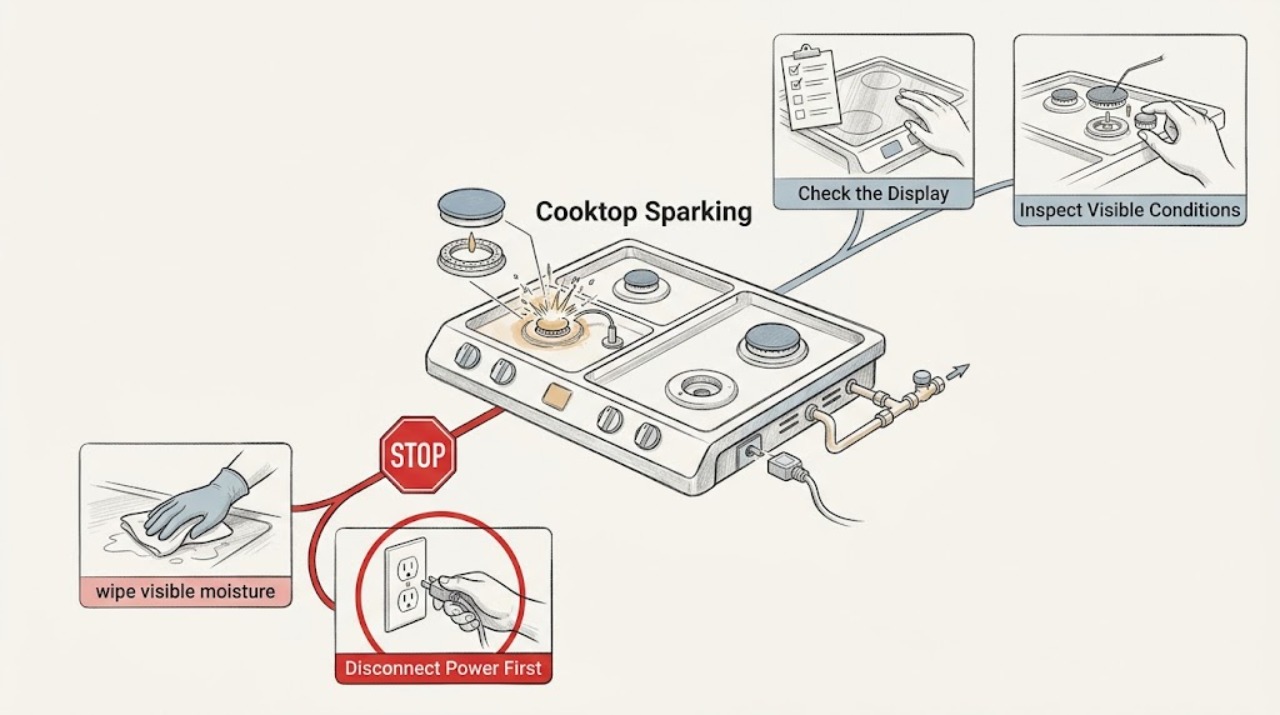
A Thermador gas cooktop normally sparks while a burner knob is being turned to ignite a burner, and some ExtraLow models click as the flame cycles. Sparking that continues after every knob is OFF, occurs without a knob being pressed, or appears after a spill or wet cleaning surface may come from a damp or dirty igniter, a misplaced burner cap, clogged or wet burner ports, a draft, a stuck knob, or a fault that needs service. Turn every knob fully OFF, stop cooking, and let the cooktop cool. Only then may you dry the surface and igniters with the low-risk method in the Thermador guide, and reseat a loose burner cap if its tabs and notches are obvious. Do not use a flame to test ignition, probe wiring, open the cooktop, adjust a regulator, or work on gas fittings. If there is gas odor, smoke, an abnormal flame, electrical arcing, or sparking that will not stop, turn off the appliance and main gas supply if safe, leave the area, and obtain qualified gas or electrical help.
Work through in order
Diagnostic checks
Use only checks that match the exact appliance or system and its official guide.
-
Check 1
Turn every burner knob fully OFF, stop using the cooktop, and from a safe position check for gas odor, smoke, flame outside the burner, electrical arcing, scorch marks, a hot control, or sparking away from the normal igniter area.
Expected result: A gas, fire, heat, or electrical hazard is present, or the cooktop is cool and shows only a normal-looking ignition spark or click.
Next step: For gas odor, leave the area, avoid flames and electrical switches, and follow local gas-emergency guidance. For smoke, fire, or arcing, keep the appliance off and obtain emergency or qualified service. If cool and safe, continue to classify when the spark occurs.
Stop if: Stop for gas odor, smoke, flame outside the burner, arcing, melted or scorched parts, a hot control, or a spark that cannot be stopped at the controls.
Why this matters
Why: A hazard overrides all cleaning and positioning checks. A normal ignition spark can be examined only after confirming that no unsafe symptom is present.
-
Check 2
With the cooktop cool and all knobs OFF, observe whether a click or spark appears only during intentional burner ignition, during an ExtraLow cycle, immediately after power is restored, or while no control is being touched.
Expected result: The spark occurs only during ignition, cycles during documented ExtraLow use, appears once or twice after reconnection, or continues with knobs OFF.
Next step: If timing matches normal ignition or ExtraLow operation and the flame is stable, monitor it. If it occurs with knobs OFF or continues beyond the model's documented behavior, leave the cooktop off and arrange qualified service.
Stop if: Stop for continuous OFF-position sparking, a knob that is stuck or pushed down, an unknown model behavior, or any need to access the switch or wiring.
Why this matters
Why: Thermador documents normal ignition and ExtraLow cycling, while sparking with controls OFF can involve a stuck knob, moisture, or a control or wiring fault that needs service.
-
Check 3
After the cooktop has cooled and the gas controls are OFF, wipe visible moisture from the surface and carefully dry the accessible igniter with a dry cotton swab as Thermador describes; remove only loose lint and do not pour water into the burner base.
Expected result: The sparking started after cleaning or a boil-over, the igniter is damp or soiled, the surface is dry and the symptom stops, or the spark continues after drying.
Next step: If the symptom stops after the cooktop dries, leave it unused until all parts are fully dry and monitor a single normal ignition. If it continues, keep the cooktop off and arrange service.
Stop if: Stop for moisture inside the cooktop, water near controls, a wet or damaged igniter, a chemical spill, or any need to apply powered heat or remove panels.
Why this matters
Why: Moisture and soil can prevent clean ignition or cause intermittent sparking. A persistent symptom after drying is not evidence that the user should open or electrically test the appliance.
-
Check 4
When completely cool, check that the affected burner cap sits level with its locating tabs in the base notches and that visible burner ports are dry and free of loose food soil; use only the gentle cleaning method in the Thermador guide and do not enlarge ports.
Expected result: The cap is displaced, ports are wet or visibly blocked, the cap and ports are correctly positioned, or the cap cannot be reseated without force.
Next step: Correct only an obvious, gentle cap position or loose surface soil, then allow parts to dry fully before one controlled ignition. If the cap is damaged, ports remain blocked, or the spark persists, stop use and arrange service.
Stop if: Stop for a cracked cap, damaged burner base, blocked port that will not clear gently, abnormal flame, or any need to drill, scrape deeply, or remove gas components.
Why this matters
Why: Thermador identifies a moved cap and wet or clogged ports as causes of clicking or intermittent sparking. A cap that needs force or a damaged port is a service issue, not a reason to improvise.
-
Check 5
If the flame is stable and there is no gas odor, compare the clicking with the selected mode and room airflow: note whether it occurs only on ExtraLow or when a draft disturbs the flame; do not place hands near a flame or attempt to shield it with combustible material.
Expected result: Clicking matches ExtraLow cycling, a draft is present, the flame goes out or reignites repeatedly, or clicking occurs independently of the mode.
Next step: If a draft is obvious, remove the draft source only when safe and use the documented burner setting. If the flame still goes out, the click continues outside ExtraLow, or the burner behaves abnormally, turn it off and request qualified service.
Stop if: Stop for flame outage, delayed ignition, boom, yellow or unstable flame, gas odor, or any attempt to adjust the regulator or gas pressure.
Why this matters
Why: Thermador says ExtraLow flame cycling can be normal and drafts can cause re-ignition. Repeated flame loss or mode-independent clicking needs model-specific diagnosis.
-
Check 6
Record the Thermador model, affected burner, knob position, when sparking starts and stops, recent cleaning or spill, cap and port condition, flame appearance, room draft, and whether all knobs are OFF before arranging service.
Expected result: The symptom clears after safe drying or cap positioning, remains with all knobs OFF, returns after a normal ignition, or is accompanied by gas, smoke, flame, or electrical symptoms.
Next step: If sparking persists, recurs, or is unsafe, leave the cooktop off and arrange authorized appliance, gas, or electrical service as appropriate. Do not dismantle the gas appliance or replace an igniter or switch based on appearance alone.
Stop if: Stop DIY work for gas-line or regulator work, control-switch access, wiring, ignition-module access, panel removal, or any unresolved continuous spark.
Why this matters
Why: A repeatable record separates a temporary moisture or positioning issue from a stuck control, ignition, gas, or wiring fault that requires qualified diagnosis.
Use your observations
Decision map
Find the observation that best matches what you see, then follow the next safe action.
-
PATH 01Next step
What you see
Gas odor, smoke, abnormal flame, electrical arcing, scorch marks, or sparking that cannot be stopped is present.
Do this next
Arrange qualified service and follow the exact model guidance.
Why this path and its safety boundary
Why it matters: Turn the appliance and main gas supply off only if safe, leave the area, avoid flames and electrical switches, and obtain appropriate emergency or qualified gas and electrical help.
-
PATH 02Next step
What you see
Sparking occurs only while a knob is intentionally turned to ignite a burner, then stops with a stable flame.
Do this next
Arrange qualified service and follow the exact model guidance.
Why this path and its safety boundary
Why it matters: This can be normal electronic ignition. Use the exact model instructions and monitor for delayed ignition, odor, or a change in timing.
-
PATH 03Next step
What you see
Sparking began after cleaning or a boil-over and stops after the cool surface and accessible igniter dry.
Do this next
Arrange qualified service and follow the exact model guidance.
Why this path and its safety boundary
Why it matters: Keep the cooktop off until fully dry and monitor one normal ignition. Recurrence or moisture inside the appliance needs service.
-
PATH 04Next step
What you see
The burner cap is displaced or ports are wet or visibly blocked, but no hazard is present.
Do this next
Arrange qualified service and follow the exact model guidance.
Why this path and its safety boundary
Why it matters: Reseat the cap gently and clear only loose accessible soil using the manufacturer's method. Stop if force, damage, or abnormal flame is involved.
-
PATH 05Next step
What you see
Clicking occurs only during documented ExtraLow cycling or when a draft disturbs an otherwise stable flame.
Do this next
Arrange qualified service and follow the exact model guidance.
Why this path and its safety boundary
Why it matters: Treat the cycling as a possible normal feature or remove the safe draft source. Persistent mode-independent clicking or flame loss needs service.
-
PATH 06Next step
What you see
The igniter sparks with all knobs OFF, continues after drying, or returns without a clear cap, port, draft, or ExtraLow explanation.
Do this next
Arrange qualified service and follow the exact model guidance.
Why this path and its safety boundary
Why it matters: Leave the cooktop off and arrange qualified appliance service. Do not dismantle the gas appliance or work on controls or wiring.
Helpful context
Understand the symptom
First decide whether the spark is expected
Electronic ignition can spark while a burner is being lit. On some Thermador gas models, ExtraLow cycles the flame and a click can recur as the flame reignites. That is different from a spark or click when all knobs are OFF, a spark at the edge of the cooktop, or an ignition that continues after the knob is released. Model and purchase date can affect behavior, so use the exact manual for the appliance.
Dryness and burner position matter
A recent boil-over or wet cleaning can leave an igniter damp; food soil can obstruct a burner port; and a cap that is not seated can make the spark miss the gas path. With the cooktop off and cool, wipe and dry only the accessible parts described by Thermador. Do not flood the burner base, use an abrasive tool, or remove parts whose position is not clear.
Gas and electrical symptoms change the path
A gas odor, flame that is yellow or unstable, a delayed ignition, or sparking away from the burner is not a routine cleaning issue. Likewise, a spark that continues with knobs OFF can indicate a stuck control or electrical fault. Do not test with a match, touch wiring, adjust gas pressure, or open the appliance. Keep the cooktop out of service until qualified help assesses it.
Use ExtraLow and draft observations carefully
Thermador says ExtraLow burners cycle normally, while a draft can disturb a flame and prompt re-ignition on models with that function. A steady click only during a documented low-simmer cycle may be expected. If the click is unrelated to that mode, continues when the cooktop is off, or returns after the surface dries, record the condition and arrange service.
Only after diagnosis
Potential parts
Only after qualified diagnosis confirms a damaged, dirty, wet, or failed igniter for the exact Thermador model; do not substitute or access it by guesswork.
Only when inspection confirms damage or a persistent positioning or flame-distribution fault after safe cleaning; do not enlarge ports.
Only after qualified appliance or gas service identifies the exact fault; never open the cooktop or adjust gas components as a user repair.
When checks do not resolve it
Need a professional?
Sparking continues with every knob OFF, starts without a control being touched, or does not stop after safe drying., There is gas odor, delayed ignition, a boom, flame outage, yellow or unstable flame, smoke, scorch, or arcing., A burner cap, base, igniter, port, grate, knob, or control is damaged, stuck, or cannot be positioned without force., The cooktop is wet inside, water reached controls, a breaker trips, or the symptom follows a spill and returns., Clicking occurs independently of the documented ExtraLow mode or the flame repeatedly goes out or reignites., Repair would require opening the cooktop, accessing wiring or ignition modules, adjusting gas pressure or a regulator, or dismantling a gas appliance.
Common questions
FAQ
Is it normal for a Thermador cooktop to spark?
A spark while intentionally lighting a gas burner is normal electronic ignition. ExtraLow models may also click as the flame cycles. Sparking with all knobs OFF, at the edge of the cooktop, or after the normal ignition period needs service.
Why does my Thermador cooktop keep clicking after cleaning?
Moisture on an igniter or in burner ports can cause intermittent or continuous sparking. Turn the cooktop off, let it cool, and dry accessible parts using Thermador's gentle method. If clicking continues after drying, leave it off and arrange service.
Can a burner cap cause intermittent sparking?
Yes. Thermador lists a moved cap and wet or clogged ports as possible causes. When cool, reseat a clearly misaligned cap and clear only loose accessible soil. Do not force a damaged cap or alter the ports.
What if the igniters spark when the cooktop is off?
Make sure no knob is stuck or pressed down and let a recently wet surface dry. If the igniters continue to spark with every knob OFF, keep the gas cooktop off and obtain qualified service rather than opening it.
When is cooktop sparking dangerous?
Stop immediately for gas odor, smoke, abnormal or unstable flame, a boom or delayed ignition, electrical arcing, scorch marks, hot controls, or a spark that will not stop. Avoid flames and switches, leave the appliance off, and obtain appropriate emergency or qualified help.
Read the exact guide
Official sources
- How to Use Extra Low Burners | Gas Cooktops SupportThermador · Opened official Thermador ExtraLow guide; settings and behavior vary by cooktop and exact model.
- Cleaning & Care | Gas Cooktops & Rangetops SupportThermador · Opened official Thermador cleaning guide; only perform accessible care for the exact model and never use it as permission to dismantle the appliance.
- Troubleshooting | Gas Cooktops & Rangetops SupportThermador · Opened official Thermador troubleshooting guide for gas cooktops and rangetops; the exact model manual and local gas-safety instructions take precedence.
Community feedback
Share a repair observation
Share a plain-text repair observation. Accepted observations are published automatically; this page may take a moment to update.