
On this page
Start here
Quick answer
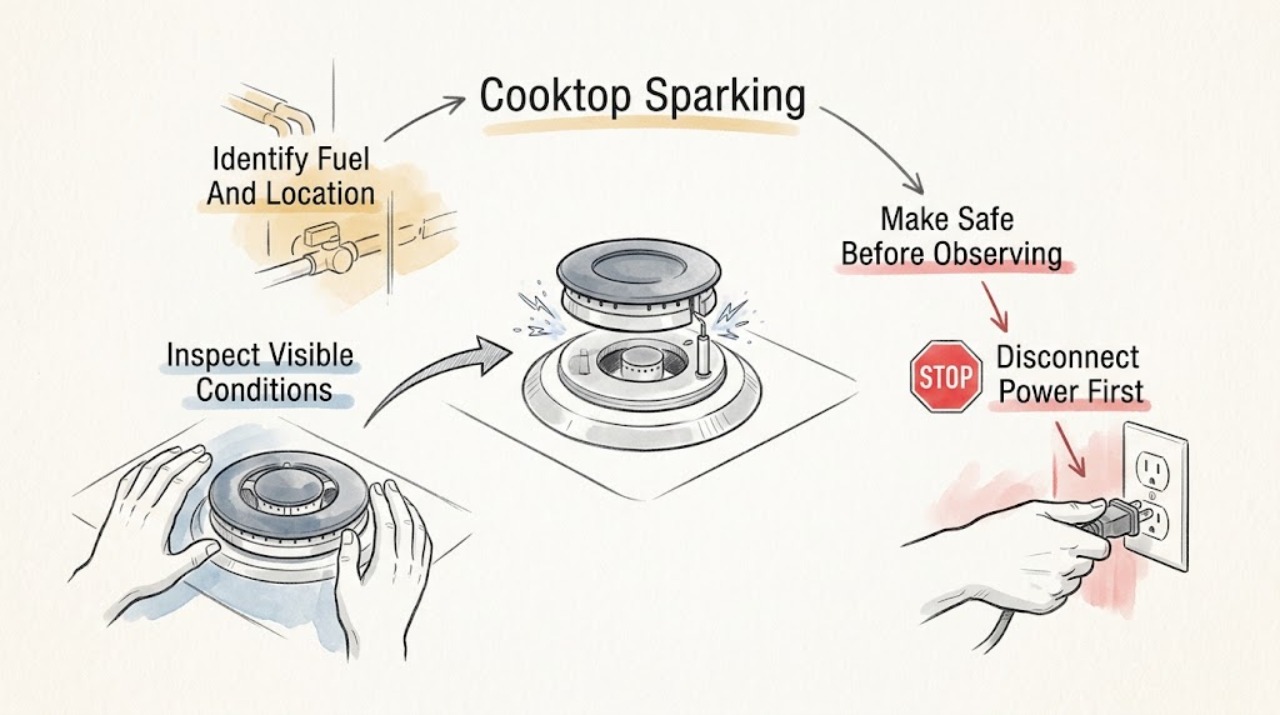
On a Viking gas cooktop, a short series of clicks and visible sparks while a burner is being turned on can be normal, and some Viking models automatically re-ignite if a flame goes out. Sparking that continues after a stable flame, appears with the control Off, jumps away from the burner, or occurs with a gas odor, smoke, fire, a cracked surface, or a tripped breaker is not a normal cooking condition. Turn the control Off, keep away from the appliance, and use the appropriate gas or electrical emergency response. If there is no immediate hazard, identify the fuel type and exact model, let the burner cool, dry and correctly reseat only the removable cap and head, and have a qualified servicer investigate persistent sparking rather than opening the appliance.
Work through in order
Diagnostic checks
Use only checks that match the exact appliance or system and its official guide.
-
Check 1
From a safe, dry position, identify whether the Viking unit has gas burner caps and knobs or a smooth electric or induction surface, and note whether the spark is at one burner electrode, across the glass, behind a control, or present while all controls are Off. Record the model label without removing panels.
Expected result: Classify the symptom as brief burner ignition clicking, continuous sparking after a flame, sparking with no flame, an arc on an electric or induction surface, or sparking while the controls are Off.
Next step: Use the exact model manual for the identified fuel type. If the surface is cracked, an arc is visible away from a gas electrode, a control is Off but sparking continues, or the unit has smoke, fire, or a burning smell, stop using it and arrange emergency or qualified service help.
Stop if: Do not remove the cooktop, open a control area, or touch wiring or energized parts.
Why this matters
Why: The Viking gas manual applies to the listed professional built-in gas cooktop families and describes burner ignition and re-ignition; it does not establish that the same checks apply to every Viking electric or induction model. A spark away from a gas electrode or with the controls Off is an abnormal electrical symptom.
-
Check 2
Turn every cooktop control to Off and keep hands, paper, towels, cookware, and other combustibles away while the surface cools. If you smell gas, do not try to light the appliance or operate electrical switches; leave the area and follow the gas supplier or fire-department emergency instructions from a safe location.
Expected result: The clicking and visible spark stop with the controls Off, there is no gas odor or smoke, and the appliance can cool without anyone approaching the hazard.
Next step: Continue only after the appliance is cool and there is no immediate hazard. For gas odor, smoke, fire, an electrical arc, or a damaged cord or surface, keep the appliance out of service and obtain emergency or qualified help.
Stop if: Do not use an open flame to look for a gas leak, and do not operate switches or continue testing when gas odor, smoke, fire, arcing, or repeated breaker trips are present.
Why this matters
Why: A brief spark during a gas ignition request can be part of the intended sequence, but a spark or flame that continues with controls Off is not a normal user-operation state. A gas odor or fire condition takes priority over diagnosis.
-
Check 3
Only on an identified Viking gas model with no immediate hazard, observe one normal start from the side: turn one control to an On position as described by the exact manual and watch the burner without placing a hand over it.
Expected result: The igniter clicks and sparks for a short time, a stable flame appears, and the spark stops; or the burner produces no flame, the clicking continues after flame ignition, the flame repeatedly goes out, or the spark appears away from the burner.
Next step: If the flame is stable and sparking stops, turn the control Off normally. If there is no flame, continuous clicking, an unstable or abnormal flame, or sparking away from the electrode, turn the control Off, do not repeat the test, and arrange qualified service.
Stop if: Stop immediately for gas odor, delayed ignition, a loud ignition event, yellow or distorted flame, smoke, fire, or any spark that does not stay at the intended gas-ignition point.
Why this matters
Why: The Viking gas manual says that igniters spark when gas is permitted to flow and that several clicks before ignition can be normal. It separately identifies continuous sparking after flame ignition as a fault pattern, with grounding, polarity, or wet or dirty igniters listed as possible causes.
-
Check 4
After the burner and grate are fully cool and all controls are Off, lift only the removable burner cap and head if the exact Viking manual permits it. Inspect for spill residue or moisture, clean with the manual's non-abrasive method, dry thoroughly, and return each part level and in its intended alignment.
Expected result: The cap or head is wet, dirty, damaged, or mis-seated; or it is clean, dry, level, and correctly aligned but the same sparking remains.
Next step: If the parts were wet or mis-seated, allow them to dry and perform at most one normal start according to the model manual. If sparking continues, or a part is damaged or cannot be aligned without force, stop and schedule qualified service.
Stop if: Do not bend or replace an electrode, enlarge burner ports, scrape with a metal tool, disassemble the burner box, bypass a safety device, or work on wiring or gas piping.
Why this matters
Why: Viking states that dirty or wet igniters can be associated with continuous sparking and that clean, dry, correctly aligned burner parts support proper ignition. A persistent fault after this limited maintenance points toward the ignition, grounding, polarity, control, or gas system and is not evidence that more cleaning will help.
-
Check 5
If the Viking gas model has no clicking at all, check only from a safe external position whether the appliance plug is seated and whether its labeled circuit breaker is visibly tripped; do not remove covers or carry out internal electrical work.
Expected result: The circuit is tripped, the appliance is not connected to power, or the external supply appears normal while the igniters remain silent or behave inconsistently.
Next step: Do not repeatedly reset a breaker. If it trips again, there is a burning smell, heat, arcing, a damaged plug or cord, or the external supply appears normal but ignition remains abnormal, leave the cooktop out of service and request qualified electrical or appliance service.
Stop if: Do not open the electrical compartment, measure live circuits, replace a fuse with a different rating, or continue after a repeat trip or visible damage.
Why this matters
Why: Viking lists a tripped circuit, blown fuse, or lack of cooktop power as reasons the igniters may not work. An external power observation does not diagnose grounding, polarity, the ignition module, or a failed electrode.
Use your observations
Decision map
Find the observation that best matches what you see, then follow the next safe action.
-
PATH 01Next step
What you see
The identified Viking gas burner clicks and sparks only while starting, then produces a stable flame and stops sparking.
Do this next
Turn the control Off normally when finished. If the symptom changes to continuous clicking or repeated loss of flame, stop and use the service branch.
-
PATH 02Next step
What you see
A gas burner lights but the igniter continues clicking or sparking after the flame is stable.
Do this next
Turn the control Off, allow the burner to cool, and perform only the permitted dry, clean, and correctly aligned removable-part check once. If the condition remains, obtain qualified service for the ignition and electrical installation.
-
PATH 03Next step
What you see
The igniter sparks but no flame appears, the flame is large, distorted, or yellow, or ignition is delayed.
Do this next
Turn the control Off and do not keep retrying. The gas supply, burner ports, gas type, or adjustment may require qualified diagnosis; any gas odor or abnormal ignition is an immediate stop-use condition.
-
PATH 04Next step
What you see
The Viking unit is electric or induction, or the visible arc is on the glass, behind a control, or present with all controls Off.
Do this next
Stop using the cooktop and isolate power only from a safe location if doing so does not require approaching a gas odor or active fire. Arrange qualified electrical or appliance service and do not apply the gas-burner procedure.
-
PATH 05Next step
What you see
There is a gas odor, smoke, fire, a loud ignition event, exposed damage, or a persistent electrical arc.
Do this next
Do not light anything or operate electrical switches. Leave the area and contact the appropriate gas emergency service or fire department from a safe location; keep the cooktop out of service until cleared.
Helpful context
Understand the symptom
First decide what kind of sparking you are seeing
Viking sells gas, electric, radiant, and induction cooking products, and the safe interpretation is different for each. A gas cooktop has burner caps, burner heads, control knobs, and an ignition electrode; a brief click and spark while a knob is being turned on can be part of its ignition sequence. A visible arc on an electric or induction glass surface, sparking while every control is Off, or a spark accompanied by damage is an electrical stop-use symptom, not a burner-cleaning problem. Check the product label and owner's manual for the exact model before applying a gas-cooktop procedure.
Why moisture and burner alignment matter on a Viking gas model
Viking's gas-cooktop instructions say that burner caps and heads should be cleaned after spills, dried thoroughly, and replaced in their intended alignment. The same manual warns that wet or dirty igniters can be associated with continuous sparking after ignition. This supports a limited, cool-surface inspection of the removable cap and head, but it does not justify scraping, bending, replacing, or adjusting the electrode or opening the burner box.
Continuous sparking is a service boundary
If a gas burner lights but the clicking continues, or a burner repeatedly sparks without establishing a stable flame, stop treating it as a normal start-up sound. Viking's troubleshooting table also lists grounding and polarity as possible causes, which are electrical installation matters rather than user adjustments. A qualified appliance servicer or electrician should diagnose those conditions. Do not keep cycling the knob, bypass ignition, or test live wiring.
Safety boundary
Stop conditions
- Stop using the cooktop for any gas odor, smoke, flame that will not stop, loud or delayed ignition, yellow or distorted flame, sparking with every control Off, arcing away from a gas ignition electrode, cracked glass, damaged cord, burning smell, heat at a control, or a breaker that trips again. Do not open the appliance, bypass ignition or safety controls, test live wiring, alter grounding or polarity, adjust gas pressure, or work on gas piping. Use the exact Viking model documentation and a qualified servicer for any internal electrical, ignition, gas, or control diagnosis.
Only after diagnosis
Potential parts
- gas ignition electrode or igniter assembly
Consider this class only if a qualified diagnosis identifies a failed or damaged ignition component after the model and fuel type are confirmed.
Confirm the exact Viking model, revision, and approved part information before ordering; do not infer fit from appearance.
When checks do not resolve it
Need a professional?
Call a qualified appliance servicer or electrician when sparking persists after the allowed cool, dry, and alignment check, when the external power check does not explain the symptom, when the cooktop is electric or induction and arcs, or whenever grounding, polarity, an ignition module, an electrode, controls, gas supply, or burner adjustment may be involved.
Common questions
FAQ
Is it normal for a Viking gas cooktop to click and spark briefly?
A short series of clicks and sparks while a gas burner is starting can be normal on the Viking gas cooktop families covered by the manual. The clicking should stop once a stable flame is established; continuous sparking, no flame, or an abnormal flame needs the appropriate stop and service branch.
What should I do if the burner keeps sparking after it lights?
Turn the control Off. After the burner is cool, inspect only the removable cap and head as the exact manual permits, and clean and dry them thoroughly before restoring their alignment. If the clicking continues, stop using the cooktop and have a qualified servicer check the ignition and electrical installation.
Can I use this gas-cooktop procedure for a Viking induction or electric cooktop?
No. Confirm the fuel type and model first. A spark or arc on an electric or induction glass surface, behind a control, or while controls are Off is an electrical stop-use symptom and needs qualified service rather than gas-burner cleaning.
Read the exact guide
Official sources
- 30"W.Gas CooktopViking Range, LLC · Viking RVGC33015BSS 3 Series gas cooktop product page
- Use & Care Professional Built-in Gas CooktopsViking Range, LLC · Viking Professional Built-in Gas Cooktops VGC530, CVGC530, VGC536, CVGC536, VGSU530, CVGSU530, VGSU536, and CVGSU536
Community feedback
Share a repair observation
Share a plain-text repair observation. Accepted observations are published automatically; this page may take a moment to update.