
On this page
Start here
Quick answer
A click or spark while a Samsung gas burner is being lit can be normal, and all burners may spark when one knob is set to Lite. Continuous sparking after every knob is Off usually points to moisture or contamination around the ignition switches, while a burner that sparks but does not light can involve a wet or incorrectly seated burner head, blocked port, or interrupted gas supply. Turn controls Off, keep the cooktop dry, and follow the model cleaning instructions only after power is off and surfaces are cool. If sparking continues when no burner is being lit, gas is smelled, the flame is abnormal, or the cooktop has smoke, arcing, or damaged parts, stop using it and arrange qualified service or gas-safety help.
Before you begin
Safety first
- User diagnosis is limited to control observation, power-off cooling, model-approved cleaning and drying, correct accessible cap and head placement, and one normal ignition observation only when no gas or fire hazard is present. A qualified technician must diagnose ignition switches, wiring, gas pressure, valves, and internal controls.
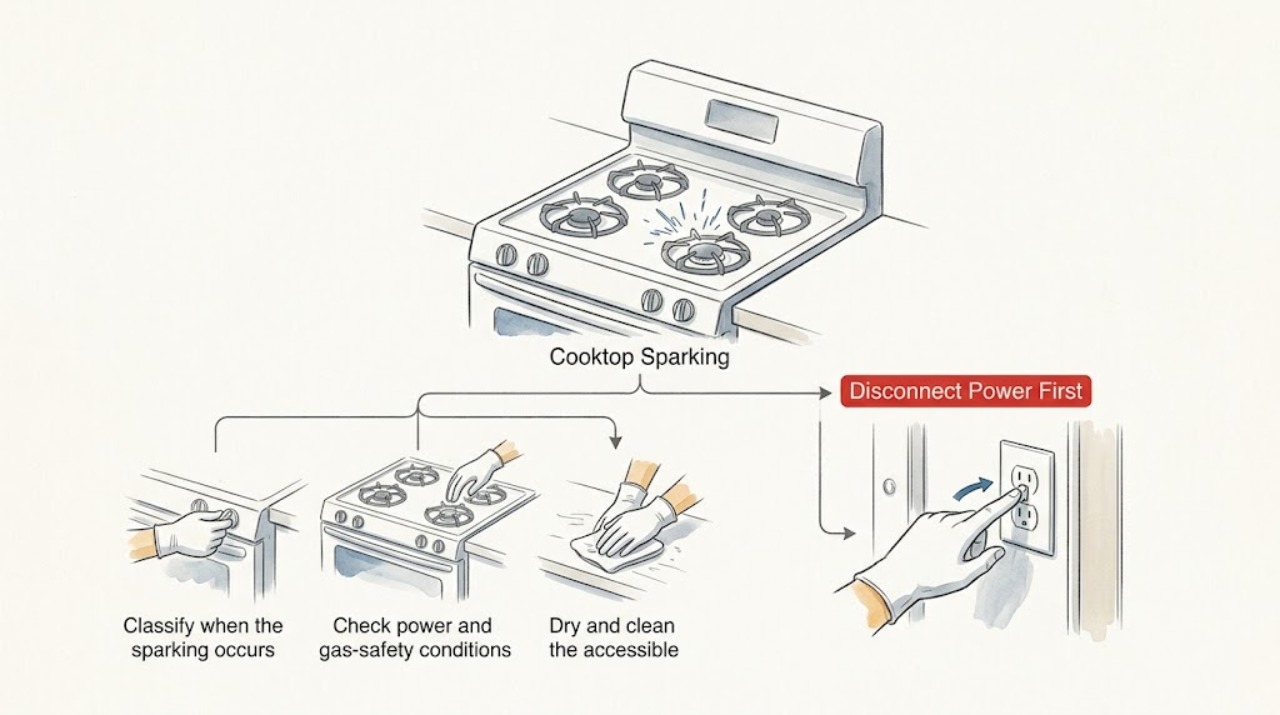
Work through in order
Diagnostic checks
Use only checks that match the exact appliance or system and its official guide.
-
Classify when the sparking occurs
Turn every surface-burner control to Off and observe from a safe position. Note whether clicking occurs only while a knob is being turned to Lite, continues after a flame is established, continues with every knob Off, or occurs without a flame. Do not touch the igniter or burner while it is sparking.
Expected result: Sparking stops after ignition, all burners spark while one is selected, or sparking continues with all controls Off.
Next step: For normal ignition behavior, continue with burner assembly and flame checks. For continuous sparking with controls Off, stop using the cooktop, disconnect power only if safe and accessible, and allow model-approved drying or arrange service; do not keep relighting.
Why this matters
Why: A spark during normal ignition and simultaneous sparks at multiple burners can be normal. Continued sparking with controls Off is abnormal and can follow moisture near ignition switches or an ignition-control fault.
-
Check power and gas-safety conditions
Confirm there is no gas smell, smoke, burning odor, arcing, cracked surface, or exposed wiring. If the cooktop is safe and the model uses electric ignition, check only the normal external power connection and household supply as permitted by the manual. Do not reset a repeatedly tripping breaker or touch internal wiring.
Expected result: The cooktop has no power and no igniter spark, the breaker trips, or power is present but the igniter still sparks abnormally.
Next step: If the supply is interrupted, restore it only through normal household procedures and retry once. If the breaker trips again or abnormal sparking remains, leave the cooktop Off and arrange qualified service.
Why this matters
Why: No power can prevent ignition, while a repeated breaker trip or abnormal electrical symptom indicates a fault beyond a burner cleaning check. Power present with uncontrolled sparking moves suspicion toward moisture, ignition switches, or the ignition circuit.
-
Dry and clean the accessible burner parts
Turn the cooktop power Off and wait until all surfaces are cool. Following the Samsung cleaning guide, remove only accessible burner caps and heads, wash them as directed, clear visible burner-port debris with the approved non-damaging method, and dry every part completely. Keep water out of the burner base, orifice, and ignition openings; never spray cleaner into manifold holes.
Expected result: Moisture, grease, debris, or a blocked port is found, or the parts look clean and dry but sparking or ignition remains abnormal.
Next step: If the parts were wet or dirty, reinstall them only in their original positions and continue with alignment checks. If the symptom persists, keep the cooktop Off and use the service branch.
Why this matters
Why: Moisture and contamination can interfere with ignition and flame travel. A clean, dry assembly with persistent sparking or failed ignition points toward gas supply, ignition, or control diagnosis rather than more cleaner.
-
Verify each cap and burner head is seated
With the cooktop cool and power Off, confirm each burner head lies flat, the cap is the correct piece for that position, and the igniter aligns with the opening in the head. Do not interchange parts between burner positions or force a cap into place.
Expected result: A cap or head is displaced, the igniter is not aligned, or every part is flat and correctly located.
Next step: Correct only the accessible assembly arrangement shown by the model manual, then observe one normal ignition attempt without leaning over the burner. If it still sparks continuously, delays, or fails to light, stop and request service.
Why this matters
Why: Incorrect seating can interrupt the spark-to-flame path, delay ignition, or create an uneven flame that leads to repeated sparking. Correct seating does not rule out a blocked gas path or failed ignition component.
-
Distinguish a stable flame from a gas-supply problem
Only when there is no gas odor and the burner parts are dry and correctly seated, make one normal ignition attempt from the user position. Observe whether the burner lights promptly and evenly, lights with a delayed burst, flickers, goes out, or sparks without producing a flame. Do not repeatedly cycle the knob or adjust gas pressure.
Expected result: The flame is stable, the spark continues after ignition, there is no flame despite sparking, or the flame is yellow, uneven, lifting, or repeatedly extinguishing.
Next step: Turn the control Off. For no flame or unstable flame, contact the gas provider or qualified gas-appliance service as appropriate; for continued sparking, leave the cooktop disconnected and request service.
Why this matters
Why: A stable flame with sparking that stops supports normal operation. Persistent sparking after ignition, no flame with spark, or an abnormal flame can indicate ignition timing, burner assembly, gas supply, pressure, or a service fault.
-
Record the symptom for qualified service
Record the Samsung model, cooktop type, burner position, whether all burners spark, whether the spark continues with controls Off, cleaning or spill history, flame appearance, gas-supply symptoms, breaker behavior, and any smoke or odor. Photograph only safe external surfaces and do not remove panels.
Expected result: Sparking remains after drying and correct assembly, the cooktop has no flame, the symptom recurs, or any electrical or gas warning is present.
Next step: Keep the cooktop out of service and provide the record to Samsung support or a qualified appliance technician. Use the gas-emergency response from a safe location for an active gas odor.
Why this matters
Why: Timing and burner-specific details help separate normal ignition from moisture, assembly, gas-supply, igniter, switch, or control faults without dangerous internal testing.
Use your observations
Decision map
Find the observation that best matches what you see, then follow the next safe action.
-
PATH 01Next step
What you see
Sparking occurs only while a burner is being lit and stops after a stable flame is established.
Do this next
This can be normal gas-ignition behavior. Keep the burner parts clean and correctly seated and follow the exact model manual for operation.
-
PATH 02Next step
What you see
All burners spark when only one burner is selected.
Do this next
This can be normal for the ignition design. Evaluate the selected burner's flame and whether sparking stops; do not treat simultaneous sparks alone as a fault.
-
PATH 03Next step
What you see
Sparking continues when every knob is Off, especially after a spill or cleaning.
Do this next
Stop using the cooktop, turn power Off if safe and accessible, let the area dry according to the model guidance, and request service if clicking persists. Do not spray cleaner into ignition openings.
-
PATH 04Next step
What you see
The burner sparks but does not ignite, or lights with a delayed burst or unstable flame.
Do this next
Turn the control Off. After confirming clean, dry, correctly seated parts without a gas odor, arrange qualified gas-appliance or gas-supply diagnosis; do not repeatedly relight or adjust pressure.
-
PATH 05Next step
What you see
Smoke, burning odor, arcing, cracked glass, exposed wiring, or gas smell is present.
Do this next
Stop immediately. Do not operate switches or relight the burner; leave the area for gas odor and seek appropriate emergency or qualified help from a safe location.
Helpful context
Understand the symptom
Sparking is not one single fault. A Samsung gas cooktop normally uses an igniter when a burner is selected, and a design may spark at more than one burner while lighting one. The important distinction is whether the clicking stops after ignition and all controls are Off, whether the spark produces a stable flame, and whether the burner parts are clean and seated.
Do not treat an active gas smell as a cleaning problem. Do not use a flame to search for a leak, spray cleaner into igniter or manifold openings, operate a wet cooktop, or open the gas or electrical enclosure. Keep children away and leave the appliance out of service when the symptom is unsafe or unexplained.
Safety boundary
Stop conditions
- Stop for gas odor, smoke, fire, arcing, burning electrical odor, damaged wiring, cracked glass, or uncontrolled flame.
- Do not use a flame to find a gas leak, repeatedly relight a burner, adjust gas pressure, bypass ignition or safety controls, or open the gas or electrical enclosure.
- Turn power Off and let the cooktop cool before cleaning; keep water and cleaner out of burner bases, orifices, and ignition openings.
- Do not keep operating a cooktop that sparks with all controls Off or continues sparking after a clean, dry, correctly seated assembly.
Only after diagnosis
Potential parts
- burner cap or burner head
Consider only when a technician or model guidance confirms a damaged, missing, or incorrectly matched burner component after cleaning and correct seating are ruled out.
Burner parts are position- and model-specific; do not infer fit from sparking or flame symptoms alone. - spark igniter or ignition switch
Consider only after qualified diagnosis confirms persistent sparking, no spark, or ignition timing fault with dry and correctly assembled burner parts.
Match the exact Samsung model and ignition configuration; internal electrical work requires qualified service. - spark module or gas-control component
Consider only when a technician confirms an internal ignition-control or gas-delivery fault; continuous sparking alone does not identify the failed component.
Verify exact model, fuel configuration, and professional diagnosis before ordering or replacing.
When checks do not resolve it
Need a professional?
Request qualified Samsung appliance service when sparking continues with all knobs Off, the igniter remains abnormal after approved drying and cleaning, a burner sparks without lighting, ignition is delayed, or the flame is unstable. Contact the gas provider or use emergency gas-safety help for an active gas odor; stop immediately for smoke, fire, arcing, or damaged electrical parts.
Safety scope: User diagnosis is limited to control observation, power-off cooling, model-approved cleaning and drying, correct accessible cap and head placement, and one normal ignition observation only when no gas or fire hazard is present. A qualified technician must diagnose ignition switches, wiring, gas pressure, valves, and internal controls.
Common questions
FAQ
Is it normal for a Samsung gas cooktop to spark when one burner is lit?
Yes. Clicking and sparking during normal ignition can be expected, and all burners may spark while one is selected. The spark should stop after a stable flame is established.
Why does my Samsung cooktop keep sparking when it is off?
Continuous clicking with every knob Off can follow moisture near the ignition switches, especially after a spill or cleaning, but it can also indicate an ignition-control fault. Turn the cooktop Off, keep it dry, and request service if it persists.
Why does my Samsung burner spark but not light?
Check only when there is no gas odor: the burner head and cap should be clean, dry, correctly positioned, and free of blocked ports. If it still sparks without a flame, stop repeated attempts and arrange qualified gas-appliance or gas-supply diagnosis.
Can I clean a Samsung cooktop igniter with spray cleaner?
No. Turn power Off and let the surface cool, then follow the Samsung cleaning guide. Keep water and cleaner out of the ignition openings and dry the burner parts completely before reassembly.
Read the exact guide
Official sources
- Samsung cooktop and range: common sounds and operational noisesSamsung Support US · Samsung gas-cooktop ignition clicking, continuous clicking, and normal operating sounds
- Home Appliance Terms and ConditionsSamsung · Samsung cooking-appliance gas, fire, electrical, smoke, burning-odor, glass, and qualified-repair safety boundaries
- How to clean your Samsung gas cooktopSamsung Support US · Samsung gas-cooktop burner, cap, head, igniter, moisture, and safe cleaning guidance
- What can you do when the burner of your Samsung gas cooktop does not ignite or has other ignition issuesSamsung Canada · Samsung gas-cooktop no-ignition, delayed ignition, abnormal flame, power, and gas-supply guidance
- Flame issues on Samsung gas cooktop or rangeSamsung Support US · Samsung gas-cooktop abnormal flame, burner cleanliness, assembly, gas pressure, and service escalation
Community feedback
Share a repair observation
Share a plain-text repair observation. Accepted observations are published automatically; this page may take a moment to update.