
On this page
Start here
Quick answer
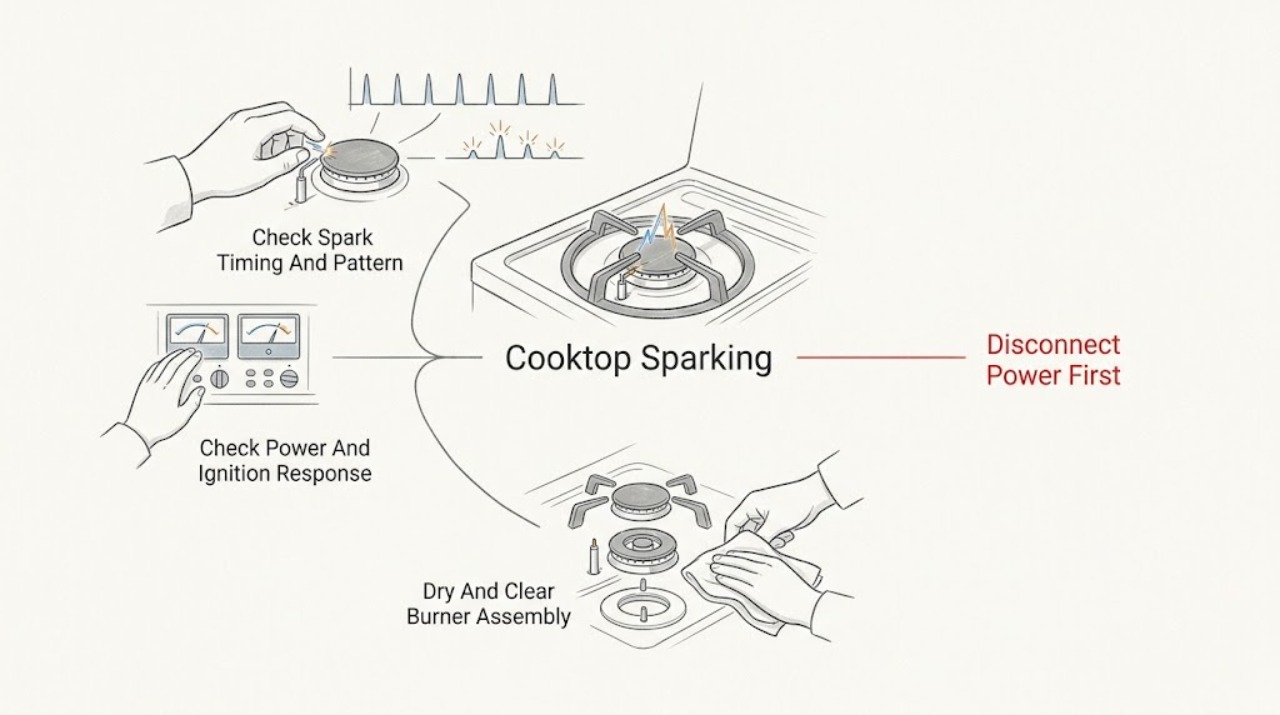
A GE gas cooktop normally makes repeated sparks while a burner knob is at Lite and the burner is igniting; on many sealed-burner models, several igniters may spark together by design. Sparking that continues after every knob is Off, or sparks without a flame, is not something to keep operating. Turn the controls Off, disconnect power at the plug or breaker, shut off the cooktop gas supply if the sparking persists, and arrange service. If the problem is limited to a burner that clicks but does not light, let the cooktop cool, disconnect power, dry and clear the burner parts, and reseat the electrode, burner head, and cap before one controlled retest.
Work through in order
Diagnostic checks
Use only checks that match the exact appliance or system and its official guide.
-
Check 1
With the cooktop cool and no cookware in the way, confirm which control is associated with the sparking and observe the timing without holding a control at Lite longer than needed for a normal ignition attempt. Return every knob fully to Off.
Expected result: Record whether the spark occurs only at Lite, stops as soon as the flame is established, or continues after the knob is Off. Also note whether several igniters spark together when one burner is selected.
Next step: If sparking continues with all knobs Off, stop operating the cooktop and follow the service boundary. If it stops normally, continue only if a burner still fails to light or the issue recurs.
Stop if: Stop immediately if a control will not return to Off, gas odor is present, or a spark continues with every knob Off.
Why this matters
Why: Sparking at Lite until ignition, including multiple igniters on a sealed GE cooktop, can be normal. Continued sparking after Off is abnormal and changes this from an ignition check to a safety/service issue.
-
Check 2
For the burner that will not light, turn its control to Lite briefly and listen for clicking while watching for a spark. Do not continue if gas is flowing without ignition; return the knob to Off first.
Expected result: There is either a repeatable click/spark, or there is no click/spark. Compare with a different burner only if all controls are Off between tests and there is no gas odor.
Next step: If there is no click or spark, check the cooktop's circuit breaker or electrical supply once; if power is available, arrange service. If there is a click or spark, disconnect power before cleaning or reseating parts.
Stop if: If clicking/sparking is absent, check the breaker or supply and stop if it is not restored; service is required when power is present but ignition remains absent.
Why this matters
Why: A click or spark means the electrical ignition is responding and the burner gas path, burner ports, electrode position, or moisture may be the next decision point. No click or spark points first to appliance power or an ignition/control fault rather than a dirty flame port.
-
Check 3
After all knobs are Off and the cooktop is cool, disconnect power. Remove only the grate, burner cap, and burner head for the affected surface burner. Inspect the electrode tip and the burner-head ignition/flame ports for moisture or spill residue; clear burner-port obstructions using the model manual's method, and dry the parts thoroughly before reassembly.
Expected result: Look for dampness after cleaning or a spill, residue around the white ceramic electrode, blocked burner ports, or a cap/head that is not seated flat. Do not bend, crack, or remove the electrode and do not probe wiring or gas fittings.
Next step: If moisture or residue was found, allow the parts to air-dry completely, then continue to the alignment check. If the electrode or wiring appears damaged, leave the cooktop disconnected and arrange service.
Stop if: Stop if the electrode ceramic is cracked, the electrode will not sit securely, wiring is exposed, or the burner area cannot be safely separated without opening the appliance.
Why this matters
Why: Moisture or blocked ports can let the igniter keep clicking without establishing a flame. A damaged, loose, or non-flush electrode is not a cleaning success and needs service rather than an improvised repair.
-
Check 4
With power still disconnected, match the burner head and cap to the correct position for the GE cooktop. Press the ceramic electrode down only as GE describes if it is not sitting flush, then place the head and cap so the cap lies flat and fits securely. Restore power only after everything is dry and correctly seated.
Expected result: The cap should be the correct size for that burner, sit flat without rocking, and align with the electrode and burner body. A cap that is tilted, loose, or on the wrong burner indicates an assembly problem.
Next step: If the assembly was corrected, perform one brief retest at Lite and move the knob to the desired setting only after a stable flame appears. If it still sparks without lighting, or sparks after Off, disconnect power and arrange service.
Stop if: If the parts cannot be matched or seated correctly, stop using that burner and use the model manual or service support rather than forcing them.
Why this matters
Why: A mismatched or poorly seated cap/head can prevent the spark from igniting the gas at the intended location even when the igniter clicks. A properly seated assembly followed by persistent clicking or no ignition points beyond a user-cleaning issue.
Use your observations
Decision map
Find the observation that best matches what you see, then follow the next safe action.
-
PATH 01Safety boundary
What you see
The spark is present only while a burner is at Lite and stops after ignition; multiple igniters may spark together on a sealed design.
Do this next
No repair is indicated by this pattern alone. Use the burner normally, turning the control away from Lite after the flame appears, and monitor for a change in behavior.
Why this path and its safety boundary
Safety stop: If sparking begins in another control position or continues after Off, stop and use the abnormal-sparking branch.
-
PATH 02Safety boundary
What you see
A spark or clicking continues after every burner control is Off, or a control cannot be returned fully to Off.
Do this next
Do not operate the cooktop. As a safeguard, disconnect the cooktop at its plug or breaker and turn off the cooktop gas supply until a qualified service person checks it.
Why this path and its safety boundary
Safety stop: This is the end of homeowner troubleshooting; do not reopen the cooktop or attempt to replace an ignition or gas component.
-
PATH 03Safety boundary
What you see
The igniter clicks or sparks at Lite but the affected burner does not establish a flame.
Do this next
With power disconnected and the cooktop cool, dry and clear the burner parts, check the electrode, and reseat the matching head and cap. Make one brief retest only after reassembly.
Why this path and its safety boundary
Safety stop: If the burner still will not light after the parts are dry and correctly seated, stop testing and arrange service.
-
PATH 04Safety boundary
What you see
The control is at Lite but there is no click or visible spark.
Do this next
Check the cooktop's electrical supply or circuit breaker once. If power is available and the igniter remains inactive, arrange service.
Why this path and its safety boundary
Safety stop: Do not bypass the ignition system or light the burner manually as a routine workaround.
Helpful context
Understand the symptom
GE gas cooktops use electric ignition. The spark is expected during ignition, and the selected burner receives gas when its control is turned on. On sealed-burner designs, all four igniters can spark when one burner is selected; some lift-top designs use paired igniters. That pattern alone does not mean every burner is failing.
Treat the timing of the spark as the first decision point. A short series of clicks at Lite that stops after the flame is established is normal. A click or visible spark after the control is returned to Off, or with all controls Off, can indicate a wet or contaminated ignition area, a control or ignition fault, or another condition that needs service.
Do not keep cycling a burner that is not lighting. If gas is present without ignition, stop the test, turn the knob Off, ventilate normally, and wait before any further attempt. Do not open the cooktop or work on wiring, the spark module, gas valve, or supply line as a homeowner check.
Only after diagnosis
Potential parts
- spark electrode or ignition component
Consider a replacement only if qualified service confirms that a correctly positioned, dry burner still has an ignition fault or continues sparking after the controls are Off.
Confirm the exact cooktop model and the manufacturer's fit information before ordering; do not infer compatibility from appearance.
When checks do not resolve it
Need a professional?
Arrange qualified appliance service if sparking continues after the controls are Off, if a control will not return to Off, if there is gas odor, if the electrode or wiring is damaged, if the cooktop has power but an igniter does not respond, or if a burner still will not light after it is dry and correctly assembled.
Common questions
FAQ
Is it normal for a GE cooktop to spark when one burner is turned on?
Yes, a short series of sparks at Lite is normal for a GE gas cooktop. On many sealed-burner models, more than one igniter may spark when one burner is selected. The spark should stop after ignition and the control should be moved away from Lite.
Why does my GE cooktop keep sparking after I turn the burner off?
Persistent clicking or sparking after all burner controls are Off is not a normal ignition pattern. Disconnect power at the plug or breaker, turn off the cooktop gas supply as a safeguard, and arrange qualified service.
Can wet burner parts cause a GE cooktop to keep clicking?
Yes. GE identifies moisture in the burner head ignition or flame ports as a common cause of continuous clicking or failure to ignite after cleaning. Disconnect power, let the parts dry thoroughly, and reinstall the matching burner head and cap before retesting.
What if the GE cooktop sparks but the burner does not light?
With the cooktop cool and power disconnected, inspect for moisture or blocked ports and make sure the electrode, burner head, and cap are correctly seated. If the burner still does not light after one careful retest, stop and arrange service rather than repeatedly releasing gas without ignition.
Read the exact guide
Official sources
- Gas Range & Cooktop - Electric Ignition for Surface BurnersGE Appliances · Explains normal spark patterns and the safety response when clicking persists after the controls are Off.
- Gas Range & Cooktop - Surface Burners Not Clicking, Not Trying to IgniteGE Appliances · Covers correct burner control, Lite position, cap placement, and electrical supply when no spark occurs.
- Gas Range & Cooktop - Burners Won't LightGE Appliances · Provides the click-or-no-click decision, power check, cleaning sequence, and service boundary.
- Gas Range & Cooktop - Common Causes for Slow Ignition, No Ignition or Clicking on Surface BurnersGE Appliances · Covers moisture, residue, electrode seating, and burner cap/head alignment checks.
Community feedback
Share a repair observation
Share a plain-text repair observation. Accepted observations are published automatically; this page may take a moment to update.