
On this page
Start here
Quick answer
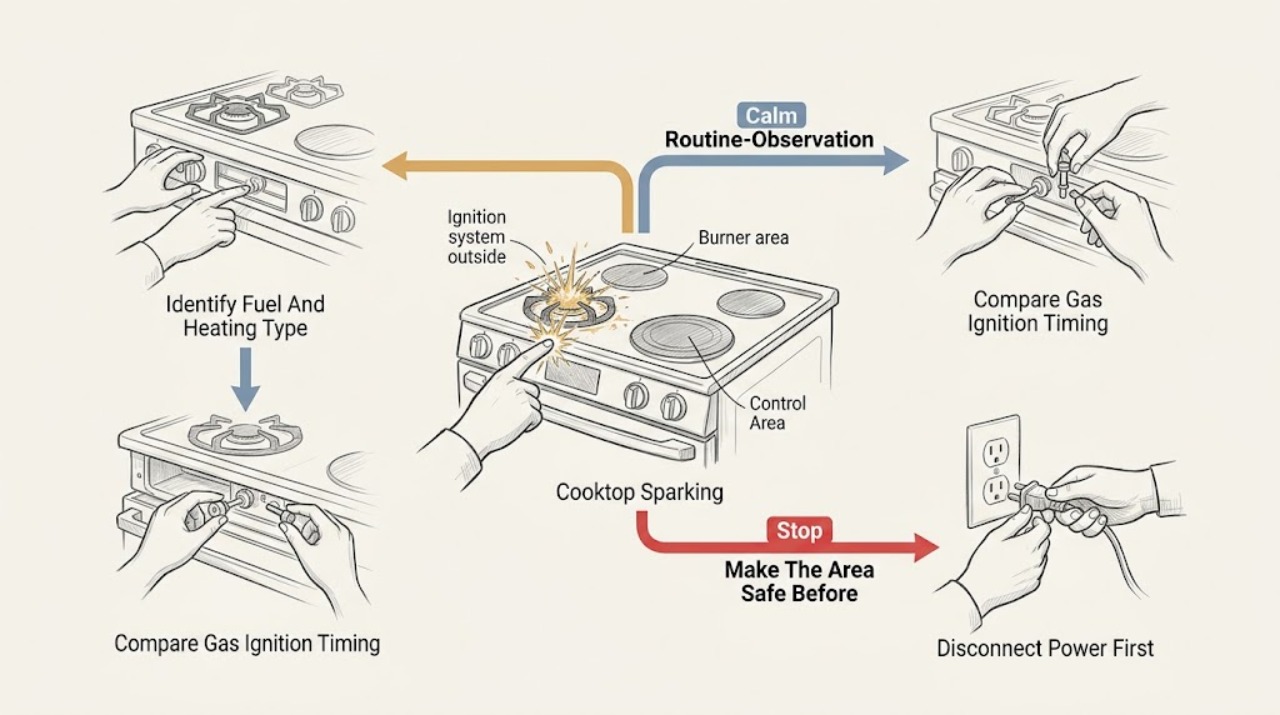
A short spark at a gas burner while its control is deliberately turned to Ignite can be normal, and some gas cooktops make every igniter click or spark during one burner start. Sparking that continues after all controls are off, appears away from a designed gas igniter, follows a spill or cleaning, or is accompanied by gas odor, delayed ignition, an abnormal flame, smoke, heat damage, or a tripped breaker should not be repeatedly tested. Because the brand and fuel type are unspecified, first identify whether this is a gas cooktop with an electronic igniter, an electric surface, or an induction unit; use only the low-risk checks that match that identity.
Before you begin
Safety first
- Keep the cooktop out of service whenever the spark is not clearly part of a confirmed gas-ignition sequence. Gas odor, hissing, smoke, fire, burning smell, visible arcing, cracked glass, or repeated breaker trips requires immediate stopping and professional or emergency help. Never troubleshoot a wet, energized, or damaged cooktop.
Work through in order
Diagnostic checks
Use only checks that match the exact appliance or system and its official guide.
-
Check 1
Stop cooking, keep people and flammable items clear, and look only from a safe position. If there is gas odor, hissing, smoke, an arc, burning smell, damaged glass, or a breaker that has tripped, do not touch the cooktop or reset it for another test; leave and seek help from a safe location.
Expected result: The hazard is either present now, or the area is quiet with no odor, smoke, heat damage, or electrical warning signs.
Next step: If any hazard is present, keep the appliance out of service and contact emergency, gas-safety, electrical, or appliance professionals as appropriate. Otherwise continue without energizing an unidentified cooktop.
Why this matters
Why: An active gas, fire, hot-surface, or electrical hazard is a stop condition, not a troubleshooting branch. A quiet area allows only the identity and symptom checks below.
-
Check 2
With the cooktop cool and unused, read the rating label or manual and identify whether it is a gas cooktop with burner caps and igniters, an electric radiant or coil surface, or an induction surface. Note whether the reported spark was at a burner igniter, on the glass, near a control, or somewhere else, and whether every control was off.
Expected result: A gas model has burner caps and an Ignite position; an electric or induction model has no gas-burner ignition sequence. The location and timing of the spark are also recorded.
Next step: Follow the matching branch: inspect only the cool, accessible gas burner parts for a gas model, or stop and arrange service for an unintended spark on an electric or induction model.
Why this matters
Why: A spark at a gas igniter during an intentional start can be normal. A visible spark on an electric or induction surface, or a spark at an unintended location or with all controls off, is not a reason to keep testing.
-
Check 3
Only if the manual confirms a gas cooktop and there is no gas odor or other hazard, observe one deliberate start from the normal control position without putting your hands over the burner: the knob is pushed and turned to Ignite, then returned to the normal heat setting once a stable flame appears. Do not keep gas flowing when no flame appears.
Expected result: The spark occurs only during the start sequence and stops after a stable flame, or it continues with the knob off, never lights, lights with a delay, or produces an abnormal flame.
Next step: For a normal timed spark, use the cooktop as directed. For continued sparking, delayed ignition, or an abnormal flame, turn the control off, stop testing, and arrange service; if gas odor remains, leave immediately.
Why this matters
Why: Timed ignition supports normal operation. Continued clicking with controls off points to moisture or a control/ignition fault; failure to light or delayed or abnormal flame behavior can leave unburned gas and needs the manual-specific service boundary.
-
Check 4
For a confirmed gas model with no active hazard, wait until the burner is completely cool, then look at the accessible burner cap and surrounding surface. If the manual permits removal, check that the cap is dry, seated flat, and matched to its burner base; wipe only accessible residue with the manual-approved method. Do not poke into gas passages, press an electrode, open the top, or work on wiring.
Expected result: The cap or burner area is wet, dirty, displaced, or mismatched, or it is dry, correctly seated, and undamaged.
Next step: If the manual-approved dry-and-reassemble check resolves the symptom, monitor it. If it does not, or if the electrode, glass, cap, or surface is damaged, stop and request a qualified appliance inspection.
Why this matters
Why: Spills, cleaning moisture, residue, or a cap that is not seated can disturb ignition. A dry and correctly assembled burner with continuing sparking makes an internal or control fault more likely.
-
Check 5
Recall whether the sparking began immediately after cleaning or a spill and whether it occurs with every control fully off. Do not use a flame or hot air to dry the cooktop; keep it de-energized for the manual-specified drying period and avoid touching wet controls or electrical areas.
Expected result: The symptom fades after the accessible area has dried, or the igniters still click or spark while all controls are off.
Next step: If drying resolves it, resume only according to the manual. If off-state sparking remains, keep the appliance out of service and schedule a technician; do not repeatedly cycle the controls.
Why this matters
Why: A recent spill or cleaning event can account for temporary ignition noise on a gas model. Sparking in the off state after drying is a fault pattern rather than a normal start sequence.
-
Check 6
If the appliance is electric radiant or induction, or if the spark was on the glass, at a control, beneath a surface, or in an unidentified location, stop using it. If it is safe and dry to do so, isolate power using the normal household disconnect; do not touch wet electrical equipment, cracked glass, exposed wiring, or the inside of the cooktop.
Expected result: The spark stops only after power is isolated, or it is associated with visible damage, moisture near controls, smoke, heat, or a repeated trip.
Next step: Leave the cooktop disconnected and arrange qualified appliance or electrical service. If there is smoke, fire, or immediate danger, leave the area and contact emergency help.
Why this matters
Why: These observations are outside a normal gas-igniter start and can indicate an electrical or surface fault. A cooktop that trips protection or shows damage needs professional diagnosis.
Use your observations
Decision map
Find the observation that best matches what you see, then follow the next safe action.
-
PATH 01Next step
What you see
Gas odor, hissing, smoke, fire, burning insulation, an uncontrollable flame, or an arc is present.
Do this next
Do not operate controls, switches, phones, or flames in the area. Leave, keep others out, and contact local emergency or gas-safety help from outside; leave the cooktop off until professionals make it safe.
-
PATH 02Next step
What you see
The manual confirms a gas cooktop and the spark occurs only when a control is intentionally turned to Ignite, followed by a stable flame.
Do this next
The spark is consistent with electronic gas ignition. Use the manual's operating sequence and stop if the timing, flame, or odor changes.
-
PATH 03Next step
What you see
A gas burner was recently cleaned or spilled on and the cool, accessible cap is wet, dirty, displaced, or mismatched.
Do this next
Follow the model manual's low-risk cleaning and drying instructions. Do not enlarge ports, probe wiring, or continue if gas odor or abnormal flame appears.
-
PATH 04Next step
What you see
Sparking continues with all controls off, occurs away from a gas igniter, or occurs on an electric or induction surface.
Do this next
Stop testing, isolate power only from a safe dry position if appropriate, and arrange qualified service; do not open the cooktop or work on gas or wiring.
-
PATH 05Next step
What you see
The cooktop remains dry and correctly assembled but still sparks, fails to light, has delayed ignition, or trips protection.
Do this next
Keep it out of service and provide the technician with the model, fuel type, spark location, timing, recent spill or cleaning history, odor, flame, and breaker observations.
Helpful context
Understand the symptom
What the spark may mean
The word sparking covers several different symptoms. A gas cooktop is designed to make a spark at an igniter when a knob is pushed and turned to Ignite. On some sealed-burner designs, other burners click or spark at the same time even though only the selected burner receives gas. That is different from a spark jumping from a glass surface, wiring, a control panel, or an unselected burner while every control is off. Electric radiant and induction cooktops do not use a gas-burner ignition sequence, so do not borrow gas-burner tests for those appliances.
Start with safety
Keep hands, pans, and flammable items away from the area while a spark or flame is present. Do not touch a wet cooktop, exposed conductor, damaged glass, or a control that will not turn off. If you smell gas or hear hissing, do not light a burner, operate a switch, use a phone in the area, or keep testing; leave and contact local emergency or gas-safety help from outside. If smoke, an arc, burning insulation, an uncontrollable flame, or repeated breaker trips occur, stop using the cooktop and arrange professional service after the area is safe.
Use the model manual before cleaning
Record the model number and whether the unit is gas, electric radiant, or induction. The same word cooktop can describe different ignition and heating systems, and a manual may restrict which caps, electrodes, surfaces, or controls a homeowner may remove. If the spark began after a spill or cleaning, leave the appliance off and let accessible surfaces dry naturally as the manual permits. Do not use a flame, metal probe, or powered heat source to hunt for a fault.
When a service visit is the right next step
A professional should inspect a cooktop that sparks with all controls off, sparks outside its intended ignition point, has a cracked surface, repeatedly trips protection, or still sparks after a correctly completed cool-and-dry check. A technician can distinguish a wet or mis-seated gas burner from an ignition control, electrode, wiring, switch, or power-electronics fault without asking you to work inside the appliance or gas system.
Safety boundary
Stop conditions
- Stop immediately for gas odor, hissing, smoke, fire, an arc, burning insulation, or an uncontrollable flame.
- Do not touch wet electrical equipment, cracked glass, exposed wiring, or the inside of the cooktop.
- Do not repeatedly reset a breaker, keep gas flowing without ignition, or test with a flame, metal probe, or hot air.
- Do not open the cooktop, adjust gas components, or bypass an ignition or safety control as a homeowner.
When checks do not resolve it
Need a professional?
Call qualified appliance service when sparking continues with controls off, occurs away from a designed gas igniter, remains after the model-approved cool-and-dry check, or is paired with delayed ignition, an abnormal flame, cracked glass, smoke, heat damage, or repeated breaker trips. For gas odor, hissing, smoke, fire, or an arc, leave immediately and contact the appropriate emergency or utility service from a safe location.
Common questions
FAQ
Is it normal for a gas cooktop to spark when I turn it on?
A spark and clicking at the designed igniter during an intentional Ignite start can be normal. Some gas cooktops also make multiple burners click. It is not normal to keep sparking with every control off or to spark away from the igniter.
Why did the sparking start after I cleaned the cooktop?
Cleaning moisture or spill residue can disturb a gas burner’s ignition path. Keep the appliance off, let accessible parts dry as the model manual permits, and stop if clicking continues with the controls off or any gas odor appears.
What if I see a spark on an electric or induction cooktop?
Do not treat it as a gas-igniter event. Stop using the cooktop, avoid wet or damaged areas, and arrange qualified service. Smoke, an arc, cracked glass, heat damage, or repeated trips requires immediate stopping and appropriate emergency help.
Can I keep trying if the gas burner clicks but does not light?
No. Turn the control off and do not keep gas flowing without a flame. After any odor has cleared and the manual allows a safe check, a cool, dry, correctly seated cap may be inspected; persistent failure, delayed ignition, abnormal flame, or gas odor needs professional help.
When should sparking be treated as an emergency?
Treat gas odor, hissing, smoke, fire, burning insulation, visible arcing, an uncontrollable flame, or danger from wet electrical equipment as a stop condition. Leave the area and contact emergency or gas-safety help from a safe location.
Read the exact guide
Official sources
- Gas Range & Cooktop - Common Causes for Slow Ignition, No Ignition or Clicking on Surface BurnersGE Appliances · GE gas range and cooktop wet or dirty burner ignition troubleshooting
- Your Family Disaster PlanU.S. Department of Energy; FEMA and American Red Cross · Household natural-gas and electrical safety during suspected leaks or damage
- Gas Range & Cooktop - Surface Burners SparkingGE Appliances · GE gas range and cooktop surface-burner spark behavior
- Lighting the Burners - Electronic IgnitionWhirlpool Corporation · Whirlpool gas cooktop electronic ignition operation and burner-cap guidance
Community feedback
Share a repair observation
Share a plain-text repair observation. Accepted observations are published automatically; this page may take a moment to update.