
On this page
Start here
Quick answer
First identify whether the Whirlpool cooktop is gas, radiant electric, or induction. On a gas model, a spark or click while a knob is being turned to Ignite can be normal, and some models may briefly re-ignite a flame after a spill, draft, or low setting. It is not normal for ignition to continue with every control off, for a burner to release gas without lighting, or for flames to be yellow, unstable, noisy, or accompanied by a gas odor. On electric or induction models, visible arcing, smoke, cracked glass, water near controls, abnormal heat, or repeated breaker trips means stop immediately; a radiant element may otherwise cycle without glowing continuously. Record which zone sparks, when it happens, the control position, flame or heating result, display code, and model number. Use only the exact Whirlpool manual for a one-time documented reset or ordinary cleaning, and leave gas, wiring, igniters, elements, induction electronics, and safety devices to qualified service.
Before you begin
Safety first
- This article covers model identification and ordinary-access observations only. It does not authorize gas-line or regulator work, leak-finding, live electrical testing, panel access, safety-device bypass, sharp or flame-based cleaning, or repeated powered tests.
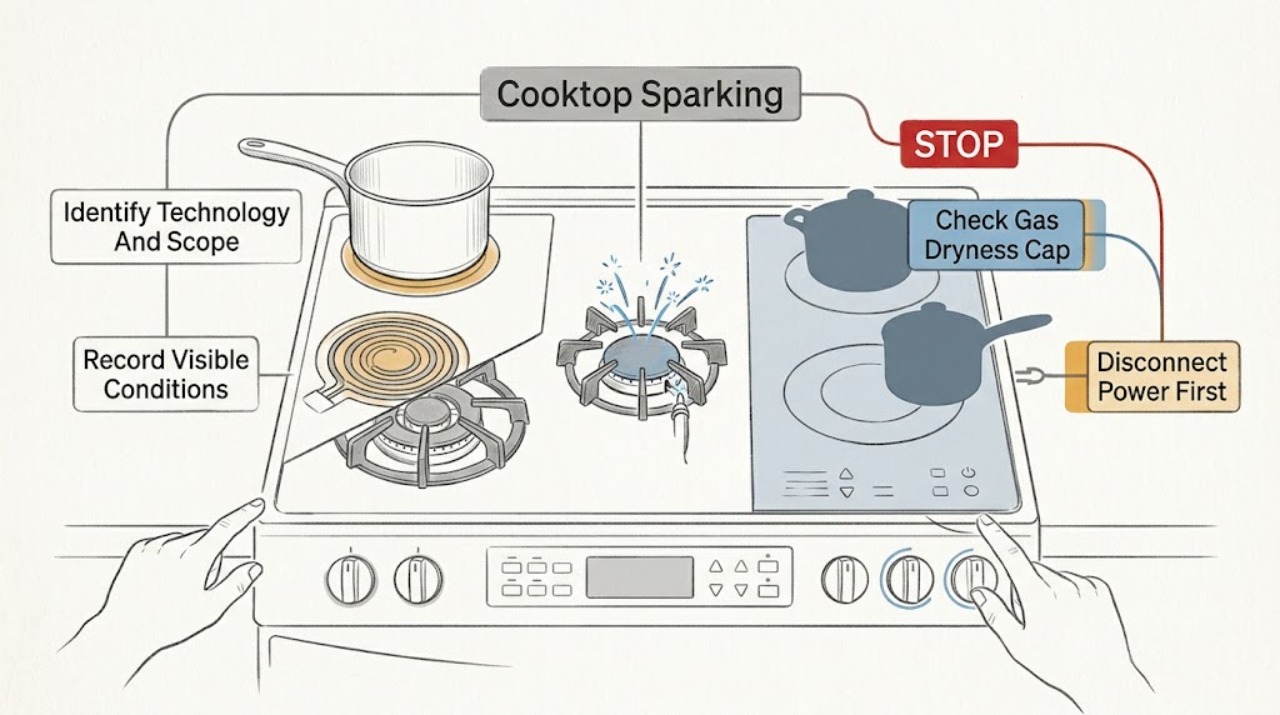
Work through in order
Diagnostic checks
Use only checks that match the exact appliance or system and its official guide.
-
Check 1
Use the model label and matching Whirlpool manual to identify the cooktop as gas, radiant or coil electric, or induction, then identify whether sparking affects one zone or the whole surface.
Expected result: Record the model, technology, affected zone, display or code, control position, whether other zones operate, and whether there is a flame, radiant heat, cookware recognition, smoke, odor, or visible arc.
Next step: Follow only the matching technology branch and exact manual; if the model or technology cannot be confirmed, stop experimentation and request qualified identification.
Stop if: Do not lift the cooktop, remove trim, touch wiring, or use a procedure from another Whirlpool model.
Why this matters
Why: A gas ignition spark can be a normal part of lighting, while an electric or induction arc is not a normal heating indication. One-zone behavior points to a local burner, element, control, or recognition path; whole-surface behavior points toward power or controls.
-
Check 2
For a gas cooktop with no gas odor, observe one normal ignition attempt only from a safe position and record whether the spark occurs only while the knob is in Ignite, stops when the flame is established, or continues with the knob off.
Expected result: Record which burners click, whether only the selected burner lights, whether the flame is stable, and whether clicking continues after a spill, cleaning, wind, or downdraft; do not repeat an unsuccessful ignition attempt.
Next step: Turn the affected control off, allow only ordinary external drying described by the manual, remove drafts if the manual permits, and request service if clicking continues or the flame does not establish normally.
Stop if: Stop immediately for gas odor, delayed ignition, a whoosh or boom, flame outside the burner area, smoke, soot, or a burner that releases gas without lighting.
Why this matters
Why: Whirlpool states that all surface burners may click when one knob is pushed, while reignition systems may spark after a flame is extinguished by water, wind, or ventilation. Continued sparking with controls off is not established as normal and may involve moisture or an ignition fault.
-
Check 3
With all gas controls off and the surface cool, inspect only the visible burner cap, base, and surrounding area for moisture or spill residue, and confirm the cap is seated as the exact manual permits.
Expected result: Record whether the burner is damp from cleaning or a spill, the cap is centered and matched to its base, ports are visibly obstructed, a downdraft is affecting the flame, or the condition cannot be judged without disassembly.
Next step: Allow the area to dry thoroughly and restore only the documented cap position or cleaning procedure; request qualified gas-appliance service when the cap, port, igniter, or draft issue persists.
Stop if: Do not use a flame to dry or test, enlarge ports, loosen gas fittings, remove sealed components, or operate if gas odor or an abnormal flame appears.
Why this matters
Why: Whirlpool identifies damp burners, cap or base condition, port obstruction, and room drafts or downdraft ventilation as possible causes of clicking, poor ignition, or reignition. A visible condition does not authorize gas adjustment or port enlargement.
-
Check 4
If a gas burner clicks or sparks but does not light and there is no gas odor, check the model's control or cooktop lock state and external power or gas-supply status from ordinary safe access.
Expected result: Record whether the lock indicator is active, all burners or only one fail, the display has power, the external breaker or fuse is open, the main gas valve is on, and the burner is correctly aligned with Ignite; do not loosen the supply line.
Next step: Use the exact manual to clear the lock or correct an accessible control state once; if supply, ignition, or lighting remains abnormal, stop and contact an electrician or qualified gas-appliance technician.
Stop if: Do not repeatedly open a gas control, purge a line, adjust a regulator, bypass a lock, or continue ignition attempts after unlit gas may have accumulated.
Why this matters
Why: Whirlpool notes that a lockout can allow clicking or visible sparking while preventing the burner from lighting, and that power or gas-supply conditions can affect all burners. The symptom still requires service if the burner does not light normally after one documented correction.
-
Check 5
If a gas flame is present, observe its shape and color from a normal distance without reaching over the burner or adjusting the gas supply.
Expected result: Record a stable normal-looking flame, a yellow or noisy flame, flickering or lifting, soot, a flame that goes out and re-ignites, or no flame with continued clicking; separately record any gas odor.
Next step: Turn the control off and request qualified gas service for abnormal flame or repeated reignition; if gas odor or delayed ignition is present, leave the area and contact the appropriate emergency gas resource from a safe location.
Stop if: Do not relight repeatedly, use a match, search for a leak, adjust an orifice or regulator, or continue operation with odor, smoke, soot, or abnormal flame.
Why this matters
Why: Whirlpool associates abnormal flame color or noise with port, cap, or conversion concerns and directs flame adjustment to the installation instructions or service. Gas odor, delayed ignition, soot, or a flame outside the burner area is a safety event, not a cleaning task.
-
Check 6
For radiant or coil electric models, observe whether the zone heats cookware and cycles normally, and check external power or visible coil seating only as the Whirlpool manual permits.
Expected result: Record whether the element cycles, does not glow red on the selected setting, remains cold, only part of a dual or triple zone works, the coil is visibly seated, or a breaker or fuse opens.
Next step: Allow the surface to cool and follow one documented external power recovery only if no hazard is present; arrange qualified service for a persistently cold zone or recurring power problem.
Stop if: Do not touch a hot or apparently dark zone, reset a breaker repeatedly, remove an element, open wiring, or continue with smoke, arcing, cracked glass, or water near controls.
Why this matters
Why: Whirlpool says radiant elements can cycle on and off and may not glow red on every setting, while a zone that never returns after cooling or a recurring power trip indicates a fault. Visible arcing, smoke, cracked glass, or wiring damage is never a normal cycle.
-
Check 7
For an induction model, remove only an ordinary-access object from the control area, confirm suitable cookware is centered and not empty, and allow the cooktop to cool when the manual or display indicates excess heat.
Expected result: Record whether cookware is recognized, an overheat or other code appears, ventilation is obstructed, the control area is wet or covered, the zone resumes after cooling, or the same spark or fault returns.
Next step: Follow the exact manual for one cooling or power-recovery procedure and observe once; request induction service if the code, arcing, no-heat condition, or abnormal heat returns.
Stop if: Do not continue heating an empty pan, cover vents, touch hot glass, open the electronics, bypass a sensor, or repeat powered tests after arcing or smoke.
Why this matters
Why: Whirlpool identifies excessive surface or electronics temperature, poor ventilation, empty cookware, and control-area objects as possible induction fault clues. A visible arc, returning code, or persistent no-heat condition is not a normal cookware issue.
Use your observations
Decision map
Find the observation that best matches what you see, then follow the next safe action.
-
PATH 01Safety boundary
What you see
A gas spark occurs only while a selected knob is in the documented Ignite range, the burner lights promptly, and the flame is stable.
Do this next
Turn the knob to the desired setting and use the exact manual for normal operation; no repair is indicated from the spark alone.
Why this path and its safety boundary
Why it matters: Whirlpool describes this as normal electronic ignition behavior on applicable gas models.
Safety stop: Stop for continued sparking after ignition, gas odor, delayed ignition, abnormal flame, smoke, or a burner that will not light.
-
PATH 02Safety boundary
What you see
Clicking continues briefly after a spill, cleaning, wind, or downdraft, or a model with reignition tries to restore a flame.
Do this next
Turn the control off, allow ordinary external drying, remove a draft if the manual permits, and request service if the spark persists or the burner behaves abnormally.
Why this path and its safety boundary
Why it matters: Whirlpool identifies moisture, external flame disturbance, and drafts as possible reasons for temporary or occasional sparking.
Safety stop: Do not use flame or heat to dry the burner, and stop for gas odor, delayed ignition, or an unstable flame.
-
PATH 03Safety boundary
What you see
A gas burner clicks or sparks but does not light, especially after a power interruption or with a lock indicator.
Do this next
Use the exact manual for one lock or control correction and inspect only visible cap and dryness conditions; service the appliance if it does not light normally.
Why this path and its safety boundary
Why it matters: Whirlpool says a control lock, power state, gas supply, cap or port condition, or moisture may prevent lighting.
Safety stop: Do not purge gas, repeatedly attempt ignition, bypass the lock, or loosen the gas connection.
-
PATH 04Safety boundary
What you see
The gas flame is yellow, noisy, unstable, sooty, lifting, repeatedly extinguishing, or sparking continues after the control is off.
Do this next
Turn the burner off and arrange qualified gas-appliance service; report any gas odor or delayed ignition as an emergency from a safe location.
Why this path and its safety boundary
Why it matters: Whirlpool identifies burner port, cap, draft, conversion, and ignition concerns, but the condition is not safe to resolve by guesswork.
Safety stop: Do not adjust gas pressure or orifices, relight repeatedly, use a flame to inspect, or continue operation.
-
PATH 05Safety boundary
What you see
A radiant element heats cookware but cycles on and off or does not glow red continuously.
Do this next
Judge the zone by cookware heating and the exact manual, not by glow alone; request service if it remains cold or does not return after cooling.
Why this path and its safety boundary
Why it matters: Whirlpool states that cycling and uneven glowing can be normal on radiant elements and certain settings, and the surface can remain hot after cycling off.
Safety stop: Do not touch the zone, pour liquid on hot glass, or continue with cracked glass, smoke, or visible arcing.
-
PATH 06Safety boundary
What you see
An induction zone shows an overheat or cookware-related indication, or there is visible arcing, smoke, or abnormal heat.
Do this next
Remove ordinary-access objects only when safe, allow cooling, and follow one model-documented recovery; service any returning code, arc, smoke, or no-heat condition.
Why this path and its safety boundary
Why it matters: Whirlpool identifies cookware, ventilation, control-area objects, and excess electronics temperature as possible causes of an overheat code; visible arcing or smoke is a safety fault.
Safety stop: Do not touch hot glass, continue heating an empty pan, open electronics, or repeat powered testing after an arc.
-
PATH 07Safety boundary
What you see
There is gas odor, delayed ignition, fire, smoke, arcing, cracked glass, water near controls, damaged wiring, abnormal heat, or a repeated breaker trip.
Do this next
Stop operation, move away from the hazard, and contact the appropriate emergency, gas, electrical, or qualified appliance professional from a safe location.
Why this path and its safety boundary
Why it matters: The cooktop is outside ordinary troubleshooting and continued operation can increase fire, explosion, burn, or shock risk.
Safety stop: Do not operate switches near a gas odor, unplug a gas-smelling appliance, spray water, relight a burner, reset power, or open the cooktop.
Helpful context
Understand the symptom
The timing of the spark is the first diagnostic clue
A gas cooktop may spark during normal ignition, and on some models all surface burners click when one knob is pushed. A spark that continues after the burner is lit can also relate to reignition, dampness, wind, or a downdraft. A spark or arc from an electric or induction surface is a different risk. Record the exact timing and technology before attempting a correction.
Gas, radiant electric, and induction need different checks
Gas checks involve the control state, burner cap, visible port condition, dryness, and supply, but never gas-line disassembly or leak-finding. Radiant elements can cycle on and off and may not glow red continuously. Induction heating depends on cookware recognition and electronic temperature protection. Whirlpool directs owners to the exact model manual for detailed operation.
Stop before a normal-looking spark becomes a hazard
Turn the appliance off and stop for gas odor, a burner that does not light, delayed ignition, yellow or unstable flames, smoke, visible arcing, damaged glass or wiring, water near controls, abnormal heat, or a breaker that opens again. Do not keep testing, bypass a lock or sensor, open panels, or use a flame to check for gas.
Safety boundary
Stop conditions
- Stop immediately for gas odor, delayed ignition, a whoosh or boom, an abnormal or unstable flame, soot, smoke, or a burner that sparks without lighting; contact the appropriate gas or emergency resource from a safe location.
- Stop for visible arcing, sparks outside normal gas ignition, cracked or shattered glass, water near controls, damaged wiring, abnormal heat, smoke, or a breaker that opens again.
- Do not use a flame to find a leak or dry a burner, purge a gas line, adjust a regulator or orifice, loosen a gas fitting, or relight repeatedly.
- Do not touch hot glass or elements, open electrical or induction panels, perform live electrical work, remove a limiter, or bypass a lock, sensor, or safety switch.
- Do not repeatedly reset power, continue heating an empty induction pan, cover ventilation, force a burner cap, enlarge burner ports, or reach into an energized mechanism.
- Use the exact Whirlpool model manual before applying a control, cleaning, code, or reset procedure; persistent sparking belongs with qualified service.
When checks do not resolve it
Need a professional?
Arrange qualified Whirlpool appliance service when sparking continues with gas controls off, a burner will not light normally, a flame is yellow, noisy, unstable, sooty, or repeatedly extinguishes, a radiant zone stays cold after normal cycling, an induction code or arc returns, a breaker opens again, or internal access is needed. Treat gas odor, delayed ignition, smoke, fire, visible arcing, cracked glass, water near controls, and severe overheating as urgent safety conditions.
Safety scope: This article covers model identification and ordinary-access observations only. It does not authorize gas-line or regulator work, leak-finding, live electrical testing, panel access, safety-device bypass, sharp or flame-based cleaning, or repeated powered tests.
Common questions
FAQ
Is a spark from a Whirlpool gas cooktop always dangerous?
No. Whirlpool says electronic igniters spark while a gas knob is in the Ignite range, and all burners may click when one knob is pushed. A spark that continues after ignition or with controls off, or one accompanied by odor, delayed ignition, smoke, soot, or an abnormal flame, requires stopping and service.
Why does a Whirlpool gas cooktop keep clicking after cleaning?
Whirlpool identifies moisture from cleaning or a spill as a possible cause, and drafts or a reignition feature can also produce occasional clicking. Turn the controls off, allow ordinary external drying as the manual permits, and stop for gas odor or persistent clicking.
What if the burner sparks but will not light?
With no gas odor, check the exact manual's lock state, external power or gas-supply status, Ignite position, cap seating, dryness, and visible port condition. Do not repeatedly release gas, enlarge ports, or loosen fittings. Arrange qualified service when lighting remains abnormal.
Why does an electric Whirlpool element cycle instead of staying red?
Whirlpool says radiant elements can cycle on and off and may not glow red on every setting. The glass can remain hot after the element cycles off. Judge by cookware heating and the exact manual; stop for arcing, smoke, cracked glass, or a zone that remains cold.
Can an induction Whirlpool cooktop spark because it is too hot?
Whirlpool's induction guidance describes excess surface or electronic temperature, poor ventilation, empty cookware, and control-area objects as overheat-related clues. Visible arcing is not a normal cookware warning: stop, allow only safe cooling, and arrange service if it returns.
When should I stop using a Whirlpool cooktop that is sparking?
Stop for gas odor, delayed ignition, abnormal flame, smoke, visible arcing, cracked glass, water near controls, damaged wiring, abnormal heat, or a breaker that opens again. Do not reset repeatedly, open the appliance, bypass safety devices, or continue test cycles.
Read the exact guide
Official sources
- Burner(s) Sparking or Clicking - Gas CooktopWhirlpool Product Help · Whirlpool Product Help for gas cooktops; exact model instructions and gas-safety boundaries control.
- Cooktop Not Working - Electric CooktopWhirlpool Product Help · Whirlpool Product Help for electric cooktops; element appearance and cycling vary by model and setting.
- Lighting the Burners - Electronic IgnitionWhirlpool Product Help · Whirlpool Product Help for electronic-ignition gas burners; use the exact model manual for controls and safety.
- Product Manuals & LiteratureWhirlpool · Whirlpool's official manual resource; match the exact cooktop model before applying a control, code, gas, or reset procedure.
- Noisy or Yellow Flames - Gas CooktopWhirlpool Product Help · Whirlpool Product Help for gas flame concerns; gas adjustment and conversion work belongs to qualified service.
- F0EA - Induction CooktopWhirlpool Product Help · Whirlpool Product Help for a specific induction overheat code; exact code and model manual control.
- Not Powering On - Electric CooktopWhirlpool Product Help · Whirlpool Product Help for electric cooktops; exact model instructions and qualified electrical service control.
- Gas Burners are Clicking but Not LightingWhirlpool Product Help · Whirlpool Product Help for gas burners that click without lighting; use only with no gas odor and follow the exact model manual.
Community feedback
Share a repair observation
Share a plain-text repair observation. Accepted observations are published automatically; this page may take a moment to update.