
On this page
Start here
Quick answer
A Thermador dishwasher can finish with wet dishes without having a failed heater: Thermador uses condensation drying rather than a bottom heating element, and plastics stay wetter than glass. Check that the selected cycle includes drying, the rinse-aid dispenser is supplied, the spray arms and filter are clean, and the incoming water is hot enough for the cycle. If the cycle is long, limescale is visible, or a heater or heat-pump code appears, use the exact model manual and error-code guidance. Do not open the heater or live electrical area; persistent cold water, poor cleaning, an unlisted fault, leakage, smoke, or a recurring heater code requires Thermador service.
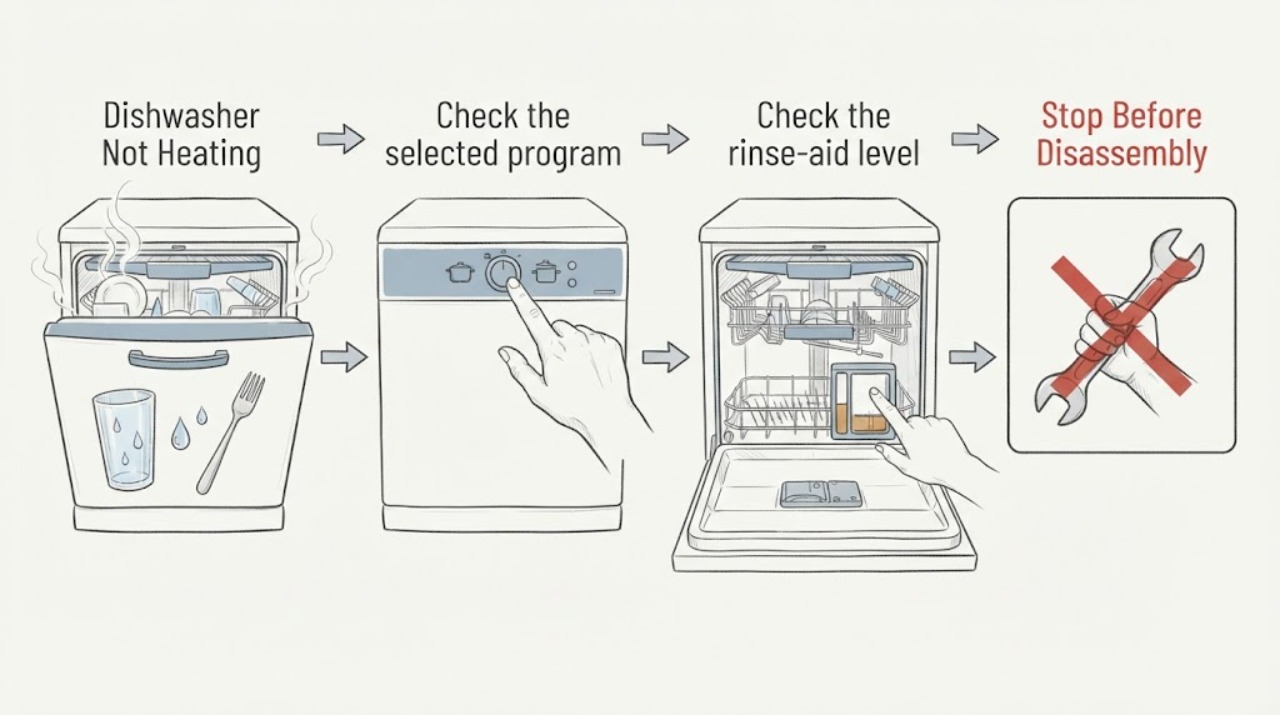
Work through in order
Diagnostic checks
Use only checks that match the exact appliance or system and its official guide.
-
Check 1
After a completed cycle, compare glass or metal items with plastic items and feel the dishware only after the cycle has ended and it is safe to do so. Note whether the tub and nonplastic items are warm, whether dishes are merely wet, or whether everything is cold and the wash result is poor.
Expected result: Only plastics are wet, the final-rinse dishware is warm, or the entire load and tub are cold with poor cleaning.
Next step: Continue with cycle, rinse-aid, water, and filter checks for a cold-load symptom. Do not order a heater from wet plastics alone; request service if the complete load remains cold.
Why this matters
Why: Thermador describes condensation drying and says plastics do not heat as much as glass or porcelain. A cold load with poor cleaning is less consistent with normal condensation drying and keeps incoming water, cycle selection, limescale, or a heating fault in consideration.
-
Check 2
Check the selected program and options in the exact Thermador manual. Confirm that a cycle with drying was selected and, where the model provides it, check whether Extra Dry is available and enabled. Do not assume every cycle or model has the same option.
Expected result: A no-dry cycle was selected, Extra Dry is available but off, or the cycle includes drying and the load is still cold or wet.
Next step: Run one normal cycle with the model-approved drying option. If the same cycle remains cold or a fault returns, stop owner testing and use Thermador service.
Why this matters
Why: Thermador lists a cycle without drying as a common reason for poor drying and says Extra Dry is available only on select models. Correcting the option can explain wet dishes; it does not explain a fully cold wash or a heater fault code.
-
Check 3
Check the rinse-aid level and refill it only with the product and procedure specified by the exact model manual. Arrange dishes so they slope and do not nest, then compare the next completed cycle with the previous result.
Expected result: Rinse aid was empty, dishware was flat or nested, or rinse aid and loading were already appropriate but drying remains poor.
Next step: Correct the documented rinse-aid or loading condition and monitor one cycle. If nonplastic items and the tub remain cold, continue to the water and service checks rather than increasing detergent or disassembling the appliance.
Why this matters
Why: Thermador says rinse aid improves condensation drying and that loading angle and spacing affect runoff. These conditions can leave water without proving that the dishwasher is failing to heat.
-
Check 4
Before starting a cycle, run the hot-water faucet nearest the dishwasher briefly as Thermador recommends for a long-cycle symptom, then confirm the dishwasher is connected to the intended hot-water supply and that the inlet line is not visibly kinked. Do not disconnect plumbing while pressurized.
Expected result: Incoming water was cold, the cycle is unusually long, the supply line is kinked, or the water supply and cycle length appear normal.
Next step: Correct only a visible accessible kink or use the installation manual for supply questions. If water remains cold, the cycle never reaches its normal result, or a heater code appears, arrange qualified Thermador service.
Why this matters
Why: Thermador says incoming water that is not hot enough can extend a cycle while the internal heat pump heats it, and a cold-water connection can also lengthen the cycle. A normal supply does not rule out a heating-system fault.
-
Check 5
Inspect the filter, spray-arm openings, and visible tub for food debris or limescale. Rinse the user-removable filter and clear only accessible debris according to the exact manual; if limescale is present, use only the model-approved descaling procedure. Do not reach into a heater, pump, or wiring area.
Expected result: The filter or spray arms are blocked, limescale is visible, the tub is clear, or cleaning does not change the cold or poor-wash symptom.
Next step: Reinstall the filter and run one model-approved cycle after a safe cleaning. If limescale is heavy, a heat-pump/heater code appears, or the symptom persists, stop and contact Thermador support.
Why this matters
Why: Thermador links blocked filters and spray arms to poor wash results and says limescale can build up in the heat pump and damage the heating system. Cleaning may improve circulation or a documented descaling path, but it does not prove the heater works.
-
Check 6
Record any exact code, flashing pattern, water in the base, leakage, smoke, burning odor, or electrical smell from the display and manual. Do not reset repeatedly or open the appliance to test a heater; if a code is not listed, treat it as a service condition.
Expected result: A heater or heat-pump fault is displayed, a safety or leak code is displayed, no code is present, or the code returns after the model-approved reset.
Next step: Follow only the exact code instruction; stop the dishwasher and turn off water for a leakage-protection indication. Arrange Thermador service for a recurring, heater-related, unlisted, or safety code.
Why this matters
Why: Thermador's error-code guidance identifies heater electronics, heat-pump heater, limescale, leakage protection, and other faults with model-specific next steps. A recurring or unlisted code cannot be narrowed safely from a symptom-only article.
Use your observations
Decision map
Find the observation that best matches what you see, then follow the next safe action.
-
PATH 01Next step
What you see
Glass or metal dishes and the stainless tub are warm, but plastic items remain wet and the selected cycle includes drying.
Do this next
Confirm rinse aid and loading angle, then monitor a normal cycle. Request service only if the whole load is cold, wash performance is poor, or another fault appears.
Why this path and its safety boundary
Why it matters: This matches Thermador's condensation-drying behavior more closely than a confirmed heater failure.
-
PATH 02Next step
What you see
The selected program has no drying, rinse aid is empty, or dishes are nested or flat, while wash water and nonplastic dishware become warm.
Do this next
Use the model-approved drying option, refill rinse aid, and load items to drain; reassess after one cycle.
Why this path and its safety boundary
Why it matters: A cycle or drying-condition issue is more likely than a failed heater.
-
PATH 03Next step
What you see
The cycle is unusually long, incoming water is cold, or the dishwasher is connected to a cold supply, but no heater code is present.
Do this next
Use the nearest hot-water faucet as directed and verify the supply with the installation guide. If the cycle still does not heat or complete normally, arrange service.
Why this path and its safety boundary
Why it matters: Thermador says the dishwasher may extend the cycle while heating insufficiently hot incoming water internally.
-
PATH 04Next step
What you see
Everything remains cold, wash results are poor after filter and supply checks, limescale is heavy, or a heater or heat-pump fault returns.
Do this next
Stop testing and contact Thermador service with the exact model, selected cycle, temperature observation, and any code.
Why this path and its safety boundary
Why it matters: An internal heating, heat-pump, control, or water-temperature problem remains possible and cannot be identified by owner checks.
-
PATH 05Next step
What you see
There is water in the base, a leak, smoke, burning odor, damaged wiring, or an electrical smell.
Do this next
Stop the dishwasher, shut off the water supply for a leak indication when safely accessible, and arrange qualified service. Do not open the heater or electrical compartment.
Why this path and its safety boundary
Why it matters: This is a safety or leakage condition outside routine drying checks.
Helpful context
Understand the symptom
First separate wet dishes from a dishwasher that never heats wash water. Thermador's published drying explanation says the final rinse heats dishware and then moisture condenses on the cooler stainless tub; plastics may remain wet even when the cycle is operating normally. A truly cold tub, poor wash result, a long cycle, or a heater fault indication needs a different path.
Thermador model families use different controls and error displays. Use the exact owner's manual for the cycle, reset, descaling, and code procedure; the checks below do not identify a heater or heat-pump part for an unknown model.
When checks do not resolve it
Need a professional?
Thermador service should diagnose a dishwasher that remains cold, has a recurring heater or heat-pump code, has heavy limescale that does not clear through the model-approved procedure, or cannot complete a cycle after the water, cycle, loading, rinse-aid, and filter checks.
Common questions
FAQ
Why are my Thermador dishwasher plastics still wet?
Thermador uses condensation drying, and plastics do not heat as much as glass or porcelain. Confirm a drying cycle, rinse aid, and sloped loading before treating wet plastic alone as a heater fault.
Can cold incoming water make a Thermador dishwasher run longer?
Yes. Thermador says the cycle can extend while its internal heat pump heats incoming water. Use the model installation guidance for the hot-water connection and arrange service if the dishwasher remains cold or does not complete normally.
What should I do about a Thermador heater error?
Record the exact code and follow only the matching Thermador error-code or owner-manual instruction. A recurring heater or heat-pump code needs Thermador support; do not open the heating or electrical area.
Read the exact guide
Official sources
- Appliance Features | Dishwashers Support | ThermadorThermador · Thermador dishwasher loading, cleaning, drying, rinse aid, limescale, and condensation-drying behavior
- Error Codes | Dishwashers Support | ThermadorThermador · Thermador dishwasher heater, heat-pump, limescale, leakage-protection, and other error-code guidance
- Troubleshooting | Dishwashers Support | ThermadorThermador · Thermador dishwasher troubleshooting for cycle duration, water temperature, filters, spray arms, and service conditions
Community feedback
Share a repair observation
Share a plain-text repair observation. Accepted observations are published automatically; this page may take a moment to update.