
On this page
Start here
Quick answer
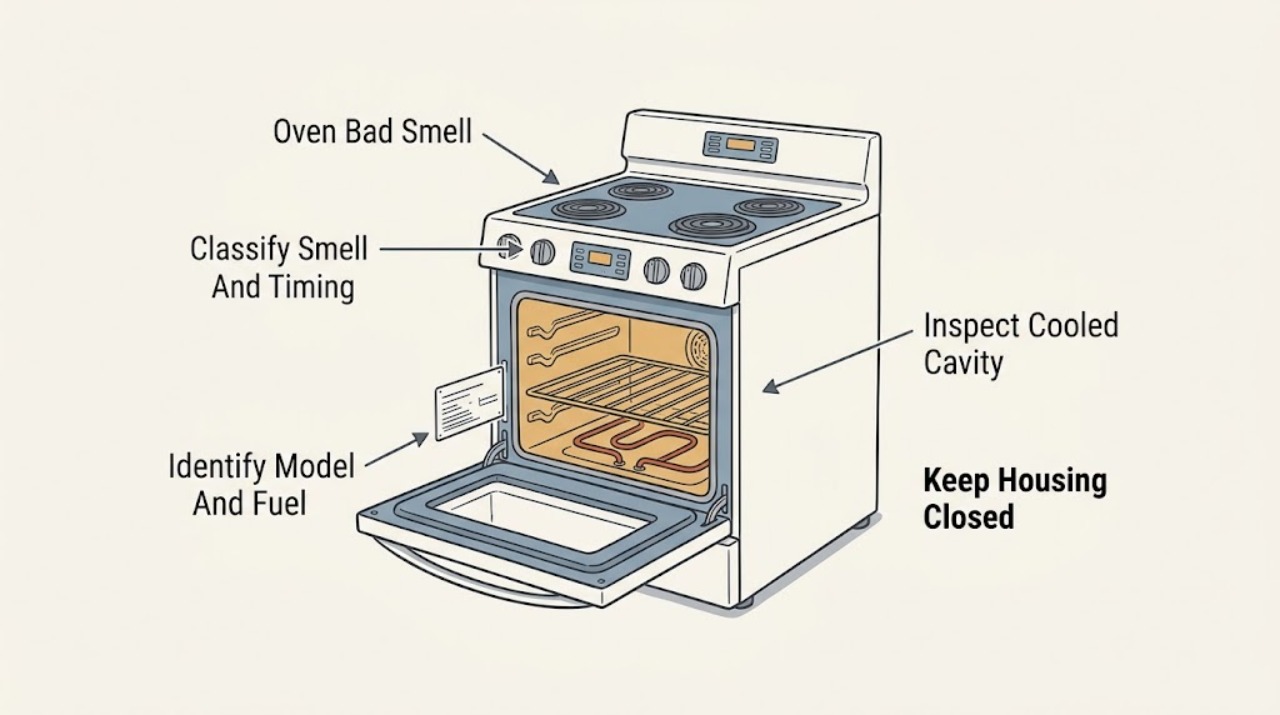
First classify the smell before cleaning or testing: food or grease residue, a first-use factory-oil smell, cleaner or plastic, an electrical burning smell, or gas. Thermador says smoke during initial use can come from factory oils and that warm air or steam from the vent can be normal, while food spills should be wiped after the oven cools. A persistent gas smell, smoke that grows, an electrical burning smell, arcing, severe overheating, or a hot connection is not a cleaning problem: stop using the oven, avoid ignition sources and switches for a gas event, leave the area if needed, and arrange qualified service from a safe location. Confirm the exact model and whether it is gas, electric, dual-fuel, steam, or combination before using a cleaning or self-cleaning procedure.
Before you begin
Safety first
- Do not use self-cleaning as a diagnostic test, mix cleaners, use flammable solvents, search for a gas leak with a flame, repeatedly relight, bypass a safety control, remove covers, perform energized electrical checks, or continue operation after smoke, gas odour, arcing, or uncontrolled heat.
Work through in order
Diagnostic checks
Use only checks that match the exact appliance or system and its official guide.
-
Check 1
From a safe position, switch the oven off if it is safe to do so and record the smell description, where it is strongest, when it starts, the selected mode, whether the oven is new or recently cleaned, and whether there is visible smoke or residue.
Expected result: Classify it as food or grease, first-use oil, cleaner or plastic, musty moisture, electrical burning, gas, or unknown; note whether it occurs only during heating, self-cleaning, ignition, cool-down, or while the oven is off.
Next step: Keep a photo of any residue or display message and continue only with the low-risk branch that matches the smell and exact model.
Stop if: Stop for gas odour, smoke, an electrical burning smell, arcing, a hot connection, severe heat, dizziness or other suspected combustion exposure, or an odour that intensifies when heating.
Why this matters
Why: Food or first-use oil can follow a manual-approved cool-down and cleaning path. Gas, electrical, smoke, or unknown odour with heat requires a safety path rather than more testing.
-
Check 2
Record the Thermador product code and confirm from the label and matching owner documentation whether the appliance is an electric oven, gas oven, dual-fuel range oven, steam oven, or combination unit.
Expected result: Confirm the manual's model identity, fuel type, cavity, cleaning system, and any first-use or odour instructions; note if the available document is for a different model or category.
Next step: Use Thermador's owner-support resources to locate the matching manual or service route, and do not borrow a cleaning or ignition procedure from another oven.
Stop if: Do not remove panels, inspect a gas path, or operate an unidentified oven after a strong, persistent, or hazardous smell.
Why this matters
Why: The fuel and feature set change the safe interpretation of gas odour, burner or element smells, steam, and self-cleaning. An uncertain identity means model-specific procedures cannot be safely applied.
-
Check 3
After the oven is fully cool and isolated from normal operation, inspect only the visible cavity floor, racks, door seal, and accessible surfaces for spilled food, grease, foil, packaging, cleaner residue, or a plastic item; remove only a loose cool item that needs no force.
Expected result: Record whether residue is visible near an element, burner area, rack, seal, or vent and whether the smell is strongest at that location; note any melted material, charring, cracked glass, damaged seal, or exposed part.
Next step: Follow the exact manual's cool-surface cleaning method for ordinary food residue; arrange service for melted material, damage, or an unexplained smell.
Stop if: Do not touch hot residue, scrape an element or burner, remove covers, use a knife or metal tool, or continue if smoke or electrical odour appears.
Why this matters
Why: A visible food spill can produce smoke or odour during heating, but melted plastic, charring, exposed wiring, or damage is not a normal cleaning issue. The absence of residue keeps the heating, ignition, control, or ventilation system in scope.
-
Check 4
If the oven is newly installed or has a documented first-use smell, compare the smell with the manual's first-use guidance and check that all packaging, protective film, ties, and shipping material have been removed without opening the appliance.
Expected result: Observe whether the smell and light initial smoke lessen after the manual-approved first-use process, or instead persist, intensify, produce thick smoke, or smell like burning plastic or wiring.
Next step: Allow the appliance to cool and ventilate only under the exact manual's instructions; stop and arrange service if the smell does not lessen or any hazard appears.
Stop if: Do not run self-cleaning, leave the oven unattended, or repeat a first-use cycle after thick smoke, flames, burning plastic, electrical odour, gas odour, or abnormal cabinet heat.
Why this matters
Why: Thermador identifies factory oils as a possible source of smoke during initial use, but worsening smoke or a plastic, electrical, or gas smell is outside that normal explanation.
-
Check 5
When the cavity is cool and the smell is clearly food or grease, wipe visible spills and racks using only the cleaning method and products approved by the exact Thermador manual; keep vents clear and do not mix cleaning chemicals.
Expected result: After the surface is dry, record whether the smell is gone, returns only with a small residue, or returns immediately with smoke, a sharp burning smell, or abnormal heat.
Next step: Keep the cleaning product and result in the service notes; stop further cleaning and arrange qualified service when the source remains uncertain.
Stop if: Never use flammable cleaners, mix chemicals, spray liquid into controls or vents, scrape heating parts, or use an unapproved solvent or abrasive.
Why this matters
Why: A smell that resolves after approved cleaning supports food residue as the source. A smell that returns without residue or is accompanied by smoke, electrical odour, or high heat needs service rather than stronger chemicals or a hotter cycle.
-
Check 6
Only if the model documentation confirms a gas or dual-fuel appliance, note whether the smell occurs during a normal ignition attempt, after the flame is established, while the oven is off, or outside the appliance; do not relight or search for a leak.
Expected result: Record a brief ignition odour that fully clears, a persistent gas odour, delayed ignition, a whoosh or boom, an unstable flame, soot, or symptoms that could indicate combustion exposure.
Next step: For persistent or abnormal gas odour, avoid switches and ignition sources, leave the area if needed, and contact the local gas utility or emergency service from safety; arrange qualified gas-appliance service before reuse.
Stop if: Do not operate controls, light a match, use a flame to find a leak, relight repeatedly, dismantle the appliance, or continue after gas odour, delayed ignition, a boom, soot, an unstable flame, or suspected carbon-monoxide symptoms.
Why this matters
Why: Thermador's gas-appliance guidance says gas odour should not be ignored and directs the owner to shut off the main gas supply and arrange service when the smell does not disappear. Persistent or abnormal odour is not a cleaning problem.
-
Check 7
From a dry, safe position, note whether the smell is electrical or plastic and whether the display, controls, breaker, isolator, plug, or nearby connection shows heat, discolouration, sparks, or repeat trips; do not open the appliance or perform energized electrical checks.
Expected result: Record a hot connection, smoke, arcing, a tripped breaker, abnormal cabinet heat, a heating element that glows or remains active unexpectedly, or normal visible power with an unexplained smell.
Next step: Leave the appliance isolated when safe after a repeat trip or any sign of heat or damage, and arrange qualified appliance or electrical service.
Stop if: Stop immediately for smoke, flames, arcing, a hot or scorched connection, water near electrical parts, uncontrolled heat, or repeated breaker trips.
Why this matters
Why: These signs place wiring, control, heating, ventilation, or installation faults in scope and require isolation and qualified diagnosis. A normal display does not make a burning smell safe.
Use your observations
Decision map
Find the observation that best matches what you see, then follow the next safe action.
-
PATH 01Next step
What you see
There is persistent gas odour, delayed ignition, an abnormal flame, smoke, flames, electrical burning smell, arcing, severe overheating, or a hot connection.
Do this next
Stop using the oven. For a gas event avoid switches and ignition sources, leave the area if needed, and contact the local gas utility or emergency service from safety; arrange qualified service before reuse.
-
PATH 02Next step
What you see
The observation is only warm air or steam from the oven vent, with no smoke, burning smell, or abnormal heat.
Do this next
Keep the vent clear and follow the normal operating and cooling guidance in the exact manual; do not block the vent.
-
PATH 03Next step
What you see
The oven is new or recently installed and the smell is consistent with light initial-use oil or factory residue.
Do this next
Follow the model manual's first-use process once, with ventilation and supervision as instructed. Stop if smoke increases, the smell becomes plastic, electrical, or gas-like, or the source does not lessen.
-
PATH 04Next step
What you see
The oven is cool and visible food or grease residue is the strongest likely source.
Do this next
Clean only with the exact manual-approved method and products, dry the cavity, and reassess without using a hotter or self-cleaning cycle as a test.
-
PATH 05Next step
What you see
The appliance is gas or dual-fuel and the odour persists after ignition, appears while off, or accompanies delayed ignition, soot, a boom, or an unstable flame.
Do this next
Treat it as a gas safety event: do not relight or search for a leak, leave the area if needed, and seek gas or emergency assistance from safety.
-
PATH 06Next step
What you see
The smell is electrical or plastic, or there is smoke, arcing, a hot connection, abnormal cabinet heat, or a repeat breaker trip.
Do this next
Stop operation and leave the appliance isolated when safe. Arrange qualified appliance or electrical service; do not open covers or test live wiring.
-
PATH 07Next step
What you see
The smell persists after approved cool-surface cleaning, has no visible source, or returns during ordinary heating without a clear first-use explanation.
Do this next
Stop repeated test cycles and arrange qualified service with the model, fuel type, mode, timing, smell description, photos, and any display or power observations.
-
PATH 08Next step
What you see
The proposed remedy is self-cleaning or the model has an unknown cleaning system.
Do this next
Do not start the cycle as a smell test. Verify the exact manual, remove only items the manual identifies, and stop if the oven is an affected older model, overheats, smokes heavily, or has any hazard.
Helpful context
Understand the symptom
Classify the smell before choosing a remedy
A short-lived first-use oil smell, a food spill, and a gas or electrical smell have different safe next steps. Note when the smell begins, whether it comes from the cavity, vent, controls, or outside the appliance, and whether it changes when the oven is off. Do not use a self-cleaning cycle to investigate an unidentified smell.
Normal vent warmth is different from smoke or burning
Thermador says warm air and steam from the oven vent can be normal, and initial-use smoke can come from factory oils. Smoke that persists, thickens, comes with a burning smell, or appears with abnormal heat is a stop condition. Keep vents clear and use the exact owner's manual for any first-use or cleaning instruction.
Gas and electric configurations need separate boundaries
A gas or dual-fuel oven can add fuel, ignition, and combustion hazards that do not apply to a fully electric model. A smell that may be harmless in an electric cavity must not be assumed harmless in a gas model. If the fuel type is unclear, identify the model first and do not relight, search for a leak, or open the appliance.
Only after diagnosis
Potential parts
- door seal or insulation component
Consider only if qualified inspection finds a damaged seal or insulation problem that explains odour, smoke, heat escaping, or abnormal cabinet temperature after the cavity and settings are checked.
Match the exact Thermador product code and oven cavity; do not assume a seal or insulation part from another model fits. - heating element or burner and ignition assembly
Consider only after qualified diagnosis links the smell, smoke, ignition symptom, or abnormal heat to the model-specific heating or gas ignition assembly.
Gas components and heating parts require exact model and fuel matching and qualified installation; do not test by repeated ignition or dismantling. - control board, relay, or wiring assembly
Consider only when qualified service identifies a control, relay, or wiring fault after a burning smell, arcing, repeat trip, or heating-control symptom.
Electrical parts require exact model matching and safe de-energized service procedures; never bypass a safety control.
When checks do not resolve it
Need a professional?
Arrange qualified service when the smell persists after the approved cool-surface check, returns during ordinary heating, has no clear source, or is accompanied by smoke, gas odour, delayed ignition, abnormal flame, electrical burning smell, arcing, severe heat, a hot connection, or repeat breaker trips.
Safety scope: Do not use self-cleaning as a diagnostic test, mix cleaners, use flammable solvents, search for a gas leak with a flame, repeatedly relight, bypass a safety control, remove covers, perform energized electrical checks, or continue operation after smoke, gas odour, arcing, or uncontrolled heat.
Common questions
FAQ
Is a smell from a new Thermador oven normal?
Thermador says smoke during initial use can come from factory oils. Follow the exact model's first-use guidance once, but stop for thickening smoke, burning plastic, electrical odour, gas odour, abnormal heat, or a smell that does not lessen.
Can warm air or steam from a Thermador oven smell?
Thermador says warm air and steam from the vent can be normal. Keep the vent clear, but treat smoke, a sharp burning smell, gas odour, or abnormal heat as a stop condition rather than normal venting.
What should I do about a gas smell from a Thermador oven?
Do not relight or search for a leak. Avoid switches and ignition sources, leave the area if needed, and contact the local gas utility or emergency service from safety. Thermador's gas guidance says persistent odour requires the main gas supply to be shut off and service arranged when it is safe to do so.
Should I run self-cleaning to remove a bad smell?
No. Verify the exact manual and model first; do not use self-cleaning as a diagnostic test. Thermador lists a historical safety notice for certain older ovens where self-cleaning could cause overheating, so an unknown model or any smoke or heat problem needs service guidance.
Read the exact guide
Official sources
- Gas Cooktops & Rangetops - TroubleshootingThermador · Thermador gas-appliance ignition and gas-odour safety guidance used only for the gas-specific safety branch
- Customer Support, Service, Repair & PartsThermador · Thermador owner support, manuals, troubleshooting, error codes, safety notices, and service routing
- Oven Troubleshooting for RangesThermador · Thermador oven troubleshooting for preheating, food spills, vent warmth, initial-use smoke, door behavior, and cleaning guidance
- Product Recalls and Safety NoticesThermador · Thermador safety notices and model-specific recall or overheating warnings
Community feedback
Share a repair observation
Share a plain-text repair observation. Accepted observations are published automatically; this page may take a moment to update.