
On this page
Start here
Quick answer
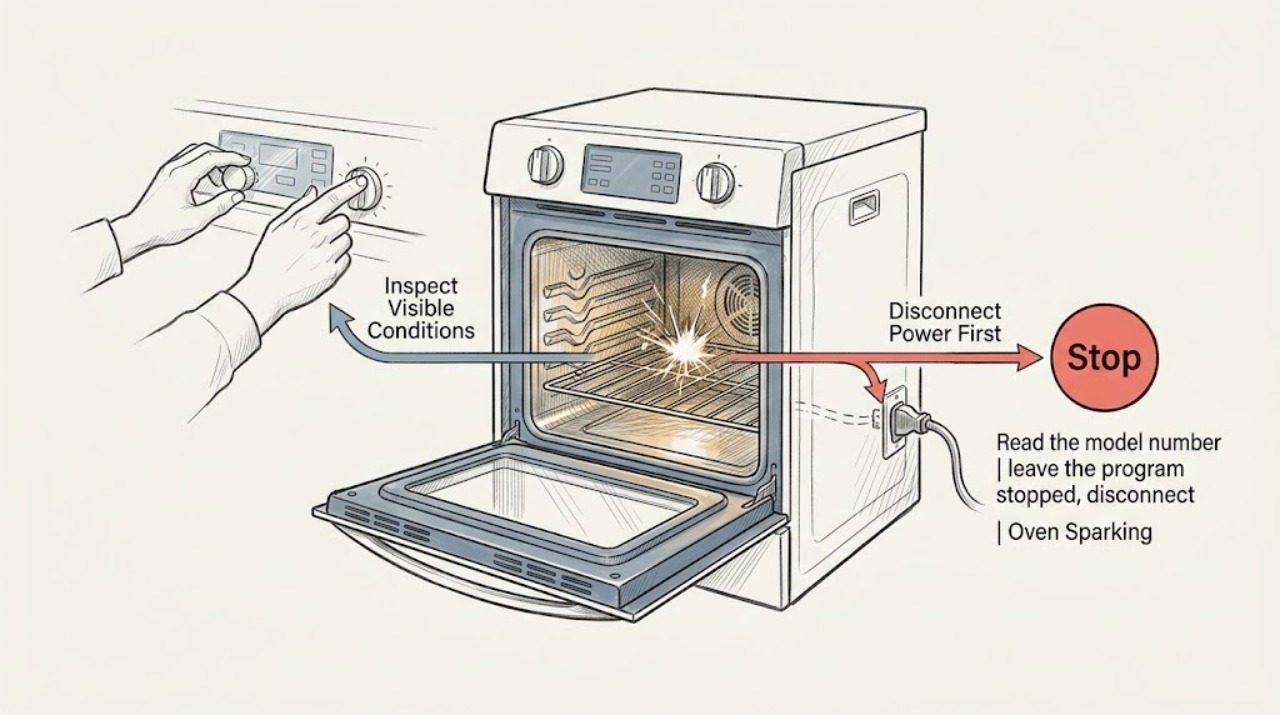
Treat a visible spark as a stop signal until you know exactly what produced it. A Thermador gas or dual-fuel appliance may have model-specific ignition behavior, but a spark in the cooking cavity, at the control panel, cord, outlet, or wiring is not a normal user test. If there is gas odor, delayed ignition or booming, abnormal flame, smoke, burning or melting odor, heat at the connection, arcing, or repeated breaker trips, do not operate the oven again: avoid flames and electrical switching when gas may be present, leave when needed, and seek emergency or qualified help from a safe location. If this is a Thermador speed or microwave oven and the spark occurred in the cavity, stop it and remove any metal object only after power is off and the cavity is cool; recurring or unexplained sparking requires qualified service.
Work through in order
Diagnostic checks
Use only checks that match the exact appliance or system and its official guide.
-
Check 1
Stop the oven or speed-oven program and observe from outside without opening panels, touching the plug, reaching into the cavity, or attempting another ignition. Note where the spark occurred and whether any smoke, odor, flame, heat, or breaker trip followed it.
Expected result: There is gas odor, delayed ignition or booming, abnormal flame, smoke, burning or melting odor, a hot or damaged connection, visible arcing, or repeated circuit trips.
Next step: Stop. Avoid flames and electrical switches when gas may be present, leave when needed, and seek emergency or qualified gas help from a safe location. For an electrical hazard, leave the circuit off and arrange qualified service. Do not test again.
Why this matters
Why: This is an immediate gas, fire, or electrical safety condition rather than a harmless ignition click or a cleaning issue.
-
Check 2
Read the model number and identify whether the appliance is an electric wall oven, gas or dual-fuel range, steam oven, or microwave or speed oven; retrieve the exact Thermador manual before interpreting a spark or ignition behavior.
Expected result: The rating label and manual confirm the appliance type and describe its applicable heating, ignition, cavity, door, and control systems.
Next step: Use only the matching manual's safe operating and reset guidance. If the appliance type or model cannot be confirmed, stop at the safety boundary and arrange qualified service rather than guessing.
Why this matters
Why: A gas ignition spark may be model-specific, while an electric oven, microwave cavity, control panel, or outlet arc follows a different safety path. Features and codes cannot be transferred between models.
-
Check 3
If and only if the exact appliance is a Thermador microwave or speed oven and the spark was inside the cavity, leave the program stopped, disconnect power from a dry reachable location, allow it to cool, and remove any metal utensil, foil, or metal-trimmed container before any further use.
Expected result: The spark stopped when the program stopped and a metal object was present, or there is residue, burn damage, door damage, or sparking with no metal object visible.
Next step: Do not use the cavity if there is damage or unexplained recurrence. Arrange qualified service; never remove the door, cover, waveguide component, or internal panels yourself.
Why this matters
Why: Metal can cause cavity sparking in microwave operation, but damage or a spark with no clear removable cause indicates a fault that should not be tested by the owner.
-
Check 4
If the spark was associated with a gas or dual-fuel oven's documented ignition sequence, do not stare into the burner area or repeat the ignition. From outside, note whether ignition is prompt and stable or whether the smell, flame, sound, or sparking continues after the control is released.
Expected result: Gas odor persists, ignition is delayed, there is a boom or flash outside the expected sequence, flame is abnormal, or sparking continues when the control is not calling for ignition.
Next step: Stop using the oven. Avoid flames and electrical switching, do not relight or test for a leak, leave if needed, and seek qualified gas or appliance service from a safe location.
Why this matters
Why: The event may involve unburned gas, unstable combustion, a control or ignition fault, or an unsafe condition; it is not a user-adjustment opportunity.
-
Check 5
For a spark at the control area, outlet, cord, or visible cabinet edge, inspect only from a safe distance after power is isolated; do not pull a wet plug, move a built-in oven, or remove a cover. Record whether the breaker or fuse trips and whether the display or controls changed.
Expected result: The connection is discolored or hot, the breaker trips again, the display is dead or erratic, or a spark is visible outside a gas ignition or microwave cavity.
Next step: Leave the circuit off and arrange qualified electrical or appliance service. Do not reset the circuit repeatedly or use an extension lead as a workaround.
Why this matters
Why: An external electrical arc or supply fault can energize damaged components and is unsafe to diagnose by repeated operation.
-
Check 6
Record any exact error code or message and the stage when sparking occurred, then follow at most one reset or acknowledgement explicitly authorized by the exact Thermador manual or official error guidance, without running another spark test.
Expected result: The code returns, an unlisted code appears, the appliance remains unusable, or sparking recurs after the permitted reset.
Next step: Turn the appliance off and arrange qualified service with the model, fuel or oven type, exact code, spark location, and cycle stage. Stop immediately if any odor, smoke, heat, arcing, or trip is present.
Why this matters
Why: Thermador treats a continuing oven code as a fault requiring assistance; recurrence means the underlying condition has not been resolved.
Use your observations
Decision map
Find the observation that best matches what you see, then follow the next safe action.
-
PATH 01Next step
What you see
Gas odor, delayed ignition or booming, abnormal flame, smoke, burning odor, visible arc, hot connection, or repeated breaker trip is present
Do this next
Do not test again. Avoid flames and electrical switching when gas may be present, leave when needed, and seek emergency or qualified service assistance from a safe location.
Why this path and its safety boundary
Why it matters: Immediate safety stop
-
PATH 02Next step
What you see
The spark occurred inside a Thermador microwave or speed-oven cavity and metal was present
Do this next
Stop, isolate power safely, allow cooling, remove the metal item, and do not use the cavity if there is damage or the spark recurs.
Why this path and its safety boundary
Why it matters: Cavity metal may be the immediate trigger, subject to model instructions
-
PATH 03Next step
What you see
The spark came from a gas or dual-fuel ignition sequence and stopped promptly with normal flame and no odor
Do this next
Do not repeat the test; verify the exact manual and arrange service if the event was visible outside the documented sequence or happens again.
Why this path and its safety boundary
Why it matters: A model-specific ignition event may be possible, but applicability is not confirmed without the exact manual
-
PATH 04Next step
What you see
The spark came from the control, outlet, cord, cabinet, or an electric oven with no documented ignition system
Do this next
Leave power isolated and arrange qualified electrical or appliance service. Do not open panels or reset the circuit repeatedly.
Why this path and its safety boundary
Why it matters: Abnormal electrical arcing is possible
-
PATH 05Next step
What you see
The appliance shows a recurring or unlisted fault code after one permitted acknowledgement
Do this next
Turn the appliance off and give the technician the exact code, model, oven type, spark location, and cycle stage.
Why this path and its safety boundary
Why it matters: Model-specific fault requires service
Helpful context
Understand the symptom
Do not assume every spark means the same thing
A spark from a gas ignition system, a flash in a speed-oven or microwave cavity, and an arc at an outlet or control are different events. The appliance type, exact model, location, timing, and whether gas is involved determine the safe next step. Never repeat a spark just to obtain a better view.
Use the model number before choosing a repair path
Thermador supports wall ovens, ranges, steam ovens, and speed ovens with different controls and heating systems. Read the rating label and retrieve the matching manual. A gas or dual-fuel model may have ignition hardware; an electric wall oven does not use a gas ignition sequence; a speed or microwave oven has separate cavity rules.
Cavity sparking needs a different boundary
For a Thermador microwave or speed-oven cavity, stop the operation and do not use metal objects. If the cavity is safe to approach after power is off and it has cooled, remove the offending metal item and look only for obvious residue or damage. Do not wipe, scrape, or dismantle a damaged waveguide, door, or interior component; recurring sparks need service.
Gas odor and electrical arcing override troubleshooting
A brief model-specific ignition event cannot be used to justify a continuing gas smell, delayed ignition, an abnormal flame, smoke, or a visible arc. Do not light another burner, test for a leak, reset a tripping circuit repeatedly, or open panels. When gas may be present, avoid flames and electrical switching, leave the area if the odor is strong or persistent, and contact the appropriate emergency or qualified resource from a safe location.
Safety boundary
Stop conditions
- Stop immediately for gas odor, delayed ignition or booming, abnormal flame, smoke, burning or melting odor, suspected combustion trouble, or visible arcing.
- Stop immediately for a hot or damaged outlet or cord, exposed wiring, repeated breaker trips, erratic controls, or a spark outside a documented ignition system or microwave cavity event.
- Do not repeat ignition, light another burner, test for a gas leak, reset a tripping circuit repeatedly, or open any oven, microwave, or speed-oven panel.
- Do not use a microwave or speed-oven cavity after unexplained or recurring sparks, damaged door or cavity surfaces, or damage that cannot be safely identified from outside.
- Stop after one manual-authorized acknowledgement or reset if the fault remains or sparking recurs; arrange qualified service.
Only after diagnosis
Potential parts
- gas ignition component
Relevant only for a confirmed gas or dual-fuel model after qualified diagnosis identifies an ignition-system fault rather than unsafe gas or wiring conditions.
Confirm the complete model and fuel configuration and use model-specific qualified service; do not select or fit gas parts from a generic spark symptom. - electric heating or control component
Relevant only after qualified testing identifies a failed control, element, sensor, or related circuit in an electric or dual-fuel model.
Verify the exact model, revision, and manufacturer's fit information before any replacement. - microwave cavity or door component
Relevant only for a confirmed microwave or speed-oven cavity spark with damage or recurrence after metal has been removed and the appliance is safely isolated.
Cavity, door, and high-voltage service must be assessed and fitted by an authorized or qualified technician.
When checks do not resolve it
Need a professional?
Arrange qualified Thermador service for any spark outside a clearly model-documented ignition event, any microwave or speed-oven cavity spark that recurs or leaves damage, any control or outlet arc, a returning code, or an appliance that will not operate normally after one safe documented reset. Use emergency or qualified gas assistance first for a strong or persistent gas odor or combustion concern.
Common questions
FAQ
Is a spark from a Thermador oven always dangerous?
The location and appliance type matter, but do not assume it is safe. Stop first; a gas ignition event may be model-specific, while a cavity, control, outlet, or wiring arc is abnormal. Never repeat the spark to investigate.
What should I do if a Thermador speed oven sparks inside the cavity?
Stop the program and isolate power safely. Once cool, remove any metal utensil, foil, or metal-trimmed container. Do not use the cavity if the spark recurs or leaves damage, and arrange qualified service.
Can a gas Thermador oven make a spark during ignition?
Some gas or dual-fuel models may use model-specific ignition systems, but the exact manual must confirm the behavior. Gas odor, delayed ignition, booming, abnormal flame, or continuing spark means stop and seek qualified help.
What if the spark came from the Thermador control panel or outlet?
Leave power isolated and do not touch damaged or hot connections, move the built-in oven, or remove panels. Arrange qualified electrical or appliance service.
Should I reset my Thermador oven after it sparks?
Only one reset or acknowledgement specifically authorized by the exact manual or official support is appropriate, and only when no safety warning is present. Do not reset a tripping circuit or use a reset to justify another spark test.
When should I stop troubleshooting Thermador oven sparking?
Stop immediately for gas odor, abnormal flame, smoke, burning odor, visible arcing, heat at a connection, repeated trips, cavity or door damage, or any spark that is unexplained or returns.
Read the exact guide
Official sources
- Oven TroubleshootingThermador / BSH Home Appliances · Official Thermador support page used for model-dependent preheat, door, vent, and safe service-boundary context; exact model instructions take precedence.
- Customer Support, Service, Repair & PartsThermador / BSH Home Appliances · Official Thermador support hub used for qualified service and safety escalation paths.
- Find Owner ManualsThermador / BSH Home Appliances · Official manual lookup used to identify the exact appliance type, fuel configuration, ignition or cavity behavior, controls, codes, and safe reset steps.
- Ovens - Error CodesThermador / BSH Home Appliances · Official Thermador oven error page used for exact code recording, a permitted acknowledgement or reset, and escalation when a code returns.
- Range Oven FeaturesThermador / BSH Home Appliances · Official Thermador feature page used to establish that cooking modes and preheat behavior vary by model.
- Microwaves & Speed Ovens - TroubleshootingThermador / BSH Home Appliances · Official Thermador support page used only for microwave or speed-oven cavity sparking, door, power, and service guidance; it does not establish behavior for conventional ovens.
Community feedback
Share a repair observation
Share a plain-text repair observation. Accepted observations are published automatically; this page may take a moment to update.