
On this page
Start here
Quick answer
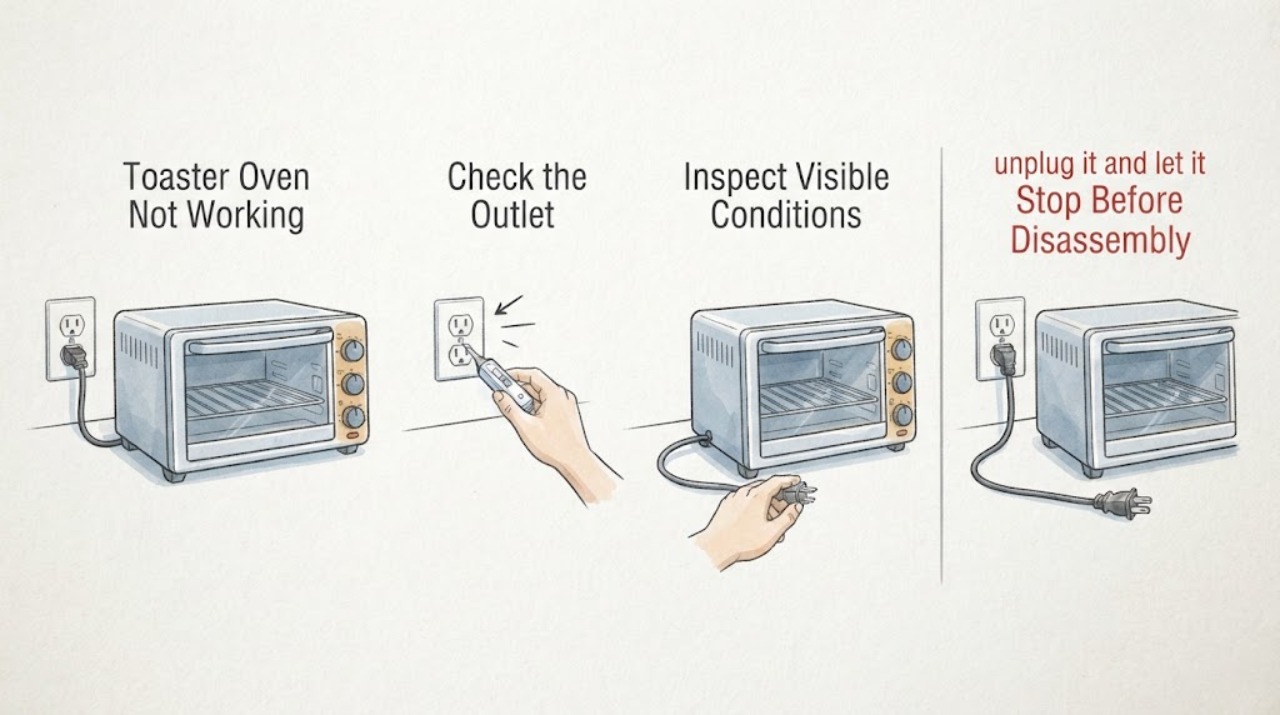
A toaster oven that is not working should be separated into no power, no heat, and an error or over-temperature condition. Check the outlet and controls, allow a hot oven to cool, and record any display code. Breville’s manual routes non-resettable codes to support and warns against continued use when a fault persists.
Work through in order
Diagnostic checks
Use only checks that match the exact appliance or system and its official guide.
-
Check 1
Check the plug, outlet, display, and function selector from outside the oven.
Expected result: The display is blank, the display works but no function starts, or the oven responds normally.
Next step: Use the outlet once with another small appliance and arrange service if the oven remains dead.
Why this matters
Why: Blank power suggests the supply or internal power path; an illuminated display shifts the check to controls and thermal state.
-
Check 2
Select a basic toast or bake function with the door and rack correctly positioned, then observe whether the heating elements cycle.
Expected result: The elements heat, remain cold, or the control cancels immediately.
Next step: Stop after one controlled attempt and do not touch hot elements or bypass controls.
Why this matters
Why: A normal element cycle can pulse as temperature is controlled; no heat after a valid start needs diagnosis.
-
Check 3
If the oven is hot or shows an over-temperature message, unplug it and let it cool for the manual’s stated period before one restart.
Expected result: The message clears after cooling, or returns while the oven is cool.
Next step: Keep it unplugged and contact service if the code returns.
Why this matters
Why: Breville identifies an over-temperature code and a cooling step; recurrence is a service condition.
-
Check 4
Record E01, E02, E03, E04, or E05 exactly and compare it with the operating manual.
Expected result: A non-resettable code appears, an over-temperature code persists, or no code appears with no operation.
Next step: Arrange Breville or qualified appliance service with the code and model details.
Why this matters
Why: The manual assigns different service boundaries to codes; no generic symptom selects a component.
Use your observations
Decision map
Find the observation that best matches what you see, then follow the next safe action.
-
PATH 01Next step
What you see
The display is blank and the outlet is dead, or the breaker trips.
Do this next
Leave the oven off and have the circuit checked.
Why this path and its safety boundary
Why it matters: The household supply is more likely than a toaster-oven heater.
-
PATH 02Next step
What you see
The display works but no heat follows a valid program and the oven is cool.
Do this next
Stop testing and arrange qualified service.
Why this path and its safety boundary
Why it matters: A control, element, sensor, or internal power fault is possible.
-
PATH 03Next step
What you see
An over-temperature or non-resettable code returns after the prescribed cool-down.
Do this next
Unplug it and contact authorized support; do not open the oven.
Why this path and its safety boundary
Why it matters: Breville treats the recurring code as an appliance fault.
Helpful context
Understand the symptom
This guide focuses on whether the toaster oven powers, heats, or reports a code. The symptom is a starting point, not a part diagnosis; each result changes the next safe check.
The cited manufacturer guidance supports these external checks. Confirm model-specific controls, parts, and service procedures in the appliance manual.
Only after diagnosis
Potential parts
- heating element or temperature sensor
Relevant only after power, control, and code checks with exact model diagnosis.
Confirm the exact appliance model and manufacturer instructions before ordering.
When checks do not resolve it
Need a professional?
Use qualified toaster-oven service when power is present but no function heats, a code recurs, or any cover removal would be required.
Common questions
FAQ
Is pulsing heat normal in a toaster oven?
Breville describes short heating-element pulses as normal temperature control on the cited model.
Can I keep using it after E01 or E02 appears?
No. The manual says to remove power and contact Breville support for non-resettable faults.
Read the exact guide
Official sources
- Instruction ManualBreville · toaster oven power, temperature, door, cooling, and error guidance
Community feedback
Share a repair observation
Share a plain-text repair observation. Accepted observations are published automatically; this page may take a moment to update.