
On this page
Start here
Quick answer
For a toaster oven that overheats, stop the cycle and let it cool before checking the exact fault display, surrounding clearance, and accessible power connection. Breville's manual provides a cool-down path for an over-temperature fault and sends recurring or non-resettable faults to service. If the heater behaves unexpectedly, a code returns, vents are blocked, or the plug is hot or damaged, keep the oven disconnected and arrange qualified service.
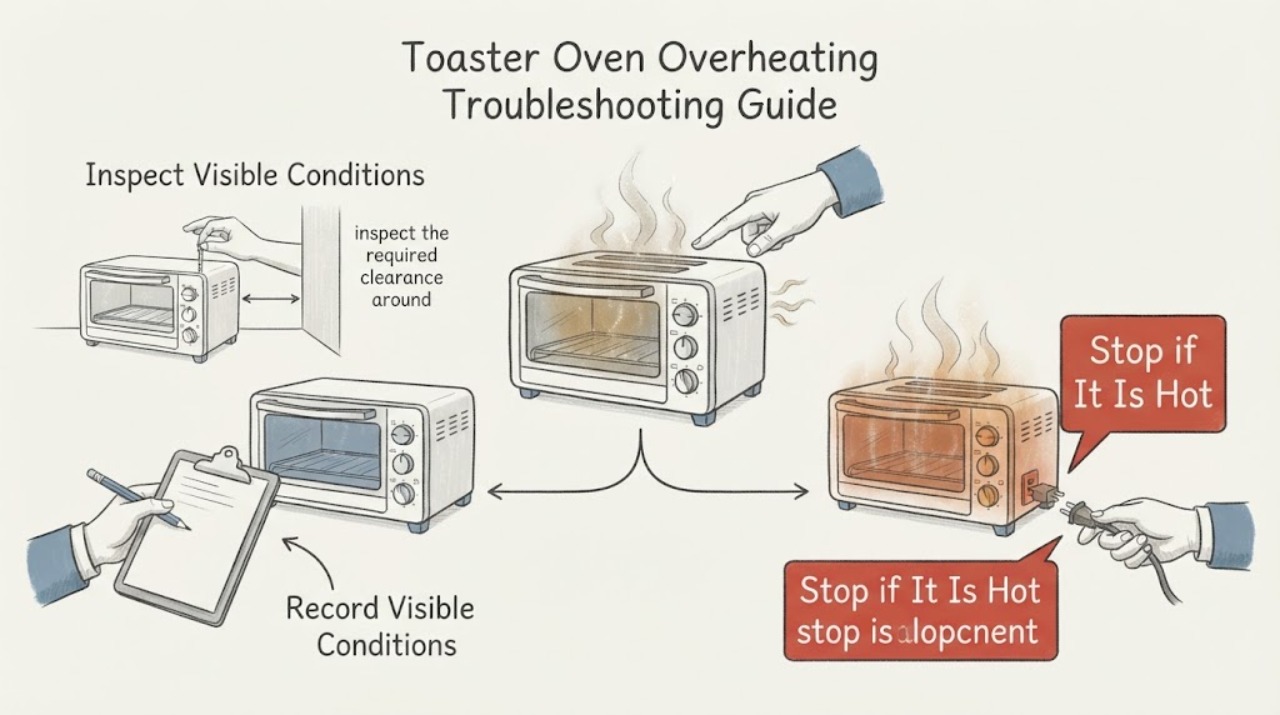
Work through in order
Diagnostic checks
Use only checks that match the exact appliance or system and its official guide.
-
Check 1
Stop the cook cycle and observe from outside whether the oven is actually heating, the fan is running, the display shows a fault, or only the cabinet feels warm. Do not touch the cavity, rack, element, or door glass while hot.
Expected result: Heating continues unexpectedly, an over-temperature message appears, the fan runs without heat, or the oven is merely warm after a normal cycle.
Next step: If overheating or a high-temperature fault is present, stop the cycle and follow the manual's cool-down and power guidance. Do not repeatedly restart it while hot.
Why this matters
Why: A running heater or over-temperature indication is different from residual warmth. A fault display narrows the manual's path but does not identify a replaceable part.
-
Check 2
Once the oven is cool and disconnected safely, inspect the required clearance around the unit and confirm that the rear, side, and top ventilation areas are not covered by cookware, towels, or cabinetry. Do not modify the enclosure or place the oven in a tighter space.
Expected result: A vent or clearance path is blocked, the unit is installed with the manual's space, or the cabinet and controls show heat damage.
Next step: Restore only the documented clearance, let the oven cool fully, and perform no more than one supervised retest. Escalate for heat damage or recurrence.
Why this matters
Why: Restricted heat dissipation can raise cabinet temperature and make an over-temperature event more likely. Correct clearance does not rule out a sensor, relay, or heating fault when the symptom persists.
-
Check 3
Record the exact display text or fault pattern before disconnecting power. Compare it with the Breville manual for the exact oven family, and note whether the fault clears only after the documented cool-down or returns immediately.
Expected result: The code clears after cool-down, returns after a normal start, or is not listed for the exact model.
Next step: Keep the oven disconnected when the fault returns or cannot be identified, and provide the recorded display and model information to service.
Why this matters
Why: A code that returns after a proper cool-down indicates a fault requiring model-specific service; an unlisted code cannot safely be mapped to a component by appearance.
-
Check 4
Inspect the plug and accessible cord only after the oven is cool. Look for scorching, melting, looseness, or a tripped circuit; never use an extension arrangement or open the oven for energized electrical measurements.
Expected result: The connection is damaged or hot, the circuit trips, or the connection appears normal and the oven still overheats.
Next step: Leave a damaged or repeatedly tripping oven disconnected and arrange qualified electrical or appliance service. Do not replace a fuse or control part based on the symptom alone.
Why this matters
Why: Connection damage or repeated tripping is an electrical safety problem. A normal connection shifts attention back to the oven's thermal control, sensor, relay, or element path.
Use your observations
Decision map
Find the observation that best matches what you see, then follow the next safe action.
-
PATH 01Next step
What you see
The oven was warm only after a normal cycle, no heater remains on, and no fault or damage is present.
Do this next
Allow the oven to cool with its documented clearance and monitor the next normal use without covering vents.
Why this path and its safety boundary
Why it matters: Residual heat is more likely than an active overheating fault.
-
PATH 02Next step
What you see
An over-temperature indication returns after the oven cools, the heater behaves unexpectedly, or the cabinet shows heat damage.
Do this next
Keep the oven disconnected and arrange Breville or qualified appliance service with the recorded fault and model.
Why this path and its safety boundary
Why it matters: A thermal control or heating fault remains possible and the symptom is unsafe to localize by repeated operation.
-
PATH 03Next step
What you see
The plug or socket is hot, damaged, or repeatedly trips while the oven is used.
Do this next
Stop using the circuit and have a qualified person inspect the connection and appliance before any retest.
Why this path and its safety boundary
Why it matters: The risk includes the electrical supply as well as the toaster oven.
Helpful context
Understand the symptom
Residual warmth after cooking is not the same as active overheating. The useful observations are whether the heater remains on, whether the display records an over-temperature fault, whether ventilation is restricted, and whether the power connection is damaged. The exact model manual controls the meaning of any fault display.
When checks do not resolve it
Need a professional?
Stop and arrange qualified appliance or electrical service for active heating after shutdown, recurring over-temperature faults, smoke, burning odor, melted or hot plugs, damaged wiring, repeated circuit trips, or any internal element, relay, sensor, or control work.
Common questions
FAQ
Can I restart the oven immediately after it overheats?
No. Follow the exact manual cool-down procedure and do not repeat starts while the cavity or cabinet is abnormally hot. A returning fault needs service.
Does a blocked vent explain every overheating symptom?
No. Clearance is one check. If the oven overheats with the documented space and a normal connection, a thermal control or heating fault remains possible.
Can I replace the heating element from a code?
No. A display code is evidence for the model's troubleshooting path, not proof of a compatible element or relay. Use qualified service.
Read the exact guide
Official sources
- Breville Consumer SupportBreville · toaster oven overheating, high-temperature fault, cool-down, clearance, and service
Community feedback
Share a repair observation
Share a plain-text repair observation. Accepted observations are published automatically; this page may take a moment to update.