
On this page
Start here
Quick answer
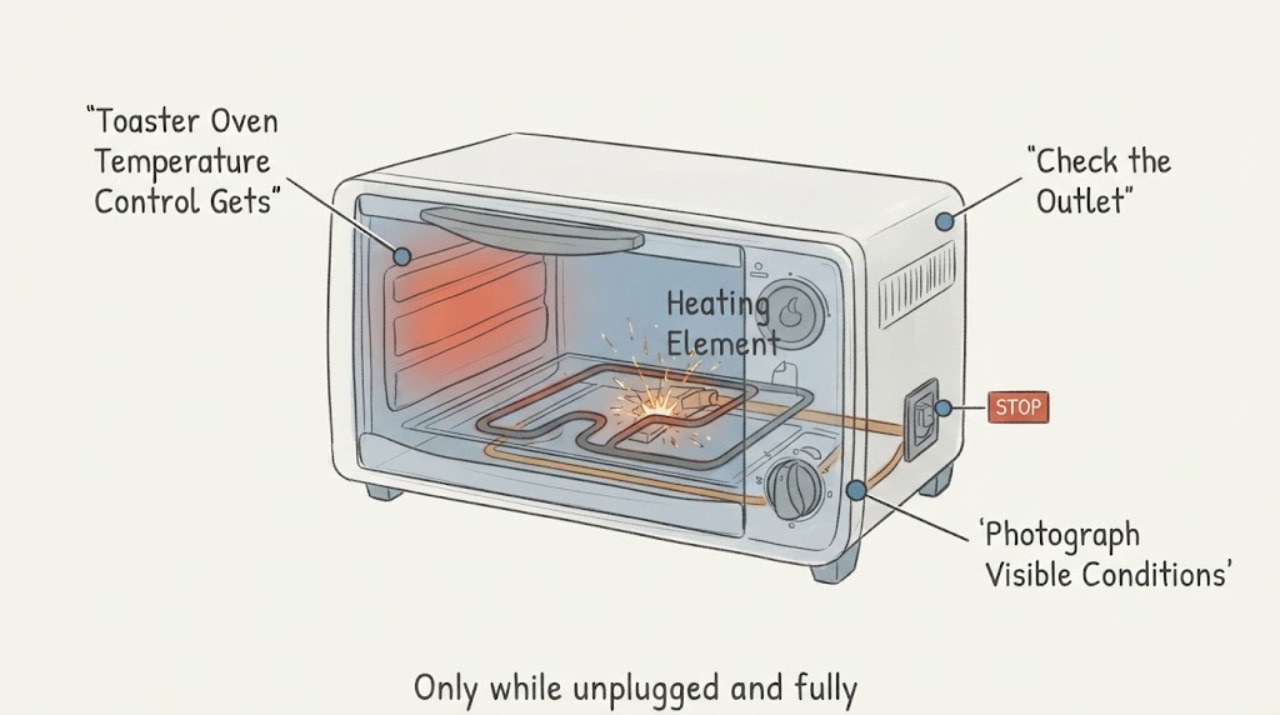
A heating element can glow during a toaster-oven cycle, and an official Proctor Silex toaster-oven manual warns that accessible surfaces can become hot. That does not establish that a temperature knob or the control area should glow red, spark, short, smell burnt, smoke or stay hot after the controls are off. Stop using the unknown-model toaster oven, turn the controls off, and unplug it only if the plug, cord, outlet and surrounding area are dry and safe to touch; otherwise isolate power from a safe location. Let it cool completely, record the exact model and serial information from the outside, and photograph only visible damage. Do not remove the housing, touch the element or controls, insert tools, bypass a control, or run another test cycle. Use the exact model manual and a qualified appliance or electrical service provider to decide whether the appliance is safe to repair or replace.
Before you begin
Safety first
- Do not operate the appliance to reproduce the symptom, remove the housing, probe wiring, bypass a thermostat or interlock, touch the element or control while energized, use metal tools, or order a replacement control or element without exact model fitment and qualified diagnosis.
Work through in order
Diagnostic checks
Use only checks that match the exact appliance or system and its official guide.
-
Check 1
Turn the toaster-oven controls to OFF and stop the cycle. If the plug, cord, outlet and surrounding area are dry and safe to touch, unplug from the wall; if there is smoke, melting, water, a hot receptacle or visible damage, keep clear and isolate power only from a safe location.
Expected result: The appliance is disconnected and cooling normally, or a cord, plug, outlet, smoke, melting, water or fire hazard is present.
Next step: Leave the toaster oven unused until it is fully cool and a qualified service provider has assessed it. For an active fire, do not open the door; leave the area and contact emergency services from a safe location.
Stop if: Stop immediately for smoke, flames, sparking, a burning smell, a hot or damaged plug or receptacle, exposed wiring, or water near the electrical connection.
Why this matters
Why: The manufacturer manual requires OFF before disconnecting, says to unplug when not in use and before cleaning, and says not to operate a malfunctioning or damaged appliance. A visible electrical or fire hazard is beyond user testing.
-
Check 2
After the appliance is cool and disconnected, read the brand, full model number, serial or type information from the exterior nameplate without removing a panel. Photograph the control area, cord and plug only from a safe position if there are visible marks.
Expected result: The nameplate is legible, missing or unreadable, and the visible damage can be documented without touching the appliance.
Next step: Give the exact identity and photographs to the manufacturer or qualified service provider. If identity cannot be confirmed, keep the article at the general safety boundary and do not order a control, thermostat or heating element.
Why this matters
Why: The model determines which temperature-control design, recall notice, manual and service instructions apply. The CPSC notice identifies the recalled Panasonic toaster oven by model NB-G200 and its back nameplate, so a generic toaster-oven assumption is insufficient.
-
Check 3
Only while unplugged and fully cool, inspect from outside and through the normal oven opening for scorch marks, melted plastic, a damaged knob, loose glass, a damaged cord, debris touching the visible element, or a foil-covered crumb tray. Do not remove the housing, reach toward the element, scrape it, insert a utensil or clean with a metal pad.
Expected result: There is visible scorching, melting, damaged insulation, a foreign object, foil covering or element damage, or the cold visual check is clear.
Next step: Remove only an obviously loose, cool item that can be lifted without contacting the element, if the exact manual permits it; otherwise leave the appliance unused and arrange model-appropriate service. Do not re-energize it to see whether the symptom returns.
Stop if: Stop and arrange service for any scorching, melting, exposed conductor, damaged element tube, damaged cord or unknown object near wiring or the element.
Why this matters
Why: The official manual warns against metal utensils, metal scouring pads, foil that can cause overheating, and damage to the heating-element tube. A clear cold view does not prove that the control, thermostat, wiring or element is safe under power.
-
Check 4
Compare the observation with the exact model manual without touching the appliance: note whether only the heating element glowed during a documented cycle, or whether the temperature knob/control area itself became red-hot, sparked, made a shorting sound, smelled burnt, smoked or stayed hot after OFF.
Expected result: Only the element glowed with no spark, smoke, odor or control-area heating, or an abnormal control/power symptom occurred.
Next step: For only documented element glow, ask the manufacturer whether the behavior is normal for the exact model before using it again. For any control-area glow, spark, short, smoke, odor or continued heat, keep it disconnected and arrange qualified service.
Why this matters
Why: A manual may document heater operation or hot surfaces, but no opened source establishes that an unknown model's control area should glow, spark or continue heating. Abnormal control or power symptoms remain an unconfirmed electrical/fire fault.
-
Check 5
Provide the service provider with the model and serial, operating mode and temperature setting, when the heat or spark appeared, whether it was at the element or control area, any odor or smoke, breaker or outlet behavior, and the photographs taken while cold and disconnected.
Expected result: The symptom is persistent or hazardous, the model is covered by a recall or warranty path, or the exact model manual does not explain the behavior.
Next step: Keep the appliance out of service until the manufacturer or qualified appliance/electrical professional gives a model-specific disposition. Replace rather than repair only if that provider or the applicable recall/warranty instructions recommend it.
Why this matters
Why: The manufacturer manual directs examination, repair and adjustment of a malfunctioning or damaged appliance to qualified personnel. The CPSC notice shows that a model-specific recall remedy can require stopping use rather than repairing a suspected cord or control yourself.
Use your observations
Decision map
Find the observation that best matches what you see, then follow the next safe action.
-
PATH 01Next step
What you see
Only the visible heating element glowed during a documented cooking cycle, with no spark, smoke, odor, control-area heating or power interruption.
Do this next
Use the exact model manual or contact the manufacturer before another use, and do not touch or probe the control area.
Why this path and its safety boundary
Why it matters: The observation may be part of heater operation, but the unknown model's manual is needed to confirm it; it does not prove that the temperature control is safe.
-
PATH 02Next step
What you see
The knob or control area became red-hot, sparked, made a shorting sound, smelled burnt, smoked or stayed hot after the controls were OFF.
Do this next
Keep the appliance disconnected and arrange qualified appliance/electrical service. Do not repeat the cycle to identify a part.
Why this path and its safety boundary
Why it matters: No opened source establishes that behavior as normal for an unknown toaster oven; it is a suspected electrical or fire hazard rather than a confirmed thermostat or element diagnosis.
-
PATH 03Next step
What you see
The cord, plug or receptacle is hot, damaged or discolored, a breaker trips, or smoke or melting is present.
Do this next
Stop use, isolate power only from a safe location, and contact a qualified appliance/electrical professional. Identify the model before checking recall information.
Why this path and its safety boundary
Why it matters: The risk may involve the supply cord, outlet or appliance power circuit and cannot be separated safely by an external symptom alone. The Panasonic recall is an example of a model-specific toaster-oven cord hazard, not a diagnosis of this unknown unit.
-
PATH 04Next step
What you see
The contents ignite or there is an active fire.
Do this next
Do not open the door; if it can be done without approaching danger, disconnect power, leave the area and contact emergency services. Wait for the appliance to cool before any inspection.
Why this path and its safety boundary
Why it matters: This is an immediate fire emergency, not a temperature-control troubleshooting situation.
Helpful context
Understand the symptom
Some heater glow is different from a red-hot control area
The assigned topic has no brand or model, so the internal layout and the meaning of any light are unknown. The opened Proctor Silex manual describes hot accessible surfaces and a heating element, but it does not say that a temperature knob or control panel should glow red. Treat a light from the element during a documented cooking cycle as a separate observation from heat, sparking or a short at the control area.
Stop testing an electrical or fire symptom
A spark, shorting sound, burnt odor, smoke, damaged cord or hot plug or receptacle is not a reason to keep cycling the appliance to find the failed part. The manufacturer manual says not to operate an appliance that malfunctions or has damage and directs repair to qualified personnel. Keep hands and tools away from the energized appliance and do not open its enclosure.
Use the model number to check the right safety information
A toaster-oven recall or manual applies only to the identified model and its documented range. The CPSC Panasonic notice identifies NB-G200 by model number and tells owners of that model to stop using it for a cord-insulation shock and fire hazard; it does not show that an unknown toaster oven is the same product. Record the outside nameplate before contacting the manufacturer or service provider.
When checks do not resolve it
Need a professional?
Arrange qualified appliance or electrical service before using the toaster oven again when the control area glows or overheats, the element sparks, there is a shorting sound, smoke, a burning odor, cord or outlet damage, a repeated breaker trip, continued heat after OFF, or any symptom the exact model manual does not explain.
Safety scope: Do not operate the appliance to reproduce the symptom, remove the housing, probe wiring, bypass a thermostat or interlock, touch the element or control while energized, use metal tools, or order a replacement control or element without exact model fitment and qualified diagnosis.
Have this ready
- Provide the brand, full model and serial or type information, operating mode and temperature, timing of the event, whether the light or heat came from the element or control area, spark/odor/smoke details, breaker or outlet behavior, and cold disconnected photographs.
Common questions
FAQ
Is it normal for a toaster-oven heating element to glow red?
Some models may visibly heat an element during a cooking cycle, and the opened Proctor Silex manual warns that accessible surfaces can be hot. That does not confirm that an unknown model's element behavior is normal, and it does not make a red-hot knob, sparking, smoke, burning odor or continued heat after OFF safe. Check the exact model manual or ask the manufacturer before using it again.
What should I do if the temperature knob area is hot or glowing?
Stop the cycle, turn the controls OFF and unplug only if the plug, cord and outlet are dry and safe to touch. Otherwise isolate power from a safe location. Let the appliance cool, do not remove its housing or run another test, and arrange qualified service with the exact model information.
Can I replace the thermostat or heating element myself?
Do not choose or replace an internal part from this symptom alone. The manufacturer manual says not to operate a malfunctioning or damaged appliance and directs cord replacement and repairs to the manufacturer, service agent or similarly qualified person. The model, circuit design and failed component have not been established.
How do I know whether a toaster oven is recalled?
Read the exact model and serial information from the exterior and compare it with the manufacturer and government recall notice. The opened CPSC notice applies specifically to Panasonic NB-G200 toaster ovens and tells owners of that model to stop use; it is not evidence that every toaster oven or this unknown unit is recalled.
Read the exact guide
Official sources
- Panasonic Recalls Electric Toaster Ovens Due to Shock and Fire HazardsU.S. Consumer Product Safety Commission · Opened CPSC recall for Panasonic NB-G200 only. It is not evidence that the assigned unknown toaster oven is recalled or has the same defect; it supports model-first recall checking and stop-use handling when a toaster-oven electrical or fire hazard is suspected.
- Proctor Silex Toaster Oven [31122] - Use & CareProctor Silex / Hamilton Beach · Opened official manufacturer manual for Proctor Silex 31122 only. Used for explicit generic safety boundaries—hot accessible surfaces, OFF/unplug/cool steps, no operation after malfunction or damage, fire handling and qualified repair—not for the unknown toaster oven's internal design or a diagnosis of its knob or element.
Community feedback
Share a repair observation
Share a plain-text repair observation. Accepted observations are published automatically; this page may take a moment to update.