
On this page
Start here
Quick answer
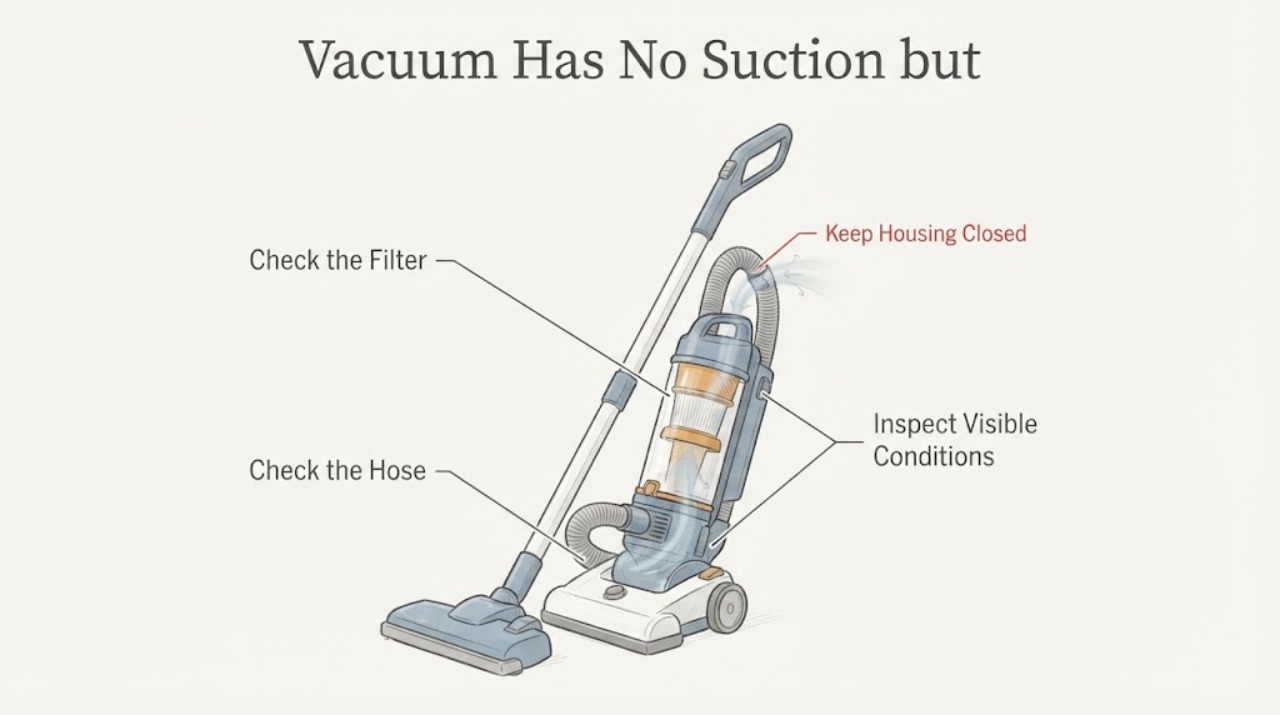
Air from a small outlet may be the vacuum's normal filtered exhaust, so it does not by itself prove that suction has failed. Check the actual pickup path: turn the machine off, empty the bag or dust container, confirm the lid and filter are seated, inspect the hose, wand and nozzle for an accessible blockage, and clean the filter only as the model manual allows. BISSELL's official CleanView guidance checks the hose, lower air passage, dirt tank and filter for common no-suction causes; Dyson says a full bin, blocked airway, or dirty filter can reduce performance and requires a completely dry filter before refitting. Do not open the motor housing, bypass a thermal protector, run with a wet or missing filter, or infer a failed motor from the vent airflow alone.
Work through in order
Diagnostic checks
Use only checks that match the exact appliance or system and its official guide.
-
Check 1
With the vacuum switched off, identify the small outlet and observe whether it is a normal exhaust grille or a damaged opening, loose seal, or disconnected hose path. Do not block the outlet or put fingers or tools into it. If the machine has been running, let it cool before examining it.
Expected result: Air exits cleanly from a fixed grille while the housing is intact, or air carries dust, smells hot or electrical, comes from a crack, or the machine is overheating or pulsing.
Next step: If the outlet is damaged or the air is dusty, smoky, unusually hot, or electrical-smelling, stop using the vacuum and arrange service. Otherwise continue with the external airflow checks below.
Why this matters
Why: A fixed clean exhaust can be normal filtered discharge. Dusty, unusually hot, smoky, electrical-smelling, or leaking airflow indicates a restricted, damaged, or unsafe air path and cannot be cleared by guessing at a motor part.
-
Check 2
Turn the vacuum off and disconnect the plug or remove the battery as the model requires. Empty the dust cup to its fill mark or replace the bag, then check that the container, lid, gasket and filter access cover are fully seated without visible gaps.
Expected result: The container is full, the bag is collapsed, a lid or filter cover is not latched, the seal is visibly damaged, or the container and covers are correctly seated.
Next step: Correct only the user-removable condition described by the model manual. Do not run the vacuum without its required container, filter, or cover; request service for a damaged seal, housing, or latch.
Why this matters
Why: BISSELL and Dyson identify a full container or an incorrectly maintained airflow path as a cause of reduced pickup. A damaged seal or cover can let air bypass the intended pickup path, but its exact replacement is model-specific.
-
Check 3
With power disconnected, inspect the hose, wand, inlet, floor nozzle and brush area from the outside for hair, lint or a lodged object. Detach only parts the model manual identifies as user-removable and use the manual's non-damaging clearing method; do not push a sharp rod into an unseen passage.
Expected result: A visible obstruction is found in one section, the hose or nozzle is cracked or collapsed, or every accessible passage looks clear.
Next step: Clear a visible blockage only as the manual permits and reassemble every cover and fastener before testing. Replace or service a damaged hose, nozzle or seal through the manufacturer rather than improvising a fit.
Why this matters
Why: Official BISSELL guidance treats blocked hose, lower hose, air passage and nozzle paths as common external causes of low suction. Finding a blockage in one section localizes the restriction; finding none does not prove an internal motor fault.
-
Check 4
Service the filter only according to the exact model instructions. If it is a washable filter, clean it with the approved method and leave it in airflow until fully dry before reinstalling; never run the vacuum with a wet, missing, damaged, or incorrectly seated filter.
Expected result: The filter is visibly loaded with dust, has been washed but is still damp, is damaged, or is clean, dry and correctly seated.
Next step: Use the model manual to complete or replace the filter service. If suction remains absent after a correct dry filter is installed, stop repeating generic cleaning and move to the staged suction test or service.
Why this matters
Why: Dyson states that filter buildup can reduce performance and that a filter must be completely dry before refitting to avoid motor damage. BISSELL likewise warns that dirty filters restrict airflow and require complete drying; filter construction and washing rules vary by model.
-
Check 5
After the container, covers, filter and accessible air paths are correctly restored, compare suction at the hose or hand-vac inlet and then at the floor nozzle using the model's normal operating mode. Keep hair, fingers and loose clothing away from any brushroll and do not run the machine with a removed safety cover.
Expected result: Suction is strong at the hose but weak at the floor nozzle, weak at both points, or restored at both points while the small vent still exhausts air.
Next step: Clear or service the downstream attachment if the manual identifies a safe user check. If both test points remain weak, the vacuum overheats, shuts down, or emits abnormal noise or odor, leave it off and contact authorized service with the model number.
Why this matters
Why: Strong upstream suction with weak nozzle pickup points toward a downstream hose, wand, brush or floor-head restriction. Weak suction everywhere after external maintenance suggests an unresolved airflow, seal, thermal, power or motor condition; vent airflow alone cannot distinguish them.
Use your observations
Decision map
Find the observation that best matches what you see, then follow the next safe action.
-
PATH 01Next step
What you see
The small outlet is an intact exterior grille with clean, ordinary airflow, while suction returns after emptying the container, restoring the filter, or clearing a visible hose/nozzle blockage.
Do this next
Keep the container below its fill mark, follow the exact filter interval and drying instructions, and monitor pickup without blocking the outlet.
Why this path and its safety boundary
Why it matters: The vent is behaving as an exhaust outlet and the pickup problem was likely an external airflow restriction or maintenance condition.
-
PATH 02Next step
What you see
Suction is strong at the hose or hand-vac inlet but weak only at the wand, brush area, or floor nozzle.
Do this next
Turn the vacuum off, inspect that downstream section using only the model's user-removable procedure, and arrange service for a cracked or inaccessible attachment.
Why this path and its safety boundary
Why it matters: The restriction is downstream of the upstream test point, so the vent airflow does not identify a motor or fan failure.
-
PATH 03Next step
What you see
Suction is weak at every safe test point after a correctly seated, completely dry filter and an empty container are restored.
Do this next
Stop repeated testing and contact authorized service with the exact model and observed results. Do not open the motor housing or order a guessed motor, fan, belt, or control part.
Why this path and its safety boundary
Why it matters: The remaining problem is not scoped by simple container or visible-clog checks; it may involve a seal, thermal protection, power path, or internal airflow component that cannot be identified from the vent symptom.
-
PATH 04Next step
What you see
The vent emits dust, smoke, an electrical smell, or unusually hot air, or the vacuum repeatedly overheats, pulses, or shuts off.
Do this next
Switch off, disconnect power or remove the battery when safe, keep the unit out of service, and obtain qualified manufacturer service. Do not block the vent or bypass thermal protection.
Why this path and its safety boundary
Why it matters: The airflow or electrical condition may be unsafe and is outside routine user maintenance.
Helpful context
Understand the symptom
First decide whether the vent is an exhaust outlet
Many vacuums move air through a filter and return the filtered air through an outlet. Dyson describes filtered air being expelled from the machine, while BISSELL's no-suction guidance separately checks the hose, lower air passage, dirt tank and filter when pickup is poor. Feel for airflow only at a safe exterior outlet; judge suction at the hose, hand-vac inlet, or floor nozzle. A strong exhaust stream does not prove that the pickup path is clear.
Keep checks outside the motor and model-specific internals
The device type and model are not supplied. Empty the container, inspect visible air paths, and service a removable filter only according to the exact manual. Do not insert a sharp object, open the motor housing, remove an internal fan, or assume the small vent is a broken hose connection. Stop if the exhaust is unusually hot, dusty, smoky, or smells electrical.
When checks do not resolve it
Need a professional?
Arrange authorized vacuum service when airflow remains weak at every safe test point after model-directed maintenance, the exhaust is dusty, smoky, unusually hot, or electrical-smelling, the machine repeatedly overheats or shuts off, or a hose, seal, housing, or floor head is damaged or inaccessible.
Common questions
FAQ
Is air from a small vent normal on a vacuum?
It can be normal if the opening is an intact exhaust grille: vacuum airflow is filtered and discharged back into the room. The vent stream does not prove that the pickup path is working. Check suction at the hose or floor nozzle and stop if the air is dusty, smoky, unusually hot, or electrical-smelling.
Why does my vacuum blow air but not pick up dirt?
A full container, dirty or incorrectly seated filter, blocked hose or nozzle, or damaged airflow seal can reduce pickup while the motor still moves air through an exhaust. Empty the container, restore the dry filter and inspect accessible air paths using the exact manual; do not infer a failed motor from the vent alone.
Can I run the vacuum with the filter removed to test it?
No. Manufacturer instructions require the filter and dust container to be in place, and a washed filter must be completely dry before refitting. Use the model's normal configuration for any suction comparison.
Should I replace the motor or fan when suction is weak?
Not from this symptom alone. First document container, filter, hose and nozzle checks and compare suction at safe upstream and downstream points. Persistent weak suction, overheating, abnormal odor, or internal access requirements call for authorized service and a model-specific diagnosis.
Read the exact guide
Official sources
- Support | Dyson Digital Slim cordless vacuumDyson · Used only as a manufacturer example that blocked airways, filter condition, and an overfilled bin are distinct maintenance alerts/checks. Its display alerts and model-specific procedures are not transferred to this unidentified vacuum.
- Vacuum filter and dirt-tank maintenance for low or no suction (video description)BISSELL · Used for the relationship between full tanks, dirty filters, complete drying and persistent low suction. Exact filter access and replacement intervals remain model-specific.
- Vacuum filter careDyson · Used for filter buildup reducing performance, filtered air being expelled, and the requirement to dry a washed filter completely before refitting. It is not used to infer the unbranded vacuum's filter design.
- CleanView Upright Vacuum Cleaner, No Suction (video description)BISSELL · Used for the external sequence of power-off, hose and lower air-passage inspection, full dirt-tank and dirty-filter checks, and service escalation. It is not used to identify the assigned vacuum's model or internal parts.
- How to choose the right vacuum cleanerDyson · Used only for the general distinction between pickup suction and filtered air expelled back into the room; it does not diagnose the assigned vacuum.
Community feedback
Share a repair observation
Share a plain-text repair observation. Accepted observations are published automatically; this page may take a moment to update.