
On this page
Start here
Quick answer
Clarify what the vacuum cleaner should dispense: dry suction, water, cleaning solution, or debris. For a wet-cleaning machine with no spray, unplug it, confirm the clean-water/solution tank is filled and seated, and inspect only the model-approved filter or spray path. If spray reaches the hose but not the floor head, or no spray returns after those checks, stop and arrange service; do not open a pressurized pump or use the cleaner on electrical wetness.
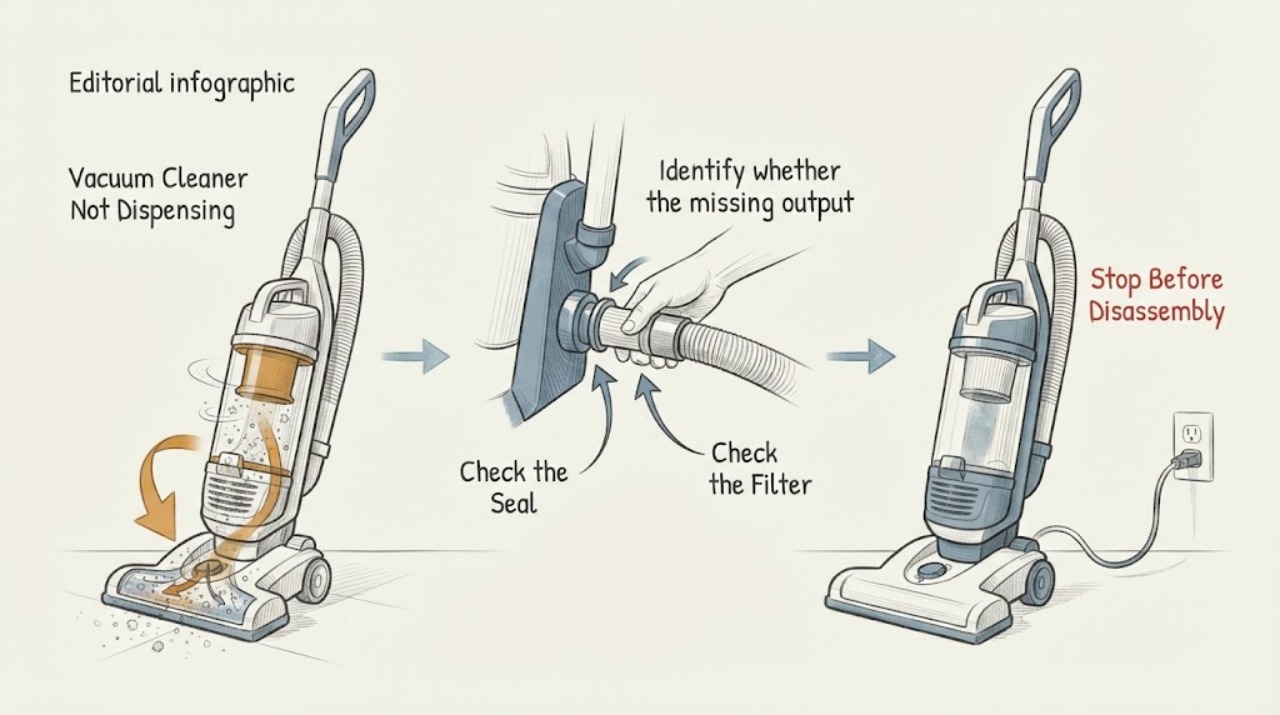
Work through in order
Diagnostic checks
Use only checks that match the exact appliance or system and its official guide.
-
Check 1
Identify whether the missing output is suction, water/solution spray, or debris collection and note whether the motor runs.
Expected result: Only spray is missing, suction is also weak, or dry debris collection is affected.
Next step: Use the matching wet or dry-cleaner path and keep hands clear of moving parts.
Why this matters
Why: Different systems use different tanks, pumps, hoses, and filters; a generic unclog step can misdiagnose them.
-
Check 2
Unplug the cleaner and check the clean-water/solution tank, caps, seals, and seating according to its manual.
Expected result: Tank is empty, cap/seal is loose, tank is mis-seated, or tank is correct.
Next step: Refill with the documented fluid and reseat; replace damaged caps/tanks only by model.
Why this matters
Why: A missing seal or poor seating can prevent gravity-fed solution flow.
-
Check 3
Inspect the accessible filter, spray tips, hose, foot, and nozzle for dried solution or debris after power is isolated.
Expected result: A removable restriction is visible or the path is clear.
Next step: Clean only model-authorized parts and do not insert sharp tools.
Why this matters
Why: A blockage can stop dispensing, but the pump/valve cannot be diagnosed from the symptom alone.
-
Check 4
Test the model’s documented rinse or spray mode with the collection tank and solution tank correctly seated.
Expected result: Spray reaches the hose, the floor foot, both, or neither.
Next step: Stop if spray is absent after the documented check and arrange service.
Why this matters
Why: Hose-only spray points toward the foot/nozzle/tank path; no spray anywhere points toward supply, pump, or control.
-
Check 5
Check for leaks, electrical wetness, unusual motor noise, burning odor, or repeated cutout.
Expected result: Any safety symptom is present or dispensing returns normally.
Next step: Unplug and isolate the machine for safety symptoms.
Why this matters
Why: Water near electricity or abnormal motor behavior overrides routine cleaning checks.
Use your observations
Decision map
Find the observation that best matches what you see, then follow the next safe action.
-
PATH 01Next step
What you see
Tank is empty or not seated and spray returns after correction.
Do this next
Use only documented fluid and seating.
Why this path and its safety boundary
Why it matters: The fluid supply/seating caused the symptom.
-
PATH 02Next step
What you see
Spray reaches the hose but not the floor head.
Do this next
Clean approved parts and service if it persists.
Why this path and its safety boundary
Why it matters: The floor nozzle/foot path or tank interface is restricted or faulty.
-
PATH 03Next step
What you see
No spray reaches either hose or foot with a correct tank and clear path.
Do this next
Keep unplugged and arrange model-specific service.
Why this path and its safety boundary
Why it matters: A pump, valve, filter, or control fault remains.
-
PATH 04Next step
What you see
Leak, electrical wetness, smoke, or burning odor occurs.
Do this next
Disconnect power if safe and stop using it.
Why this path and its safety boundary
Why it matters: The cleaner is unsafe.
Helpful context
Understand the symptom
Clarify what the vacuum cleaner should dispense: dry suction, water, cleaning solution, or debris. For a wet-cleaning machine with no spray, unplug it, confirm the clean-water/solution tank is filled and seated, and inspect only the model-approved filter or spray path. If spray reaches the hose but not the floor head, or no spray returns after those checks, stop and arrange service; do not open a pressurized pump or use the cleaner on electrical wetness.
Identify the symptom before choosing a repair
When checks do not resolve it
Need a professional?
Stop for water near electrical parts, smoke, burning odor, a hot/damaged cord, leaking tank, or repeated motor cutout.
Common questions
FAQ
What is the safest first check?
Start with the symptom-specific external check in this guide, keep power or fuel isolated when directed, and use the exact model manual for any control or part decision.
When should I stop troubleshooting?
Stop for smoke, burning odor, hot or damaged electrical parts, leaks near electricity, repeated breaker trips, or any condition requiring opening a sealed or energized assembly.
Should I replace a part based on the symptom alone?
No. Confirm the model and diagnostic result first; a symptom can come from several causes.
Read the exact guide
Official sources
- My ProHeat 2X Upright Carpet Cleaner has No SprayBISSELL · vacuum/carpet cleaner solution dispensing and tank checks
Community feedback
Share a repair observation
Share a plain-text repair observation. Accepted observations are published automatically; this page may take a moment to update.