
On this page
Start here
Quick answer
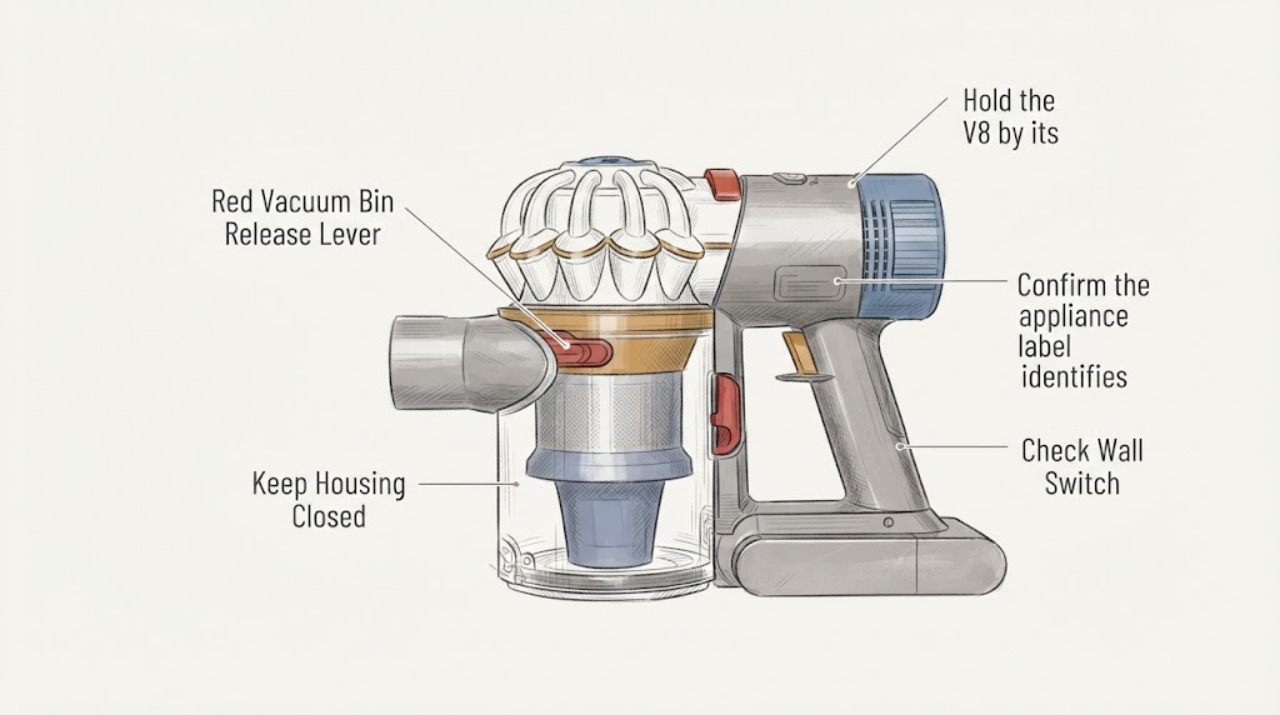
A red release lever is model-specific, so first read the vacuum's rating label and match the bin layout to its owner's manual. Do not assume that a red lever on an unidentified vacuum has the Dyson V8 function or release direction. If the label confirms Dyson V8/SV10, Dyson's manual says to disconnect the appliance from its charger, remove the wand and floor tool if needed, hold the machine by the handle, pull the red lever back and lift it to release the cyclone, then continue until the bin base opens. If the lever will not move through the model's normal motion, do not force it, pry the bin with a tool, or dismantle the body. Stop with the appliance disconnected and contact the identified brand's support; once a V8 bin is open, Dyson requires a dry, correctly seated bin and cyclone and forbids detergent, polish, lubricant or a dishwasher on the clear bin.
Work through in order
Diagnostic checks
Use only checks that match the exact appliance or system and its official guide.
-
Check 1
Confirm the appliance label identifies a Dyson V8/SV10-family cordless vacuum and that its clear bin has the V8 red cyclone-release lever. If the label or bin layout differs, do not use this procedure.
Expected result: The rating label and clear-bin layout match the Dyson V8 manual, or the brand/model and release mechanism are different or unknown.
Next step: For a confirmed V8 layout, continue with the V8 checks below. For any mismatch or missing identity, stop and obtain the exact model manual or Dyson/brand support rather than guessing the release mechanism.
Why this matters
Why: The red lever's function and release direction are model-specific. A similar-colored lever on another vacuum may release a different latch or canister.
-
Check 2
Switch the vacuum off and disconnect it from the charger. Remove the wand and floor tool if they make the machine awkward to hold, and keep your finger away from the ON trigger while inspecting the bin.
Expected result: The machine is disconnected and the bin can be viewed without activating the trigger, or the charger/trigger condition cannot be made safe.
Next step: Do not continue until the appliance is disconnected and stable. If the battery, charger or body is damaged, stop and contact Dyson support instead of attempting a release.
Why this matters
Why: The manual treats disconnection as a prerequisite for emptying or removing the clear bin; an energized or trigger-ready vacuum can start while hands are near moving parts.
-
Check 3
Hold the V8 by its main handle and use only the normal red-lever motion described by Dyson: pull the lever back toward you and lift it upward to release the cyclone. Do not twist the clear bin, pry the lid, insert a tool or add force if the lever stops.
Expected result: The cyclone releases and the bin base opens as the lever completes its travel, or the lever remains fixed/partly moved and the bin does not open.
Next step: If it does not release with normal hand motion, stop and contact Dyson support. Do not force the lever, pry the bin or disassemble the body to reach a hidden latch.
Why this matters
Why: A completed motion matches the intended emptying sequence. A fixed or incomplete motion indicates that the release is not operating normally; the manual does not identify the hidden cause from this symptom alone.
-
Check 4
If the bin opens normally, empty it into a bag before the debris reaches the MAX line and inspect only the visible bin base, cyclone shroud and accessible catch for loose dust or an obvious overfill. Clean the clear bin only as the manual allows.
Expected result: The bin was overfilled or visibly dusty around the accessible shroud/catch, or the visible surfaces are clear but the release previously remained stuck.
Next step: For a normally opened V8, use a damp cloth on the clear bin only, keep detergents/polish/lubricant out, and let every washed part dry completely. If the lever sticks again, stop using it and request service.
Why this matters
Why: Overfilling and dust can make emptying difficult, but a clean visible surface does not prove the internal release mechanism is undamaged.
-
Check 5
After cleaning, refit the clear bin by aligning its tabs with the main-body grooves and sliding it upward until the catch clicks; push the cyclone down to its normal position and close the bin base until it clicks. Do not operate without the clear bin and filters correctly in place.
Expected result: The bin and cyclone seat fully with the specified clicks, or a tab/catch will not align, the bin remains loose or the base will not secure.
Next step: Do not run the vacuum with a loose bin, open base or missing filter. Recheck only the manual's alignment, then contact Dyson if the parts will not seat without force.
Why this matters
Why: A complete click and secure fit indicates the normal reassembly position. Misalignment or a loose catch can indicate damage or an incomplete assembly and can allow dirt release or unsafe operation.
Use your observations
Decision map
Find the observation that best matches what you see, then follow the next safe action.
-
PATH 01Next step
What you see
The rating label and clear-bin layout match Dyson V8/SV10, and the red lever releases the cyclone with the normal back-and-up motion after the charger is disconnected.
Do this next
Empty and clean only by the V8 manual, allow washed parts to dry completely, and reassemble until the bin and cyclone click securely.
Why this path and its safety boundary
Why it matters: The mechanism is operating as Dyson describes; the original difficulty may have been incomplete lever travel, overfill or a visible bin-area obstruction, but no internal repair is proven.
-
PATH 02Next step
What you see
The lever remains stuck or the bin will not release after the appliance is disconnected and the normal hand motion is attempted once.
Do this next
Stop. Do not pry, insert a screwdriver, spray lubricant, force the clear bin or open the body; contact Dyson support with the exact model and serial number.
Why this path and its safety boundary
Why it matters: The release is not functioning normally, and the symptom does not identify whether dust, a seal, latch, alignment or damage is responsible.
-
PATH 03Next step
What you see
The clear bin, cyclone or base will not seat and click during reassembly, or a catch/tab appears broken.
Do this next
Do not operate the vacuum. Preserve the parts and arrange Dyson service or exact model support rather than ordering an unverified replacement bin or latch.
Why this path and its safety boundary
Why it matters: The bin is not secured in the position required for safe operation, regardless of whether the motor still starts.
-
PATH 04Next step
What you see
The label or bin layout does not match Dyson V8/SV10, or the brand/model cannot be read.
Do this next
Record the rating-plate information and use the manufacturer's exact manual/support channel. Do not apply the Dyson procedure to an unidentified vacuum.
Why this path and its safety boundary
Why it matters: The red lever identity and release direction are unresolved; similar-looking vacuum mechanisms are not interchangeable.
Helpful context
Understand the symptom
Identify the mechanism before pulling harder
The task does not provide a brand or model, and a red lever is not a universal vacuum latch. Dyson's V8/SV10 design is one verified example in which the red lever releases the cyclone so the clear bin can open. Treat the Dyson steps below as conditional: use them only after the rating label and bin layout confirm V8/SV10. Otherwise use the exact manual for the identified vacuum and do not guess the release mechanism.
A stuck release is a service boundary
A lever that remains stuck after the appliance is disconnected is not a reason to pry the clear bin, insert a screwdriver, spray lubricant into the mechanism or force the cyclone. Dyson's V8 manual says not to carry out maintenance beyond the manual or Helpline advice and warns against incorrect disassembly. The safe owner-level decision is to stop, preserve the bin and cyclone in their current state, and give the identified manufacturer's support team the model, serial number and description of how far the lever moves.
When checks do not resolve it
Need a professional?
Stop and contact Dyson support if the red lever will not move normally, the bin cannot be secured, the mechanism needs force or tools, or the exact vacuum identity is not confirmed.
Common questions
FAQ
What does the red lever do on a Dyson V8?
If the rating label confirms a Dyson V8/SV10, Dyson's manual uses the red lever to release the cyclone so the clear bin can empty. With the charger disconnected, hold the machine by the handle, pull the lever back and lift it upward; the bin base should then open as the release completes its travel. Do not apply this sequence to an unidentified vacuum.
Can I pry the clear bin open if the lever is stuck?
No. A stuck lever is a stop point. Disconnect the appliance, avoid tools, force, lubricants and body disassembly, and contact Dyson support with the model and serial number.
Can I wash the Dyson V8 clear bin in a dishwasher?
No. Dyson says to clean the clear bin with a damp cloth only, not with detergents, polishes or air fresheners, and not in a dishwasher. Any washed part must be completely dry before refitting.
What if my vacuum is not a Dyson V8?
Do not assume that a red lever has the same function on another vacuum. Read the rating label and use that manufacturer's exact manual or service support; the V8 release sequence is conditional on the Dyson V8 bin layout.
Read the exact guide
Official sources
- Dyson V8 Animal Operating ManualDyson · Opened Dyson-hosted PDF; cover identifies SV10 and the V8 operating manual. Used for the red lever and clear-bin sequence, disconnection and no-force/service boundaries.
- Dyson V8 Cyclone vacuumDyson Support · Opened Dyson support page to verify the V8 family and official manual/service path; technical operating steps are taken from the opened manual, not from the support index.
Community feedback
Share a repair observation
Share a plain-text repair observation. Accepted observations are published automatically; this page may take a moment to update.