
On this page
Start here
Quick answer
First confirm that the machine is a carpet extractor or wet-capable cleaner. A normal dry vacuum is not a substitute for a carpet cleaner, and some wet-and-dry products are designed only for controlled hard-floor cleaning or do not collect water at all. If the machine is intended to extract carpet water, stop it, empty and reseat the dirty-water tank, check the float, gasket, filter, hose, and floor nozzle using the exact manual, and test suction only in the model-approved way. If there is no suction at the motor duct, the tank is cracked, the carpet cleaner leaks, or a dry vacuum was exposed to water, unplug it and arrange manufacturer service rather than opening the motor housing.
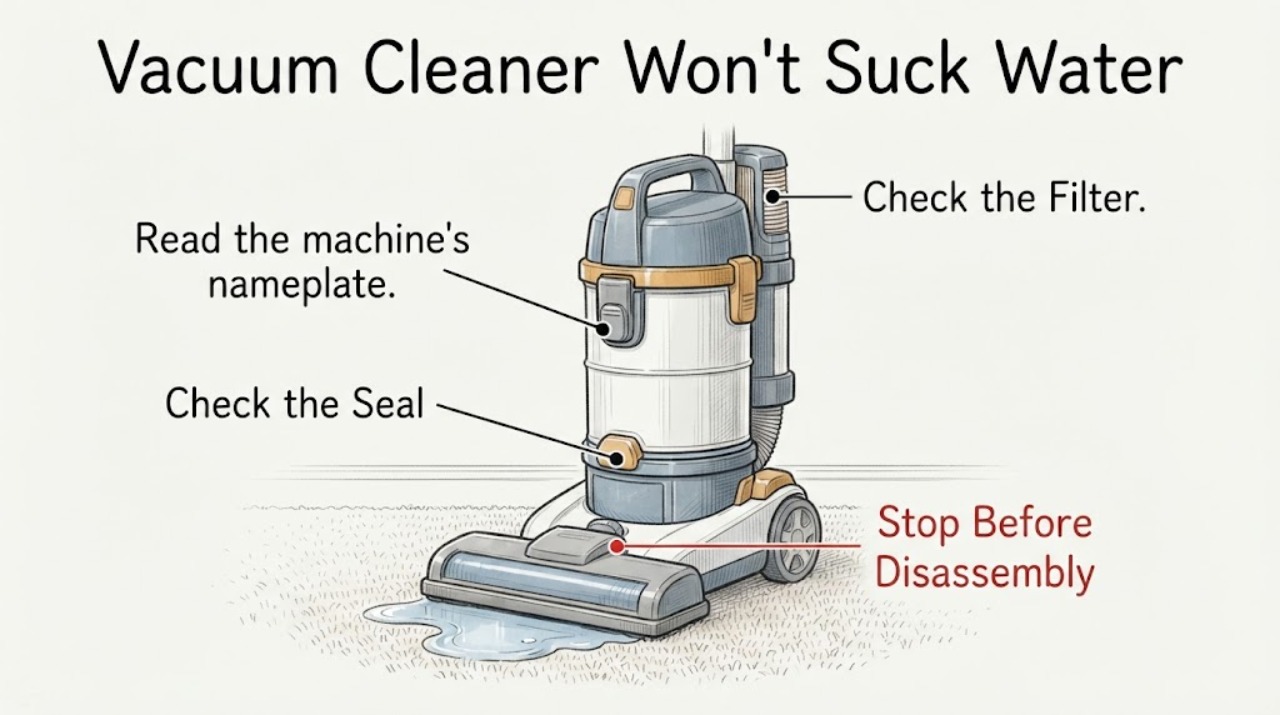
Work through in order
Diagnostic checks
Use only checks that match the exact appliance or system and its official guide.
-
Check 1
Read the machine's nameplate and manual and identify whether it is a carpet cleaner/extractor with a dirty-water tank and extraction setting, a wet/dry vacuum, a hard-floor wet cleaner, or a dry-only vacuum.
Expected result: The machine has a documented carpet-extraction mode and collection tank, or it is dry-only, a hard-floor wet cleaner, or a product that does not collect water.
Next step: If it is not documented for carpet-water extraction, stop using it on the wet carpet and follow the manual's surface limits. If it is an extractor, continue with the model-specific checks below.
Why this matters
Why: Only the first category is a candidate for pulling water from carpet; a dry-only vacuum or a wet cleaner with a different surface purpose can be damaged or simply cannot perform this task.
-
Check 2
With an approved carpet extractor switched off and unplugged, empty the dirty-water tank, inspect its lid, gasket, plug, and float, and reseat the tank exactly as the manual shows.
Expected result: The tank is full, not latched, cracked, missing a gasket or plug, or the float is stuck; or the tank is intact and seated.
Next step: Correct only the documented tank, gasket, plug, and float condition. Replace a damaged tank or seal only with the exact model-approved part; if the tank cannot seal, stop using the cleaner and arrange service.
Why this matters
Why: A full or poorly sealed collection tank can stop suction or let air leak, while a stuck float can close the path early. A clean tank does not prove the motor or floor path is healthy.
-
Check 3
Using the exact model instructions, inspect the accessible filter, lint screen, motor duct, floor nozzle, and suction path for lint or debris; keep the machine unplugged while cleaning removable parts.
Expected result: The filter or screen is blocked, the nozzle is cracked or not latched, the path is clear, or there is no suction at the approved motor-duct check.
Next step: Clear only accessible debris and refit the documented nozzle/filter. Do not open the motor housing or run a dry vacuum with a wet filter; arrange service when the motor-duct check fails.
Why this matters
Why: Debris, a damaged nozzle, or an unseated part can interrupt extraction. No suction at the motor duct points beyond the floor tool and needs manufacturer service rather than a guessed nozzle replacement.
-
Check 4
If the machine is a carpet extractor and the manual permits a hose check, remove the tool, check for suction at the hose or motor duct, and inspect the hose and tool for cracks or clogs before reconnecting them.
Expected result: There is suction at the motor duct but not at the hose/tool, suction is present at the tool, or suction is absent at the motor duct.
Next step: Rinse or clear the approved removable tool and reconnect it. If the hose is cracked, the tool is damaged, or the motor duct has no suction, stop and use the manufacturer's service path; do not improvise a sealed hose or electrical repair.
Why this matters
Why: Suction that stops at the hose or tool supports a blockage, loose connection, or damaged attachment; absent motor-duct suction suggests a machine-level fault.
-
Check 5
After the machine passes its dry external checks, use the approved carpet mode, formula, and nozzle technique; move slowly on the recovery pass instead of repeatedly spraying the same area.
Expected result: The cleaner recovers water into the dirty tank and the carpet becomes only slightly damp, or the carpet remains saturated with little or no recovery.
Next step: Stop adding water when recovery is poor. Ventilate and dry the area, then arrange service or a qualified carpet-cleaning professional if the carpet remains wet.
Why this matters
Why: Normal recovery indicates the machine path is functioning; persistent saturation indicates a remaining suction, seal, nozzle, tank, or carpet-surface issue and not merely a need for more spray.
-
Check 6
If a dry-only vacuum was already used on water, turn it off, disconnect it from power or its charger when safe, and do not restart it to test suction.
Expected result: The dry vacuum stayed dry, or water entered its bin, filter, motor path, charger, or electrical enclosure.
Next step: Keep a wet-exposed dry vacuum out of service and contact the manufacturer or a qualified repair provider. Do not wash or reinstall a wet electrical filter or disassemble the motor housing.
Why this matters
Why: The machine's liquid-use rating controls the safe next step; moisture in a dry vacuum can create damage or an electrical hazard even if the vacuum still runs.
Use your observations
Decision map
Find the observation that best matches what you see, then follow the next safe action.
-
PATH 01Next step
What you see
The product has no dirty-water tank or carpet-extraction mode, or its manual says it is for dry debris or a different wet surface.
Do this next
Stop using it on the wet carpet. Follow the product's dry/wet surface limits and use a documented carpet extractor or professional water-removal service instead.
Why this path and its safety boundary
Why it matters: The assigned device wording does not establish that this is a water-extracting carpet cleaner; the machine may be functioning as designed.
-
PATH 02Next step
What you see
The extractor's dirty tank is full, unlatched, cracked, or has a stuck float or damaged seal.
Do this next
Empty, clean, and reseat only the model-approved removable parts. Stop and arrange service for a damaged tank, gasket, plug, or float assembly.
Why this path and its safety boundary
Why it matters: The collection side cannot maintain the sealed recovery path required for suction.
-
PATH 03Next step
What you see
Suction exists at the motor duct but disappears at the hose or floor tool.
Do this next
Clear or rinse the approved removable attachment and check its seal. Replace only a model-confirmed damaged attachment or arrange service if the fault remains.
Why this path and its safety boundary
Why it matters: The hose, tool, nozzle, gasket, or accessible suction path is the narrowed area, although a specific replacement part is not proven.
-
PATH 04Next step
What you see
There is no suction at the approved motor-duct check, the cleaner leaks, or the carpet stays saturated after the tank and nozzle checks.
Do this next
Unplug the cleaner and arrange manufacturer or qualified service. Dry and ventilate the carpet, and do not open the motor housing or keep spraying water to repeat the test.
Why this path and its safety boundary
Why it matters: The remaining fault may be in the motor, internal duct, pump/extractor assembly, or a hidden obstruction; the generic symptom cannot identify a safe part.
Helpful context
Understand the symptom
A dry vacuum and a carpet extractor are different machines
The phrase vacuum cleaner covers several designs. A dry vacuum collects dry debris; a carpet extractor sprays or applies solution and pulls dirty water into a collection tank. BISSELL documents separate dry-vacuum and wet-mop modes on one product, and its wet-mopping robot does not suction water or solution. Its carpet-cleaner guidance, by contrast, checks a dirty tank, float, gasket, hose, and floor nozzle. Identify the exact product and manual before putting more liquid through it.
Water left in carpet needs a drying plan
Even a working extractor should leave carpet only slightly damp, not saturated. Use only the machine's approved solution and surface instructions, make controlled passes, and ventilate the room. If the machine is not designed for carpet extraction, stop using it on the wet carpet and remove standing water with a suitable approved method or professional service.
When checks do not resolve it
Need a professional?
Stop immediately for smoke, burning odor, sparks, a hot charger, a damaged cord, water near an energized connection, or a dry vacuum that has ingested water. Disconnect power only when safe and arrange qualified service. Do not keep testing a wet-exposed dry vacuum, bypass a float, open the motor housing, or add water to a machine whose manual does not authorize liquid pickup.
Common questions
FAQ
Can any vacuum cleaner pull water out of carpet?
No. A machine must be documented for carpet extraction or liquid pickup. Some products separate dry-vacuum and wet modes, some wet cleaners are designed for hard floors, and some wet-mopping products do not suction water at all.
Why does a carpet cleaner spray but not recover the water?
A full or poorly sealed dirty tank, stuck float, blocked filter or nozzle, damaged hose, or loss of suction at the motor duct can interrupt recovery. Use the exact model's checks to distinguish the collection side from the hose or motor path.
Should I keep adding water if the carpet stays wet?
No. Stop spraying when recovery is poor, ventilate and dry the carpet, and arrange service if the extractor does not recover water after the approved tank, filter, hose, and nozzle checks.
Read the exact guide
Official sources
- SpinWave® Wet and Dry Robotic VacuumBISSELL · Opened BISSELL product page used only to distinguish dry vacuuming, wet mopping, carpet avoidance in wet mode, and a product that does not suction water; it is not a model match for the unbranded task.
- My SpotBot® Portable Carpet Cleaner has No SuctionBISSELL · Opened support for listed SpotBot models; used only to show collection-tank sealing and motor-duct branching, not to transfer a part or access layout.
- ProHeat® Essential Upright Carpet Cleaner | No SuctionBISSELL · Opened support for listed upright carpet cleaners; used for conditional mode, filter, tank, float, nozzle, and hose checks.
- My SpotClean ProHeat® Portable Carpet Cleaner/ My Little Green® ProHeat® Portable Carpet Cleaner has No Suction Hose & ToolBISSELL · Opened official support for model-listed portable carpet cleaners; used only for conditional hose/tool checks and the need to identify the exact model before applying steps.
- How to Clean Mud Off Carpet, Upholstery and Hard FloorsBISSELL · Opened BISSELL guidance distinguishing dry-vacuum cleanup, upright deep carpet cleaners, and wet/dry hard-floor machines; used for tool identity and drying boundaries.
- My ProHeat 2X® Upright Carpet Cleaner has No SuctionBISSELL · Opened support for listed ProHeat 2X models; used for general extraction-system categories, not as proof of compatibility with an unbranded cleaner.
- How to use a wet/dry vacuum: a complete guideDyson · Opened Dyson guidance for wet/dry machines: controlled water use, separate dirty-water collection, slow extraction passes, drying, and surface limits; not a model-specific carpet extractor manual.
Community feedback
Share a repair observation
Share a plain-text repair observation. Accepted observations are published automatically; this page may take a moment to update.