
On this page
Start here
Quick answer
Do not assume a Viking cooktop is gas, radiant electric, or induction. Read the model and energy type from the rating information or the matching Viking manual, then use the branch for that design. Gas: confirm the control is on and the burner cap is dry, clean, and seated, but do not adjust gas orifices or valves. Electric radiant: check the correct control, external power, lockout, and whether the element is cycling under its temperature limiter. Induction: select the correct zone and use a flat magnetic pan of the model-appropriate size. Stop immediately for gas odor, continuous sparking, an abnormal or yellow flame, cracked glass, smoke, burning odor, visible arc, or a breaker that trips again; do not perform gas-line or live electrical work.
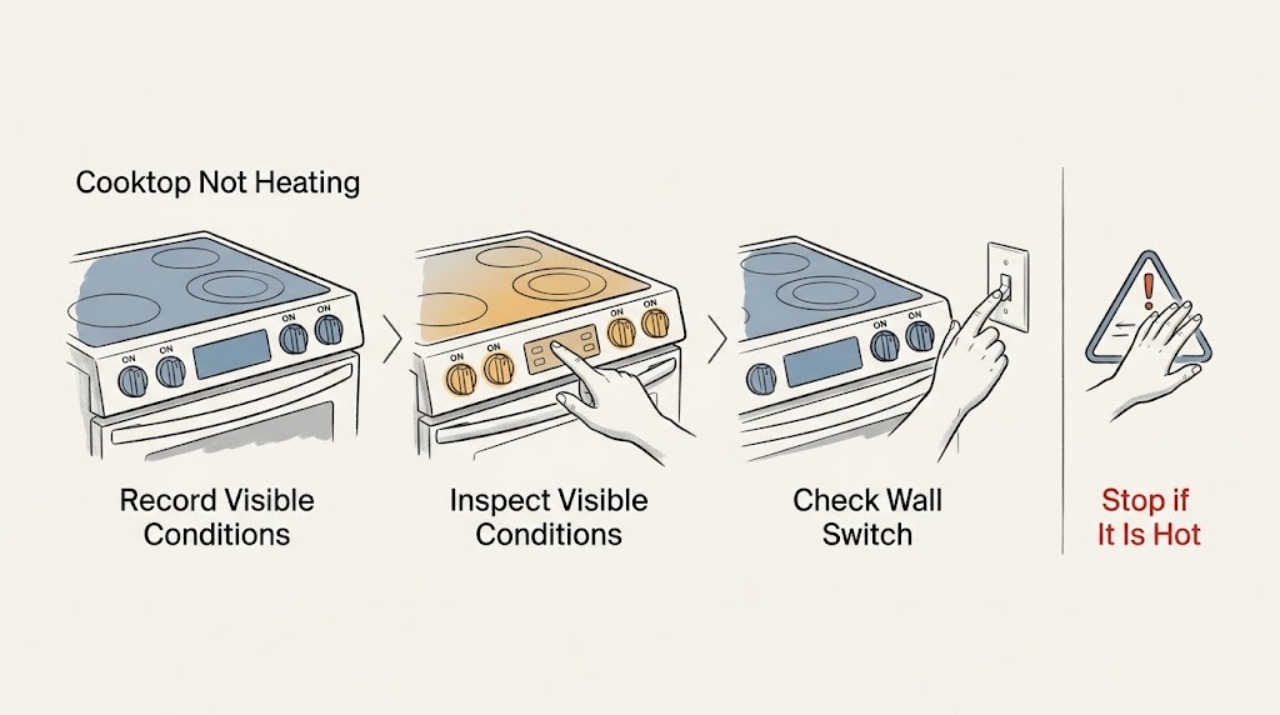
Work through in order
Diagnostic checks
Use only checks that match the exact appliance or system and its official guide.
-
Check 1
Turn all controls off and identify the Viking model and energy type from the rating label, product documentation, or owner manual. Note whether the symptom affects one burner or zone, all positions, or only one cookware item; record any lockout, indicator, sound, odor, smoke, spark, or visible damage.
Expected result: The appliance is gas, radiant electric, induction, or a combination; one position is cold while others work, or every position is cold. A hazard or a lockout may also be visible.
Next step: If gas odor, smoke, burning odor, sparks, arcing, cracked glass, overheating, or a breaker trip is present, stop immediately. Otherwise continue with the matching energy-type branch and model manual.
Stop if: Stop for gas odor, continuous sparking, an abnormal flame, cracked glass, smoke, burning odor, visible arc, or a repeated breaker trip.
Why this matters
Why: One cold position suggests a local burner, element, sensor, or control branch, while all positions cold suggests shared power, lockout, or supply. Energy type determines whether the next check is gas flame, electric element, or pan detection.
-
Check 2
For a gas Viking cooktop, confirm the selected knob is turned to an operating position and observe one ignition attempt only if there is no gas odor and the area is ventilated. Look at the burner cap and head after the surface is cool: they should be dry, clean, level, and aligned with the igniter. Do not remove or adjust gas fittings.
Expected result: The igniter does not click, it clicks without a flame, the cap or ports are wet or dirty, or the burner lights with a large, distorted, or yellow flame.
Next step: With controls off and the burner cool, wipe and correctly reseat only an accessible cap or head as the manual permits. If there is no flame, continuous sparking, an abnormal flame, or suspected gas-supply or adjustment issue, stop and call a qualified gas appliance technician.
Stop if: If gas is smelled, do not try to ignite, touch electrical switches, or continue the test; leave and contact the gas supplier or emergency service from a safe location.
Why this matters
Why: Viking's gas manual links no ignition clicking to power, fuse, or breaker conditions; clicking without flame to gas supply; continuous sparking to wet or dirty igniters or grounding/polarity; and abnormal flames to clogged ports, wrong gas, or adjustment issues.
-
Check 3
For a radiant-electric Viking cooktop, check only the external supply, accessible switch, fuse or breaker, and the correct element control. Confirm the control is not in lockout and that the element has been selected at a normal setting; keep hands away from the glass and wiring.
Expected result: All elements are cold and the cooktop has no indicators, the breaker or fuse is open, a lockout is shown, or one element remains cold while the others work.
Next step: Restore an obviously switched-off external state only once if dry and safe. Have an electrician inspect supply or junction-box connections and have an appliance technician diagnose a local element or control fault; do not open the cooktop.
Stop if: Stop for a warm or discolored receptacle, damaged cord, smoke, burning odor, arc, wet electrical area, or a breaker that trips again.
Why this matters
Why: Viking identifies absent electrical supply, a blown fuse or tripped breaker, lockout, loose power connection, and a failed element or control as different possibilities. A single cold element after shared power and control checks points to a local fault; an all-cold surface points to shared supply or control.
-
Check 4
For an induction Viking cooktop, select the intended zone and place one flat, heavy, magnetic pan centered on it. Use a magnet on the pan base only while everything is cool and safe, and compare the pan size and condition with the model manual. Watch whether the control indicator changes from no-pan or flashing to an active heating state.
Expected result: The pan is non-magnetic, warped, too small, not centered, or the indicator still shows no cookware; alternatively, a known-suitable pan is recognized but the zone remains cold.
Next step: Try one known-suitable, properly sized pan once. If multiple suitable pans are not recognized, or a recognized pan does not heat, stop and arrange appliance service; do not open the cooktop.
Stop if: Do not heat an empty pan, oil, or fat unattended. Stop for cracked glass, abnormal heat, smoke, odor, sparks, or repeated shutdown.
Why this matters
Why: Viking's induction manual says the cookware must have a magnetic layer and flat base, and that the element can indicate absent or unsuitable cookware. Recognition with no heat after correct settings suggests a zone or power fault rather than a pan problem.
-
Check 5
Check for normal protective cycling before calling a heat failure. On radiant electric models, observe whether an element cycles off and later returns at a high setting. On induction models, remove hot cookware from the control area, allow the surface to cool, and check whether the manual describes a heat limiter or indicator state. Do not keep adding heat to reproduce the symptom.
Expected result: The element returns after cooling, the induction control resumes after a normal cool-down, or the same zone remains cold and the protection behavior does not clear.
Next step: Use the cooktop normally only if the protective state clears and heating is stable. If it returns immediately, affects one zone repeatedly, or is accompanied by damage or odor, stop and request service.
Stop if: Stop for overheating, smoke, burning odor, arcing, cracked glass, or an element that stays uncontrolled or remains cold after cooling.
Why this matters
Why: Viking documents temperature limiters and high-load thermal protection as conditions that can temporarily cycle elements off. A persistent cold zone after a safe cool-down is not normal cycling and needs diagnosis.
-
Check 6
Read any indicator or unusual behavior exactly and compare it with the model manual. For gas, note whether the flame is absent, delayed, continuously sparking, large, distorted, or yellow. For electric or induction, note whether a lockout, no-pan indicator, hot-surface indicator, or power symptom is shown.
Expected result: The manual explains the indicator as a normal state, or the indicator persists, conflicts with the physical result, or is accompanied by a fault, odor, smoke, or unstable power.
Next step: Record the model, indicator, energy type, affected position, and one safe observation for the technician. Stop rather than attempting wiring, gas, or internal component tests.
Stop if: Stop immediately for gas odor, continuous ignition, abnormal flame, smoke, burning odor, sparks, arcing, cracked glass, or repeated breaker trips.
Why this matters
Why: The same visible symptom has different meanings across Viking energy types. A persistent mismatch after correct controls and safe cookware or cap placement points to a sensor, igniter, element, control, or supply fault that cannot be isolated safely by guessing.
-
Check 7
After only an obvious, safe correction such as reseating a cool burner cap, selecting the correct control, using suitable cookware, or restoring an external switch, make one brief normal heating attempt. Stop observing if any hazard appears; do not run repeated tests or leave a pan unattended.
Expected result: The intended burner or zone heats steadily, or it remains cold, repeatedly cycles off, sparks, produces an abnormal flame, trips power, or develops smoke or odor.
Next step: If the cooktop still does not heat, stop and arrange qualified service with the model, energy type, affected position, and observations. Do not order a burner, element, igniter, sensor, or board from the symptom alone.
Stop if: Stop immediately for any gas, fire, heat, or electrical hazard and do not repeat the test.
Why this matters
Why: Stable heat after a visible setting, cookware, cap, or external-supply correction supports that branch. Persistence or recurrence indicates a technical fault or unsafe supply condition.
Use your observations
Decision map
Find the observation that best matches what you see, then follow the next safe action.
-
PATH 01Next step
What you see
The model is gas and the igniter does not click.
Do this next
Check only the external power, fuse, or breaker; have a qualified technician diagnose persistent no-ignition or supply issues.
-
PATH 02Next step
What you see
A gas burner clicks but produces no flame or a large, distorted, or yellow flame.
Do this next
Turn the control off and call qualified gas service; do not adjust gas type, valves, or ports yourself.
-
PATH 03Next step
What you see
The model is radiant electric and all elements are cold.
Do this next
Check only the external switch and supply; an electrician or appliance technician must inspect persistent power, lockout, or control faults.
-
PATH 04Next step
What you see
The model is induction and a pan is not recognized.
Do this next
Use one cool, flat, magnetic, correctly sized pan centered on the selected zone; stop if it remains unrecognized.
-
PATH 05Next step
What you see
A radiant element cycles off and later returns, or an induction thermal protection state clears after cooling.
Do this next
Treat this as documented protective behavior and avoid excessive unattended heat; service a recurring or uncontrolled condition.
-
PATH 06Next step
What you see
A lockout or control state prevents the element or zone from activating.
Do this next
Use the exact model manual to clear the state; do not bypass it or open the control panel.
-
PATH 07Next step
What you see
There is gas odor, continuous sparking, abnormal flame, cracked glass, smoke, burning odor, visible arc, or a repeated breaker trip.
Do this next
Stop immediately, leave the hazard area as appropriate, and contact qualified gas, electrical, appliance, or emergency help from a safe location.
Helpful context
Understand the symptom
Identify the cooktop before diagnosing heat
A gas burner should produce a stable flame, a radiant element should glow or transfer heat to suitable cookware, and an induction zone heats the magnetic pan rather than glowing itself. Viking publishes separate manuals for gas, electric, and induction families. Use the model-specific manual before interpreting a control symbol, lockout, indicator, or cookware requirement.
Separate no heat from normal cycling
A radiant element can cycle off temporarily under its temperature limiter, and an induction cooktop can stop or limit power when all elements have been run hard or suitable cookware is absent. A gas igniter can click several times before ignition, but repeated clicking, no flame, an abnormal flame, or gas odor is not a reason to keep trying.
Only low-risk checks belong at home
Keep controls off and the surface cool before cleaning. Safe user checks are limited to model identity, external power or switch status, normal control settings, dry and correctly seated gas burner caps, clear burner ports, and suitable induction cookware. Internal wiring, junction-box connections, gas conversion, valves, igniters, heating elements, and control boards require a qualified technician.
When to stop
If you smell gas, do not light an appliance or operate electrical switches; leave the area and contact the gas supplier or emergency service from a safe location. For any type, stop for smoke, burning odor, sparks, arcing, cracked glass, a hot cord, or a repeated breaker trip.
Safety boundary
Stop conditions
- If gas is smelled, do not light an appliance or operate electrical switches; leave the area and contact the gas supplier or emergency service from a safe location.
- Stop for continuous sparking, an abnormal or yellow flame, smoke, burning odor, visible arc, or a gas burner that cannot be shut off normally.
- Stop for cracked or fractured glass; do not cook on it because spillovers can create electric-shock risk.
- Stop for a hot or damaged cord, wet electrical area, repeated breaker trip, uncontrolled element, or overheating that does not clear after documented cooling.
- Do not remove panels, adjust gas valves or conversions, probe live wiring, replace an element or igniter, or continue testing a hazardous cooktop.
Only after diagnosis
Potential parts
- gas igniter or burner component
Consider only when the correct gas supply and cool, clean, correctly seated burner components are confirmed and a qualified technician identifies an ignition or burner fault.
Gas burner and igniter parts vary by model and fuel configuration; confirm model-specific fit and gas requirements before ordering. - radiant heating element or control
Consider only when external supply and lockout are ruled out and a technician confirms one radiant element or its control is faulty.
Do not infer the element or control from a cold surface alone; confirm the full model and diagnosis. - induction power module or cookware sensor
Consider only when a known-suitable pan is correctly centered and recognized but the selected zone remains cold and a technician confirms an electronic fault.
Induction electronics and sensors are model-specific; require professional diagnosis and fit confirmation.
When checks do not resolve it
Need a professional?
Call a qualified appliance technician when the cooktop remains cold after the correct energy-type checks, a known-suitable induction pan is recognized but does not heat, a radiant element remains cold while others work, a gas burner will not ignite or has an abnormal flame, or a lockout or indicator persists. Use an electrician for supply, fuse, breaker, cord, or junction-box concerns and a qualified gas professional for gas-supply or flame concerns. Treat gas odor, continuous sparking, abnormal flame, smoke, arcing, cracked glass, overheating, and repeated breaker trips as urgent.
Common questions
FAQ
How do I know whether my Viking cooktop is gas, electric, or induction?
Use the model and energy type on the rating information or the matching Viking owner manual. Gas has burner caps and ignition; radiant electric uses heating elements; induction requires suitable magnetic cookware and may show a no-pan indicator.
Why does my Viking gas burner click but not heat?
With no gas odor, turn the control off and, after the burner is cool, check that the cap and head are dry, clean, and correctly seated. If it still will not ignite, or the flame is abnormal, call qualified gas service rather than adjusting the gas system.
Why is one Viking electric element not heating while the others work?
Confirm the correct control and any lockout, then check external power only from a safe position. If one element remains cold while the others operate, a technician should diagnose the local element or control; do not open the cooktop.
Why does my Viking induction cooktop not heat my pan?
Select the correct zone and use one flat, magnetic, correctly sized pan centered on it. If a known-suitable pan is not recognized or is recognized but stays cold, arrange service for the zone or induction electronics.
Can a Viking cooktop cycle off even when set high?
Yes. Viking documents temporary thermal limiting on radiant elements and protective shutdown on some induction conditions. If heat does not return after cooling or the behavior repeats with overheating, odor, smoke, or damage, stop and request service.
Read the exact guide
Official sources
- 3 Series Built-In Gas Cooktops Use & CareViking Range, LLC · Viking gas cooktop ignition, burner flame, power, cleaning, and service safety
- 5 Series Built-In Electric and Induction Cooktops Use & Care ManualViking Range, LLC · Viking radiant-electric and induction cooktop cookware, operation, safety, and care
- 5 Series Built-In Electric and Induction Cooktops Use & CareViking Range, LLC · Viking electric and induction cooktop troubleshooting, thermal limiting, power, lockout, and service boundaries
- Viking Range, LLC | Support and Docs | DocumentationViking Range, LLC · Viking model-specific cooktop product documentation across gas, electric, and induction families
Community feedback
Share a repair observation
Share a plain-text repair observation. Accepted observations are published automatically; this page may take a moment to update.