
On this page
Start here
Quick answer
First identify the Viking oven or range model and whether it is electric, gas, or dual fuel. Confirm that a normal bake or broil mode, start command, temperature setting, and door position are correct, and look for a control lock, delayed start, self-clean state, or power interruption. On a gas or dual-fuel model, do not open the gas path or repeatedly ignite; on an electric model, inspect only the accessible household supply and do not remove covers. If the oven smells of gas, has delayed ignition or an abnormal flame, shows smoke, arcing, scorching, uncontrolled heat, or repeatedly trips a breaker, stop immediately and get qualified or emergency help. A persistent no-heat symptom after the safe control and supply checks needs Viking or qualified appliance service rather than a guessed element, igniter, sensor, or control replacement.
Before you begin
Safety first
- Keep the oven off for gas odor, smoke, fire, abnormal flame, CO alarm, electrical odor, arcing, uncontrolled heat, hot connections, or repeated breaker trips. Do not relight, open panels, perform live checks, alter gas components, or reset a recurring trip.
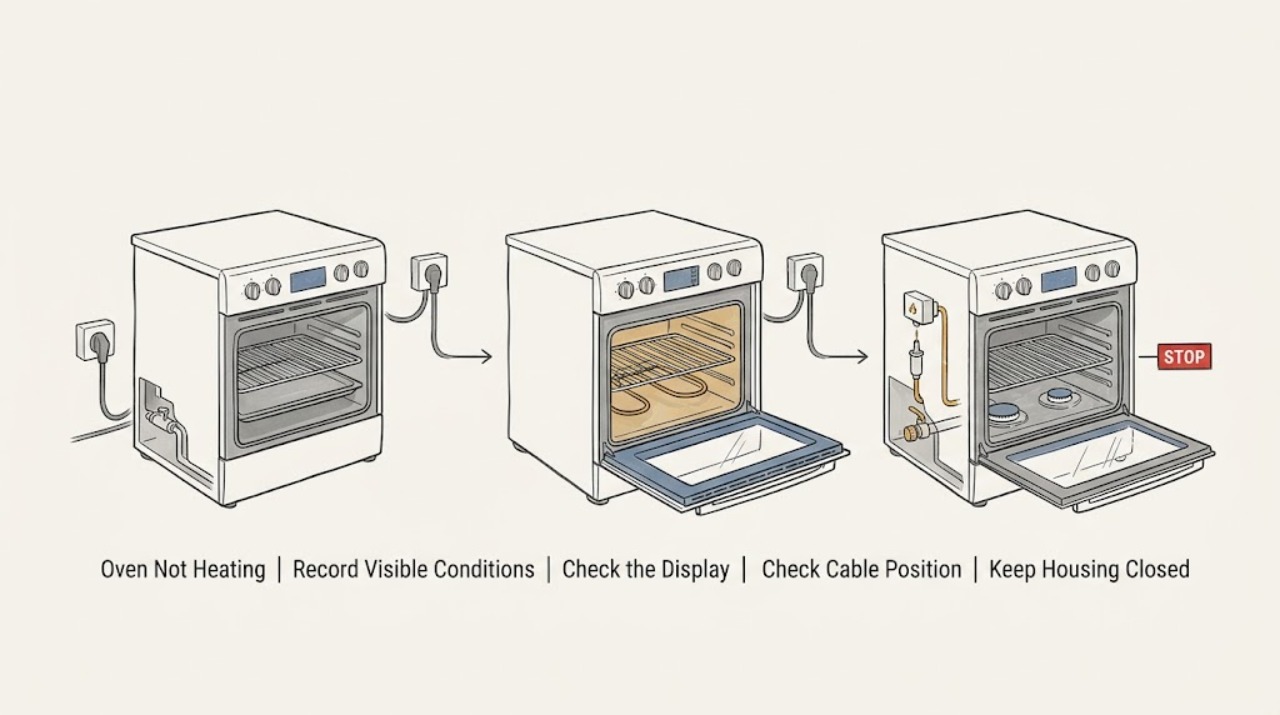
Work through in order
Diagnostic checks
Use only checks that match the exact appliance or system and its official guide.
-
Check 1
Turn the oven controls off and record the exact Viking model, fuel configuration, selected mode, temperature setting, display state, door position, and whether any other mode or cooktop function operates. Look from a safe position for gas odor, smoke, abnormal flame, arcing, scorching, a hot connection, or a repeated breaker trip.
Expected result: The display is dark, a mode will not start, the display starts but the cavity stays cold, only one mode fails, or a hazard sign is present.
Next step: Follow the matching control, power, gas, or safety branch. Stop and arrange qualified or emergency help for any gas odor, smoke, abnormal flame, arcing, scorching, uncontrolled heat, or repeated trip.
Stop if: Do not continue a heat test or open the oven if a warning sign is present.
Why this matters
Why: The symptom may be a supply or control state, a mode-specific heating fault, or an immediate gas, fire, or electrical hazard; the observation alone does not identify a part.
-
Check 2
With the oven cool and no hazard present, confirm that the oven selector and temperature controls are set to a normal bake or broil function, the start command has been accepted, and a delayed-start, self-clean, lock, or other special mode is not active. Close the door fully without forcing it.
Expected result: The mode or start command was not set, a special mode or lock is active, the door does not close correctly, or the control state appears normal but the oven remains cold.
Next step: Use only the exact model manual to clear a mode or lock and try the normal cycle once if no safety symptom exists. If the door, latch, controls, or heating response remain abnormal, leave the oven off and arrange service.
Stop if: Stop for a damaged door or gasket, a control that activates unexpectedly, a hot surface that should be cool, or any smoke, gas odor, or electrical smell.
Why this matters
Why: A control or door state can prevent a heating command; a valid normal cycle with no heat shifts attention to power, gas, heating, ignition, or control hardware.
-
Check 3
For an electric or dual-fuel oven, check only the accessible household breaker, fuse, plug, or visible cord and connection from a dry safe position. Do not remove a terminal cover, pull out a hard-wired range, probe a receptacle, or reset a breaker repeatedly.
Expected result: The breaker or fuse is open, the plug or outlet is hot or discolored, installation power is uncertain, the supply appears normal, or the breaker trips again when the oven is selected.
Next step: If a breaker is open and there is no damage, follow local safety guidance for one safe reset only; if it opens again, leave the oven off and call qualified appliance or electrical service. Do not use an extension cord or perform live testing.
Stop if: Stop for repeated trips, smoke, scorch marks, a hot outlet, damaged insulation, moisture, or exposed conductors.
Why this matters
Why: A supply or connection problem can prevent heating, while a recurring trip or damaged connection indicates an electrical hazard rather than a normal reset condition.
-
Check 4
For a gas or dual-fuel Viking oven, only when there is no gas odor and the area is safe, observe whether the oven igniter clicks, whether ignition occurs promptly, and whether the flame is stable and within the intended burner area. Do not light gas manually, remove the burner, adjust a regulator, or repeat a failed ignition.
Expected result: The igniter does not operate, it sparks without prompt flame, gas supply is uncertain, ignition is delayed, the flame is large, distorted, or yellow, or gas odor remains after the control is off.
Next step: Turn the control off and arrange qualified appliance service. For gas odor, hissing, delayed ignition, or unburned gas, leave without operating switches or flames and contact gas or emergency service from a safe location.
Stop if: Do not relight, search for a leak, disassemble gas components, or keep clicking the igniter after an unsuccessful ignition.
Why this matters
Why: Viking identifies power, gas supply, wet or dirty igniters, continuous sparking, burner ports, gas type, and air-shutter conditions as model-specific causes; these require qualified diagnosis when the safe external checks do not resolve them.
-
Check 5
If the controls and accessible supply appear normal, compare the symptom by mode only when the oven is safe, cool, and the exact manual supports normal operation. Note whether bake, broil, or convection responds differently, and whether a temperature indication changes without actual heat. Do not remove panels or test a live element, sensor, relay, or igniter.
Expected result: Only one mode fails, no mode heats, the oven heats briefly then stops, the door is not sealing, or the control indicates heat while the cavity remains cold.
Next step: Stop using the oven and provide the mode comparison and display behavior to Viking or qualified appliance service. Do not order a heating part based on the symptom alone.
Stop if: Stop immediately for persistent heating, smoke, scorching, abnormal flame, electrical odor, arcing, or a breaker trip.
Why this matters
Why: A mode-specific element, igniter, sensor, control, door, or supply fault is possible, but the pattern cannot safely identify the failed component.
-
Check 6
Prepare the service handoff with the exact model and serial information, fuel type, selected mode and temperature, start response, door and lock state, breaker or fuse history, ignition sounds and flame behavior when applicable, and all odor, smoke, alarm, or overheating observations. Do not claim a component failed without qualified confirmation.
Expected result: The oven remains cold after a valid normal-cycle check, a symptom returns, an error or lock state persists, or the fault cannot be safely reproduced.
Next step: Keep the oven off and arrange Viking-authorized or qualified appliance service. Add qualified electrical, gas, or emergency help when the corresponding hazard occurred.
Why this matters
Why: The remaining issue needs model-specific diagnosis of the supply, controls, heating system, ignition path, door, or installation rather than additional user tests.
Use your observations
Decision map
Find the observation that best matches what you see, then follow the next safe action.
-
PATH 01Next step
What you see
The oven selector, temperature, start command, door, lock, or special mode was not in the required state.
Do this next
Use the exact Viking manual to set a normal cycle and try once only if no hazard sign exists. Service a persistent control or door fault.
Why this path and its safety boundary
Why it matters: A control or door-state issue may have prevented a heating command.
-
PATH 02Next step
What you see
The accessible electrical supply is open, damaged, hot, uncertain, or trips again.
Do this next
Leave it off and arrange qualified appliance or electrical service; do not open the terminal area or perform live checks.
Why this path and its safety boundary
Why it matters: The oven has a supply or electrical safety condition that should not be diagnosed by repeated resets.
-
PATH 03Next step
What you see
A gas or dual-fuel oven has no prompt ignition, continuous sparking, delayed ignition, interrupted supply, or an abnormal flame.
Do this next
Turn the control off and arrange service. If gas odor or unburned gas is present, leave and contact gas or emergency service from outside without relighting.
Why this path and its safety boundary
Why it matters: The gas ignition or combustion path needs model-specific qualified diagnosis.
-
PATH 04Next step
What you see
The oven is safe, controls and supply are normal, but one or more modes remain cold.
Do this next
Stop using the oven and provide the mode comparison to qualified Viking appliance service. Do not open panels or select a replacement element by appearance.
Why this path and its safety boundary
Why it matters: A mode-specific heating component, sensor, control, door, or internal connection may have failed.
-
PATH 05Next step
What you see
Gas odor, smoke, fire, CO alarm, arcing, scorching, uncontrolled heating, or repeated breaker trips occurs.
Do this next
Stop, leave or evacuate as appropriate, and contact the relevant emergency, gas, appliance, or electrical professional from a safe location. Do not restart.
Why this path and its safety boundary
Why it matters: Gas, combustion, fire, or electrical risk takes priority over restoring heat.
Helpful context
Understand the symptom
No heat can be a control state or a hardware fault
A dark display, a display that accepts settings but produces no heat, a gas oven that clicks without ignition, and an oven that heats only in one mode are different symptoms. Record the model, fuel type, mode, temperature setting, door state, display message, and whether the cooktop or other oven mode works. Do not infer a failed element or igniter before those observations are separated.
Separate electric and gas checks
Viking ranges include electric, gas, and dual-fuel configurations. An electric oven may have a household supply or control problem; a gas or dual-fuel oven also depends on a safe gas path and ignition system. Leave terminals, panels, burners, regulators, igniters, and live measurements to qualified service. A working cooktop does not prove that the oven's heat path is safe or operating.
A heat test is not safe when warning signs are present
Never use repeated bake attempts to diagnose gas odor, delayed ignition, abnormal flame, smoke, arcing, scorching, or a breaker that trips again. Turn controls off, keep clear, and use the appropriate gas, emergency, appliance, or electrical response. Only run a single supervised normal cycle after low-risk external checks have passed and the exact manual supports it.
Safety boundary
Stop conditions
- Stop immediately for gas odor, hissing, delayed ignition, abnormal flame, smoke, fire, a CO alarm, arcing, uncontrolled heating, scorching, a hot outlet, or repeated breaker trips. Do not relight, reset, or repeat the test.
- For suspected gas, do not operate electrical switches or flames, search for a leak, open panels, or use a phone inside. Leave and contact gas or emergency service from outside.
- Do not remove panels, probe live wiring, adjust gas pressure, manually light a burner, bypass a door or safety device, or move a connected range to inspect behind it.
- Do not touch hot elements or a hot door, run self-clean to diagnose no heat, or replace an element, igniter, sensor, or control without exact model diagnosis and qualified installation.
Only after diagnosis
Potential parts
- oven heating element or sensor
Consider this only after qualified diagnosis identifies a failed electric heating element or temperature-sensing component in the affected mode.
Heating parts and sensors vary by Viking model and configuration. Confirm exact model fit and qualified installation before replacement. - oven igniter or burner component
Consider this only after qualified diagnosis confirms a gas-oven ignition or burner fault and the gas system is safe.
Igniters and burners differ by Viking gas or dual-fuel model. Do not select or install one from a no-heat symptom or visual resemblance. - oven control or door component
Consider this only if qualified service confirms that a control, door switch, latch, or related connection prevents the heating command.
Controls and door components are model-specific and may involve live electrical access. Use qualified diagnosis and installation.
When checks do not resolve it
Need a professional?
Request qualified Viking appliance service for persistent no-heat, mode-specific no-heat, a recurring control or door state, no or delayed gas ignition, an abnormal flame, a returning error, or any symptom that requires opening the appliance. Complete gas, fire, or electrical emergency response first when present.
Safety scope: Keep the oven off for gas odor, smoke, fire, abnormal flame, CO alarm, electrical odor, arcing, uncontrolled heat, hot connections, or repeated breaker trips. Do not relight, open panels, perform live checks, alter gas components, or reset a recurring trip.
Common questions
FAQ
Why is my Viking oven on but not heating?
Check the exact model's mode, start command, door, lock or special state, and accessible power before assuming a failed element. If controls and supply are normal but heat does not return, stop using the oven and arrange qualified service.
Why does my Viking gas oven click but not heat?
Viking troubleshooting distinguishes power, gas-supply, ignition, and burner conditions. Do not keep clicking or manually light the oven. Turn the control off and request qualified service; leave immediately for gas odor or unburned gas.
Can I reset the breaker when my Viking oven will not heat?
Check only the accessible breaker or fuse from a dry safe position. Do not repeatedly reset it. If it trips again, the outlet is hot or damaged, or smoke or a burning smell is present, leave the oven off and arrange qualified appliance or electrical service.
When should I stop testing a Viking oven that is not heating?
Stop for gas odor, delayed ignition, abnormal flame, smoke, fire, CO alarm, arcing, scorching, uncontrolled heat, a hot connection, or repeated breaker trips. Do not relight or open the oven; use emergency or qualified service as appropriate.
Read the exact guide
Official sources
- Educational Messages Desk ReferenceNational Fire Protection Association · General home-fire-safety guidance; follow local emergency instructions and the exact appliance manual.
- Viking Use & Care Manual: Designer Freestanding 30” Dual Fuel Self-Clean Sealed Burner RangeViking Range Corporation · Specific Viking F20648 manual for a Designer Freestanding 30-inch dual-fuel range; use the exact manual for a different model, oven, or fuel configuration.
Community feedback
Share a repair observation
Share a plain-text repair observation. Accepted observations are published automatically; this page may take a moment to update.