
On this page
Start here
Quick answer
A Viking oven can sound active after the controls are turned off because a cooling fan may run during the cool-down, while some models use timed cook, hold, delay, or Sabbath settings that change when heat stops. First decide whether the oven is only moving air or whether an element, burner flame, or heat output is still active. Check the exact Viking model manual for the OFF, timer, hold, delay, Sabbath, and cooling behavior; Viking documentation is model-specific. If heat continues with all controls off, a burner or element stays energized, the flame is abnormal, the oven smells of gas or burning, smoke or arcing appears, the door or controls behave abnormally, or the breaker trips, stop using the oven. Follow one model-authorized power reset only when there is no fire, gas odor, water, or electrical damage; do not repeatedly reset, bypass a control, force a gas shutoff, or open panels. Arrange qualified Viking appliance service for persistent heat, an unresponsive control, or a fan that runs unusually or never settles after the documented cool-down.
Before you begin
Safety first
- The servicer determines whether the issue is normal cool-down, a model-specific timer or mode, a control or relay, a temperature sensor, a heating element or burner, or a cooling system fault. The homeowner should not open panels, test energized parts, bypass safety controls, or perform gas-path work.
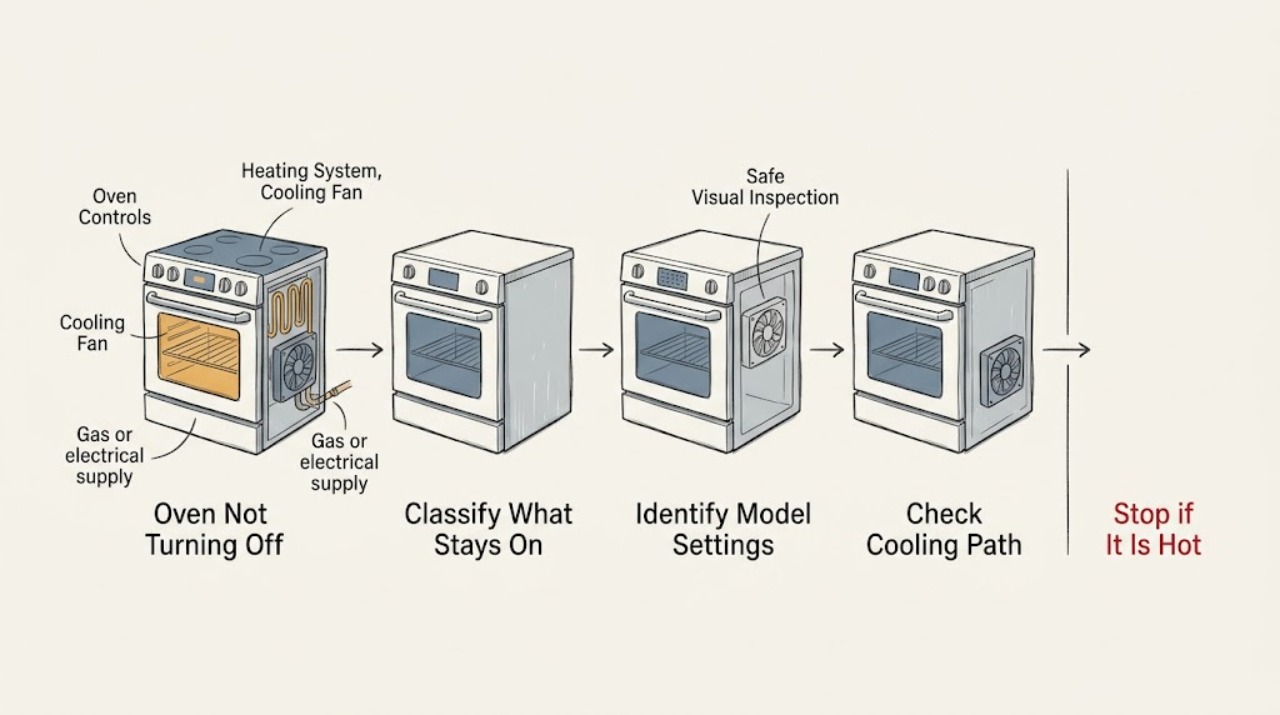
Work through in order
Diagnostic checks
Use only checks that match the exact appliance or system and its official guide.
-
Check 1
From a safe position with hands away from the vent and cavity, turn the normal oven control to OFF once and record whether the remaining symptom is only fan air or noise, a display or light, residual warmth, an active element, an active gas flame, or continued heat output.
Expected result: Only the fan or display remains; the cavity is warm but cooling; a heating element or flame remains active; heat rises; or the result cannot be seen safely.
Next step: Photograph the display without touching hot surfaces and note whether the fan sound and warmth decrease; stop use and arrange service for continued heat or an active burner or element.
Stop if: Stop immediately for gas odor, smoke, flame outside its normal location, arcing, scorching, damaged glass or wiring, uncontrolled heat, or a breaker that trips.
Why this matters
Why: A fan, display, or falling residual warmth can be normal model behavior. An active element, flame, rising heat, or an unobservable condition is not safe evidence of normal cool-down and needs the model manual or service.
-
Check 2
Record the Viking model, fuel type, selected function, temperature, display indicators, and any COOK TIME, STOP TIME, DELAY, HOLD, SABBATH, LOCK, or error indication shown before changing a setting.
Expected result: A timer or hold indicator is present; Sabbath or another special mode is shown; the controls are locked or unresponsive; the display is blank; or no special indicator is present.
Next step: Use the exact Viking use and care manual for the recorded model and mode; do not apply a sequence from another Viking series.
Stop if: Do not open the control area, bypass a lock, repeatedly press controls, or continue operation after smoke, gas odor, arcing, abnormal flame, or repeated trips.
Why this matters
Why: A programmed timer, hold state, or model-specific mode can explain continued fan or heat behavior. A blank, frozen, or unresponsive display points toward power or control diagnosis; no indicator does not rule out a relay or heating fault.
-
Check 3
With the oven controls OFF, observe the fan sound and the display from outside the hot area for the model-documented cool-down period; keep the oven vent unobstructed and do not touch the door, vent, or nearby trim.
Expected result: The fan cycles or settles while warmth falls; the fan is unusually noisy; the display shows a cooling message; the fan never stops after the manual's cool-down; or heat continues to rise.
Next step: Keep the vent clear from ordinary access and provide the sound, display, and cool-down timeline to a Viking-qualified servicer if it does not settle as documented.
Stop if: Do not insert tools into the vent, remove a grille, block airflow, touch hot surfaces, or continue if smoke, burning odor, arcing, or uncontrolled temperature appears.
Why this matters
Why: A cooling fan that runs and then settles can protect the cavity and controls. Unusual noise, no fan during an applicable operation, persistent fan operation beyond the model guidance, or rising heat requires qualified diagnosis rather than a fan obstruction test.
-
Check 4
If the display shows a timed cook, stop time, delay, or hold state and there is no hazard, compare the indicator with the exact model manual and use only its documented CLEAR or OFF control once.
Expected result: The manual confirms an intentional hold or delayed stop; the indicator clears and heating stops; the timer clears but heating continues; or the control does not respond.
Next step: Leave the controls OFF and arrange service when heat continues after the manual-authorized stop, the display returns to the same state, or a timer cannot be cleared normally.
Stop if: Do not repeatedly cycle settings, enter unverified codes, use a setting from another model, or leave the oven unattended while a heat source remains active.
Why this matters
Why: An intentional hold or delay can make an oven seem unwilling to turn off. If clearing the documented state does not stop heat, or the control ignores the instruction, treat the problem as a control or heating fault.
-
Check 5
If the exact Viking manual lists Sabbath, control lock, showroom, or another special mode for this model, compare the display and button response with that manual without changing a mode that you cannot identify.
Expected result: The mode is confirmed and the manual explains its heating or button behavior; the mode is not confirmed; the controls are locked; or the oven remains hot despite OFF.
Next step: Follow only the documented exit or unlock instruction once; if the mode cannot be exited or heat continues, keep the oven out of service and provide the display photo to qualified service.
Stop if: Do not bypass the lock, disconnect internal wiring, force knobs, or continue a cycle that produces abnormal heat, gas odor, smoke, or arcing.
Why this matters
Why: Sabbath and lock behavior can intentionally change control response on applicable models, but an unconfirmed mode is not evidence that continued heating is safe. Persistent heat with OFF remains a service boundary.
-
Check 6
Only when the oven is free of fire, gas odor, water exposure, damaged wiring, smoke, and active uncontrolled heat, check whether the exact Viking manual authorizes one power reset for the recorded control symptom; if so, perform that documented reset once.
Expected result: The display and controls recover and the oven remains OFF; the same symptom returns; heat remains active; or the reset condition was not authorized for this model.
Next step: Leave the oven unused and arrange qualified Viking appliance service if the fault returns, heat persists, or the manual does not authorize the reset.
Stop if: Do not repeatedly reset a tripping circuit, work on live wiring, remove panels, bypass a safety control, or reset during any gas, fire, water, or smoke hazard.
Why this matters
Why: A one-time authorized reset can clear a temporary control state, but a returning fault indicates an underlying control, relay, sensor, element, burner, or wiring issue. An unauthorized or ineffective reset does not justify another attempt.
-
Check 7
Prepare a service handoff with the Viking model and fuel type, selected mode, display indicators, whether fan air or a heat source remained, cool-down timeline, timer or Sabbath state, reset result, and any odor, smoke, flame, arcing, or breaker history.
Expected result: The record distinguishes normal fan cool-down, intentional timer or mode behavior, persistent element or flame output, and an unresponsive control.
Next step: Keep the oven out of service until qualified help confirms safe operation; for a confirmed gas model, follow only the manual's safe shutoff guidance when it can be reached without approaching an odor or flame.
Stop if: Do not move the oven, search for a gas leak, open panels, test live wiring, force a valve or latch, or repeat a hazardous cycle.
Why this matters
Why: This evidence lets a qualified servicer choose a model-specific control, relay, sensor, heating, burner, latch, or cooling diagnosis without guessing from not turning off. It does not authorize internal testing.
Use your observations
Decision map
Find the observation that best matches what you see, then follow the next safe action.
-
PATH 01Safety boundary
What you see
No element or flame remains active and the cavity is cooling.
Do this next
Leave the vent unobstructed and allow the documented cool-down to finish; arrange service if the fan is unusually noisy or does not settle as the manual describes.
Why this path and its safety boundary
Safety stop: Stop for smoke, burning odor, rising heat, arcing, gas odor, or damaged wiring.
-
PATH 02Safety boundary
What you see
The display and manual identify an intentional timed or hold behavior.
Do this next
Use the manual's documented CLEAR or OFF procedure once and observe whether heating stops; service the oven if the state returns or heat continues.
Why this path and its safety boundary
Safety stop: Do not repeatedly change timer settings or leave an active heat source unattended.
-
PATH 03Safety boundary
What you see
The exact Viking manual confirms the mode and its exit behavior.
Do this next
Follow only the model-documented exit or unlock procedure once; treat continued heat after the documented exit as a control or heating fault.
Why this path and its safety boundary
Safety stop: Do not bypass the lock or use a sequence from another Viking series.
-
PATH 04Safety boundary
What you see
A heat source remains active or the cavity continues getting hotter.
Do this next
Stop using the oven and arrange qualified Viking appliance service; do not repeatedly operate the controls to test the fault.
Why this path and its safety boundary
Safety stop: For a gas model, do not approach or manipulate gas equipment when there is an odor, flame abnormality, or fire concern; leave and obtain appropriate help from a safe location.
-
PATH 05Safety boundary
What you see
A gas, fire, electrical, or severe heat hazard is present.
Do this next
Stop using the oven, leave the area for a gas or fire concern, and obtain emergency or qualified service help from a safe location. Do not attempt another ignition or reset.
Why this path and its safety boundary
Safety stop: Do not open panels, operate electrical switches near a gas odor, touch damaged wiring, or re-energize a circuit that trips.
-
PATH 06Safety boundary
What you see
The control is unresponsive, the state returns, or the symptom persists after one authorized recovery step.
Do this next
Leave the oven unused and arrange qualified Viking appliance service with the model, display photo, selected mode, and timing record.
Why this path and its safety boundary
Safety stop: Do not repeat resets, change wiring, defeat a safety device, or remove the control panel.
Helpful context
Understand the symptom
Air movement is different from continued heating
The phrase not turning off can describe a fan, a hot cavity, a display, a heating element, or a gas flame. Viking documentation for applicable ovens says cooling air can continue after cooking, and hot surfaces and the vent can remain warm after the controls are off. A fan sound with falling heat is a different path from a burner flame, an element that remains energized, or heat that keeps rising. Observe from a safe position; do not touch the vent or reach into the cavity to decide whether it is hot.
Timers, hold, delay, and Sabbath are not universal
Some Viking controls support cook time, stop time, a hold state, or Sabbath mode, but the buttons and behavior vary by series and model. A timed cook can transition to a hold state before final shutoff, while a Sabbath setting may intentionally keep heating behavior after a door is opened on an applicable model. A display that says HOLD, ON, DELAY, or another setting should be matched to the exact manual rather than treated as proof of a failed relay.
A persistent heat source is a stop-use condition
If a bake or broil element remains visibly active, a gas burner continues, the cavity gets hotter after OFF, or the control ignores the normal stop command, stop operating the oven and arrange qualified service. A gas odor, delayed ignition, abnormal flame, smoke, arcing, scorching, damaged wiring, or repeated breaker trip requires immediate stop-use and appropriate emergency or qualified help. Never open a panel or attempt to defeat a safety device to make the oven stop.
Use a reset only when the model authorizes it
A single power reset can be a model-authorized control recovery step, but it is not a repair and it is not appropriate during a fire, gas odor, water exposure, or electrical damage. Use the exact Viking manual's reset instruction once, record what changed, and stop if the oven remains active or the fault returns. A gas model's shutoff guidance is installation- and model-dependent; do not search for a valve, move the appliance, or manipulate gas equipment during an odor or fire concern.
Safety boundary
Stop conditions
- Stop immediately for persistent heat after OFF, an active element or flame, gas odor, delayed ignition, abnormal flame, smoke, fire, arcing, scorching, damaged wiring, or a breaker that trips again.
- Stop and allow documented cool-down for a hot oven or cooling fan; do not touch the vent, force the door, or block airflow.
- Stop after one model-authorized stop or reset when the symptom returns, heat persists, or the controls remain unresponsive; do not keep resetting.
- Stop when a check would require opening panels, testing live wiring, bypassing a lock or safety control, moving the oven, or manipulating gas equipment.
- Stop for an unconfirmed timer, Sabbath, delay, or hold state rather than applying another model's button sequence.
Only after diagnosis
Potential parts
- cooling fan or fan control
Consider this only if qualified diagnosis confirms abnormal fan operation after the model's documented cool-down behavior is excluded.
Confirm the exact Viking model, voltage configuration, and approved fitment before ordering; fan noise alone does not identify a part. - oven control or relay component
Consider this only when the normal OFF command fails and qualified testing identifies a control or relay fault rather than a timer or special mode.
Verify the exact Viking model and control revision with qualified service; do not select a control from the symptom alone. - heating element or gas burner control component
Consider this only when a qualified servicer confirms that a heat source remains active after OFF and identifies the applicable electric or gas component.
Fuel type, model, installation, and safety procedure must be verified before any part decision; do not perform live or gas-path testing.
When checks do not resolve it
Need a professional?
Use Viking model-specific support or an authorized qualified appliance servicer for persistent heating, control, timer, latch, or cooling behavior. Report any gas, fire, smoke, electrical, or severe heat symptom before routine troubleshooting.
Safety scope: The servicer determines whether the issue is normal cool-down, a model-specific timer or mode, a control or relay, a temperature sensor, a heating element or burner, or a cooling system fault. The homeowner should not open panels, test energized parts, bypass safety controls, or perform gas-path work.
Have this ready
- Viking model and serial information, fuel type, and whether it is a range or wall oven
- Selected mode and temperature, display indicators, timer or special-mode state, and the normal OFF response
- Whether the remaining activity is fan noise, a display, residual warmth, an active element, an active flame, or rising heat
- When the symptom began, whether it follows a timed or self-clean cycle, and how long the fan or heat remained
- Any smoke, gas or burning odor, arcing, scorching, damaged wiring, water exposure, or breaker trip
- The result of at most one documented stop or reset and a photo of the display from a safe position
Common questions
FAQ
Is it normal for a Viking oven fan to keep running after I turn it off?
On applicable Viking models, a cooling fan can continue during cool-down while residual heat falls. Keep the vent unobstructed and use the exact model manual for the expected behavior. Unusual noise, rising heat, smoke, gas odor, or a fan that never settles needs service.
Why does my Viking oven show HOLD after I press OFF?
Some Viking controls use cook time, stop time, or a hold state that changes how a timed cycle ends. Match the display to the exact manual and use its documented CLEAR or OFF control once. If a heat source remains active or the state returns, stop use and arrange service.
Could Sabbath mode make a Viking oven seem unable to turn off?
On models that offer Sabbath mode, the control and heating behavior can differ from ordinary operation. Confirm the mode in the exact manual and follow only its documented exit procedure. Do not assume an unconfirmed mode makes persistent heat safe.
What should I do if my Viking gas oven keeps heating after OFF?
Stop using it and treat continued flame or heat as a service boundary. For gas odor, delayed ignition, abnormal flame, smoke, or fire, leave the area and obtain appropriate help from a safe location; do not relight, repeatedly reset, move the oven, or work on the gas path.
Can I turn the breaker off to stop a Viking oven?
Use a power reset only when the exact Viking manual authorizes it and there is no fire, gas odor, water, damaged wiring, smoke, or uncontrolled heat. A tripping breaker should not be repeatedly reset. Persistent operation after a safe documented step requires qualified appliance or electrical service.
Read the exact guide
Official sources
- Viking Range, LLC | Owners | Support FAQs for OwnersViking Range, LLC · Supports using the exact Viking oven type and manual rather than a generic sequence.
- Viking Oven Use and Care ManualViking Range, LLC · Supports treating Sabbath and other special settings as model-dependent and not assuming that a door or control response proves a fault.
- Viking Range, LLC | Support and Docs | DocumentationViking Range, LLC · Supports locating the exact model manual and documentation before using an OFF, timer, mode, reset, or service procedure.
- Professional Built-In Electric Touch Control Single and Double OvensViking Range, LLC · Supports model-dependent cooling fan operation, unobstructed vents, special settings, cool-down, and qualified service boundaries for applicable Viking built-in ovens.
- Educational Messages Desk ReferenceNational Fire Protection Association · Supports following manufacturer instructions, keeping cooking equipment and combustibles managed safely, and professional inspection after an oven fire.
- Using the OvenViking Range, LLC · Supports distinguishing a programmed stop, delay, or hold state from a control failure and using only the applicable model's documented controls.
Community feedback
Share a repair observation
Share a plain-text repair observation. Accepted observations are published automatically; this page may take a moment to update.