
On this page
Start here
Quick answer
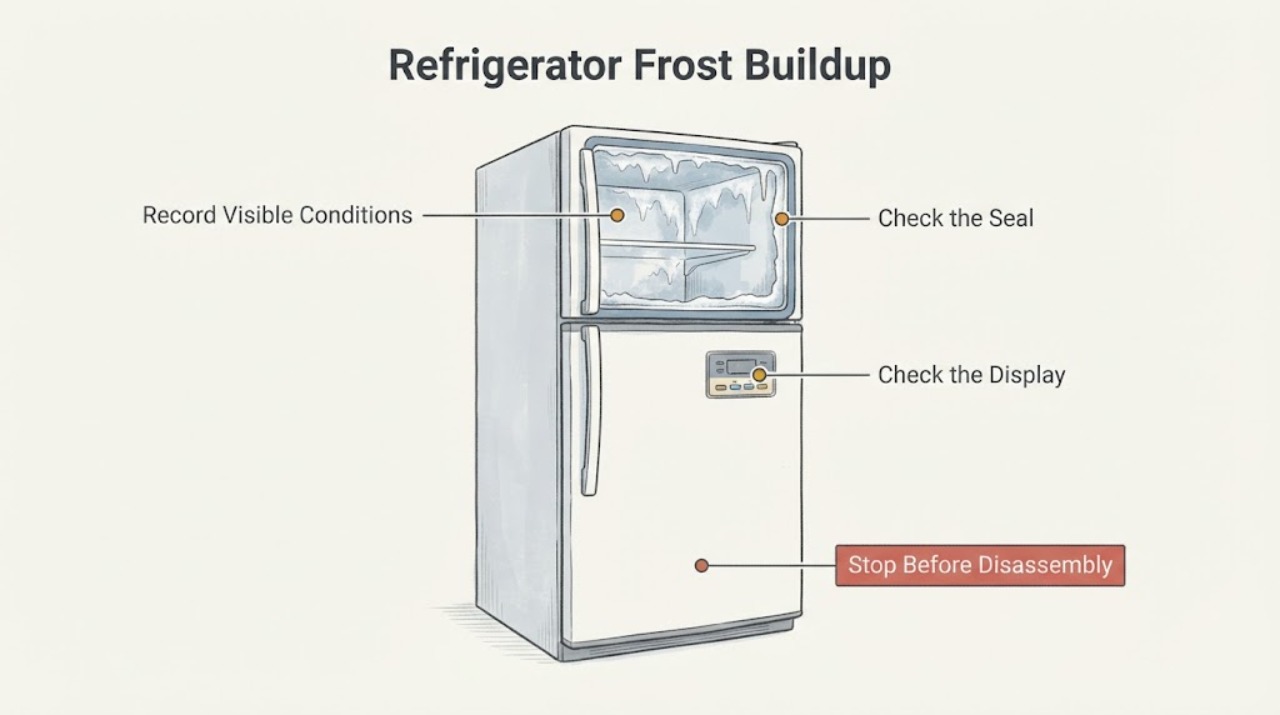
Frost inside a Viking refrigerator usually means humid room air is entering or moisture is not being managed normally. Check that every door and drawer closes fully, that food or a shelf is not holding a door open, and that vents are not blocked. If frost rapidly returns, the gasket is damaged, temperatures are unstable, or moisture collects with a door that appears closed, stop repeated defrosting and arrange qualified service.
Work through in order
Diagnostic checks
Use only checks that match the exact appliance or system and its official guide.
-
Check 1
Map the frost pattern and record the compartment temperature trend: note whether frost is at the door edge, on a rear wall, around a drawer, or over an air vent, and whether the refrigerator or freezer is too warm or too cold.
Expected result: Frost is localized at an edge, spread across a rear wall, blocking a vent, or paired with unstable temperature.
Next step: Continue with the door and loading checks for localized frost. Leave the appliance in service only long enough to document a stable mild pattern; arrange service for rapid recurrence or temperature loss.
Why this matters
Why: A localized edge pattern makes door-seal moisture more likely; broad or rapidly returning frost with temperature trouble needs a technician to distinguish airflow and defrost causes.
-
Check 2
Inspect the visible door and drawer seal around the full perimeter, and check that containers, shelves, the ice bin, and drawers are not preventing full closure.
Expected result: A door is slightly open, the gasket is folded or damaged, or the door closes evenly with an intact seal.
Next step: Reposition only the visible obstruction and wipe the gasket clean according to the manual. If the gasket is damaged or frost returns with a closed door, request service.
Why this matters
Why: A closure gap admits humid air and can create frost; an apparently good seal makes airflow, control, or defrost conditions more likely.
-
Check 3
Check that stored food is not pressed against the refrigerator's visible air vents and confirm the temperature controls match the model manual; allow the documented stabilization period after a change.
Expected result: A vent is blocked, the control is set unusually cold or warm, or vents are open and settings are appropriate.
Next step: Move items away from vents and make only the manual's permitted control adjustment. Recheck after stabilization; do not repeatedly change settings if frost continues.
Why this matters
Why: Blocked airflow or an unsuitable setting can cause local cold spots and moisture patterns, but correct settings do not rule out a defrost or sealing fault.
-
Check 4
With the appliance unplugged only when the manual permits and food protected, remove loose frost by the model-approved defrost method; never use a sharp tool or direct high heat and do not remove panels.
Expected result: Frost clears and stays away, or it returns quickly in the same area after the door and loading checks.
Next step: Monitor only after a safe manual defrost. For rapid recurrence, water, exposed wiring, or a damaged liner, keep the unit off as appropriate and arrange qualified service.
Why this matters
Why: A one-time moisture event may be resolved by a safe manual defrost, while rapid repeat frost suggests an ongoing seal, airflow, sensor, or defrost issue.
Use your observations
Decision map
Find the observation that best matches what you see, then follow the next safe action.
-
PATH 01Next step
What you see
A small patch at the door edge disappears after an obstruction is removed and the gasket closes evenly.
Do this next
Keep the seal and door path clear and monitor the same area.
Why this path and its safety boundary
Why it matters: Moist room air entering through incomplete closure likely contributed to the frost.
-
PATH 02Next step
What you see
Frost covers a rear wall or vent and returns quickly even though doors close and controls are appropriate.
Do this next
Stop repeated manual defrost cycles and arrange Viking service with the frost location and temperature trend.
Why this path and its safety boundary
Why it matters: An airflow, defrost, sensor, or related cooling condition remains possible.
-
PATH 03Next step
What you see
Frost is accompanied by water leakage, exposed wiring, a damaged liner, or loss of safe temperature.
Do this next
Protect food, keep the appliance off if safe to do so, and contact qualified refrigeration service.
Why this path and its safety boundary
Why it matters: The condition has a safety or food-preservation risk beyond routine cleaning.
Helpful context
Understand the symptom
Locate the frost before troubleshooting. A thin patch near a door opening, a heavy layer on a rear wall, frost around a drawer, and ice blocking an air outlet point to different moisture or airflow patterns. Note whether the freezer, fresh-food section, or both are affected.
Viking use-and-care materials advise keeping doors fully closed, checking for obstructions and door alignment, and allowing temperature changes time to stabilize. Settings and layout differ across Viking refrigerator families, so use the manual for the model on the product label.
Do not chip frost with a knife, use a heat gun, or remove sealed-system covers. Protect food and call service for a damaged liner, exposed wiring, repeated rapid refrosting, or temperatures that cannot be maintained.
When checks do not resolve it
Need a professional?
Arrange qualified service for frost that rapidly returns, a gasket or liner that is damaged, frost blocking vents, water leakage, exposed wiring, repeated temperature alarms, or temperatures that remain unsafe after a documented door and control check.
Common questions
FAQ
Does frost always mean the Viking refrigerator is failing?
No. A door held open by food or a compromised seal can admit humid air. If the door closes correctly and frost returns quickly, service is needed to identify the underlying condition.
Can I scrape the frost off?
Follow the exact manual's defrost method. Do not use knives or direct high heat, which can damage the liner or hidden tubing.
Read the exact guide
Official sources
- Viking Use & Care ManualViking Range, LLC · Viking freestanding refrigerator user troubleshooting and moisture/door checks
- Viking Use & Care ManualViking Range, LLC · Viking refrigerator moisture, frost, door, airflow, and temperature troubleshooting
Community feedback
Share a repair observation
Share a plain-text repair observation. Accepted observations are published automatically; this page may take a moment to update.