
On this page
Start here
Quick answer
For a leaking Viking refrigerator, protect the floor and close the water supply if the flow is active, then locate the highest wet point. Check visible filter and dispenser connections, the supply tubing, door closure, ice maker fill path, and accessible defrost drain. Viking manuals distinguish normal dispenser drips from leaks at tubing, filter, water line, door, or drain components. Do not remove sealed panels. A recurring leak, cracked tubing, water near electrics, or leak with the supply off needs qualified service.
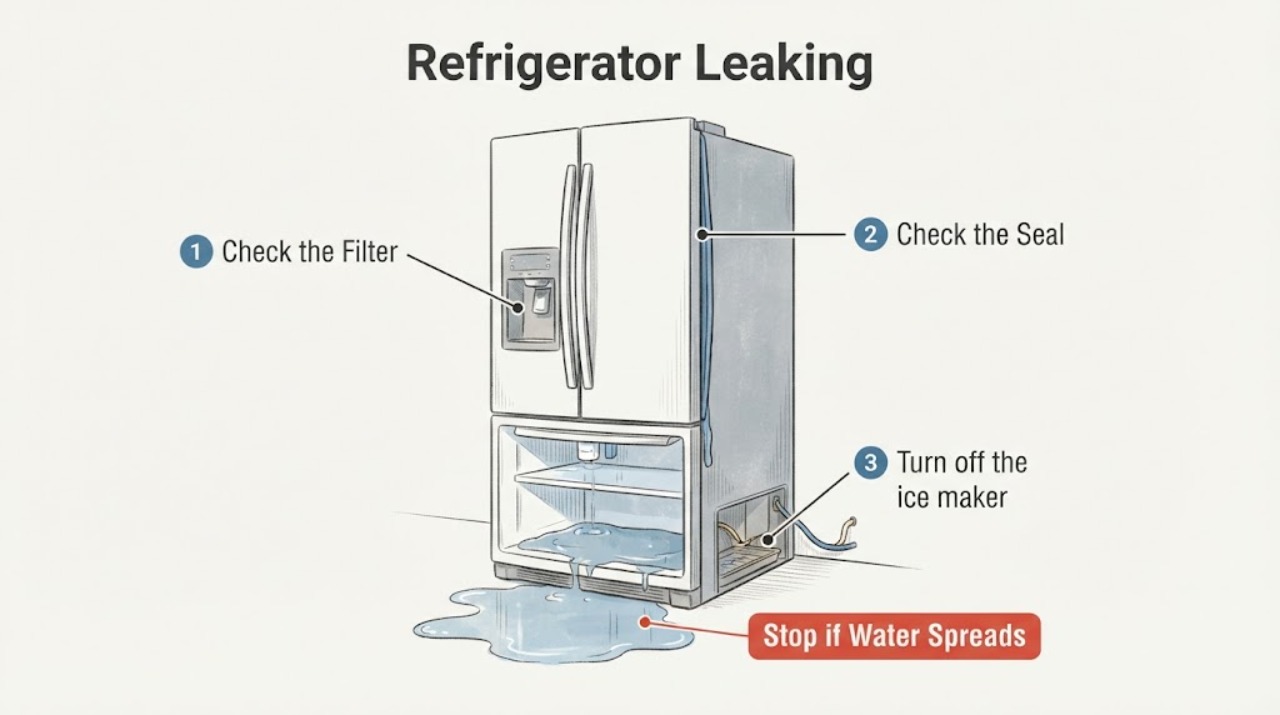
Work through in order
Diagnostic checks
Use only checks that match the exact appliance or system and its official guide.
-
Check 1
Turn off the ice maker and close the accessible refrigerator water valve if water is actively flowing; isolate power if water reaches electrical parts.
Expected result: Flow stops, slows, or continues from stored water.
Next step: Dry and trace the highest wet point before restoring water.
Why this matters
Why: The timing separates residual water from a pressurized supply or internal drain leak and identifies a safety boundary.
-
Check 2
Trace water around the filter head, dispenser tubing, inlet connection, ice maker fill tube, and rear supply line.
Expected result: A fitting, filter, tube, or fill path is wet, or all visible water connections are dry.
Next step: Reseat only a user-accessible filter or connection as the manual shows; replace no part on appearance alone.
Why this matters
Why: The first wet point identifies the water path more reliably than the floor puddle.
-
Check 3
Check the dispenser for a few residual drops versus continuing dripping, and verify the door closes against the gasket.
Expected result: Only a brief residual drop occurs, or dripping continues and the door/gasket is abnormal.
Next step: Clean and reseat the visible gasket or filter only as documented, then observe one use cycle.
Why this matters
Why: Viking notes some residual dispenser drops can be normal; persistent water suggests tubing, filter, door, or valve conditions.
-
Check 4
Inspect the freezer or refrigerator floor and accessible defrost-drain area for ice, food, or a drain-pan overflow without removing sealed covers.
Expected result: A visible drain route is blocked, or it is clear.
Next step: Follow the manual's safe thaw or cleaning method and stop if access requires panel removal.
Why this matters
Why: A defrost restriction can move meltwater into the cabinet or onto the floor even when the water supply is closed.
-
Check 5
Verify the refrigerator is level and that doors, bins, and ice container are seated and not redirecting water.
Expected result: The cabinet or bin is tilted, or the assembly is level and clear.
Next step: Correct only user-accessible alignment described by the manual and discard wet or contaminated food.
Why this matters
Why: Level and closure affect door sealing, drain flow, and where fill water lands.
-
Check 6
Apply the stop boundary after one controlled observation: check for a cracked tube, water near wiring, a leak with supply off, or a recurrence after filter and drain checks.
Expected result: The leak resolves or returns.
Next step: Leave the supply off and arrange Viking service with leak origin, timing, and photos.
Why this matters
Why: A recurrence points to a valve, drain, pan, tubing, or internal control fault requiring diagnosis.
Use your observations
Decision map
Find the observation that best matches what you see, then follow the next safe action.
-
PATH 01Next step
What you see
A fitting, filter, or supply tube is wet and the leak follows an ice or dispenser fill.
Do this next
Close the valve, reseat only the documented filter or connection, and service a recurring leak.
Why this path and its safety boundary
Why it matters: The pressurized water path is the leading suspect.
-
PATH 02Next step
What you see
The water supply is off but water collects inside or under the cabinet.
Do this next
Inspect accessible drain and level conditions; service if the route is blocked or inaccessible.
Why this path and its safety boundary
Why it matters: Residual condensate, defrost drainage, or a pan issue is more likely than an inlet leak.
-
PATH 03Next step
What you see
Only a few drops remain after dispensing and no puddle grows.
Do this next
Monitor one more use and service if dripping persists or spreads.
Why this path and its safety boundary
Why it matters: Residual dispenser water may be normal rather than a continuing leak.
-
PATH 04Next step
What you see
Water reaches wiring, tubing is cracked, or the leak continues with supply open.
Do this next
Keep the water supply off and obtain qualified service.
Why this path and its safety boundary
Why it matters: There is a safety and property-damage risk beyond user checks.
Helpful context
Understand the symptom
Dry the puddle only after photographing the wet path. Water can travel along a shelf or under a crisper, so the lowest puddle is rarely the source.
Use the exact Viking refrigerator manual for filter removal, drain access, and water-line routing. Do not tighten a plastic fitting beyond the manual's instruction or open a sealed refrigeration circuit.
Only after diagnosis
Potential parts
- water inlet tubing or filter seal
Only if the leak origin and exact manual confirm the tube or seal is damaged.
Match exact Viking model and filter system; do not substitute generic fittings.
When checks do not resolve it
Need a professional?
A technician may pressure-test the inlet valve and tubing, inspect filter head, ice-maker fill, drain pan and defrost drain, and check level and door seals. Provide model, supply status, wet point, and timing.
Common questions
FAQ
Why is my Viking refrigerator leaking only after dispensing water?
Trace the filter, dispenser tubing, and door area. A few residual drops can be normal, but continuing flow suggests a connection, filter seal, valve, or tubing issue.
Can a defrost drain cause a Viking refrigerator leak?
Yes. If water remains after the supply is closed, inspect the accessible drain and pan path as the manual allows. A hidden blockage needs service.
Should I shut off the refrigerator water line?
Yes when water is actively pooling or uncontrolled. Keep it off until the visible source is corrected or service diagnoses it.
Do I need the model number for a Viking water-line part?
Yes. Viking documentation and filter or tubing arrangements vary by model, so identify the exact unit before ordering.
Read the exact guide
Official sources
- Product DocumentationViking Range, LLC · Use to locate the exact manual before component access or replacement.
- Viking Use & Care ManualViking Range, LLC · Use for Viking refrigerators at symptom level; exact water and drain layouts vary by model.
Community feedback
Share a repair observation
Share a plain-text repair observation. Accepted observations are published automatically; this page may take a moment to update.