
On this page
Start here
Quick answer
If a Viking refrigerator is not cooling, first confirm power and that cooling has not been turned off, then check set points, blocked vents, door sealing, startup time, and accessible airflow. Allow 24 hours after installation or a major load before judging recovery. Persistent warmth in one or both compartments, abnormal frost, or any electrical or refrigerant safety symptom needs qualified service.
Work through in order
Diagnostic checks
Use only checks that match the exact appliance or system and its official guide.
-
Check 1
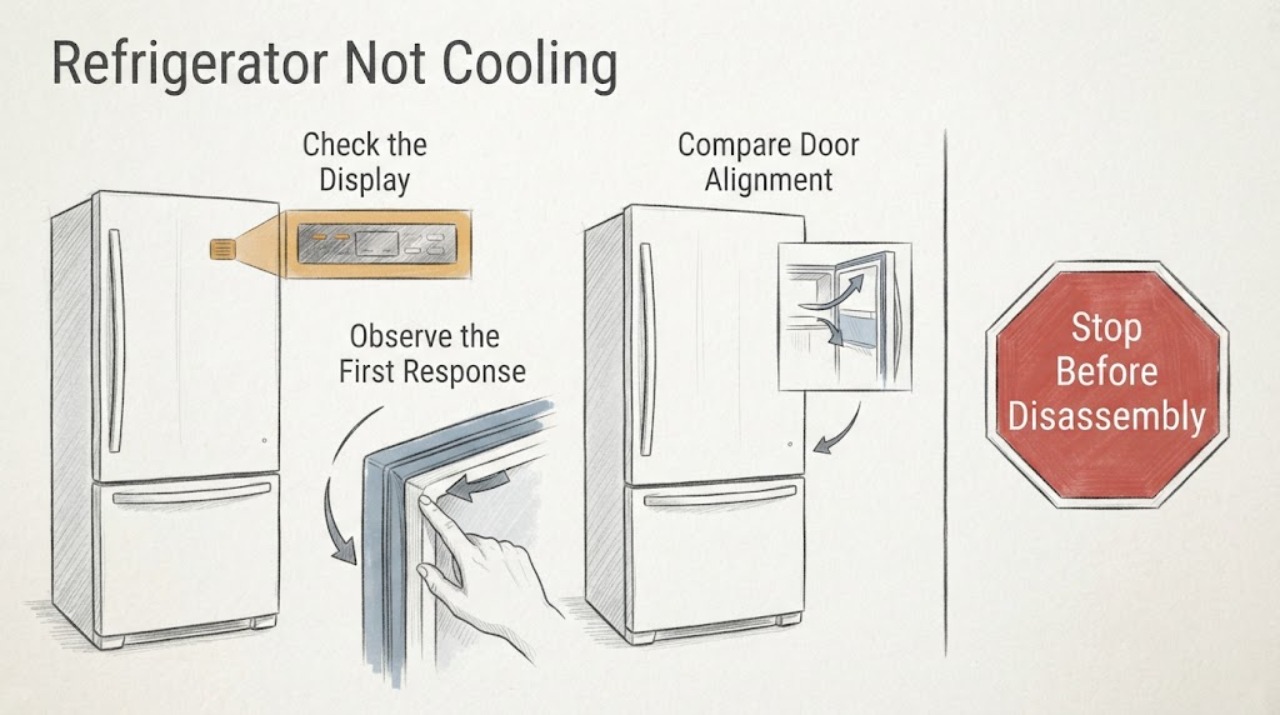
Check from outside whether the refrigerator has power, interior lights, a display, and any active cooling-off or vacation mode. Do not remove panels or change breaker size.
Expected result: Lights/display are off, controls show cooling off, or the controls and lights are on.
Next step: Restore only the documented control setting or check the accessible outlet once. If power will not hold or the unit remains warm with controls on, arrange service.
Why this matters
Why: No power or a user-selected cooling-off state can explain warm compartments; powered controls with no cooling require the temperature and airflow checks.
-
Check 2
Read the refrigerator and freezer set points and compare the actual food temperature after the door has remained closed. Keep food away from the interior air vents and do not set the controls to the coldest position as a shortcut.
Expected result: The set point is warm, vents are blocked, or settings look normal but temperatures remain high.
Next step: Correct the setting and clear only accessible obstructions, then allow 24 hours before judging the result.
Why this matters
Why: A wrong setting or blocked vent can reduce circulation; turning colder does not make a newly installed refrigerator cool faster.
-
Check 3
Inspect the door gasket and door closing from the front. Look for packages holding the door open, a dirty gasket, or a door that does not seal; do not dismantle hinges.
Expected result: Door closes and seals, door is held open, or gasket is torn/dirty and air is entering.
Next step: Reposition accessible packages and clean the gasket as the manual describes. A damaged seal or misalignment needs model-specific service.
Why this matters
Why: Warm air from a door that stays open or fails to seal can raise compartment temperature and increase compressor runtime.
-
Check 4
Consider the timing: new installation, a large load of warm food, frequent door openings, hot room, or a recent power interruption. Note whether the freezer is also warm and whether the compressor/fan can be heard.
Expected result: The unit is newly installed or heavily loaded, only the refrigerator section is warm, or both sections stay warm after stabilization.
Next step: Allow the documented stabilization period for a new installation and reduce door openings. Do not diagnose a sealed-system part from sound alone.
Why this matters
Why: Startup and load conditions can need time; both compartments warm together after that period points to a broader cooling or power issue, while one section can implicate airflow or control distribution.
-
Check 5
If the accessible manual identifies a condenser coil or rear grille, check for visible dust and blocked clearance with the appliance powered off. Do not pull a built-in unit out or touch fan, wiring, or refrigerant tubing.
Expected result: Coils/grille are visibly dirty or blocked, clearance is adequate, or the unit is built in and inaccessible.
Next step: Clean only as the exact manual allows and restore clearance. If cooling does not return or access requires moving cabinetry, use qualified service.
Why this matters
Why: Restricted airflow can reduce heat rejection, but a clean exterior does not rule out a fan, defrost, control, or sealed-system fault.
-
Check 6
Record model and serial information, actual temperatures, control states, timing, unusual sounds, frost pattern visible without removing covers, and whether the freezer or refrigerator is affected.
Expected result: Cooling returns after one safe setting correction, remains warm after 24 hours, or there is frost, leaking water, smoke, or electrical heat.
Next step: Protect perishable food, stop repeated resets, and arrange Viking service; use electrical or refrigeration professionals for their respective hazards.
Why this matters
Why: A temporary recovery does not identify the cause. Persistent warm food, unusual frost, or a safety symptom moves beyond owner checks.
Use your observations
Decision map
Find the observation that best matches what you see, then follow the next safe action.
-
PATH 01Next step
What you see
Both refrigerator and freezer remain warm after power and controls are confirmed and the 24-hour stabilization period has passed.
Do this next
Keep doors closed to protect food and arrange Viking service with the recorded temperatures and timing.
Why this path and its safety boundary
Why it matters: A broad cooling, airflow, control, or sealed-system fault is more likely than a simple shelf-position issue; the symptom does not name a part.
-
PATH 02Next step
What you see
Only the refrigerator section is warm while the freezer is cold, and food or containers obstruct an air vent.
Do this next
Clear accessible vents and allow the compartment to stabilize; seek service if temperature remains unsafe.
Why this path and its safety boundary
Why it matters: Air distribution is a stronger possibility than a total cooling failure.
-
PATH 03Next step
What you see
The refrigerator is newly installed or was loaded with warm food and has not had 24 hours to stabilize.
Do this next
Keep doors closed, use the documented settings, and reassess after 24 hours rather than repeatedly setting the control colder.
Why this path and its safety boundary
Why it matters: Startup or load recovery is plausible under the Viking guidance.
-
PATH 04Next step
What you see
The plug or cord is hot/damaged, there is smoke, burning odor, sparking, water near electricity, or repeated breaker operation.
Do this next
Stop use and isolate only if safe; obtain qualified electrical or appliance help and do not open the cabinet.
Why this path and its safety boundary
Why it matters: This is an immediate electrical or appliance safety boundary.
Helpful context
Understand the symptom
A Viking refrigerator can be warm because of a user control state, blocked circulation, a door seal, startup/load recovery, or a product fault. The freezer-versus-refrigerator pattern changes the next check.
Use owner-accessible observations only; do not infer a compressor, fan, control, or sealed-system part from temperature alone.
When checks do not resolve it
Need a professional?
Arrange qualified service when the owner checks do not restore normal operation or the symptom recurs. Provide the exact model, observed pattern, and any displayed code; do not infer a replacement part from the symptom alone.
Common questions
FAQ
How long should a Viking refrigerator take to cool after installation?
Viking guidance says to allow about 24 hours for the refrigerator to cool completely; a colder setting does not accelerate that initial period. Persistent warmth afterward needs diagnosis.
Why is the freezer cold but the Viking refrigerator warm?
First check accessible air vents, food placement, door sealing, and controls. If those checks do not restore the refrigerator compartment, airflow or control service is needed.
Should I replace a compressor because my Viking refrigerator is warm?
No. Warm compartments can result from settings, vents, doors, installation, coils, defrost, controls, or sealed-system conditions. Record observations and let qualified service identify the fault.
Read the exact guide
Official sources
- Viking Use & Care ManualViking Range, LLC · Viking refrigerator cooling controls, set points, vents, and 24-hour stabilization guidance.
- F20398A Use and Care ManualViking Range, LLC · Viking refrigerator warm-temperature troubleshooting, doors, controls, coils, vents, and defrost behavior.
- Viking Range, LLC | Support and Docs | Support CenterViking Range, LLC · Viking model documentation and authorized service routing.
Community feedback
Share a repair observation
Share a plain-text repair observation. Accepted observations are published automatically; this page may take a moment to update.