
On this page
Start here
Quick answer
Identify which side of the combination appliance produces the odor and whether it appears during washing, draining, drying, or while the unit is idle. A musty or sour smell usually points to damp laundry, moisture in the washer seal or drum, detergent residue, a dispenser, drain, or plumbing path; a smell that begins with heat may be coming from the dryer, the load, or room air. Stop immediately for smoke, sparks, abnormal heat, a persistent burning or electrical smell, or a gas odor. For a gas odor, leave the area and contact emergency services from a safe location without operating switches. For a musty smell, remove the load, follow the exact model's cleaning instructions, clean only user-accessible areas, and do not mix cleaning chemicals.
Before you begin
Safety first
- This article supports odor classification and ordinary-access cleaning or observation only. Do not operate controls around gas, smoke, sparks, or exposed electrical equipment; do not open panels, heater, pump, motor, wiring, or gas components; and do not move a wet or unsafe appliance.
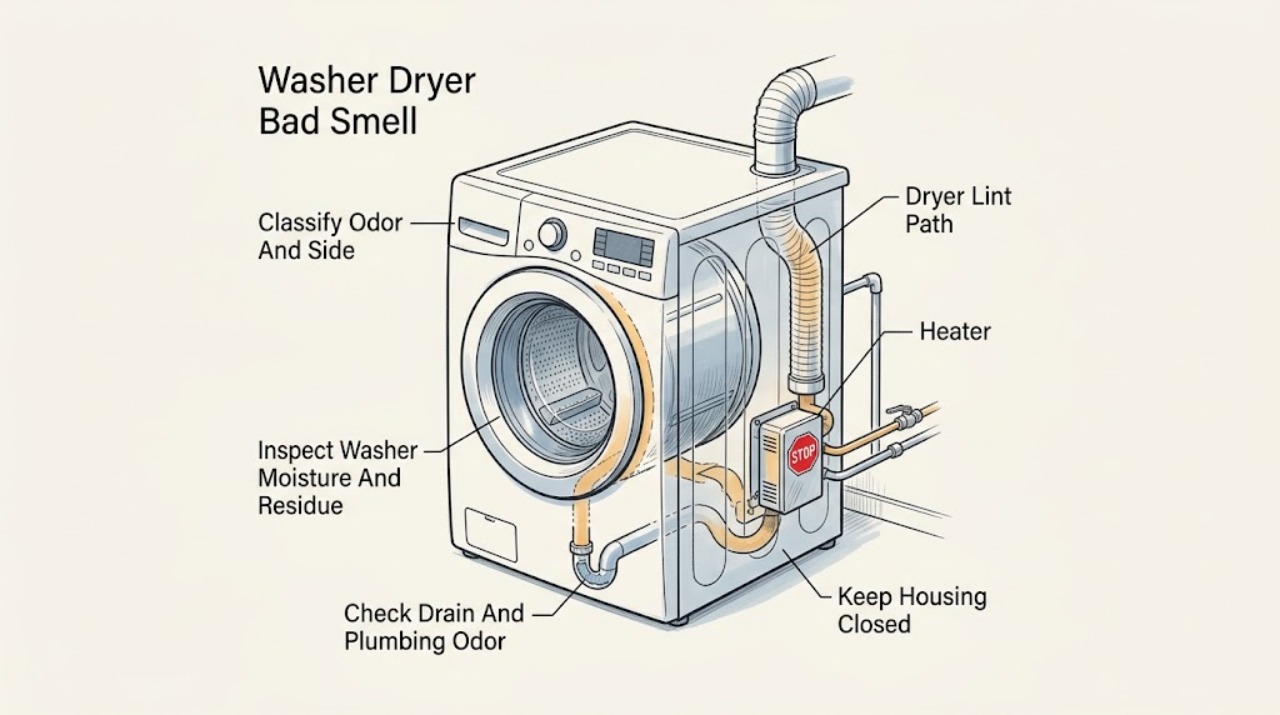
Work through in order
Diagnostic checks
Use only checks that match the exact appliance or system and its official guide.
-
Check 1
Stop the current cycle and, from a dry safe position, record which side of the washer-dryer was active, the cycle phase, the odor character, and the first location where it is strongest. Remove laundry only if the door or drum can be opened normally without heat, smoke, gas, or electrical danger.
Expected result: Classify the report as musty or sour from the washer or load, sewage-like near the drain, oily or heated-material odor from a new dryer, burning or electrical odor, chemical odor on the load, gas odor, or visible smoke or sparks.
Next step: For smoke, sparks, abnormal heat, persistent burning or electrical odor, or a gas odor, keep the appliance off and follow the stop conditions before any inspection. For a musty or sour odor with no hazard, continue with the washer-side checks.
Stop if: Do not restart the appliance to reproduce the smell, touch a hot or wet plug, operate a switch when gas may be present, or approach visible smoke, flame, or sparking.
Why this matters
Why: Musty or sour odors support a moisture, residue, load, or drain branch. Heated, burning, electrical, gas, smoke, or spark observations are safety signals and cannot be treated as ordinary odor maintenance.
-
Check 2
For a musty, sour, or detergent-like odor, remove wet laundry promptly and inspect the visible washer drum, door gasket or seal, dispenser, and accessible crevices after the machine is cool and idle. Wipe only user-accessible surfaces with the model-approved method; do not force a gasket, reach into a moving or hot drum, or pour an unapproved chemical into the machine.
Expected result: Look for damp laundry left in place, standing moisture, lint or soil in the gasket, a slimy or crusted dispenser, detergent residue, or a clean and dry washer with the odor still present in the load or room.
Next step: Follow the owner's instructions for the washer-cleaning cycle, seal, and dispenser; rewash odor-affected laundry and transfer it promptly to drying. If the odor returns after approved cleaning or resembles sewage, inspect the drain branch instead of adding stronger chemicals.
Stop if: Do not mix bleach, vinegar, ammonia, drain cleaner, or other products; do not use a sharp tool, force the seal apart, or clean inside panels or hoses.
Why this matters
Why: Moisture and residue at the seal, drum, or dispenser can support a washer-side odor, while a clean washer and odor confined to the load points toward laundry or water rather than an appliance fault. The exact cleaning product and cycle remain model-specific.
-
Check 3
If the smell is sewage-like or strongest near the washer drain, inspect only the exposed drain hose end and surrounding drain opening for an obvious kink, loose connection, standing dirty water, or an unusual return of odor after draining. Keep the appliance off and do not open plumbing traps, wall connections, or cabinet panels as a household odor test.
Expected result: Record whether the odor follows the drain hose, is present at the room drain even when the washer is idle, appears only after a drain phase, or remains inside the drum after the visible drain area is normal.
Next step: Follow the exact installation manual for a visible hose-position check only. Request qualified plumbing or appliance service if the drain odor persists, the drain is slow, water backs up, or the connection is concealed or damaged.
Stop if: Do not pour drain chemicals into the appliance or drain, open a trap with contaminated water, remove cabinet panels, or run repeated cycles when water backs up.
Why this matters
Why: A recurring sewage odor can come from a blocked or improperly installed drain hose, trap, vent, or filter; it is not necessarily mold in the washer. An odor that remains after the exposed drain path is normal needs plumbing or appliance diagnosis.
-
Check 4
For an odor that appears during drying, first check the lint screen and the accessible exhaust outlet only when the dryer is off and cool. Review whether the load contains oil, cleaning product, finishing product, or other volatile chemical residue, and whether drying has become unusually long or the exhaust airflow is weak. Do not remove the dryer cabinet or reach into the heater.
Expected result: Classify the air path as clean with normal airflow, visibly lint-loaded, restricted or weak at the outlet, contaminated by a chemical-smelling load, or impossible to assess without disconnecting ducting or opening the chassis.
Next step: Clean the lint screen and accessible areas only as the model instructions allow, keep chemical-contaminated items out of the dryer until safely laundered and dried as directed by the safety guidance, and arrange qualified vent or appliance service for weak airflow, internal lint, or persistent odor.
Stop if: Do not dry a load contaminated with gasoline, solvents, cleaning agents, cooking oils, or finishing products; do not operate with smoke, persistent burning odor, damaged ducting, blocked exhaust, or abnormal heat.
Why this matters
Why: Lint or restricted exhaust can increase heat, while volatile residues on clothing can create an odor or fire risk; an inaccessible internal lint or heater area is a service boundary. A clean accessible path does not clear a persistent burning or electrical odor.
-
Check 5
If the odor is burning, electrical, gas-like, smoky, chemical, or accompanied by heat, inspect only from a safe distance for visible smoke, flame, sparks, a hot or damaged cord, or a gas odor; do not touch the appliance or operate controls to investigate.
Expected result: Record no visible hazard, persistent burning or electrical odor, smoke or sparks, gas odor, abnormal heat, a damaged cord or outlet, or an odor clearly limited to a contaminated load or recently painted room.
Next step: For a gas odor or smoke, leave the building or affected area and contact emergency services from a safe location; do not operate switches or appliances. For burning or electrical odor without gas, turn the appliance off and isolate power only if safe, then request qualified appliance or electrical service. For a room or load odor, ventilate and follow the garment and model instructions before any drying.
Stop if: Never test live voltage, bypass a safety device, open a gas path, remove panels, use a flame to locate gas, or continue operation after smoke, sparks, overheating, a gas odor, or an electrical smell.
Why this matters
Why: Smoke, sparks, abnormal heat, persistent burning or electrical odor, and gas odor are stop-now conditions. A chemical or paint odor can enter through dryer room air or remain on a load, but the dryer must stay off until the surrounding fumes and load are safe.
Use your observations
Decision map
Find the observation that best matches what you see, then follow the next safe action.
-
PATH 01Safety boundary
What you see
The smell is musty or sour, there is no smoke, gas odor, spark, abnormal heat, or electrical warning, and it is strongest at damp laundry, the washer seal, drum, or dispenser.
Do this next
Remove the load, follow the exact model's cleaning cycle and detergent guidance, clean accessible seal and dispenser surfaces, and rewash odor-affected laundry.
Why this path and its safety boundary
Why it matters: Moisture, residue, a delayed wet load, or the washer's accessible cleaning areas are plausible sources.
Safety stop: Stop and request service for standing water, a damaged seal, repeated odor after approved cleaning, or any electrical, smoke, heat, or gas warning.
-
PATH 02Safety boundary
What you see
The odor resembles sewage or sulfur and is strongest at the drain, hose end, or after a drain phase.
Do this next
Perform only a visible hose-position check allowed by the model instructions and arrange plumbing or appliance diagnosis if the odor persists, drainage is slow, or water backs up.
Why this path and its safety boundary
Why it matters: A drain hose, filter, trap, vent, or plumbing installation issue is possible; washing-machine cleaning alone may not correct it.
Safety stop: Do not add drain chemicals, open contaminated plumbing, or continue cycles when wastewater returns or overflows.
-
PATH 03Safety boundary
What you see
The smell begins during drying, the lint screen or exhaust airflow is restricted, drying takes unusually long, or lint is visible around the dryer.
Do this next
Keep the dryer off until the lint screen and permitted accessible path are cleaned; arrange qualified vent or appliance service for duct, chassis, heater, or recurring odor work.
Why this path and its safety boundary
Why it matters: Restricted airflow and lint can increase dryer heat; the accessible check cannot rule out internal lint or heater faults.
Safety stop: Do not run with smoke, persistent burning smell, abnormal heat, blocked exhaust, or an inaccessible accumulation of lint.
-
PATH 04Safety boundary
What you see
The appliance is new, the odor is mild and oily or heated-material-like, and there is no smoke, gas odor, spark, abnormal heat, or electrical warning; or the room was recently painted, stained, or refinished.
Do this next
Ventilate the room and follow the owner's instructions for any initial empty cycle. Do not dry a load while nearby fumes remain, and stop if the odor persists, intensifies, or changes to smoke, electrical, or gas odor.
Why this path and its safety boundary
Why it matters: A new-appliance break-in odor or room fumes drawn into the dryer may be possible, but the exact model's instructions control whether an empty cycle is permitted.
Safety stop: Do not use the dryer around flammable vapors or treat a persistent or worsening burning odor as normal.
-
PATH 05Safety boundary
What you see
There is a gas odor, visible smoke, sparks, a persistent burning or electrical smell, abnormal heat, or a damaged or hot cord or outlet.
Do this next
Leave the area; for gas odor or smoke, do not operate switches or appliances and contact emergency services from a safe location. For electrical or burning odor without gas, keep the appliance off and request qualified appliance or electrical service.
Why this path and its safety boundary
Why it matters: The appliance or its fuel/electrical environment may present an immediate fire, explosion, or shock hazard.
Safety stop: Do not restart, reset a breaker to test, use a flame, open panels or gas components, or re-enter an unsafe area until it is cleared by the appropriate emergency or qualified professional.
Helpful context
Understand the symptom
The odor source may not be the side that is hot
In a washer-dryer, heat can make an odor from damp laundry or the washer more noticeable, so a smell noticed during drying does not prove that the dryer created it. Note whether the smell is musty, sour, sewage-like, plastic-like, oily, smoky, electrical, or like gas, and whether it is strongest at the washer door, drain, dryer drum, lint path, exhaust, plug, or room. Never continue a cycle simply to reproduce an odor that could be a fire, gas, or electrical warning.
Musty and sour odors need moisture and residue checks
Damp clothes left in the washer, trapped moisture in a door seal, detergent or softener residue, and a dirty dispenser can make a washer or the clothes smell stale. Manufacturer guidance recommends prompt load removal, model-approved cleaning of the drum, seal, and dispenser, and the correct detergent type and amount. A sewage-like smell that returns after these checks can be a drain, trap, vent, or plumbing problem rather than a washer-cleaning problem.
Dryer burning and gas odors are safety branches
A new dryer can have a temporary oily or heated-material odor, but a persistent burning, electrical, smoke, or gas odor is not a cleaning experiment. Lint or restricted exhaust can contribute to excessive heat, and chemical residues on clothing can create a dangerous load. Keep the dryer off, avoid opening covers or testing live parts, and use qualified service for an unresolved odor. If gas is suspected, do not operate electrical switches or appliances in the area; leave and get emergency help from a safe location.
Safety boundary
Stop conditions
- For gas odor or visible smoke, leave the building or affected area, do not operate electrical switches or appliances, and contact emergency services from a safe location.
- Stop using the washer-dryer for persistent burning or electrical odor, sparks, abnormal heat, a hot or damaged cord or outlet, or a breaker trip; request qualified service.
- Do not restart the appliance to reproduce an odor, bypass a safety device, reset a breaker as a test, or open the cabinet, heater, pump, wiring, or gas path.
- Do not dry clothing contaminated with gasoline, solvents, cleaning agents, cooking oils, or finishing products until it has been safely handled according to its care and safety instructions.
- Do not mix bleach, vinegar, ammonia, drain cleaner, or other cleaning products, and do not pour unapproved chemicals into the washer or drain.
Only after diagnosis
Potential parts
- washer door gasket or seal
Consider this category only if inspection confirms a damaged or permanently contaminated washer door seal and the odor or moisture is localized there after approved cleaning.
Confirm the exact combination-appliance model and seal design with the manufacturer or qualified technician; do not force the gasket or treat a drain or dryer odor as a seal failure. - detergent dispenser assembly
Consider this category only if the dispenser is damaged, cannot be cleaned or seated according to the model instructions, and residue or leakage is confirmed at that assembly.
Confirm the exact model, compartment arrangement, and fit information before ordering; correct detergent type and amount may resolve residue without a replacement. - dryer lint screen or exhaust component
Consider this category only after qualified inspection confirms a damaged lint screen or an exhaust component that is causing restricted airflow or recurring lint accumulation.
Confirm the exact model and vent specification; do not substitute ducting or operate with an obstructed exhaust path. - drain hose, pump, or internal odor source
Consider this category only when diagnosis confirms a recurring drain odor, slow drainage, water return, or an internal leak after visible hose and cleaning checks.
Have a qualified technician identify the failed assembly and model fit; do not order or access a pump from odor alone.
When checks do not resolve it
Need a professional?
Request qualified appliance service when a musty or drain odor returns after model-approved cleaning, the source is inside the cabinet, airflow is restricted, lint is inaccessible, the odor is persistent or worsening, a seal or cord is damaged, or the machine has smoke, sparks, abnormal heat, or electrical odor. For a gas odor or visible smoke, leave the area and contact emergency services from a safe location before seeking appliance service.
Safety scope: This article supports odor classification and ordinary-access cleaning or observation only. Do not operate controls around gas, smoke, sparks, or exposed electrical equipment; do not open panels, heater, pump, motor, wiring, or gas components; and do not move a wet or unsafe appliance.
Common questions
FAQ
Why does my washer-dryer smell musty when drying?
Heating can make a musty odor from damp laundry, washer moisture, door-seal residue, dispenser buildup, or wash water easier to notice. Separate the washer and dryer sides, remove the load, inspect accessible washer areas, follow the model cleaning instructions, and rewash stale laundry before drying it again.
Is a burning smell from a washer-dryer normal?
A mild oily or heated-material odor can occur during initial use of some new dryers, but persistent burning or electrical odor is not a normal troubleshooting condition. Keep the appliance off for smoke, sparks, abnormal heat, persistent burning, or electrical odor and arrange qualified service.
What should I do if my gas washer-dryer smells like gas?
Do not operate the appliance, lights, switches, or other electrical equipment in the area. Leave the building or affected area and contact emergency services from a safe location. Do not return or restart the appliance until it has been cleared by the appropriate professionals.
Can detergent cause a bad smell in a washer-dryer?
Yes. The wrong detergent type, too much detergent, softener residue, a dirty dispenser, or damp laundry left in the washer can create musty or sour odors. Use only the type and amount specified for the model, clean accessible areas as directed, and never mix cleaning chemicals.
Can a clogged dryer vent cause a bad smell?
Lint or a restricted exhaust can reduce airflow and increase heat, which can produce a burning or musty odor and a longer drying time. Keep the dryer off if the odor is persistent, the airflow is weak, or there is smoke or abnormal heat; clean only accessible areas allowed by the manual and arrange qualified vent service.
Read the exact guide
Official sources
- CPSC Publication 5022 - Overheated Clothes Dryers Safety AlertU.S. Consumer Product Safety Commission · CPSC consumer safety alert for clothes dryers; it supports fire-risk boundaries for a washer-dryer drying function and does not replace the appliance manual.
- Samsung dryer smells or smokesSamsung Support · Samsung dryer support guidance used for hazard classification and odor-source separation; it is not a model-specific procedure for an unbranded combination appliance.
- Dryer - OdorGE Appliances Support · GE dryer support guidance used for distinguishing initial odor and gas-related warning signs; exact model and fuel instructions control.
- How to Remove Smells in a Front Load WasherWhirlpool · Whirlpool front-load washer guidance used for general odor branches; a combination washer-dryer can have different access and cleaning requirements.
- Appliance and Electrical Fire SafetyU.S. Fire Administration · U.S. Fire Administration household appliance safety guidance; local electrical requirements and the appliance manual also apply.
- Why Does My Washing Machine Smell Like Mildew?Whirlpool · Whirlpool washer care guidance used for general moisture and residue mechanisms; cleaning-product compatibility remains model-specific.
- Removing Odors or Smells - DryerWhirlpool Product Help · Whirlpool dryer support guidance used here for odor-source distinctions; the exact washer-dryer model manual controls the permitted cleaning and initial-cycle procedure.
- How to Handle a Burning Smell in Your Washing Machine?Samsung Support · Samsung washer support guidance used to classify burning odors and the service boundary; it is not a model-specific repair procedure for an unbranded washer-dryer.
Community feedback
Share a repair observation
Share a plain-text repair observation. Accepted observations are published automatically; this page may take a moment to update.