
On this page
Start here
Quick answer
A washer-dryer that will not spin may be waiting for water to drain, protecting itself from an unbalanced load, using a low- or no-spin setting, blocked by a door or lid lock, slowed by excessive suds, or affected by a power interruption. Stop first for a leak, violent movement, metal-on-metal scraping, burning or electrical smell, sparks, overheating, or a breaker that trips again. With the drum stopped and no hazard present, check the selected spin setting, redistribute or reduce the load, confirm the door or lid closes, inspect the accessible drain hose, and use the exact model's Drain and Spin option once. If water remains, the fault returns, or the drum will not spin after these checks, keep the appliance off and arrange qualified service; do not open panels or guess at a drive part.
Before you begin
Safety first
- Do not force or bypass a lock, reach into a moving drum, open panels, test live wiring, dismantle the pump or drive, repeatedly reset a tripping circuit, or run the appliance with leaks, smoke, sparks, burning smell, overheating, or destructive noise.
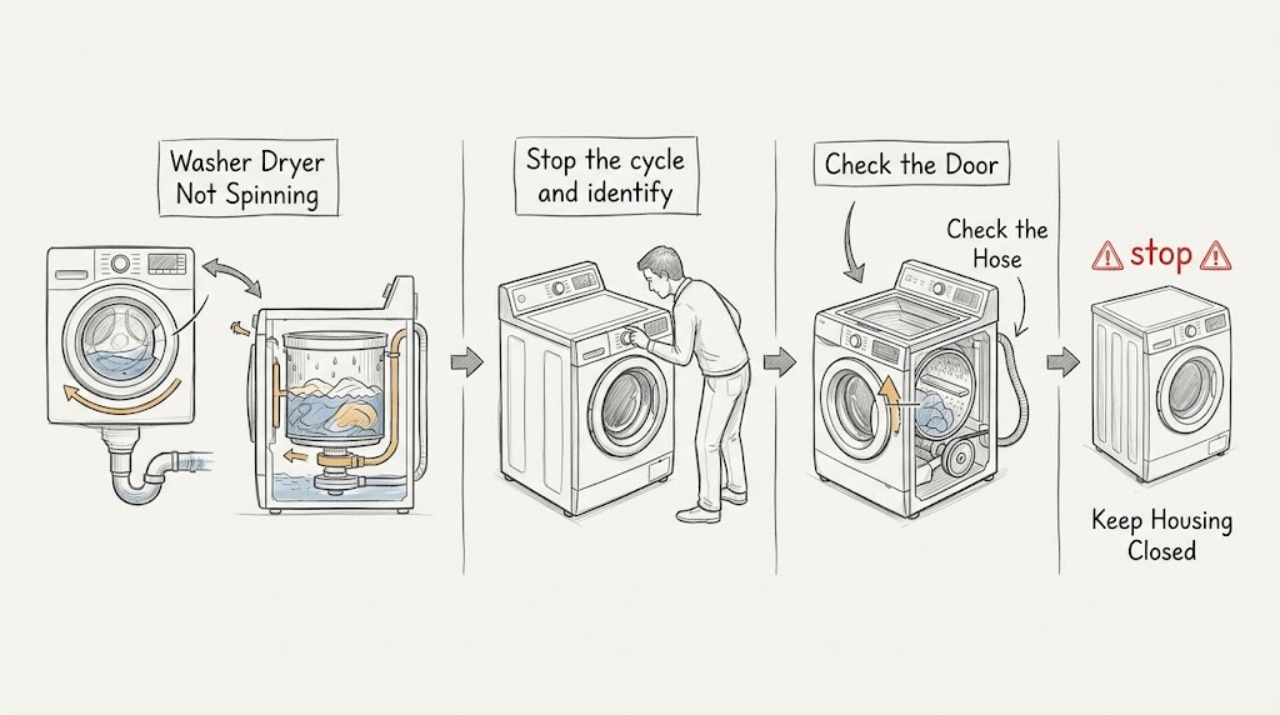
Work through in order
Diagnostic checks
Use only checks that match the exact appliance or system and its official guide.
-
Check 1
Stop the cycle and identify whether the washer side, dryer side, or both are affected. Before restarting, check from a safe position for a leak, water near electrical parts, violent movement, metal scraping, burning or electrical odor, smoke, sparks, overheating, a damaged cord, or a breaker that tripped again.
Expected result: A hazard or severe mechanical symptom is present, or the issue is limited to a washer load that remains wet without a safety warning.
Next step: For a hazard, stop, isolate water or power only if safe, keep clear, and obtain qualified or emergency help. If there is no hazard, keep the drum stopped and continue with the external checks.
Stop if: Stop immediately for a leak, violent walking or banging, metal-on-metal scraping, burning smell, sparks, smoke, overheating, shock, or another breaker trip.
Why this matters
Why: A leak, fire/electrical symptom, or destructive mechanical noise is not a normal balance or setting problem. The washer-dryer must not be repeatedly run to reproduce it.
-
Check 2
With the machine stopped and the load safe, read the selected cycle and spin option. Confirm that Low Spin, No Spin, Delicate, Hand Wash, or another model-specific gentle setting was not intentionally selected, and check that the washer door or lid closes and locks without force.
Expected result: A low/no-spin or gentle setting is selected, the door/lid is open or not locking, or the intended spin setting and closure appear correct.
Next step: Choose the model-recommended spin setting for the load and close the door or lid normally. Make one Drain and Spin or equivalent attempt if the manual allows; service a persistent lock or no-spin state.
Stop if: Stop for a damaged latch, a forced door or lid, water behind a locked door, or any attempt to defeat the safety interlock.
Why this matters
Why: Gentle or no-spin programs can leave more water by design, while an unconfirmed door or lid can prevent a safety-controlled spin. A normal setting and closure shift attention to drain, balance, suds, or drive diagnosis.
-
Check 3
Determine whether water is standing in the washer tub or drum. If it is safe and the appliance is disconnected as required by the model instructions, inspect only the accessible drain hose and household drain opening for an obvious kink, blockage, or incorrect placement; do not reach into moving parts or dismantle a pump.
Expected result: Water remains, the drain hose is visibly kinked or blocked, the drain arrangement is uncertain, or the tub is empty and the drain path appears normal.
Next step: Correct only an obvious accessible hose position or drain obstruction described by the exact manual, then use Drain and Spin once. If water remains, the drain is inaccessible, or a pump/filter requires opening a panel, arrange service.
Stop if: Stop for a leak, water near electricity, an inaccessible or pressurized drain connection, a pump-area obstruction requiring disassembly, or any need to enter a moving tub.
Why this matters
Why: A washer may refuse or limit spin when it cannot drain. A blockage or installation issue can mimic a drive failure, while an empty tub shifts attention to balance, settings, lock, suds, power, or internal drive components.
-
Check 4
With the drum stopped, open the washer only when the lock has released and redistribute the load loosely. Remove some items if tightly packed, avoid testing a single bulky item alone, and check whether the appliance visibly rocks on the floor; make only the model-approved external leveling adjustment.
Expected result: The load is a single bulky item, tightly packed, heavily concentrated on one side, or the appliance rocks; alternatively, the load and floor appear stable.
Next step: Redistribute or reduce the load and make one supervised spin attempt. If it bangs, walks, repeatedly stops, or remains unbalanced, stop and arrange service; do not keep adding water or forcing a cycle.
Stop if: Stop for violent shaking, walking, a loose or damaged foot, cabinet impact, metal scraping, or any need to lift or dismantle the appliance.
Why this matters
Why: An uneven or overloaded load can trigger reduced speed, repeated balancing, wet clothes, loud vibration, or a protective stop. A stable load shifts attention away from balance and toward drainage, settings, suds, power, or drive diagnosis.
-
Check 5
Review whether the load contains excessive foam, the wrong detergent type, or more detergent than the model recommends, and note any power interruption or tripped breaker during the cycle. Do not add random chemicals or repeatedly reset a circuit.
Expected result: There is unusually heavy suds, a detergent mismatch or overdose, a recent outage/trip, or no suds/power event is known.
Next step: Follow the exact manual's suds or recovery guidance and make at most one model-supported Drain and Spin attempt after the machine is safe. If the breaker trips again or the fault recurs, keep it off and request service.
Stop if: Stop for repeated breaker trips, hot or scorched wiring, smoke, sparks, burning smell, or a control state that cannot be safely reset.
Why this matters
Why: Excessive suds can interfere with pumping and spin, while a power interruption can leave the washer below full spin speed. Neither observation proves a failed pump, motor, belt, or control.
-
Check 6
Arrange qualified washer-dryer service when the drum remains still after the safe setting, door/lid, drain, balance, suds, and one recovery checks, or when it makes metal-scraping noise, hums without turning, spins intermittently, or stops again with a balanced empty or normal load.
Expected result: The appliance completes one supervised cycle after an external correction, or it remains still, returns the fault, leaves water, overheats, trips power, or produces abnormal mechanical noise.
Next step: Keep the washer-dryer out of service and provide the model, affected side, cycle and spin setting, water state, load, sound, power history, and safe checks performed. Let the technician decide whether a part is required.
Stop if: Do not open panels, test live circuits, remove a belt or motor, bypass a lock, or continue operating with leak, smell, sparks, overheating, scraping, or repeated trips.
Why this matters
Why: A persistent fault may involve the lock, drain pump, motor, belt, coupling, bearing, control, wiring, or a model-specific safety state. The symptom alone cannot safely identify the failed component.
Use your observations
Decision map
Find the observation that best matches what you see, then follow the next safe action.
-
PATH 01Next step
What you see
There is a leak, water near electrical parts, violent movement, metal scraping, smoke, burning smell, sparks, overheating, shock, or a breaker trips again.
Do this next
Stop the cycle, isolate water or power only if safe, keep clear, and obtain qualified or emergency help as appropriate.
Why this path and its safety boundary
Why it matters: This is a water, fire, electrical, or destructive-mechanical stop, not a routine spin adjustment.
-
PATH 02Next step
What you see
A low/no-spin, delicate, hand-wash, or another gentle setting was selected and the load is wet but there is no hazard.
Do this next
Use the model-recommended spin setting for the garment and one Drain and Spin or equivalent if supported; do not exceed garment-care or model limits.
Why this path and its safety boundary
Why it matters: The reduced spin may be intentional for the selected cycle.
-
PATH 03Next step
What you see
The door or lid does not close or lock, or a lock indicator remains while the drum should be stopped.
Do this next
Close normally and use only the model manual's release/reset procedure; never force or bypass the lock. Persistent failure needs service.
Why this path and its safety boundary
Why it matters: A safety interlock or closure condition can prevent spin.
-
PATH 04Next step
What you see
Water remains in the tub or drum, or the washer stopped before spinning.
Do this next
Check only the accessible drain hose and household drain as the model manual directs; use one safe drain/spin attempt, then call service for persistent water or inaccessible components.
Why this path and its safety boundary
Why it matters: Drainage or a water-level condition may be holding the safety-controlled spin.
-
PATH 05Next step
What you see
The washer shakes, walks, bangs, or stops with a single bulky, tightly packed, or uneven load.
Do this next
Redistribute or reduce the load and make one supervised attempt; service repeated imbalance, violent movement, or a rocking cabinet.
Why this path and its safety boundary
Why it matters: An out-of-balance or unlevel condition may be reducing or stopping spin to protect the appliance.
-
PATH 06Next step
What you see
Excessive suds, wrong/overdosed detergent, or a power interruption occurred and no immediate hazard remains.
Do this next
Follow the model's recovery guidance once, use the specified detergent, and arrange service for recurrence or another power trip.
Why this path and its safety boundary
Why it matters: Pumping or spin speed may be reduced without proving a drive failure.
-
PATH 07Next step
What you see
The load is balanced, the drain is clear, the setting and lock are correct, suds/power are normal, and the drum still will not spin or makes abnormal mechanical noise.
Do this next
Stop testing and arrange qualified washer-dryer service; do not open panels or select a replacement part from the symptom alone.
Why this path and its safety boundary
Why it matters: An internal drive, motor, pump, bearing, control, wiring, or interlock fault is possible.
Helpful context
Understand the symptom
The symptom tells you which branch to use
Standing water points first toward drainage; a balanced but very wet load points toward a setting, suds, or low-speed cycle; violent shaking points toward balance or leveling; a silent drum with a locked door points toward a safety interlock or control state. A washer-dryer may combine a washer drum with a separate dryer section, so verify that the washer side is the one not spinning. Manufacturer pages cited here are examples of documented washer behavior, not instructions that override the exact model manual.
Use a single controlled recovery attempt
When the drum is stopped and no safety symptom exists, correct one external condition at a time: select the intended spin speed, redistribute or reduce the load, close the door or lid, check the accessible drain hose, or measure detergent according to the model instructions. Then use a model-supported Drain and Spin or equivalent once. Repeatedly starting, forcing the door, or resetting a tripping circuit can worsen the fault.
Know the stop boundary
The user-level checks end when the appliance leaks, walks or bangs violently, scrapes metal, smells hot or electrical, sparks, overheats, trips power, keeps water inside, or requires a panel, live test, belt or motor access. Keep the washer-dryer out of service and give a technician the symptom sequence rather than naming a part from the noise alone.
Safety boundary
Stop conditions
- Water is leaking, standing near electrical parts, or cannot be safely drained from the washer.
- The appliance walks, bangs violently, produces metal-on-metal scraping, or the drum or cabinet appears mechanically damaged.
- Smoke, burning or electrical smell, sparks, overheating, exposed wiring, a hot or damaged cord, or repeated breaker trips occur.
- The door or lid is locked with water present, the latch is damaged, or the safety interlock would need to be forced or bypassed.
- Diagnosis would require opening panels, testing live circuits, reaching moving parts, dismantling a pump, motor, belt, bearing, or control, or repeatedly resetting the appliance.
When checks do not resolve it
Need a professional?
Request emergency or qualified electrical help for smoke, fire, sparks, shock, burning odor, overheating, exposed wiring, or a repeated breaker trip., Arrange qualified appliance service for a leak, standing water that cannot be safely removed, a damaged door/lid lock, persistent no-spin, recurring imbalance, metal scraping, or a drum that hums but does not turn., Arrange service when the correct spin setting, safe drain check, balanced load, detergent review, and one model-specific recovery attempt do not restore spin., Provide the exact model, washer or dryer side affected, cycle and spin setting, water level, load type, door/lid behavior, sound, power history, and checks already performed.
Safety scope: Do not force or bypass a lock, reach into a moving drum, open panels, test live wiring, dismantle the pump or drive, repeatedly reset a tripping circuit, or run the appliance with leaks, smoke, sparks, burning smell, overheating, or destructive noise.
Common questions
FAQ
Why is my washer-dryer not spinning but the clothes are wet?
Check for standing water, a low/no-spin or gentle setting, an unbalanced load, excessive suds, a door or lid lock, or a power interruption. Make one model-supported Drain and Spin attempt after safe external checks; persistent wet loads need service.
Can a low or no-spin setting make a washer-dryer seem broken?
Yes. Gentle cycles can intentionally use slower spin, and a no-spin option can leave more water in the load. Use the speed recommended by the exact model and garment-care instructions rather than assuming a drive failure.
Why does the washer side stop spinning with one blanket or a small load?
A single bulky item or unevenly distributed load can trigger reduced speed or a protective stop. With the drum stopped and the door unlocked, redistribute or reduce the load once; repeated violent imbalance needs service.
Can too much detergent stop a washer-dryer from spinning?
Excessive suds can interfere with pumping and spin on applicable models. Follow the exact detergent and dose instructions, use one model-supported recovery attempt, and call service if the fault returns or water remains.
Should I open the pump or remove the belt if my washer-dryer will not spin?
No. A locked door, standing water, setting, balance, suds, power, pump, motor, belt, bearing, and control fault can look similar. Keep the appliance off when a panel or internal test would be required and arrange qualified service.
When is a no-spin problem unsafe to keep testing?
Stop for a leak, water near electrical parts, violent movement, metal scraping, smoke, burning or electrical smell, sparks, overheating, damaged wiring, or a repeated breaker trip. Isolate water or power only if safe and obtain qualified or emergency help.
Read the exact guide
Official sources
- Washer Not Draining or Spinning? Troubleshooting Guide - Product HelpWhirlpool Product Help · Manufacturer example used for drainage, balance, settings, suds, door, and accessible hose/filter concepts; exact washer-dryer model and manual control access vary.
- Not Spinning - Washer - Product HelpWhirlpool Product Help · Manufacturer example used to support general symptom distinctions; it is not a universal washer-dryer instruction and exact model behavior controls.
- 8 Reasons Why Your Washing Machine Is Not SpinningWhirlpool · Manufacturer educational example used only for general branches; it includes Whirlpool-specific references and does not override another brand's manual.
Community feedback
Share a repair observation
Share a plain-text repair observation. Accepted observations are published automatically; this page may take a moment to update.