
On this page
Start here
Quick answer
First decide whether the whole washer dryer is dead, the display works but a cycle will not start, the wash side stops with water, the drum will not drain or spin, or the dry side tumbles without heat or airflow. Check only the accessible plug, wall outlet, breaker or protective outlet, door closure, water taps, hoses, drain path, load, and lint screen as the model manual permits. A single manual-approved reset can help separate a temporary control state from a recurring fault, but repeated resets are not a repair. Stop immediately for a leak near electricity, burning smell, smoke, sparks, a hot plug or cabinet, gas odor, scorching, violent movement, or a breaker that trips again. Do not open panels, bypass a door lock, work on a gas or heater circuit, or reach into a moving drum. If the fault remains after safe external checks, arrange qualified appliance repair.
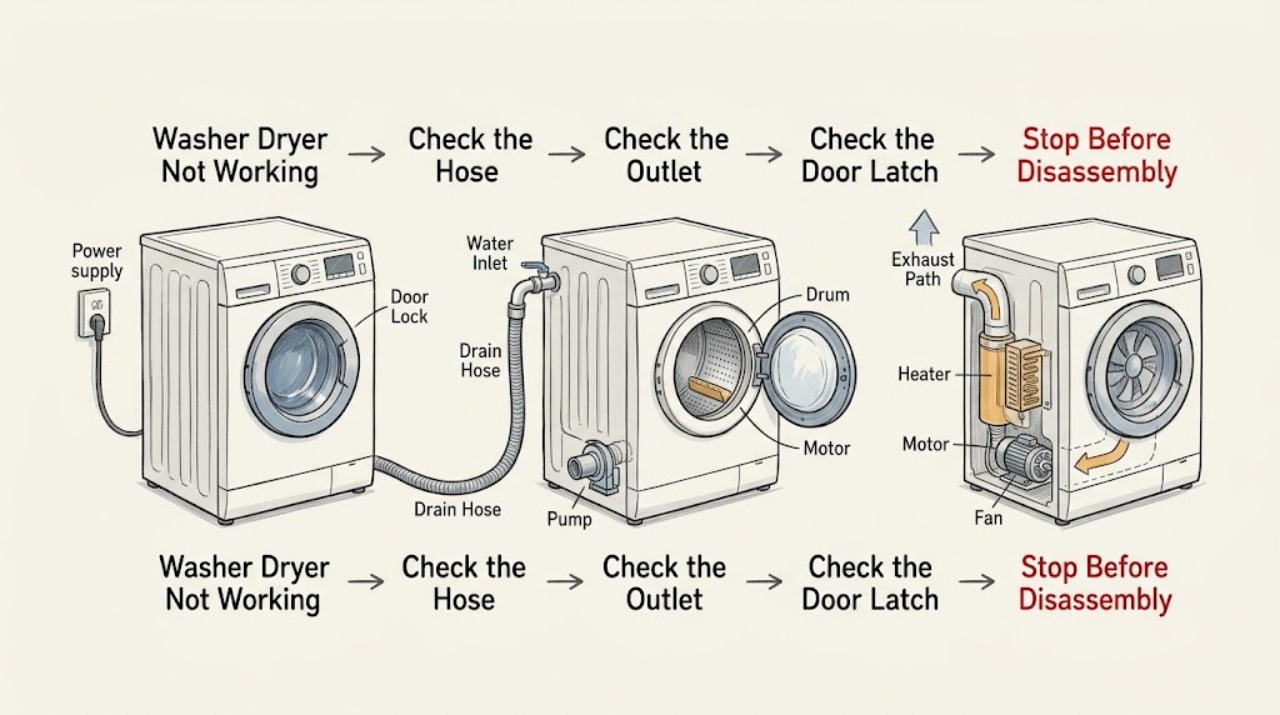
Work through in order
Diagnostic checks
Use only checks that match the exact appliance or system and its official guide.
-
Check 1
Stop the cycle and wait for the drum, water, and heat to stop. From outside the appliance, note smoke, burning smell, gas odor, sparks, a hot plug or cabinet, a leak, a damaged cord or hose, violent movement, or a breaker trip.
Expected result: The appliance stops normally with no hazard, or it continues to move, heat, leak, spark, smoke, smell scorched, or trip protection.
Next step: If there is no hazard, record whether the display is dark, the wash side fails, the drain or spin side fails, or the dry side fails. If there is a hazard, isolate the appliance only when safe and follow appropriate emergency or qualified service guidance.
Stop if: Stop immediately for smoke, flame, gas odor, sparks, a hot plug, exposed wiring, active water near electricity, violent movement, or repeated breaker trips.
Why this matters
Why: A normal stop permits low-risk external classification; an active hazard may involve electrical, water, gas, moving, or heating systems and must not be investigated by repeated cycles.
-
Check 2
If the whole appliance is dark, confirm the plug is fully seated in the intended wall outlet and check the accessible protective outlet or breaker. A small known-good device can check whether the outlet is supplying power; do not remove an outlet cover or terminal cover.
Expected result: The outlet has no power, the breaker or protective outlet is open, the appliance is on an extension or power strip, the display returns, or the outlet works but the appliance remains dark.
Next step: Restore an obvious accessible protective setting only once when safe. Plug the appliance directly into the prescribed outlet if the manual allows. If power is absent or returns only briefly, use a qualified electrician or appliance technician.
Stop if: Stop for a warm or scorched plug, damaged cord, moisture at the outlet, a loose receptacle, or any need to test or alter energized wiring.
Why this matters
Why: An external supply issue can make both sides appear dead. A working outlet with a dark appliance shifts concern to the appliance's cord, input, control, or internal supply, which is not a user replacement diagnosis.
-
Check 3
If the display works but a cycle will not start, confirm the selected program, start command, child lock or control lock state, and complete door closure. Inspect the visible seal and latch area for an obstruction without forcing the door or bypassing the lock.
Expected result: The door is not closed, a lock indicator is active, the display shows an error or paused state, the controls accept the cycle but the drum does not move, or everything appears normal but no cycle starts.
Next step: Clear a lock or paused state only with the model instructions, then make one supervised start. If the lock, latch, display, or drum remains unresponsive, stop and arrange service.
Stop if: Stop for a cracked door, damaged seal or latch, water in the control area, uncontrolled switching, smoke, odor, sparks, or a need to bypass a lock.
Why this matters
Why: A control state or door interlock can prevent a start without proving that a motor or pump failed. An error or a normal start command with no motion requires the exact model manual and possibly service.
-
Check 4
If the wash side will not fill, check that the intended water taps are open and the accessible inlet hoses are not kinked or visibly leaking. If it stops with water, do not open a drain filter until the manual explains the safe procedure and the water is cool enough to handle.
Expected result: A tap is closed, an inlet hose is kinked, water enters normally, the tub remains full, a drain hose is bent or obstructed, or water is escaping.
Next step: Correct only an obvious tap or hose position described by the manual. For a full tub, use the model's safe drain procedure; if water does not leave or a leak persists, stop and arrange service.
Stop if: Stop for active leakage, hot residual water, a burst hose, water near electricity, a pump obstruction that is not accessible, or a need to reach into the tub.
Why this matters
Why: Water supply and drainage can prevent a wash program from progressing, but the observation does not prove an inlet valve, pump, sensor, or control fault. A leak changes the priority from operation to water safety.
-
Check 5
If clothes are left wet or the washer will not spin, first determine whether water remains. With the appliance stopped, inspect the external drain hose for a kink, crush point, excessive rise, or visible obstruction and check that the load is not severely bunched. Do not force the drum or pump.
Expected result: Water drains after the hose is freed, water remains despite a clear hose, the load is unbalanced, the drum will not rotate, or the machine shakes violently.
Next step: Correct only a visible hose position or redistribute the load, then run one supervised test. If the machine still will not drain or spin, keep it out of service and arrange repair.
Stop if: Stop for violent shaking, metal scraping, water escaping, a hot or damaged hose, a blocked pump that needs disassembly, or a door that will not unlock safely.
Why this matters
Why: A drain restriction or unbalanced load can stop a spin stage, while a clear path and empty or balanced drum with no rotation points toward a pump, door lock, motor, control, or drive issue that needs diagnosis.
-
Check 6
If washing works but drying does not, confirm the load is within the model's drying capacity, use the prescribed dry program, clean the user-accessible lint screen when fitted, and inspect the visible exhaust or drain hose path for a kink or blockage. Do not touch a heater, fan, belt, or gas component.
Expected result: The load is too large, the dry program is not selected, the lint screen or visible path is blocked, water remains in the drain hose, the drum turns but stays cold, or the dryer is unusually hot.
Next step: Reduce the load and correct only a visible hose or lint-screen issue as the manual permits, then perform one supervised test without any warning sign. If drying remains cold, hot, slow, or unsafe, stop and arrange service.
Stop if: Stop for smoke, burning smell, scorching, a hot cabinet, weak airflow with overheating, sparks, gas odor, a damaged exhaust path, or a recurring breaker trip.
Why this matters
Why: A combo dryer may rely on water intake and drainage, while excess load or restricted airflow can reduce drying. A cold drum can involve a heater, sensor, control, fan, or supply issue; unusual heat raises a fire risk.
-
Check 7
Only when there is no water, heat, odor, smoke, spark, gas, or electrical warning and the model manual permits it, perform one documented control reset. Record whether the display, door lock, wash stage, drain or spin stage, and dry stage return to normal.
Expected result: The appliance works normally after one reset, the same stage fails again, an error returns, or the breaker, leak, heat, or odor problem returns.
Next step: If the fault returns, keep the appliance out of normal use and arrange qualified service. Provide the full model, failed side and stage, error display, load, water state, and all safety observations.
Stop if: Stop all operation for a leak, smoke, burning odor, gas odor, sparks, scorching, unusual heat, violent movement, or repeated electrical protection operation.
Why this matters
Why: A reset may clear a transient control state but cannot identify or repair a supply, lock, pump, motor, heater, fan, sensor, or control fault. Recurrence is evidence for model-specific diagnosis.
Use your observations
Decision map
Find the observation that best matches what you see, then follow the next safe action.
-
PATH 01Next step
What you see
The display and internal light are dark and an accessible outlet or protective device has not yet been checked.
Do this next
Arrange qualified service and follow the exact model guidance.
Why this path and its safety boundary
Why it matters: Check the direct power connection, outlet, and breaker or protective outlet once when safe. If the outlet works but the appliance stays dark, arrange repair.
-
PATH 02Next step
What you see
The display works but the cycle will not begin.
Do this next
Arrange qualified service and follow the exact model guidance.
Why this path and its safety boundary
Why it matters: Check the selected program, lock or paused state, and complete door closure. If the controls and door are correct but there is no start, stop and arrange service.
-
PATH 03Next step
What you see
The wash side does not fill or stops before washing.
Do this next
Arrange qualified service and follow the exact model guidance.
Why this path and its safety boundary
Why it matters: Check the intended taps and accessible inlet hoses for a closed position, kink, or leak. An unresolved fill fault needs service without opening the valve path.
-
PATH 04Next step
What you see
The wash side leaves water in the tub, leaves clothes wet, or will not spin.
Do this next
Arrange qualified service and follow the exact model guidance.
Why this path and its safety boundary
Why it matters: Check the accessible drain hose and load balance only after stopping safely. Persistent no-drain or no-spin behavior requires pump, lock, motor, or control diagnosis.
-
PATH 05Next step
What you see
Washing works but drying is cold, slow, incomplete, or produces a knocking sound.
Do this next
Arrange qualified service and follow the exact model guidance.
Why this path and its safety boundary
Why it matters: Check drying capacity, program, lint screen, water supply, and visible drain path. Stop for heat or fire signs and arrange service for internal airflow or heating faults.
-
PATH 06Next step
What you see
Water is escaping, the tub contains hot water, or water is near a plug, outlet, or electrical control.
Do this next
Arrange qualified service and follow the exact model guidance.
Why this path and its safety boundary
Why it matters: Stop the appliance and do not touch electrical connections in the wet area. Use qualified appliance or plumbing help after the area is safe.
-
PATH 07Next step
What you see
Smoke, burning smell, scorching, sparks, gas odor, unusual heat, or a repeated breaker trip is present.
Do this next
Arrange qualified service and follow the exact model guidance.
Why this path and its safety boundary
Why it matters: Stop use, move away from the hazard, and follow local fire, gas, or electrical emergency guidance. Do not restart, relight, or open the appliance.
Helpful context
Understand the symptom
The display tells you which side to investigate
A completely dark appliance needs a safe power check first. A lit display that will not start points toward a door lock, control state, selected program, water condition, or an error shown in the model manual. If the wash phase completes but water remains, investigate the drain path. If the drum spins but clothes remain wet or the dry phase ends cold, investigate drying capacity, water and drain behavior, airflow, and heating only from outside. Do not treat a brand's code list as a universal code list for every washer dryer.
A combination appliance has shared and separate systems
The power supply and control may be shared, while the wash water path, drain pump, drum drive, drying fan, heater, condenser, or exhaust path can differ by model. A working wash cycle does not prove that the drying system is healthy, and a powered display does not prove that a door lock or motor has engaged. Use the exact manual and record which phase fails.
Keep water and heat hazards separate from routine checks
Do not open a filter or drain area until the manual explains how to make the machine safe and you have considered hot residual water. Stop for a leak near electricity, a damaged hose, smoke, burning odor, sparks, scorching, unusual heat, or a repeated protection trip. For a gas-heated dryer, any gas odor or ignition concern is an immediate stop condition; do not relight or open the gas path.
Use the manual for the one permitted reset
A single model-approved reset may clear a temporary control state. It cannot prove that the supply, door lock, pump, motor, heater, fan, sensor, or control is sound. If the same fault returns, preserve the display and cycle information and arrange service instead of repeating resets or selecting a replacement part from the symptom alone.
Only after diagnosis
Potential parts
Only after diagnosis confirms that a valid cycle is blocked by the model's door or control system; do not bypass a lock or select a component from a no-start symptom.
Only after the water path is diagnosed for the exact model and any residual water is made safe; an open tap or bent hose does not prove an internal part failed.
Only after a qualified diagnosis confirms no-spin or repeated movement trouble with a suitable load and clear external path.
Only after qualified diagnosis of a persistent cold, slow, or overheated dry phase; do not open the cabinet or work on a gas or energized heater path.
When checks do not resolve it
Need a professional?
The outlet works but the appliance remains dark, or the display returns only briefly., The door or control will not permit a cycle, or the drum will not start with normal controls., Water will not enter or leave, the tub remains full, or the machine will not spin after a safe hose and load check., The dry phase is cold, unusually slow, overheated, or has weak airflow after the visible load and lint checks., Diagnosis would require a panel, door-lock bypass, pump, motor, heater, fan, gas path, or energized electrical access., There is a leak near electricity, smoke, burning smell, gas odor, sparks, scorching, violent movement, or repeated protection trips.
Common questions
FAQ
Why is my washer dryer not working at all?
Start with the accessible wall outlet, protective outlet, breaker, direct power connection, and display state. If the outlet works but the appliance stays dark, it needs service. If the display works, check the door and control state before splitting the problem into wash, drain or spin, and dry stages.
Why does the washer work but the dryer does not?
A combination appliance can share power and controls while using different drying water, drain, fan, heater, and airflow systems. Check the drying program, load capacity, lint screen, water supply, and visible drain path. A cold or overheated dry cycle needs service rather than repeated runs.
What should I do if my washer dryer is full of water?
Stop the cycle and keep hands away from the water until the manual's safe drain procedure is clear and the water is not hot. Check only an accessible kink or obstruction in the drain path. A persistent full tub, leak, or water near electricity requires qualified service.
Should I keep using a washer dryer that trips the breaker?
No. Do not keep resetting a breaker or protective outlet. Stop for a recurring trip, hot plug, scorch mark, smoke, burning smell, sparks, or water near electricity and arrange qualified electrical or appliance diagnosis.
Read the exact guide
Official sources
- LG washing machine - Whys is water not draining from my washer?LG USA Support · Supports checking an accessible drain path and stopping for persistent no-drain conditions for LG washer examples; do not apply its dimensions or filter procedure to another model without its manual.
- [LG Front Load Washer] Washer powers off during useLG USA Support · Supports treating a loose connection, heat at a poor contact point, or recurring breaker event as a stop-and-diagnose condition for LG washer examples.
- LG Washer - Troubleshooting Noises During the CycleLG USA Support · Supports the distinction between wash and spin symptoms, load balance, stable footing, foreign objects, and service for LG washer examples; it does not identify a component for every brand.
- Power Issues - Laundry DryerLG USA Support · Supports distinguishing no power from powered-but-not-running and checking a door lock, drum response, heat, and one reset for LG dryer examples; it is not a universal procedure.
- LG Washer – Why Won’t My LG Washing Machine Power On?LG USA Support · Supports direct outlet, protective outlet, breaker, connection, and service-routing checks for LG washer examples; other brands and models require their own manuals.
- [LG Washer] Dryer Performance TroubleshootingLG USA Support · Supports combo-dryer load, water-supply, drain-hose, and drying-performance observations for LG examples; exact capacities and settings are model-specific.
- Overheated Clothes Dryers Can Cause FiresU.S. Consumer Product Safety Commission · Supports lint-screen, exhaust-path, heat, combustible-material, and qualified internal-service warnings for clothes dryers generally; it is not a diagnosis for a particular washer dryer.
Community feedback
Share a repair observation
Share a plain-text repair observation. Accepted observations are published automatically; this page may take a moment to update.