
On this page
Start here
Quick answer
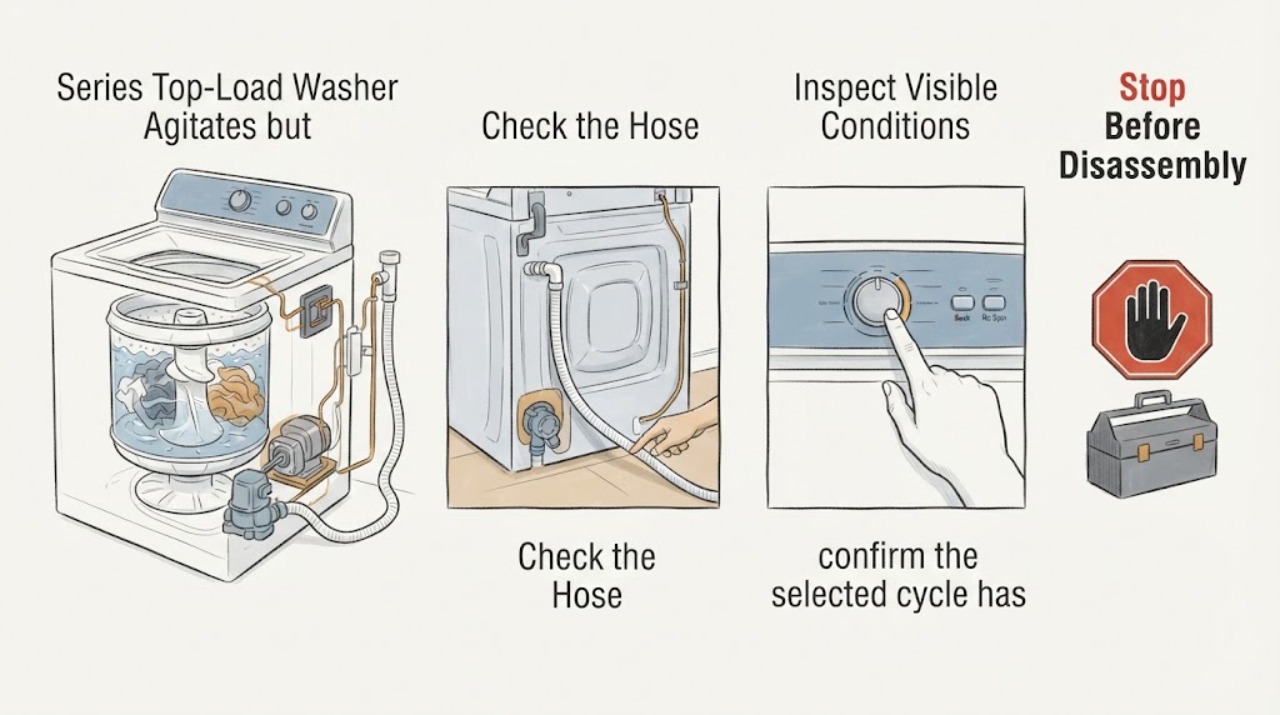
If a 70-series top loader agitates but leaves water and will not spin, first separate “not draining” from “drains but will not spin.” Stop the washer before moving hoses or handling a wet load, keep the lid closed during any operation, and record whether water remains in the tub. Whirlpool’s official top-load guidance points to the closed lid, drain-hose routing, excessive suds, low/no-spin settings and load balance as model-dependent checks; its older top-load owner manual also warns that the drain hose, lid, suds and voltage can prevent drain or spin. Do not assume a pump, lid switch, clutch, coupling or transmission from the symptom, and do not alter the lid safety circuit. If the hose and load checks do not restore the cycle, or there is a leak, burning smell, electrical concern or a machine that will not safely empty, use the exact model manual and arrange qualified service.
Work through in order
Diagnostic checks
Use only checks that match the exact appliance or system and its official guide.
-
Check 1
Stop the cycle using the normal control and observe from outside whether water remains in the tub, exits slowly, or leaves the tub while the basket stays still. Keep the lid closed and do not reach into the basket or underneath the cabinet.
Expected result: The tub remains full, drains only partly, drains fully but never spins, or neither drain nor spin occurs.
Next step: Use the water-path check for retained water and the setting/load check for a drained but wet load. If the machine leaks, smells hot or cannot be stopped safely, disconnect power from a safe location and arrange service.
Why this matters
Why: A full or partly full tub keeps the spin question unresolved; a fully drained tub with no basket movement points to a different branch. Agitation alone does not identify a pump, lid circuit or drive failure.
-
Check 2
With the washer stopped and power isolated before moving anything, inspect the visible drain hose for kinks, crushing or an end routed at an improper height. Check the household standpipe or sink for an obvious blockage without dismantling the washer.
Expected result: The hose is kinked/crushed, the drain receptacle is blocked or overflowing, the hose routing is uncertain, or the visible path is clear.
Next step: Correct only an obvious external routing issue according to the exact manual and clean the accessible household drain. If the path is clear or water still remains, stop disassembly and arrange model-specific service.
Why this matters
Why: Whirlpool’s guidance identifies hose routing and household drain restrictions as possible reasons for incomplete draining. A clear external path does not rule out an internal pump or obstruction, especially on top-loaders with no user-accessible filter.
-
Check 3
After the machine is safe and the tub is not dangerously full, confirm the selected cycle has a spin phase, no no-spin or low-spin option is selected, and the load is not a single bulky item or excessively sudsy. Redistribute only accessible clothing without reaching under the cabinet.
Expected result: The cycle/setting was low or no spin, the load was bulky or uneven, detergent suds are excessive, or the settings and load are normal.
Next step: Use the exact manual’s cycle and detergent guidance, then make one supervised test. If it still will not drain or spin, stop testing and request service rather than changing a part by symptom.
Why this matters
Why: Whirlpool says cycle selection, load balance, bulky items and excess detergent can retain water or lower spin. If the settings and load are normal, these checks do not explain the failure and no part is proven.
-
Check 4
Record the full model label, whether the tub is full, whether the drain hose moved water, whether the basket ever turned, and any humming, grinding, leak or burning odor. Do not open the cabinet or alter the lid safety circuit.
Expected result: The external checks fail, the tub remains full, the basket never turns, the same fault repeats, or a leak/electrical symptom is present.
Next step: Keep the washer out of service as appropriate and contact qualified appliance service with the recorded details. If water must be removed, follow the exact manual or have a technician handle it; do not improvise an internal drain procedure.
Why this matters
Why: The remaining possibilities include internal pump, control, lid-safety or drive faults, but the observation does not select one. A leak, burning odor or electrical concern is a safety boundary.
Use your observations
Decision map
Find the observation that best matches what you see, then follow the next safe action.
-
PATH 01Next step
What you see
Water remains in the tub or drains only partly after agitation.
Do this next
Check only visible hose routing and the household drain according to the exact manual. If clear or unresolved, arrange service without opening the cabinet.
Why this path and its safety boundary
Why it matters: The immediate problem is incomplete draining; spin may be inhibited until the tub empties. An external hose/receptacle issue is possible, but an internal pump or obstruction is not distinguished.
-
PATH 02Next step
What you see
The tub empties, but the basket never spins or the load remains very wet.
Do this next
Check the cycle and load balance once, then use the exact model manual and service path if spin still does not start. Do not alter the lid circuit.
Why this path and its safety boundary
Why it matters: The drain path may be working while a setting, lid-safety, control or drive issue prevents spin; the symptom alone does not identify the part.
-
PATH 03Next step
What you see
A low/no-spin setting, delicate cycle, single bulky item, imbalance or excessive suds is present.
Do this next
Use the correct cycle and detergent amount, redistribute the load only after stopping safely, and make one supervised test. Recurrence with a suitable load needs service.
Why this path and its safety boundary
Why it matters: Whirlpool identifies these conditions as reasons for retained water or reduced spin and they can be corrected without diagnosing an internal part.
-
PATH 04Next step
What you see
The hose and load are normal but the washer still will not drain or spin, or it has a leak, burning odor, electrical concern or cannot be safely emptied.
Do this next
Keep the washer off and arrange qualified service with the full model label and symptom sequence. Do not open the cabinet or modify the lid safety circuit.
Why this path and its safety boundary
Why it matters: This is an unresolved internal or safety service boundary; the generic “70 Series” label is insufficient for a part diagnosis.
Helpful context
Understand the symptom
Determine whether the water is actually leaving
“Will not drain or spin” can mean the tub stays full, the tub empties but the basket never spins, or both. Note the water level at the point the cycle stops, whether any water exits the hose, whether the motor makes a sound, and whether the basket moves at all. The phrase “70 Series” does not identify a single brand or model, so do not transfer a pump, lid-switch or direct-drive diagnosis from a similar-looking machine.
Keep the lid and water path within the user check
Whirlpool says a top-loader may not run with the lid open and that drain-hose access differs by model. With the washer stopped, inspect only the visible hose for a kink, crushing or an incorrectly routed end; check the standpipe or laundry sink for an obvious blockage or overflow. Do not pull a full wet tub forward, open the cabinet, or reach under the machine to get to an unseen pump.
Check settings, suds and load balance before naming a part
A low- or no-spin selection, delicate cycle, excessive detergent, a single bulky item or an uneven load can leave clothes wet or cause a washer to reduce spin. Use the exact control panel and owner manual for this washer; redistribute only a safe, accessible load after the machine has stopped. A successful spin after a load correction does not prove that the drain system or drive parts are healthy under every load.
Escalate when external checks do not explain it
If the hose and load checks are clear but water remains, or the tub drains yet never spins, the cause may be inside the pump, lid-safety circuit, timer/control or drive system. The symptom alone cannot distinguish them. Do not open the cabinet, test energized wiring, remove a lid safety device or order a pump, coupling, clutch or transmission from a series name. Give service the full model label, cycle position, water status and any sound or leak.
When checks do not resolve it
Need a professional?
Request qualified washer service when the visible drain path, cycle setting and load checks do not restore drain/spin, when the basket drains but never spins, or when there is a leak, burning odor, electrical concern or unsafe retained water. The 70-series name alone does not establish a compatible pump, lid switch, coupling, clutch or transmission.
Common questions
FAQ
Does agitation prove the motor and transmission are good?
No. Agitation and drain/spin can use different control states and mechanical paths. A washer can agitate while a drain, lid-safety, control or spin problem remains; use the symptom split and model-specific service path.
Can I bridge the lid switch to make it spin?
Do not alter or defeat the lid safety circuit. The lid must be closed during operation, and an internal safety diagnosis belongs to qualified service with the exact model.
Should I replace the drain pump first?
Not from this symptom alone. First distinguish retained water from a drained tub that will not spin, then check visible hose routing, cycle settings, suds and load balance. If those checks do not resolve it, have service identify the failed component.
Read the exact guide
Official sources
- Whirlpool Top-Load Washer Owner’s ManualWhirlpool · Opened official Whirlpool owner manual used as a model-bounded example of top-load drain/spin checks. It is not proof that every 70-series washer has the same hose height, control or internal design.
- Why is My Washing Machine Not Draining?Whirlpool · Opened official Whirlpool guidance used for general top-load symptom separation. It explicitly says model-specific manuals control filter/drain access and does not identify a part for an unnamed 70-series washer.
Community feedback
Share a repair observation
Share a plain-text repair observation. Accepted observations are published automatically; this page may take a moment to update.