
On this page
Start here
Quick answer
A flashing cycle light is not a universal washer fault code. Record which light flashes, its pattern, any display text, and the washer's exact model before assuming a lid-lock or control-board failure. With the tub empty and the washer safe and dry, check that Control Lock is not active, the intended cycle is selected, the lid or door is fully closed, and Start is pressed or held exactly as that model requires. Then observe the external hot and cold supplies and drain hose for closed valves, kinks, leaks, or a hose pushed too far into the standpipe. Whirlpool's opened guidance says these checks vary by model: some machines require a lid lock before starting, some require holding Start, and a flashing wash or lid light can relate to water-level sensing or a lock that has not reached its position. A single model-appropriate power cycle can be tried; if the same light returns, the washer leaks, or the lock never engages, stop and request service rather than opening the cabinet or guessing a lock or board.
Work through in order
Diagnostic checks
Use only checks that match the exact appliance or system and its official guide.
-
Check 1
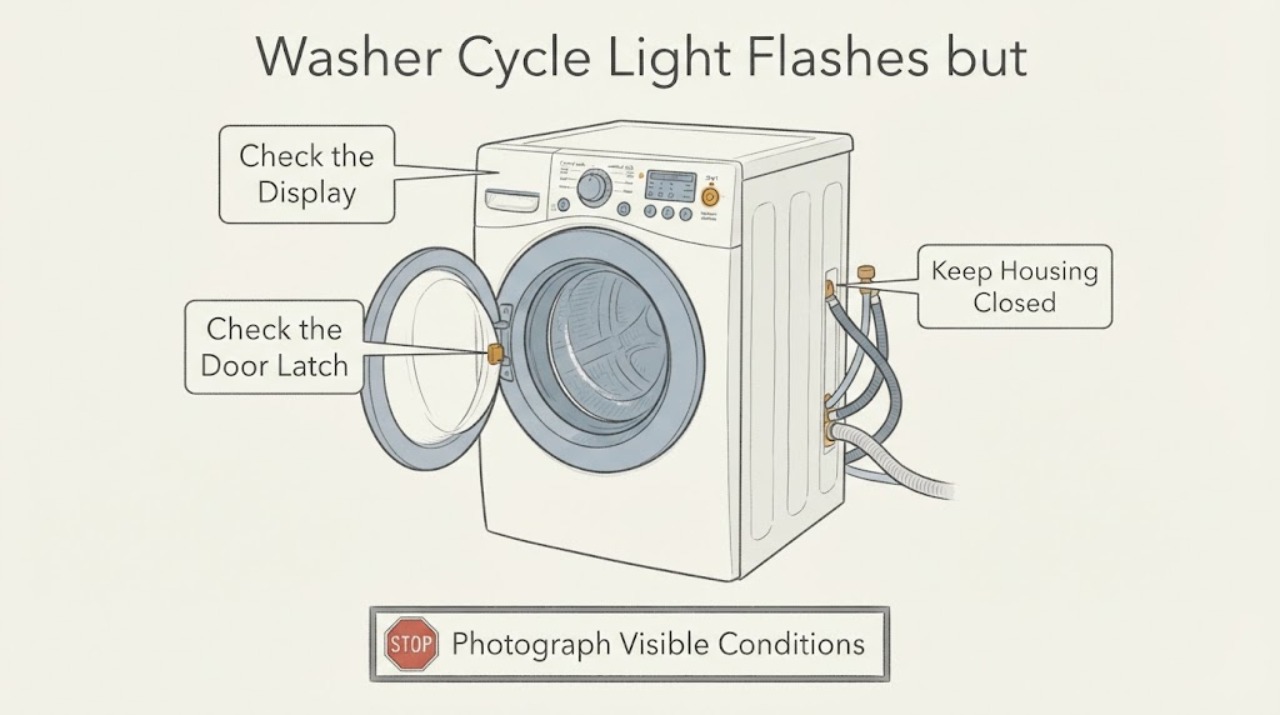
Photograph the control panel and record the exact light name, which lamps flash together, the blink pattern, any display code, the selected cycle, and the full model number from the rating label. Do not treat a generic “cycle light” description as a code.
Expected result: One named light flashes, several lights flash, a code is displayed, or the exact lamp and model cannot be identified.
Next step: Use the exact manual or manufacturer support page for the recorded model and light. If the model or pattern is unavailable, continue only with the external checks below and plan for service if the no-start remains.
Why this matters
Why: Whirlpool uses separate pages for wash, lid-lock, multiple-light, front-load, and top-load behavior, and says model manuals determine the correct interpretation. Without the lamp identity, a lid or control diagnosis would be speculation.
-
Check 2
With the washer idle, check that Control Lock is not active, the selector is aligned with a real cycle, and press or hold Start only as the exact model instructions specify. Do not press random button combinations or change cycles while the washer is trying to start.
Expected result: The controls are locked, the selector is between cycles, Start requires a hold, or the controls respond normally but the flashing light remains.
Next step: Correct only the visible setting described by the matching manual. If the controls respond but the light still flashes and no cycle begins, continue to the lid/door and supply checks rather than opening the console.
Why this matters
Why: Whirlpool says Control Lock prevents touch commands, some washers require holding Start for up to a few seconds, and a selector without an assigned cycle can prevent operation. These setup findings do not prove a failed control board.
-
Check 3
Close the lid or door firmly and inspect the visible striker, latch opening, and surrounding rim for clothing, detergent buildup, packaging, or another obstruction. Wipe only the accessible exterior with a soft damp cloth; do not press the lock, insert tools, bypass it, or open the cabinet.
Expected result: The lid/door closes and latches normally, an obstruction is visible, the lock clicks but does not engage, or there is no lock response.
Next step: Remove only a visible external obstruction and close the lid/door normally. If the light still flashes, the lock does not engage, or the machine makes repeated attempts, keep the washer unused and request model-specific service.
Why this matters
Why: Whirlpool says some washers will not start until the lid or door is closed and latched; it also lists interference, buildup, and a lock that cannot move or be powered as reasons a lid-lock light may flash. The observation does not identify whether the lock, striker, wiring, or control is at fault.
-
Check 4
From outside the machine, check that both hot and cold supply valves are open, the inlet hoses are connected without kinks or leaks, and the drain hose is not crushed or pushed too far down the standpipe. Do not disconnect hoses or reach behind a wet machine while it is powered.
Expected result: A supply valve is closed, a hose is kinked or leaking, inlet screens appear obstructed only if the model instructions explicitly permit that check, the drain hose is too far down, or the external water path looks normal.
Next step: Correct only a clearly closed valve or visible hose-routing issue and check for leaks. If the light persists, the washer fills and drains unexpectedly, or any hose must be removed, stop and request service or plumbing help.
Why this matters
Why: Whirlpool associates a flashing Wash Light with a water level that has not changed or is not detected and lists supply, inlet-screen, and drain-hose conditions as external checks. These observations do not establish a failed inlet valve, pressure sensor, or drain pump.
-
Check 5
If the washer is dry, stable, and not leaking, perform one model-appropriate power cycle using the manufacturer's instructions; Whirlpool's opened guidance commonly calls for disconnecting power for about five minutes. Restore power only after the wait and do not repeatedly reset a washer with a flashing lock or water hazard.
Expected result: The light clears and the washer starts normally, or the same light/pattern returns and the cycle still will not start.
Next step: If the symptom returns, keep the washer out of service and provide the model, light pattern, lid/door result, supply findings, and reset result to a qualified appliance technician. Do not remove panels or order a guessed part.
Why this matters
Why: A power cycle can clear a control state, but Whirlpool routes returning flashing-light or no-start symptoms to service. A reset does not prove that a lid lock, sensor, actuator, or control board has failed.
Use your observations
Decision map
Find the observation that best matches what you see, then follow the next safe action.
-
PATH 01Next step
What you see
Control Lock is lit, the selector is not on an assigned cycle, or the exact model requires a Start-button hold that was not used.
Do this next
Use the exact model instructions to clear Control Lock, select a valid cycle, and press or hold Start as specified. If the light still flashes, continue with the lid/door check.
Why this path and its safety boundary
Why it matters: The washer may be waiting for a user-setting condition rather than reporting a failed lock or board.
-
PATH 02Next step
What you see
The lid or door is not fully latched, the visible striker/rim is obstructed, or the lock clicks without reaching its position.
Do this next
Remove only an obvious external obstruction and close the lid/door normally. If engagement fails again, stop using the washer and request model-specific service; do not bypass the lock.
Why this path and its safety boundary
Why it matters: Whirlpool associates these findings with a flashing lid-lock indicator or a washer that will not start, but the symptom does not identify the internal lock or control component.
-
PATH 03Next step
What you see
The wash or sensing light flashes while no cycle is running and a supply valve is closed, a hose leaks or kinks, or the drain hose is routed too far into the standpipe.
Do this next
Correct only a clear external valve or routing issue and check for leaks. If the light remains or a hose must be removed, arrange appliance or plumbing service.
Why this path and its safety boundary
Why it matters: Whirlpool documents water-level and external fill/drain conditions that can leave a wash light on or flashing; this is not proof of an inlet valve, sensor, or pump failure.
-
PATH 04Next step
What you see
The controls, lid/door, and visible water paths are normal, but the same flashing pattern returns after one power cycle or the washer still will not start.
Do this next
Keep the washer out of service and request service with the full model, light pattern, any display text, and the observations. Do not open the console, test wiring, or buy a lock or board from the symptom.
Why this path and its safety boundary
Why it matters: The documented user-level checks did not resolve the model-specific condition, and the remaining cause cannot be identified safely from the light alone.
Helpful context
Understand the symptom
Identify the light before interpreting it
“Cycle light” can mean a selected-cycle indicator, a wash or sensing indicator, a lid-lock light, or a different status lamp on another washer. The topic has no brand or model, so it cannot be assigned a universal blink meaning. Whirlpool's opened pages explicitly say that lock timing, Start-button behavior, and the meaning of a flashing light vary by model; use the exact label and owner's manual before naming a failed part.
Use external checks to separate a setup condition from a service condition
A closed but unlatched lid, an active Control Lock, a cycle selector between positions, closed water valves, a restricted drain hose, or a required Start hold can all prevent a cycle from beginning on the documented washer families. Check these from outside, keep hands away from moving parts, and stop if there is a leak, burning smell, repeated breaker trip, damaged cord, or a lock that clicks without engaging.
When checks do not resolve it
Need a professional?
Request appliance service when the light pattern returns after the exact setup checks and one power cycle, when the lid or door will not latch, when the washer leaks or repeatedly tries to lock, when a breaker trips, or when any step would require opening a panel or testing internal wiring.
Common questions
FAQ
Does a flashing cycle light mean the lid lock is broken?
No. The light name and model matter. Whirlpool documents flashing wash lights for water-level detection conditions and flashing lid-lock lights for several lock-position or obstruction conditions. Neither symptom identifies a particular failed part.
Why won't the washer start when it has power?
Check the exact model's Control Lock, cycle selection, Start-button hold, lid or door closure, and visible water-supply and drain conditions. Whirlpool says these behaviors vary by model, so do not transfer a lock or reset sequence from another washer.
Can I hold Start longer or reset the washer repeatedly?
Use only the model-required Start hold and try one documented power cycle. If the flashing light returns, repeated resets will not identify the cause; keep the washer unused and request service.
Should I replace the lid lock when the light flashes?
Do not order a lid lock from the light alone. Whirlpool lists obstruction, lock position, power to the lock motor, and model-specific lock timing as possibilities. Service should confirm the exact model and cause before a part is selected.
Read the exact guide
Official sources
- Not Starting or Not Operating - Front Load WasherWhirlpool Product Help · Used only for model-dependent front-load examples: water valves, door closure, display-state observation, Start hold, and one power cycle. It is not used to identify the supplied washer's design.
- Not Starting - WasherWhirlpool Product Help · Used for Control Lock, lid closure, model-dependent Start-button hold, and one power-cycle guidance. It is not used to infer a failed part on an unidentified washer.
- Wash Light On or FlashingWhirlpool Product Help · Used for the manufacturer distinction between water-level detection, external supply, inlet-hose, and drain-hose checks. It is not used to transfer a Whirlpool light meaning to another brand or model.
- Lid Lock Flashing - WasherWhirlpool Product Help · Used for model-dependent lock timing, external obstruction/buildup checks, cycle selection, Start hold, and service boundary. It is not used to diagnose a universal lid-lock part.
Community feedback
Share a repair observation
Share a plain-text repair observation. Accepted observations are published automatically; this page may take a moment to update.