
On this page
Start here
Quick answer
Not necessarily. A top-load washer may have a user-accessible drain-hose connection, while many front-load designs route the hose to an internal connection and require the exact manual or an authorized technician. First identify the washer style and model, unplug the washer, close the water supplies, and inspect the visible hose, standpipe and any documented filter access for residue, kinks, cracks or leaks. Do not pull off an internal hose, tip the washer, remove panels or assume a dirty hose is the pump filter. Replace the hose only when the model instructions and fit information match; restore the manufacturer’s drain height, air gap, clamp and routing before a cautious leak check.
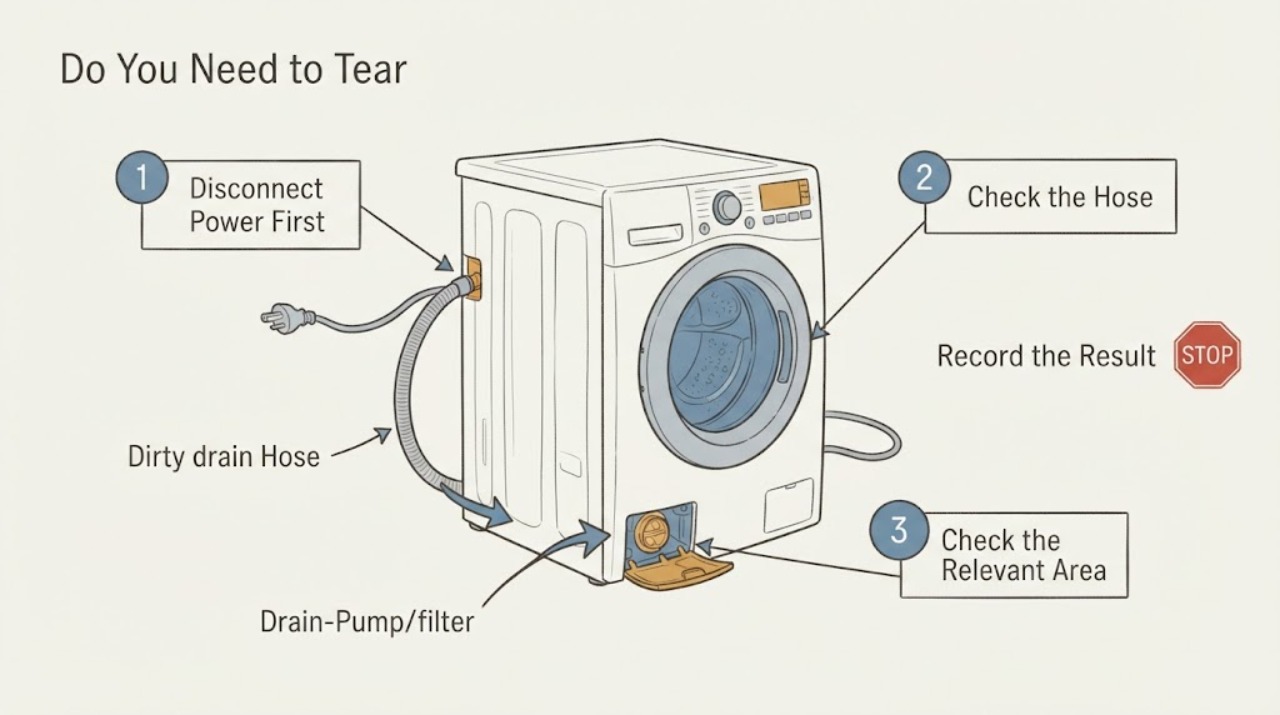
Work through in order
Diagnostic checks
Use only checks that match the exact appliance or system and its official guide.
-
Check 1
Read the model label and identify whether the washer is top-load or front-load before ordering a hose or opening an access panel. Keep the exact model and region manual available; do not infer the design from the symptom alone.
Expected result: The model and washer style are known, or the label/manual cannot be found.
Next step: If the model is unknown, limit work to external inspection and obtain the correct manual or qualified service. Do not use a hose or access procedure copied from another washer.
Why this matters
Why: The replacement path is model-dependent. Samsung documents different top-load and front-load hose connections, and Whirlpool says pump-filter access depends on the model number.
-
Check 2
Unplug the washer from a dry, reachable outlet, turn off both water supplies, and inspect the visible drain hose from the washer to the standpipe or tub. Look for slime or residue at the accessible end, a kink, crushed section, crack, bulge, loose clamp, abrasion or water trail; also check the standpipe opening for visible buildup without pushing objects into the washer.
Expected result: The external hose is visibly cracked, leaking, kinked or loose; residue is only at the free end or household drain; or the visible hose is intact.
Next step: Correct only the plainly visible, model-documented external routing or household-drain obstruction. If the hose is damaged, do not run the washer until the exact replacement path is confirmed; keep panels and internal clamps closed.
Why this matters
Why: A visible hose defect supports replacement or correction of that external section, while residue at the standpipe is a plumbing-side issue. A clean exterior does not show whether an internal hose or pump filter is dirty.
-
Check 3
Check the exact manual for a user-accessible drain filter or residual-water hose before opening any lower door or drawer. If the manual documents that access, place a shallow container and towels, drain residual water as instructed, and clean only the named filter or hose; do not call that filter the external drain hose.
Expected result: The exact manual documents a filter/residual-water access point, or it does not document one for this washer.
Next step: Follow only the exact manual’s power-disconnect, water-capture and reassembly steps. If no access procedure is documented or water cannot be contained safely, stop and arrange service.
Why this matters
Why: Whirlpool’s support instructions show that access varies by model and describe a filter and small drain hose for selected front-load designs. That procedure does not authorize removing the main drain hose or opening an unlisted panel.
-
Check 4
Compare the replacement decision with the exact model’s installation instructions. For a documented accessible connection, verify the hose diameter, clamp/retainer, outlet orientation and any plug or guide before removing the old hose; for an internal front-load connection, do not tip the washer or remove panels as a generic step.
Expected result: The manual confirms the replacement hose and gives an owner procedure, or the connection is internal/unclear and no owner procedure is provided.
Next step: Proceed only with the exact model’s documented owner-level replacement steps and matching fit information. Otherwise leave the washer disconnected and schedule qualified service rather than buying a universal hose or tearing down the cabinet.
Why this matters
Why: Samsung explicitly recommends authorized service for its front-load internal hose connection, while its top-load guidance uses model-dependent outlet and clamp arrangements. GE also directs users to model-specific installation instructions and warns that routing limits differ by washer type.
-
Check 5
After an owner-permitted external hose replacement, restore the guide/retainer, clamp and standpipe or tub routing exactly as the manual shows. Confirm the hose is not kinked, submerged or sealed airtight and that its height/insertion limits match the model; then perform only the manual’s cautious leak/drain check while watching from a dry position.
Expected result: The hose remains secure and dry during the documented check, or it leaks, backs out, drains too low, or produces a no-drain/odor symptom.
Next step: Stop the check, disconnect power and water if safe, and correct only the visible installation error within the exact manual. If the hose still leaks or the washer will not drain, arrange service without opening the pump or cabinet.
Why this matters
Why: GE and Samsung link correct height, open air connection, secure routing and no kinks with proper drainage. A leak or routing failure means the installation is not safe to continue; it does not prove the pump or control is bad.
Use your observations
Decision map
Find the observation that best matches what you see, then follow the next safe action.
-
PATH 01Next step
What you see
The washer is top-load, the model manual shows an external hose outlet with a clamp/retainer, and the hose itself is cracked, leaking or visibly contaminated.
Do this next
Use the model’s documented replacement and routing steps, then perform its leak check. Keep the machine off if the hose cannot be secured or the correct fit is uncertain.
Why this path and its safety boundary
Why it matters: This pattern can support an owner-level external hose replacement if the exact manual confirms the hose and connection; it does not make a universal hose or generic clamp compatible.
-
PATH 02Next step
What you see
The washer is front-load, the hose disappears into the cabinet, or the model manual does not expose an owner replacement procedure.
Do this next
Do not tip the washer or remove panels based on a generic guide. Obtain the exact manual or arrange authorized service for the replacement.
Why this path and its safety boundary
Why it matters: The hose connection is an internal service boundary for this unidentified washer. A filter door or small residual-water hose, if documented, is a different access point from the main drain hose.
-
PATH 03Next step
What you see
The visible hose is intact but the free end, standpipe or documented filter contains residue.
Do this next
Clean only the exact manual’s accessible filter or external drain area with power disconnected and water captured. If the washer still drains poorly or smells, escalate without opening unlisted panels.
Why this path and its safety boundary
Why it matters: The observed dirt may be in the household drain or a user-accessible filter rather than the main drain hose. Cleaning one area does not establish that the internal hose needs replacement.
-
PATH 04Next step
What you see
After reassembly, the hose leaks, slips from the standpipe, is kinked/submerged, or the washer develops a no-drain or odor symptom.
Do this next
Stop the washer, isolate power/water safely, and correct only the visible model-documented installation issue. If the fault remains or the internal connection is involved, use qualified service.
Why this path and its safety boundary
Why it matters: The routing, clamp, air gap or connection is not within the documented installation boundary; a leak can damage the floor and an incorrect height can cause siphoning or odors.
Helpful context
Understand the symptom
“Dirty drain hose” does not identify the access point
A washer can have residue at the free drain-hose end, buildup in the household standpipe, a kink or leak in the external hose, or debris at a model-specific pump filter. Those are different parts and access paths. Samsung’s guidance says the drain-hose outlet position and whether a plug is present depend on the model; Whirlpool says even pump-filter access depends on the model number. Identify the washer type and exact manual before removing anything.
Top-load and front-load replacement paths can differ
Samsung’s official guidance gives a useful family boundary: a top-load drain hose can use an outlet and clamp, whereas its front-load models have an internal hose connection and Samsung recommends authorized service for replacement. This is not a universal instruction for every brand. It is a reason to stop before tearing into a washer whose exact model and construction are unknown.
Routing is part of the repair
A clean or new hose can still cause leaks, siphoning, odors or poor draining if it is too low, pushed too far into a standpipe, kinked, submerged or sealed airtight. GE and Samsung publish different height and insertion limits for their washer families, so use the exact model’s installation instructions rather than transferring a measurement from another brand.
Only after diagnosis
Potential parts
- model-specific washer drain hose and clamp/retainer
Only consider this after the exact model manual confirms that the visible hose is damaged and identifies the correct connection, clamp or retainer.
No brand, model, region or hose connection was supplied; confirm fit and routing in the manufacturer’s exact manual before ordering.
Common questions
FAQ
Do I have to tear apart the washer to replace a dirty drain hose?
Not always. Some top-load designs expose the hose connection, but front-load designs may connect the hose internally and require authorized service. Identify the exact model before removing panels or ordering a hose.
Is the drain-pump filter the same as the drain hose?
No. A model may have a user-accessible filter or small residual-water hose while the main drain hose remains connected elsewhere. Whirlpool says filter access depends on the model; follow that manual instead of treating every lower access door as the main hose connection.
Can I install a universal washer drain hose?
Do not assume compatibility. Hose diameter, clamp or retainer, outlet position, plug, height and standpipe routing vary by washer type and model. Confirm the exact manufacturer instructions and fit information first.
What should I do if the replacement hose still leaks?
Stop the washer and isolate power and water safely. Check only the visible model-documented clamp, routing, kink, insertion and air-gap conditions; if the connection is internal or still leaks, use qualified service rather than opening the cabinet.
Read the exact guide
Official sources
- ¿Cómo instalar la manguera de desagüe de la lavadora?Samsung Colombia · Official Samsung Colombia support guidance, applicable to Samsung products sold through Colombia and used here as a documented family example only. It distinguishes top-load accessible connections from front-load internal connections and directs model-specific manual/service use; it is not a universal procedure for other brands or unidentified washers.
- Install a Samsung washing machine in your homeSamsung Electronics America · Official Samsung US installation guidance used as a family example for routing, air-gap, height, kink and leak/odor implications. Exact measurements are model/region dependent and must not be transferred to an unidentified washer.
- Washer - Drain Hose InformationGE Appliances · Official GE family support page used to show that drain height, diameter, standpipe and hose-replacement guidance varies by washer type and exact model. It is not evidence of fit for an unidentified non-GE washer.
- Cleaning the Drain Pump FilterWhirlpool · Official Whirlpool family support page used only to establish model-dependent filter access and safe residual-water handling. It is not a main drain-hose replacement procedure and is not evidence for an unidentified washer.
Community feedback
Share a repair observation
Share a plain-text repair observation. Accepted observations are published automatically; this page may take a moment to update.