
On this page
Start here
Quick answer
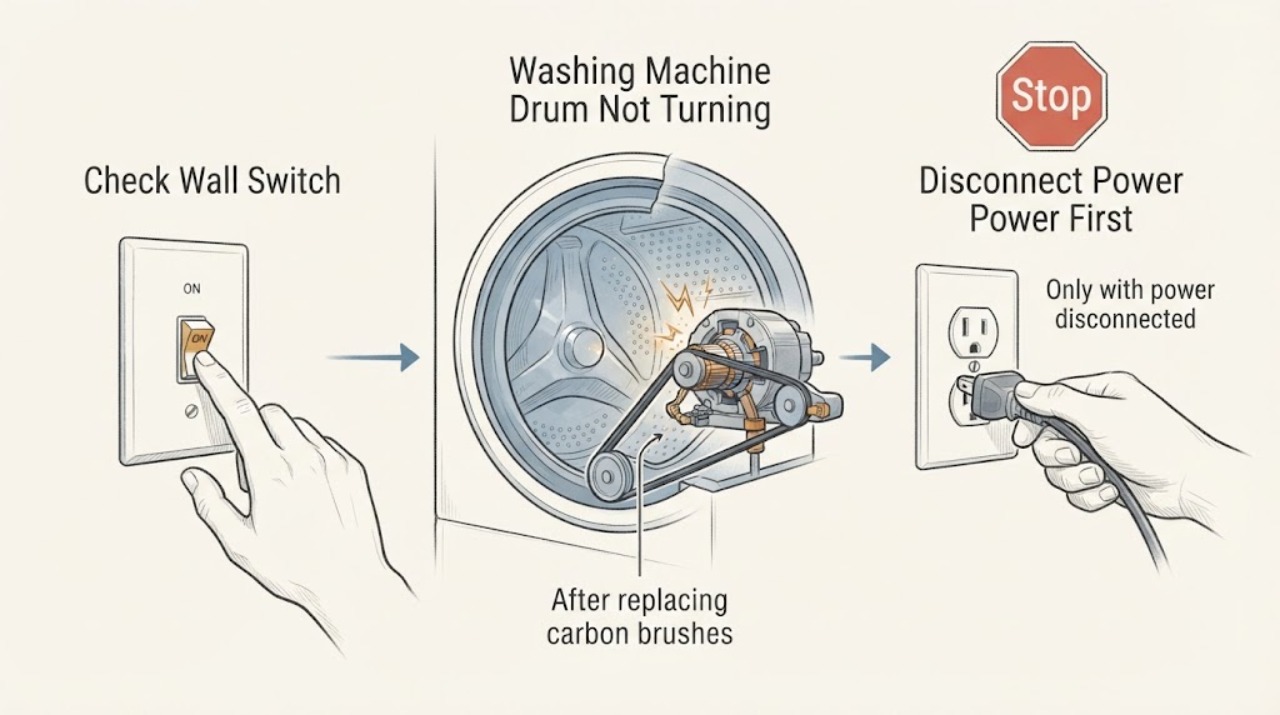
A washing machine that still does not turn and produces constant blue sparking after carbon brushes were replaced should be taken out of service and unplugged. Do not run another cycle to see whether the brushes bed in, open the cabinet, or perform a live electrical test. The exact brand and model are missing, so no brush fit, wiring, commutator condition or control-board diagnosis can be assigned. Manufacturer guidance confirms that worn brushes can be related to a drum that does not turn and directs unresolved motor/brush work to a trained or qualified engineer. Record the exact model, what was replaced, whether there was smoke or burning odor, and whether the unplugged drum turns freely; then arrange qualified appliance service.
Work through in order
Diagnostic checks
Use only checks that match the exact appliance or system and its official guide.
-
Check 1
Stop the washer, switch it off at the mains and unplug it if the plug and cord are safe to reach. Do not start another cycle or watch the motor under power. Look only from outside for smoke, burning odor, unusual heat, melted insulation, a damaged cord or a tripped protective device.
Expected result: Smoke, a burning smell, abnormal heat, visible electrical damage, repeated tripping or continuing sparks is present.
Next step: Keep the washer disconnected, keep people away from hot or damaged areas, and arrange qualified appliance service; use emergency help for an active fire or spreading smoke. Do not restore power to test it.
Why this matters
Why: The symptom has an electrical or fire-risk boundary that cannot be screened safely by a model-independent brush check.
-
Check 2
Without opening the cabinet, record the full rating-plate identity and the exact work already done: brand/model, brush part description or invoice, whether both brushes were changed, when the sparking began, and whether the drum ever turned normally afterward. Keep the washer disconnected while collecting this information.
Expected result: The model or brush identity is unknown, or the replacement was not confirmed against the manufacturer's model documentation.
Next step: Give the exact identity and work history to an authorized or qualified servicer. Do not buy another brush set, alter wiring or open the motor based only on the symptom.
Why this matters
Why: Brush geometry, holder orientation, motor type and service steps cannot be assumed across washers; a generic brush or wiring diagnosis would be unsupported.
-
Check 3
Only with power disconnected and the washer in a safe, empty state, use the owner's manual's permitted external check to turn the drum gently by hand. Do not remove panels, reach into the motor area, move wiring or use a meter.
Expected result: The drum turns smoothly by hand, or it is tight, seized, scraping or blocked.
Next step: Leave the washer disconnected in either case. Report the hand-turn result to the servicer and do not run a cycle to compare the noise or spark.
Why this matters
Why: A smooth hand movement does not clear the motor or electrical circuit; resistance or scraping adds a possible mechanical issue. Neither observation identifies a particular part.
-
Check 4
Use the documented symptom pattern to request a motor/drive assessment rather than another trial replacement: no drum rotation, continuous visible sparking after brush work, and any smoke, odor, clicking or fault indication should all be reported.
Expected result: The drum remains unable to complete wash or spin movement, or the sparking returns whenever power is restored.
Next step: Book qualified service and provide the model and work history. Keep the washer out of service until inspected.
Why this matters
Why: The unresolved drive problem needs model-specific professional diagnosis; the evidence does not distinguish brushes, brush holders, commutator, motor, wiring or control electronics.
Use your observations
Decision map
Find the observation that best matches what you see, then follow the next safe action.
-
PATH 01Next step
What you see
Smoke, burning odor, abnormal heat, visible damage, repeated tripping or sparking that continues when the motor accelerates is observed.
Do this next
Keep power disconnected and arrange qualified service; use emergency help for an active fire or spreading smoke.
Why this path and its safety boundary
Why it matters: The washer has an unresolved electrical/motor hazard and should not be operated for diagnosis.
-
PATH 02Next step
What you see
The unplugged drum turns freely but the washer will not turn it under a normal program after the brush replacement.
Do this next
Do not re-energize the washer. Give the servicer the model, brush history and sparking description for a model-specific drive assessment.
Why this path and its safety boundary
Why it matters: The mechanical drum is not proven seized, but the motor drive circuit remains unresolved; free hand movement does not prove the new brushes or wiring are correct.
-
PATH 03Next step
What you see
The unplugged drum is tight, scrapes, or will not turn by hand.
Do this next
Leave the washer disconnected and request qualified service without removing panels or attempting to free the drive.
Why this path and its safety boundary
Why it matters: A mechanical obstruction or binding condition may be present in addition to the reported electrical symptom, but the location is not established.
-
PATH 04Next step
What you see
The washer has no smoke or odor, but the original no-spin/sparking condition is not independently reproduced after power is restored.
Do this next
Do not create a repeat test; provide the full history to service and keep the appliance out of use until the cause is assessed.
Why this path and its safety boundary
Why it matters: An intermittent symptom is still unverified and does not justify declaring the brush replacement successful or safe.
Helpful context
Understand the symptom
The reported sequence matters: the washer previously stopped turning, new brushes were fitted, and the machine then showed continuous blue sparking at higher speed. That history does not prove that the new brushes are correct, incorrectly seated, or the only damaged component. With no brand, model or service manual, the safe answer is an external assessment and qualified service boundary rather than a brush, commutator or control-board repair recipe.
A small amount of motor arcing cannot be judged safely from a generic description, and constant visible sparking plus a no-spin symptom should not be treated as a normal break-in test. Do not re-energize the washer to compare the spark. Any smoke, burning odor, heat, damaged cord or repeated trip is an immediate stop-use signal.
When checks do not resolve it
Need a professional?
Arrange qualified appliance service before further use when visible sparking occurs after brush replacement, the drum still does not turn, or any smoke, burning odor, heat, damaged cord or protective trip is present. Do not treat the condition as a normal brush break-in test.
Common questions
FAQ
Is constant blue sparking normal after fitting new washing-machine brushes?
Do not assume it is normal. In this task the sparking is paired with a no-spin history and occurred after brush work, while the exact machine and brush fit are unknown. Stop using the washer, unplug it, and have the drive system assessed rather than running a bedding-in test.
Can I replace the carbon brushes again to see whether the drum starts?
No. Without the brand, model and verified brush specification, another replacement could repeat the fault or hide a motor, holder, commutator, wiring or control problem. Give the exact work history to a qualified servicer and do not restore power for testing.
What can I safely check myself?
After disconnecting power, record the model and visible symptoms and, only if the owner's manual permits it, note whether the empty drum turns gently by hand. Do not open panels, reach the motor, move wiring or measure live circuits. A drum that does not turn at all through wash and spin generally requires an engineer.
Read the exact guide
Official sources
- What to do if your washing machine is not spinningSamsung Support · Samsung guidance used for general external observations and stop/service boundary only; Samsung model codes and cycle steps are not transferred to the unidentified washer.
- Washing machine drum is not turningBosch Home Appliances · Bosch-specific guidance used only for general decision categories and the professional-service boundary; it does not assign Bosch parts, values or procedures to this unidentified washer.
- Are IKEA washing machines brushless?IKEA Sweden · IKEA guidance used only to establish that brushes are motor wear components and that replacement help should come from the appliance manufacturer; no IKEA model or brush fit is transferred.
Community feedback
Share a repair observation
Share a plain-text repair observation. Accepted observations are published automatically; this page may take a moment to update.