
On this page
Start here
Quick answer
For the Kenmore Elite HE3t front-load washer covered by the opened Sears/Kenmore owner manual, F02 is a drain problem. Confirm that the washer's model label matches the manual's Elite HE3t model 110 family before applying these steps. Press PAUSE/CANCEL twice, disconnect power, and check only the accessible drain hose for a kink, freeze condition, clog, or an installation height above 96 inches (2.4 m). If F02 returns after those external checks, or if the washer still contains water, stop and arrange service; do not open the pump, perform electrical tests, or use this code meaning on another Kenmore series.
Before you begin
Safety first
- Disconnect power before the manual's F02 inspection. Do not remove panels, open the pump, perform energized electrical checks, bypass controls, or transfer F02 meanings from another Kenmore series.
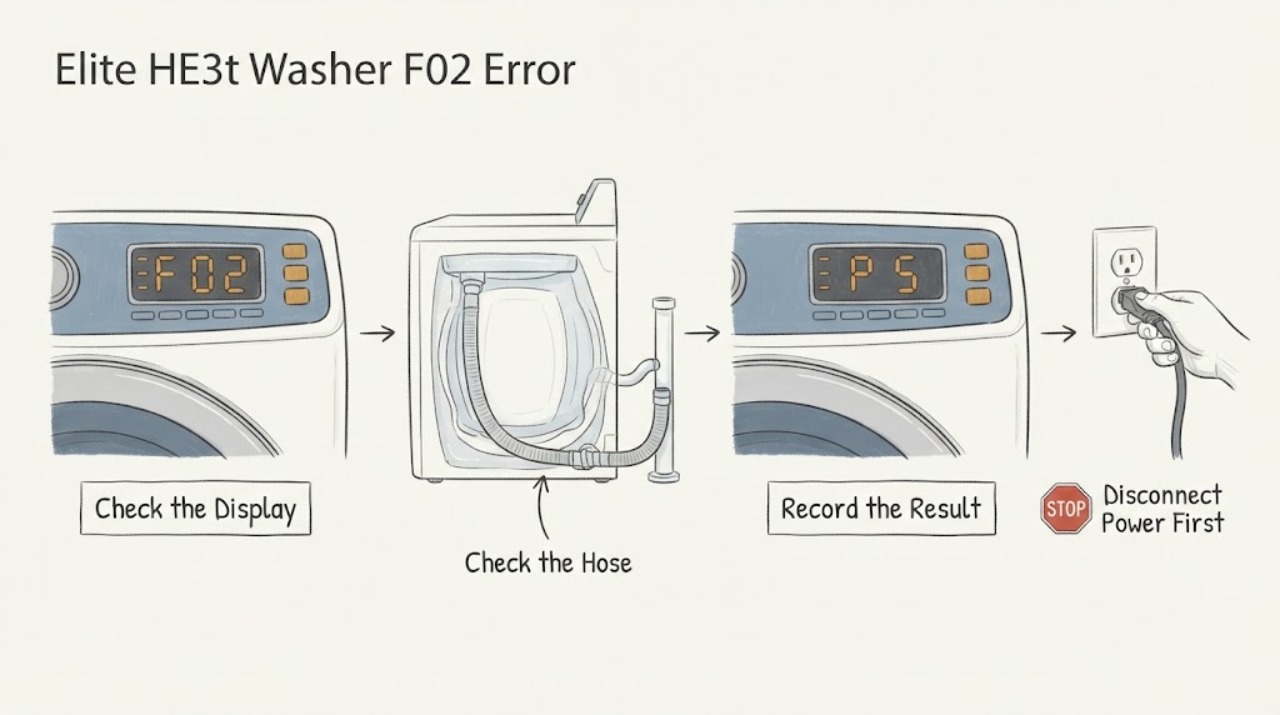
Work through in order
Diagnostic checks
Use only checks that match the exact appliance or system and its official guide.
-
Check 1
Read the complete model and serial label before interpreting the code. Compare the label with the Kenmore Elite HE3t owner manual and its model-number field beginning with 110; do not apply this F02 definition to a different Kenmore series.
Expected result: The label matches the Elite HE3t model 110 family, or the label identifies another or incomplete model.
Next step: If the label does not match, stop and use the correct model manual or request model-specific service. If it matches, continue with the manual's external drain checks.
Why this matters
Why: A matching label supports the manual's code table. A different or unreadable label leaves the code meaning unresolved because Kenmore code meanings vary by series.
-
Check 2
Press PAUSE/CANCEL twice to cancel the cycle, then disconnect the washer from power before inspecting the accessible drain hose. Do not reach into the pump, remove panels, or perform energized electrical checks.
Expected result: The cycle cancels and the washer is safely disconnected, or water remains and the washer cannot be safely stopped or disconnected.
Next step: If the washer cannot be made safe, leave it out of service and call a qualified appliance technician. Otherwise continue with the hose inspection while power is disconnected.
Why this matters
Why: The manual directs cancellation and disconnection for F02. Standing water or an unsafe electrical condition means the problem needs a controlled service response rather than repeated starts.
-
Check 3
Inspect the full accessible drain hose for a kink, crushed section, visible clog, or freeze condition. Check that the hose is routed no higher than 96 inches (2.4 m) above the floor, as specified by the manual; do not push excess hose tightly into the standpipe.
Expected result: The hose is kinked, frozen, visibly obstructed, or above the documented height, or it is open, correctly routed, and free of an accessible defect.
Next step: Correct only an obvious external routing problem after the washer remains disconnected. If no external issue is found, stop rather than opening the pump and arrange service.
Why this matters
Why: A restricted or excessively high drain path matches the manual's F02 checklist. A clear, correctly routed hose does not prove that the pump or another internal part is defective.
-
Check 4
Check the display for SUD separately from F02 and note the detergent type and amount used. Do not treat a SUD display as proof that F02 has a different code meaning.
Expected result: SUD is displayed, F02 is displayed without SUD, or the display alternates between the two.
Next step: Follow the detergent guidance for a SUD condition. If F02 remains after the drain path is externally clear, keep the washer out of service and request diagnosis.
Why this matters
Why: The manual describes SUD as a separate routine caused by excessive suds and recommends reducing detergent or using HE detergent; F02 remains the manual's drain problem code.
-
Check 5
After an obvious external hose correction, restore power once and observe one normal drain attempt without opening the cabinet. Record whether water leaves the washer and whether F02 returns; stop immediately for leakage, abnormal electrical odor, or repeated failure.
Expected result: The washer drains normally and F02 clears, or it drains slowly, leaves water, or F02 returns.
Next step: For recurrence, retained water, leakage, or abnormal odor, disconnect power if safe and arrange service. Do not remove the pump cover, test wiring, or order a pump from the code alone.
Why this matters
Why: A cleared code after correcting a documented external restriction supports a drain-path explanation. Recurrence or retained water means the manual's external checklist did not resolve the issue and does not identify an internal part by itself.
Use your observations
Decision map
Find the observation that best matches what you see, then follow the next safe action.
-
PATH 01Next step
What you see
The model label matches the manual's Kenmore Elite HE3t model 110 family and the drain hose is kinked, frozen, clogged, or routed above 96 inches (2.4 m).
Do this next
Disconnect power, correct the accessible hose condition, and make one normal test. Stop if F02 returns or water remains.
Why this path and its safety boundary
Why it matters: The documented external drain path contains a condition that can account for the manual's F02 drain problem.
-
PATH 02Next step
What you see
The model label matches, the accessible hose is correctly routed and clear, and F02 returns or the washer still holds water.
Do this next
Leave the washer disconnected and request model-specific appliance service. Do not open the pump or perform internal electrical tests.
Why this path and its safety boundary
Why it matters: The manual's external F02 checks did not resolve the drain problem; the code does not identify a specific pump, pressure, control, or wiring failure.
-
PATH 03Next step
What you see
The display shows SUD rather than F02, or alternates between SUD and F02.
Do this next
Use only HE detergent and reduce the amount as directed by the manual; if F02 remains, return to the external drain check and service boundary.
Why this path and its safety boundary
Why it matters: The manual treats SUD as a separate excessive-suds routine, while F02 is the drain problem code.
-
PATH 04Next step
What you see
The model label is not readable, does not match the Elite HE3t model 110 family, or the washer has a leak, exposed damage, or an electrical odor.
Do this next
Keep the washer out of service and obtain the correct manual or qualified service. Disconnect power only from a safe location and do not continue testing.
Why this path and its safety boundary
Why it matters: The manual's F02 interpretation cannot safely be transferred, or the appliance has exceeded an external user check.
Helpful context
Understand the symptom
Scope F02 to the Kenmore Elite HE3t manual
The opened owner manual is for a Kenmore Elite HE3t front-loading automatic washer and records a model-number field beginning with 110. Its troubleshooting section explicitly labels F02 as a Drain Problem. Because Kenmore uses different code tables across series, check the full model label on the washer before using this interpretation; an F02 on another Kenmore family needs that family's manual.
Start with the external drain path
The manual's F02 checklist stays at the drain hose and installation path: look for a kink, freezing, clogging, or a hose routed higher than 96 inches (2.4 m). It does not establish that the pump, control, pressure system, or another internal component has failed. Keep the front panel and pump area closed unless a qualified technician is performing model-specific service.
When checks do not resolve it
Need a professional?
Request qualified appliance service when F02 returns after the documented external drain-hose checks, water remains in the drum, the model label does not match the Elite HE3t model 110 family, or the washer has a leak, electrical odor, exposed damage, or another unsafe condition.
Safety scope: Disconnect power before the manual's F02 inspection. Do not remove panels, open the pump, perform energized electrical checks, bypass controls, or transfer F02 meanings from another Kenmore series.
Common questions
FAQ
What does F02 mean on a Kenmore Elite HE3t washer?
In the opened Kenmore Elite HE3t owner manual for the model 110 family, F02 is labeled a Drain Problem. Confirm the full model label before applying that meaning to another Kenmore washer.
Should I remove the pump to fix F02?
The user-facing manual first directs cancellation, power disconnection, and checks of the accessible drain hose for kinks, freezing, clogging, and excessive height. If F02 remains, arrange service instead of opening the pump or performing internal tests.
Is F02 the same as SUD?
No. The manual lists F02 as a Drain Problem and describes SUD as a separate excessive-suds routine. Use HE detergent and reduce the amount for SUD; do not use SUD guidance to reinterpret F02.
What should I give the technician?
Provide the complete model and serial numbers, the exact display code, whether water remains, the drain-hose routing and condition, whether SUD appeared, and what happened after any external hose correction.
Read the exact guide
Official sources
- Kenmore Elite HE3t Front-Loading Automatic Washer Owner's Manual and Installation InstructionsSears, Roebuck and Co. / Kenmore · Coordinator verified and registered this exact URL as an official Kenmore/Sears document exception. The cover identifies the Elite HE3t front-loading automatic washer; the article is limited to that manual-confirmed family and requires the washer label to be checked before applying the F02 definition. No claim is transferred to other Kenmore series.
Community feedback
Share a repair observation
Share a plain-text repair observation. Accepted observations are published automatically; this page may take a moment to update.