
On this page
Start here
Quick answer
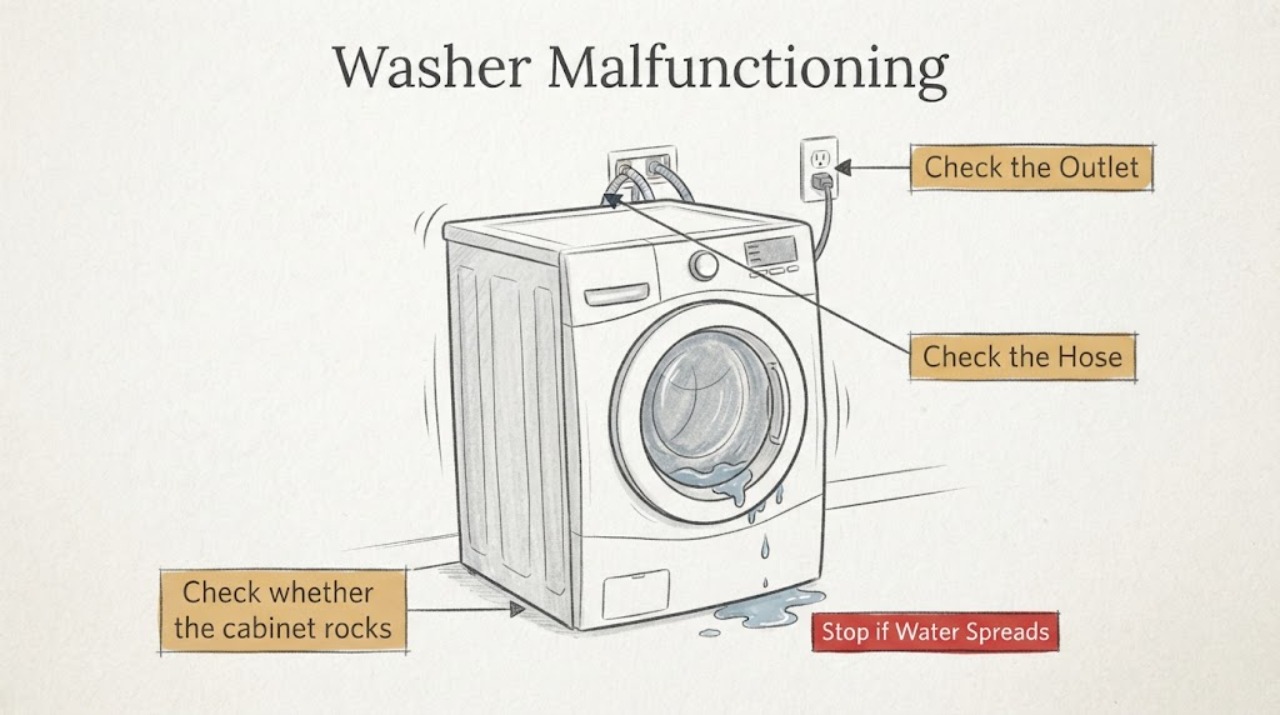
Stop relying on duct tape or repeatedly running a washer that rocks, knocks loudly, or leaks. The reported symptoms do not prove that the drum is slipping or that the bearings are bad. First disconnect power if water is near the outlet, close the water taps, and identify whether the movement is the cabinet rocking on its feet, an unbalanced load, a hose or object making the noise, or a visible leak at the door, drain, inlet, or detergent area. Do not tighten unidentified front-panel screws or remove panels without the exact model manual. If the empty washer still rocks or knocks, the front panel is separating, or any leak continues after visible hose, gasket, filter, and drain checks, leave it out of service and arrange qualified repair.
Work through in order
Diagnostic checks
Use only checks that match the exact appliance or system and its official guide.
-
Check 1
Stop the washer, unplug it if water is near the power cord or outlet, close both water taps, and wipe up accessible water. Do not run another cycle to reproduce a loud knock or leak.
Expected result: Water is near the electrical supply, the washer continues to leak while idle, or the area is dry after the taps are closed.
Next step: Keep the washer disconnected and request service for an active or unexplained leak. If the area is dry, continue with the visible checks without opening the cabinet.
Why this matters
Why: Water and electricity create an immediate hazard; a leak while idle points to a supply, valve, hose, or other unresolved source rather than a spin-only imbalance.
-
Check 2
With the washer empty and stopped, inspect the front panel, door frame, gasket, detergent drawer, lower access/filter cover, and floor for the first wet point. Also inspect the visible inlet and drain hoses and their connections without moving the machine aggressively.
Expected result: The first wet point is at the door/gasket, detergent area, drain/filter area, inlet hose, drain hose, or cannot be located.
Next step: Clean or reseat only the visible component described by the exact manual, and check again with the water taps closed. If the source is the rear, cabinet, tub, or remains unknown, arrange service rather than removing panels.
Why this matters
Why: LG lists gasket debris or damage, detergent oversudsing, loose or damaged inlet/drain hoses, drain-filter caps, and drain backflow as distinct leak paths; an unidentified source remains unresolved.
-
Check 3
Check whether the cabinet rocks corner-to-corner while empty, and use a level across the top. Inspect that all feet contact a solid floor and that any accessible foot locknuts are secure; do not tilt a heavy machine alone.
Expected result: The empty cabinet rocks, one foot is not firmly planted, the floor is uneven, or the washer is stable when empty.
Next step: If the manual permits, adjust the feet with the machine stable and tighten the locknuts. If it still rocks empty, the cabinet/panel is separating, or adjustment cannot be done safely, leave it off and call service.
Why this matters
Why: LG and Electrolux identify an unlevel installation or uneven feet as causes of unwanted movement; Beko likewise directs users to check balance and feet for knocking. This check does not diagnose the drum or suspension.
-
Check 4
If the washer is stable and dry, inspect the load and the visible rear hoses or nearby wall/cabinet before a single supervised test. Remove pockets/loose objects, redistribute an uneven load, and keep hoses from striking the cabinet; do not run a test if the panel is loose enough to catch or the leak is active.
Expected result: The knock occurs only with an uneven load or hose/object contact, or it occurs with an empty/stable washer or at every spin.
Next step: Correct only the visible load or hose condition and monitor one low-risk cycle. If the noise remains empty, becomes violent, or the washer moves across the floor, stop and request service.
Why this matters
Why: Manufacturer guidance attributes rhythmic knocking to an uneven load or foreign object and also identifies hoses or the cabinet/wall as noise sources. A persistent empty-load knock is outside those simple checks.
-
Check 5
Verify that the exact model manual is available before touching any front-panel screw. Photograph the loose panel and model label, and compare the panel's fasteners only with the manufacturer's documented exterior procedure; never substitute a similar washer's screw locations.
Expected result: The manual confirms an exterior panel adjustment, or there is no exact manual or the panel appears bent, cracked, detached, or close to the door/gasket.
Next step: If the manual does not explicitly cover the adjustment, leave the panel untouched and arrange qualified service with the model number and photos. Do not use duct tape as a structural repair.
Why this matters
Why: A screw that is visible is not evidence that the panel is user-serviceable or that tightening it will correct the movement or leak. Model-specific access and safety procedures remain unverified.
Use your observations
Decision map
Find the observation that best matches what you see, then follow the next safe action.
-
PATH 01Next step
What you see
The washer leaks while idle, water reaches the electrical supply, or a leak source is not visible after the taps are closed.
Do this next
Keep power and water off and arrange qualified appliance service; do not run another cycle or open the cabinet.
Why this path and its safety boundary
Why it matters: The water hazard and unresolved source take priority over diagnosing noise or panel movement.
-
PATH 02Next step
What you see
The empty cabinet rocks but becomes stable after a documented foot adjustment, and there is no active leak or panel separation.
Do this next
Run only one supervised light test. Stop immediately if the washer rocks, knocks violently, or leaks again.
Why this path and its safety boundary
Why it matters: The installation was unstable and can account for cabinet movement and some spin noise; it does not prove an internal repair is unnecessary if knocking continues.
-
PATH 03Next step
What you see
Knocking occurs only with an uneven load, loose hose, wall/cabinet contact, or a visible foreign object.
Do this next
Correct the visible condition and monitor a single cycle. Escalate if the noise returns with an empty balanced drum.
Why this path and its safety boundary
Why it matters: The pattern matches an external load, installation, hose, or object cause described by manufacturer guidance.
-
PATH 04Next step
What you see
The washer remains stable and dry but the front panel is loose, the empty drum movement is abnormal, or knocking persists after external checks.
Do this next
Leave the washer out of service and request qualified diagnosis using the exact model. Do not tighten unknown screws, remove panels, or order an internal part from the symptom alone.
Why this path and its safety boundary
Why it matters: The symptom is no longer explained by simple leveling, load, hose, or visible leak checks. Bearings, suspension, counterweights, tub, and panel structure remain unconfirmed possibilities.
Helpful context
Understand the symptom
Treat the loose panel and water as stop signals
The exact report describes loose front panels, rocking, loud knocking, and occasional water, but it does not identify a brand or model. A panel that moves may be cosmetic, structural, or a sign that the cabinet or tub is moving abnormally; the leak may have a separate source. Keep the washer off while water is near electrical connections, close the supply taps, and use only visible checks that the appliance manual supports.
Do not turn a symptom cluster into an internal diagnosis
A community suggestion such as worn bearings, shocks, counterweights, or a slipping drum cannot be confirmed from the post. The public manufacturer guidance supports external installation, load, hose, filter, gasket, drain, and leak-source checks. The exact model is required before a panel fastener, suspension assembly, drum, or part can be identified.
When checks do not resolve it
Need a professional?
Call qualified service when water reaches electrical parts, the washer leaks while idle or after visible checks, the empty cabinet rocks, the front panel is separating, the machine moves violently, or knocking persists with a stable empty drum.
Common questions
FAQ
Can I just tighten the two screws on the loose front panel?
Not safely from the symptom alone. The screw locations, panel function, and access procedure are model-specific, and tightening a wrong fastener could damage the cabinet, door seal, wiring, or tub. Use the exact manual or arrange service.
Does rocking and knocking prove the drum bearings are bad?
No. Manufacturer guidance lists leveling, feet, transit hardware, load balance, hoses, foreign objects, and floor or cabinet contact before internal diagnosis. Persistent empty-load movement needs qualified inspection.
What should I do about the small leak?
Stop the washer, close the water taps, and identify the first wet point without opening the cabinet. Check visible gasket, hose, drain/filter, detergent, and drain areas only as the exact manual allows. If the leak continues or its source is unclear, request service.
Read the exact guide
Official sources
- LG Washer – Troubleshooting Vibration IssuesLG USA Support · LG general support; supports external vibration checks only and does not identify the task washer's brand, model, or internal fault.
- LG Washer - Common Noises During the Washer CycleLG USA Support · LG general noise guidance; used only to distinguish ordinary sound sources from persistent abnormal movement.
- Washing machine emits noises and shakes while spinningElectrolux · Electrolux UK support article covering front and top loaders; used only for common external causes and explicitly not as a model-specific procedure.
- LG Washer – Why Is My Front Load Washing Machine Leaking?LG USA Support · LG general front-load guidance; supports visible leak checks and service boundary, not the task washer's model or internal diagnosis.
- Help Center: Washing Machine TroubleshootingBeko · Manufacturer help center for Beko washers; used for general symptom distinctions and external checks, not for a specific model or internal part diagnosis.
Community feedback
Share a repair observation
Share a plain-text repair observation. Accepted observations are published automatically; this page may take a moment to update.