
On this page
Start here
Quick answer
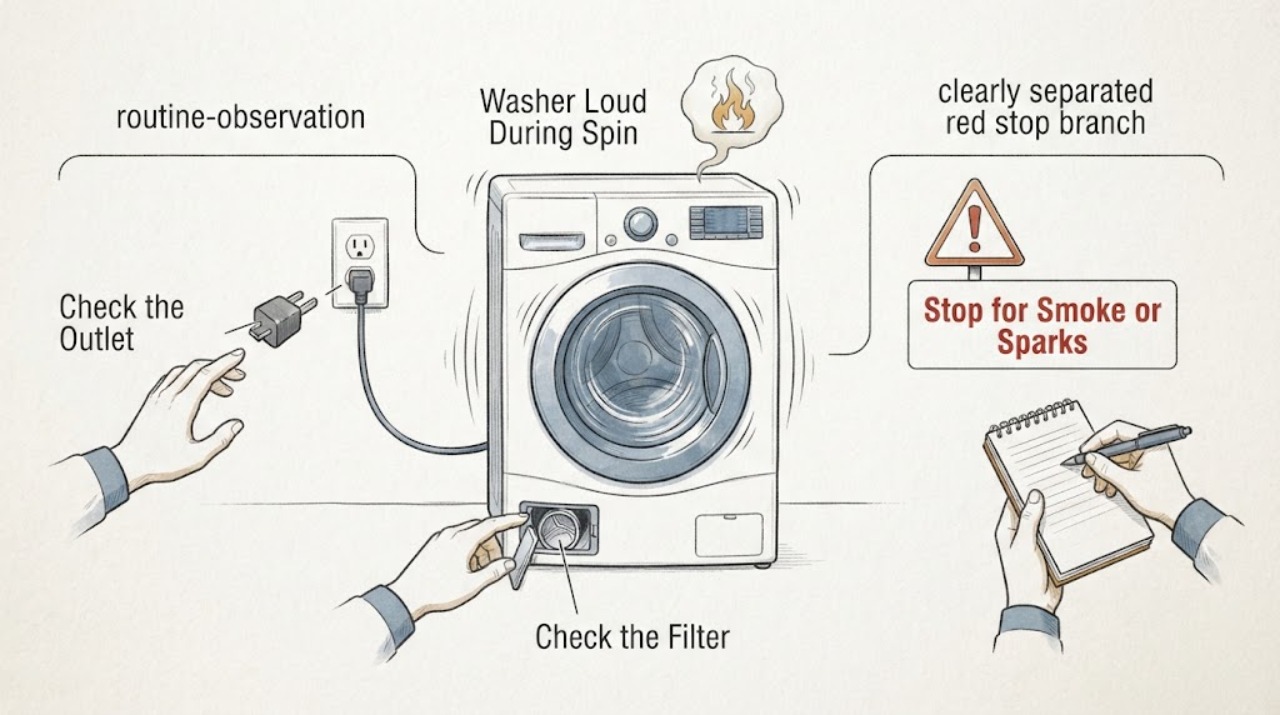
A loud spin combined with a burning smell is a stop-use symptom, not a reason to keep running test cycles. Cancel the cycle, disconnect the washer at the plug or socket once it is safe to do so, and leave it disconnected. With power off and the machine cool, record the sound, look for smoke, scorching, a hot or damaged plug/socket, and inspect only accessible areas for loose objects or trapped debris. Whirlpool's washer guidance says unbalanced loads, an unlevel machine, bulky loads, shipping materials, and foreign objects can create spin noise, but those checks do not prove a belt, motor, bearing, pump, or control failure. Have a qualified technician diagnose the washer before it is used again, especially if the smell, scorch marks, arcing, or breaker trips return.
Work through in order
Diagnostic checks
Use only checks that match the exact appliance or system and its official guide.
-
Check 1
Press pause or cancel if the washer responds, keep clear of moving parts, and disconnect power at the plug or socket after the drum has stopped. If there is smoke, sparking, a hot outlet, or an active fire, leave the area and contact local emergency services; do not reach behind the machine to unplug it.
Expected result: The washer stops without smoke or visible fire, or there is smoke, arcing, a hot or scorched plug/socket, a tripped breaker, or a smell that remains after stopping.
Next step: Leave the washer disconnected and do not restart it. If smoke or fire is present, evacuate and call emergency services; otherwise arrange qualified appliance service and do not use an extension lead or bypass a protection device.
Why this matters
Why: London Fire Brigade advises unplugging white goods and seeking expert advice when there is a burning smell or electrical sparking noise. A persistent or escalating burning symptom is not a normal-load troubleshooting result.
-
Check 2
Once the washer is unplugged and cool, document the event without powering it: note whether the sound was banging, rubbing, grinding, or a high-pitched whine; when it began; whether the drum was accelerating or stopping; and whether the smell was rubber-like, electrical, or accompanied by smoke.
Expected result: The noise and smell can be located to a visible area such as the plug/socket, rear hose area, door seal, drum opening, or floor, or the source cannot be localized from outside.
Next step: Photograph any visible mark or residue and provide the technician with the model/serial label, cycle, load, and timing. Do not remove a cabinet panel or run the washer to reproduce the sound.
Why this matters
Why: A symptom description helps service distinguish a load or installation observation from a fault that needs internal inspection. It cannot determine a belt, pulley, bearing, motor, wiring, or control diagnosis without the exact appliance and a qualified inspection.
-
Check 3
With power still disconnected, perform only an accessible visual check: inspect the plug, socket, power cord, floor, door seal, tub opening, drain/filter access specified by the owner's manual, and hose area for scorching, melted material, a loose fitting, or a foreign object. Do not reach into a guarded drive area or remove panels.
Expected result: There is visible scorching, melted material, a damaged cord or socket, water near the electrical connection, a loose object, or no external abnormality.
Next step: Keep the washer off and report every finding. Remove only a loose object that is plainly accessible without tools or force; leave trapped, melted, or inaccessible material for a qualified technician.
Why this matters
Why: Scorching, heat, and damaged wiring are safety findings that require service; a loose object in the accessible drum or gasket can explain noise but does not explain every burning smell. No visible damage does not clear an internal fault.
-
Check 4
Compare the event with Whirlpool's documented external spin-noise factors without restarting the appliance: was the load uneven or bulky, did the washer rock, were all four feet in firm contact, and if the washer was recently installed, were shipping materials removed according to its installation instructions?
Expected result: An unbalanced or oversized load, a rocking cabinet, a drain-pan contact, or retained shipping material is visibly present, or none of those conditions is present.
Next step: Do not run a confirmation cycle while a burning smell is part of the report. Tell the technician which external factor was present and follow the exact owner's manual or service advice before making any powered test.
Why this matters
Why: Whirlpool says these conditions can create vibration, movement, and excessive spin noise. They may explain the noise, but they do not prove that a burning smell is harmless or that the drive system is undamaged.
-
Check 5
Arrange a model-specific inspection before returning the washer to service. Give the technician the exact model/serial information, a description or recording of the sound if safely obtained before the fault worsened, the load type, and whether the plug, socket, breaker, hose, seal, or drum showed any visible sign.
Expected result: The smell or noise was a one-time event with no visible damage, or it recurs, the breaker trips, the plug/socket heats, the drum does not move normally, or smoke appears.
Next step: Keep the appliance disconnected until service clears it. Do not order a belt, motor, pulley, bearing, or control board based only on the smell and sound, and do not operate with a panel removed.
Why this matters
Why: Whirlpool directs owners to the manual and service route when external noise checks do not resolve the issue, while London Fire Brigade advises unplugging and expert advice for burning or sparking warnings. Neither supports a remote diagnosis of a specific washer part from this symptom pair.
Use your observations
Decision map
Find the observation that best matches what you see, then follow the next safe action.
-
PATH 01Next step
What you see
There is smoke, sparking, a hot or scorched plug/socket, a damaged cord, a breaker trip, or a burning smell that continues after the cycle is stopped.
Do this next
Leave the washer disconnected, keep people away from the area, and contact emergency services for active smoke or fire; otherwise contact the manufacturer or a qualified repair technician before any use.
Why this path and its safety boundary
Why it matters: This is an electrical or overheating warning rather than a routine load-balance decision.
-
PATH 02Next step
What you see
The cabinet rocks, the load was concentrated on one side, or a bulky item was being spun, and there are no signs of heat, scorch, smoke, or electrical damage.
Do this next
Keep the washer off and disclose the finding to service; do not run another spin cycle solely to see whether the noise disappears.
Why this path and its safety boundary
Why it matters: Whirlpool identifies imbalance, bulky loads, and leveling as causes of spin noise and vibration, but the reported burning smell still needs to be treated separately.
-
PATH 03Next step
What you see
A loose coin, wire, or other foreign object is plainly accessible in the drum or door area while the washer is unplugged.
Do this next
Remove only the loose accessible object without tools or panel removal, keep the washer disconnected, and request service if any burning smell occurred or if the noise returns.
Why this path and its safety boundary
Why it matters: Whirlpool says foreign objects can create rattling or clunking noise, but removing one does not prove that it caused the burning smell.
-
PATH 04Next step
What you see
No external cause is visible, or the noise sounds like metal grinding, rubbing, or a repeated mechanical scrape.
Do this next
Keep the washer disconnected and schedule qualified service; do not remove the cabinet or attempt a belt, pulley, bearing, motor, or wiring repair from the symptom description.
Why this path and its safety boundary
Why it matters: The accessible checks have not established a safe user correction. Whirlpool advises professional help for unusually loud metal-on-metal noise and directs users to model-specific service information.
Helpful context
Understand the symptom
Burning smell changes the decision
A spin-cycle noise can come from load balance, leveling, bulky items, shipping materials, or an object in the tub, and some drive-system sounds are normal. A burning smell adds a potential overheating or electrical warning. The safe sequence is therefore to stop and de-energize the washer first, then gather external observations without opening panels or repeating the spin cycle. The symptom does not identify a belt, motor, bearing, pump, or control as the failed part.
When checks do not resolve it
Need a professional?
Stop using the washer and arrange qualified service whenever a burning smell accompanies the noise, especially if there is smoke, arcing, scorch marks, a hot or damaged plug/socket, a tripped breaker, water near electrical connections, or a grinding/rubbing sound. Do not repeat spin tests or open the cabinet.
Common questions
FAQ
Can an unbalanced load cause a burning smell during spin?
An unbalanced or bulky load can cause spin noise and vibration according to Whirlpool, but it does not prove that a burning smell is harmless. Stop, disconnect the washer, and have the odor assessed before running another cycle.
Should I run the washer empty to reproduce the noise?
No when a burning smell was reported. Record what happened and keep the appliance disconnected. A qualified technician can decide whether a controlled test is safe after inspecting the machine.
Does this symptom prove the belt or motor is bad?
No. The sound and odor alone do not identify a belt, motor, bearing, pulley, pump, wiring, or control failure. Do not order a part or remove a panel until the exact model is inspected and the cause is established.
What should I check before calling service?
Only after power is disconnected and the washer is cool, record the sound and smell, check the plug/socket and cord for heat or scorch marks, look for accessible debris, and note whether the washer rocked or the load was bulky. Do not reach into guarded drive areas or operate with panels removed.
Read the exact guide
Official sources
- Sounds: Clunk or Clunking Noise During SpinWhirlpool Product Help · Used only for its explicit unbalanced-load, foreign-object, leveling, and manual/service guidance; the assigned topic has no verified brand or model, so no top-load-specific mechanical conclusion is transferred.
- Whirling or Spinning Noise - Front Load WasherWhirlpool Product Help · Used for the general external spin-noise factors it explicitly lists: unbalanced loads, bulky items, leveling, shipping materials, and escalation to service. It is not used to infer the unknown washer's internal part or to authorize running after a burning smell.
- Electrical SafetyGreater Manchester Fire and Rescue Service · Used for the danger-sign boundary: do not use electrical items when there is a burning or unusual smell, sparks or smoke, scorch marks, or overheating, and use a qualified professional. It does not diagnose a washer component.
- Product Recalls and White Goods SafetyLondon Fire Brigade · Used for the stop-use boundary when a washer has a burning smell or electrical sparking noise. It does not diagnose a washer component or replace the appliance owner's manual.
- How to Fix a Washing MachineWhirlpool · Used for general washer load, level, noise, odor, and manual/service boundaries. It does not identify a cause of burning odor or authorize internal repair on an unidentified washer.
- Grinding or Rubbing Noise - WasherWhirlpool Product Help · Used for the distinction between normal drive sounds and louder grinding/rubbing, plus external load, leveling, and drain-pan observations. It is not used to diagnose or replace a belt, pulley, bearing, or motor.
Community feedback
Share a repair observation
Share a plain-text repair observation. Accepted observations are published automatically; this page may take a moment to update.