
On this page
Start here
Quick answer
If the washer agitates but leaves water in the tub and never reaches drain or spin, stop the cycle and keep hands out of the water until the basket is still. Start with external checks: confirm the selected cycle is supposed to spin, redistribute an overloaded or uneven load, inspect the visible drain hose and standpipe for kinks or blockage, and check the lid or door is fully closed. Excess detergent suds can also reduce pumping and spin speed. Do not bypass a lid lock, open the cabinet, or assume the pump, motor, belt, clutch, or control is bad from this symptom. If the tub remains full, the lid will not latch, water is leaking, or the washer still will not drain or spin after the no-leak checks, leave it out of service and use the exact model manual or qualified appliance service.
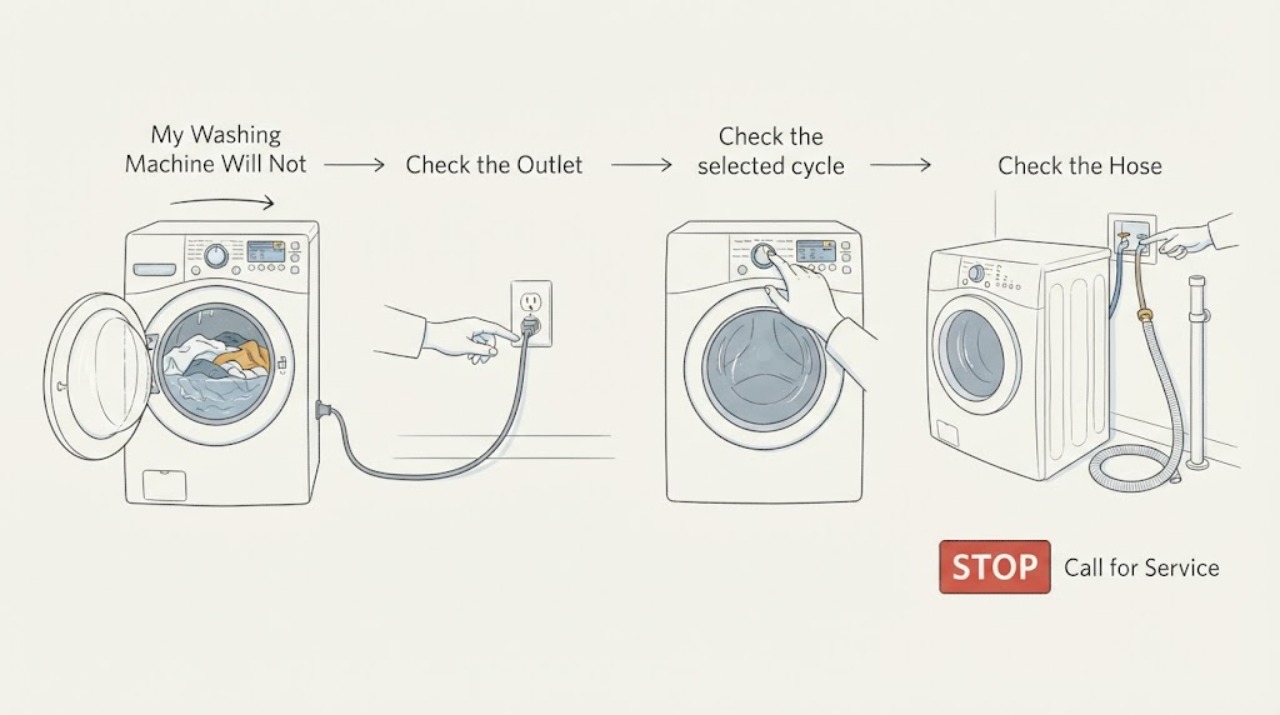
Work through in order
Diagnostic checks
Use only checks that match the exact appliance or system and its official guide.
-
Check 1
Stop the cycle and wait until the basket or drum is motionless; if water is near the outlet, cord, or other electrical equipment, keep clear and arrange service rather than handling the plug from a wet position.
Expected result: The tub is still full, the water level is rising, a leak is active, or no water is present and the washer is safe to inspect externally.
Next step: Close the water faucets if the washer is filling or leaking. Do not reach into the tub, force a locked door, or run another cycle until the water and electrical safety issue is controlled.
Why this matters
Why: A full or rising tub and any active leak make repeated test cycles unsafe and can change how the lid or door behaves. A dry, motionless washer permits only external checks.
-
Check 2
Check the selected cycle and spin option, then remove or redistribute a tightly packed, single-heavy, or bulky load while the washer is stopped.
Expected result: Low or no spin is selected, the load is tightly packed or uneven, bulky items are in a cycle not intended for them, or the cycle and load are appropriate.
Next step: Use the model-supported cycle and a loosely balanced load for one supervised test only when there is no leak and the tub is safe. If it still will not drain or spin, stop and continue to the external drain check or service.
Why this matters
Why: Low spin settings, bulky or unbalanced loads can leave clothes wet and can make the washer reduce or stop spin even though agitation during wash worked.
-
Check 3
Inspect the visible drain hose, standpipe or utility-sink opening, and the hose connection without opening the cabinet.
Expected result: The hose is kinked, crushed, visibly blocked, taped over, inserted incorrectly, or the drain path appears clear; exact insertion and height must be checked against the model manual.
Next step: Straighten the hose and clear only an accessible external obstruction with the washer stopped. Do not pull the pump, remove hoses containing standing water, or use a generic dimension as a substitute for the manual. If the path is clear but water remains, request service.
Why this matters
Why: A restricted or incorrectly installed drain path can prevent water from leaving or let it flow back, which can also prevent a normal spin sequence.
-
Check 4
Check that the lid or door closes and latches, and clean only visible residue or clothing from the latch contact area with the washer stopped.
Expected result: The lid or door is obstructed, does not latch, remains open, or closes and latches normally.
Next step: Remove only an accessible obstruction and close the lid or door. Never bypass or jumper the lock. If it still will not latch or the washer stops before drain/spin, use the model manual or arrange service.
Why this matters
Why: The official guidance says the lid or door must be closed for the washer to advance through drain and spin on applicable designs; a brief click and slight basket movement at startup can be a normal latch self-test.
-
Check 5
Confirm that the detergent was the type and amount specified for this washer, and note any heavy suds; do not add more detergent or water to force the cycle.
Expected result: Non-HE detergent, excess detergent, or persistent suds are present, or the detergent and amount appear appropriate.
Next step: Follow the exact detergent directions in the washer manual and avoid repeating a failed cycle until the cause is addressed. If the tub still will not drain or spin with the correct detergent and external checks, leave the washer out of service.
Why this matters
Why: Excessive suds can interfere with pumping and reduce spin speed, leaving the load wet even when agitation was normal.
Use your observations
Decision map
Find the observation that best matches what you see, then follow the next safe action.
-
PATH 01Next step
What you see
The tub is full or rising, an active leak is present, or water is near electrical equipment.
Do this next
Stop using the washer, close the supply faucets if safe, keep clear of wet electrical areas, and arrange qualified appliance service. Do not force the door or reach into the tub.
Why this path and its safety boundary
Why it matters: The problem has an immediate water or electrical safety boundary; more cycle tests can worsen the situation and the symptom does not identify a safe user-replaceable part.
-
PATH 02Next step
What you see
There is no leak, the cycle or load is clearly unsuitable, and the hose and latch appear normal.
Do this next
Correct the load and select the model-supported spin cycle for one supervised test. If the washer still does not drain or spin, stop testing and use the exact manual or service.
Why this path and its safety boundary
Why it matters: A documented load or setting condition may be preventing effective spin even though the wash portion agitates.
-
PATH 03Next step
What you see
The drain hose or external drain opening is kinked, blocked, or installed outside the model's instructions.
Do this next
Correct only the visible external hose or opening issue with the washer stopped. If water remains after the path is clear, do not open the cabinet; arrange service.
Why this path and its safety boundary
Why it matters: The washer may be unable to pump out or may be receiving backflow, so it may not proceed to a normal spin.
-
PATH 04Next step
What you see
The lid or door will not latch, excessive suds are present, or the washer still fails with a balanced load and clear external drain path.
Do this next
Leave the washer out of service and provide the exact model number, cycle, water level, latch behavior, sounds, and observations to qualified service. Do not bypass the lock or order a part from the symptom alone.
Why this path and its safety boundary
Why it matters: The remaining fault is beyond generic external checks; agitation alone cannot distinguish a lid, pump, drive, control, or other internal problem.
Helpful context
Understand the symptom
Agitation does not prove that the drain and spin system is healthy
A washer can agitate during the wash portion and still be unable to complete the later drain or spin portion. Official multi-brand washer guidance lists a closed lid or door, an unbalanced load, a low or no-spin selection, excessive suds, and a restricted or incorrectly installed drain hose among the first checks. Those observations narrow the next safe step, but they do not identify an internal component without the washer's model-specific literature.
Keep water and moving parts contained while you check
Stop the cycle before opening the lid or door, and do not reach into a tub that may move or contain water. Look only at the accessible hose, drain opening, controls, and latch area. If water is near the power cord, outlet, or other electrical equipment, do not handle the plug from a wet position; keep clear and arrange service. A pump-filter cleaning procedure is model-dependent and is explicitly limited to some front-load models, so do not copy it to a top-load or unknown washer.
Use the symptom pattern to decide whether one supervised retry is reasonable
If there is no leak and the load or cycle setting is clearly wrong, correct that external condition and make only one supervised test. If the washer has a full tub, a blocked-looking drain path, a lid that will not latch, or the same failure returns with an ordinary balanced load, stop testing. Persistent failure after these checks needs model-specific diagnosis; the fact that agitation works is not a safe reason to order a drain pump, lid switch, belt, or other part.
Record the model before using a detailed procedure
The assigned problem has no brand or model. Drain-hose dimensions, filter access, lid or door behavior, error codes, and service-test sequences vary by design. Use the rating-plate model number to locate the manufacturer's manual before applying any exact measurement or opening a panel. A generic troubleshooting page can support the external checks here, but it cannot transfer a component diagnosis or internal repair from another washer.
When checks do not resolve it
Need a professional?
Stop using the washer and arrange service for an active or recurring leak, water near electrical equipment, a full tub that will not drain, a lid or door that will not latch, repeated failure after a clear hose and balanced-load check, or any need to open the cabinet or bypass a safety lock.
Common questions
FAQ
Does agitation working rule out a bad washer motor?
No. It only shows that the washer can perform the observed wash movement. Official guidance still directs you to check the drain path, lid or door, load, spin selection, and suds before service; the symptom does not prove which internal component is involved.
Should I clean the pump filter?
Only if the exact model manual identifies an accessible filter and gives the procedure. The official guide says a drain-pump filter is accessible on some front-load models, so do not apply that procedure to an unknown or top-load washer.
Can too much detergent stop a washer from spinning?
Yes. Official guidance says excessive suds can interfere with pumping and reduce spin speed, leaving clothes wet. Use the detergent type and measured amount specified for the exact washer, then seek service if the drain/spin failure remains.
Can I bypass the lid lock to see why it will not spin?
No. Do not jumper, defeat, or hold a safety lock open. The lid or door must be closed for drain and spin on applicable designs; a latch that will not operate needs the exact manual or qualified service.
Read the exact guide
Official sources
- Not Draining - WasherWhirlpool Product Help · Top-load guidance used only for the generic drain-path and detergent observations; do not transfer its exact hose dimensions to an unknown model.
- Washer Not Draining or Spinning? Troubleshooting GuideWhirlpool Product Help · Official multi-brand product-help page; supports general external checks for an unknown washer, not exact model dimensions, codes, or internal diagnosis.
- Cleaning the Pump Filter - Front Load WasherWhirlpool Product Help · Used only to warn that filter access and draining procedure are limited to some front-load models and must follow the exact manual; it is not a procedure for this unknown washer.
- Lid Not Latching - WasherWhirlpool Product Help · Top-load latch guidance used for external obstruction and no-bypass boundaries; exact latch behavior varies by model.
- Not Spinning - WasherWhirlpool Product Help · Official top-load guidance for generic spin symptoms; supports the external decision branches without identifying a component or applying exact model settings.
Community feedback
Share a repair observation
Share a plain-text repair observation. Accepted observations are published automatically; this page may take a moment to update.