
On this page
Start here
Quick answer
First determine whether the washer is failing to agitate during washing, failing to spin at the end, or simply using a low/no-spin cycle. Whirlpool's official guidance points to cycle selection, bulky or unbalanced loads, level, standing water and drain-hose conditions as safe external checks. If you have already seen a snapped belt-roller bolt or similar mechanical damage, do not install a generic bolt, remove panels, or keep running the washer to test it: the exact model is needed to identify the assembly and repair method. Isolate power before any inspection and arrange model-matched service when the basket or agitator still does not move.
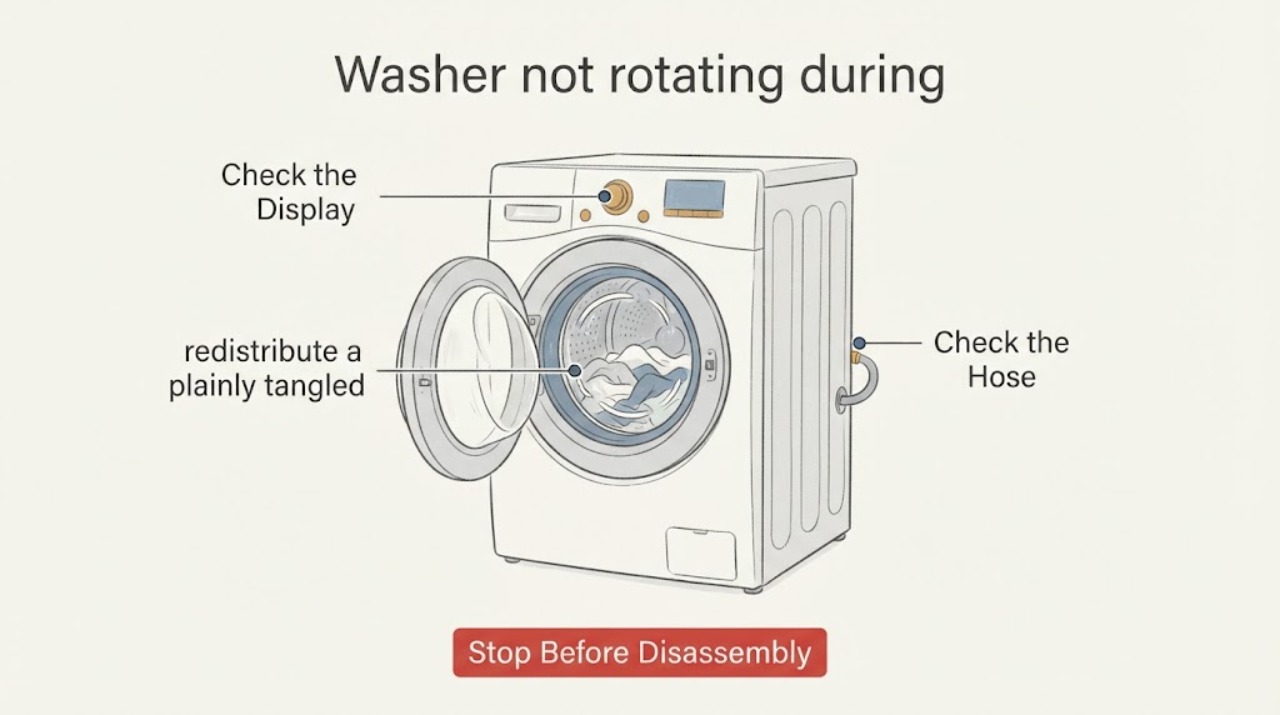
Work through in order
Diagnostic checks
Use only checks that match the exact appliance or system and its official guide.
-
Check 1
Identify whether the basket or agitator fails during the wash/agitation portion, during final spin, or during both, and note the selected cycle and spin option on the control panel.
Expected result: The washer uses Low Spin or No Spin, agitates but does not reach final spin, or never produces wash motion at all.
Next step: Use the exact owner's manual for the selected cycle and, if appropriate, choose the documented cycle or Drain & Spin option once there is no active mechanical damage or leak. If no motion occurs in the correct cycle, stop and arrange service.
Why this matters
Why: A selected low/no-spin option can leave more water in clothing, while a failure during the wash portion is a different symptom from a final-spin limitation. The observation does not identify a broken belt or roller.
-
Check 2
With the washer stopped, redistribute a plainly tangled or heavily one-sided load and use the cycle intended for bulky bedding or other heavy items; do not reach into a moving basket.
Expected result: The washer is overloaded or off balance, or the load is reasonably distributed and the washer remains unable to rotate.
Next step: If redistribution restores motion, use the model's load and cycle guidance. If the washer still will not rotate, keep it off and obtain model-matched service.
Why this matters
Why: Whirlpool says an uneven load can reduce spin speed or stop spinning, and bulky items may need a dedicated cycle. A balanced load with no rotation makes a mechanical or control issue more likely but does not select a particular part.
-
Check 3
Check from outside whether water remains in the tub and inspect the accessible drain hose for a kink, blockage, or visibly incorrect routing, without removing panels or disconnecting hoses unless the exact manual permits it.
Expected result: Water remains in the tub, the drain hose is visibly kinked or blocked, or the tub is empty and the drain path appears normal.
Next step: Correct only a visible hose-routing issue described by the model instructions. If water remains or the washer still does not rotate after the external drain check, stop using it and schedule service.
Why this matters
Why: Whirlpool links standing water and drain-hose problems with poor spin results because the washer may not complete the drain portion. A clear drain path does not prove that the drive assembly is defective.
-
Check 4
If a belt roller bolt, pulley, belt, or other mechanical hardware is visibly snapped or loose, photograph the part in place, record the full model number and serial information, and do not run another cycle or substitute a generic fastener.
Expected result: There is visible mechanical damage, or the “snapped bolt” is only a suspicion based on the no-rotation symptom.
Next step: Keep power isolated and arrange service or obtain the exact model's official parts and repair documentation. Do not remove panels, bypass a lid or door interlock, or test the drive while energized.
Why this matters
Why: Visible damage supports a mechanical service need, but the generic Whirlpool guidance does not establish the correct assembly, fastener specification, torque, or compatible replacement for an unspecified washer.
-
Check 5
Check that the washer is visibly level and note abnormal noise, vibration, burning odor, repeated breaker trips, or a control that stops the cycle before motion begins.
Expected result: The cabinet is visibly unlevel or the washer has abnormal electrical/mechanical symptoms, or it is level and otherwise quiet but still does not rotate.
Next step: Correct only a plainly visible leveling issue allowed by the manual. For abnormal noise, odor, electrical symptoms, or persistent no-motion, leave the appliance off and call qualified service.
Why this matters
Why: Whirlpool says level and balance affect spin, while persistent no-motion with abnormal noise or electrical symptoms needs service assessment. None of these observations identifies a belt, roller, motor, transmission, or board by itself.
Use your observations
Decision map
Find the observation that best matches what you see, then follow the next safe action.
-
PATH 01Next step
What you see
Low Spin or No Spin was selected, or the washer spins after the cycle and load are corrected.
Do this next
Use the exact model's recommended cycle and spin setting and monitor the next load; do not change hardware based on this branch.
Why this path and its safety boundary
Why it matters: The control choice or load distribution can explain the reported result without establishing a broken drive part.
-
PATH 02Next step
What you see
The washer is out of balance, contains bulky items, or is visibly unlevel and spin improves after the load or level is corrected.
Do this next
Follow the model's load and leveling guidance. Escalate if the washer still stops or refuses to rotate with a balanced load.
Why this path and its safety boundary
Why it matters: Balance and cycle selection were plausible contributors to reduced or withheld motion.
-
PATH 03Next step
What you see
Water remains in the tub or the drain hose is visibly restricted, while no snapped mechanical hardware has been confirmed.
Do this next
Use the model-specific external drain guidance and arrange service if water remains or rotation does not return.
Why this path and its safety boundary
Why it matters: The washer may not be completing drain, which can prevent or limit spin.
-
PATH 04Next step
What you see
A roller bolt or related drive hardware is visibly snapped, or the washer still has no motion after the external checks.
Do this next
Keep the washer off, do not substitute a generic bolt or open the cabinet, and obtain model-matched qualified service.
Why this path and its safety boundary
Why it matters: A service-level mechanical or control issue remains possible, but the correct part and repair cannot be established without the full model documentation.
Helpful context
Understand the symptom
Separate wash agitation from final spin
“Not rotating” can describe a washer that never agitates during the wash portion, one that drains but does not reach final spin, or one that selects a low/no-spin cycle by design. Whirlpool's support pages treat cycle selection, bulky loads and out-of-balance behavior as separate decisions. Identify the stage before treating a mechanical part as the cause.
A snapped bolt needs model-matched repair
A report that a belt roller bolt has snapped may be useful evidence that a mechanical assembly is damaged, but it does not establish the correct bolt, belt, roller, torque, or replacement method. Without a model number and the manufacturer's parts documentation, keep the washer off and arrange service rather than substituting hardware or opening the cabinet.
Check only the external causes first
Before service, the safe checks are the selected cycle and spin option, load distribution and bulky-item cycle, visible level and drain condition, and whether water remains in the tub. These observations can explain reduced or withheld spin without proving a belt, roller, motor, transmission, or control failure.
When checks do not resolve it
Need a professional?
Leave the washer off and arrange qualified service for visible snapped or loose drive hardware, persistent no motion after external checks, burning odor, damaged wiring, repeated breaker trips, water that will not drain, or any need to remove panels. Do not install an unverified bolt, bypass a lid or door interlock, test energized drive parts, or continue running cycles to see whether a damaged assembly holds.
Have this ready
- Provide the complete model and serial information, whether the failure is during wash agitation or final spin, selected cycle and spin option, load and drain observations, visible damage photographs, noises or odors, and the external checks already completed.
Common questions
FAQ
Can I just replace the snapped belt-roller bolt?
Not safely from the symptom and title alone. The correct fastener and assembly depend on the full washer model and design. Keep the washer off and use model-matched service or official parts documentation rather than a generic bolt or an improvised repair.
Why would a washer not rotate during a wash cycle?
First separate agitation from final spin. Whirlpool lists cycle and spin selection, bulky or unbalanced loads, level, standing water and drain-hose conditions as external checks. If those do not explain the result, service is needed to diagnose the drive or control system.
Should I run another cycle to test the broken hardware?
No. If a belt, roller, bolt, or related hardware is visibly damaged, repeated operation can worsen the damage. Isolate power and arrange model-matched service.
Read the exact guide
Official sources
- Not Spinning - Washer - Product Help | WhirlpoolWhirlpool Product Help · Opened Whirlpool's official top-load washer not-spinning page. It directly supports cycle/spin selection, bulky-load, standing-water/drain-hose, level and power-failure checks, plus service escalation. The assigned topic has no model, so this is used as family-level external guidance and not as evidence for a belt, roller, bolt, or compatible part.
- Not Agitating - Washer - Product Help | WhirlpoolWhirlpool Product Help · Opened Whirlpool's official top-load not-agitating page to distinguish wash motion from final spin and support load-balance and cycle-selection checks. It does not identify the assigned washer's model or any broken hardware.
Community feedback
Share a repair observation
Share a plain-text repair observation. Accepted observations are published automatically; this page may take a moment to update.