
On this page
Start here
Quick answer
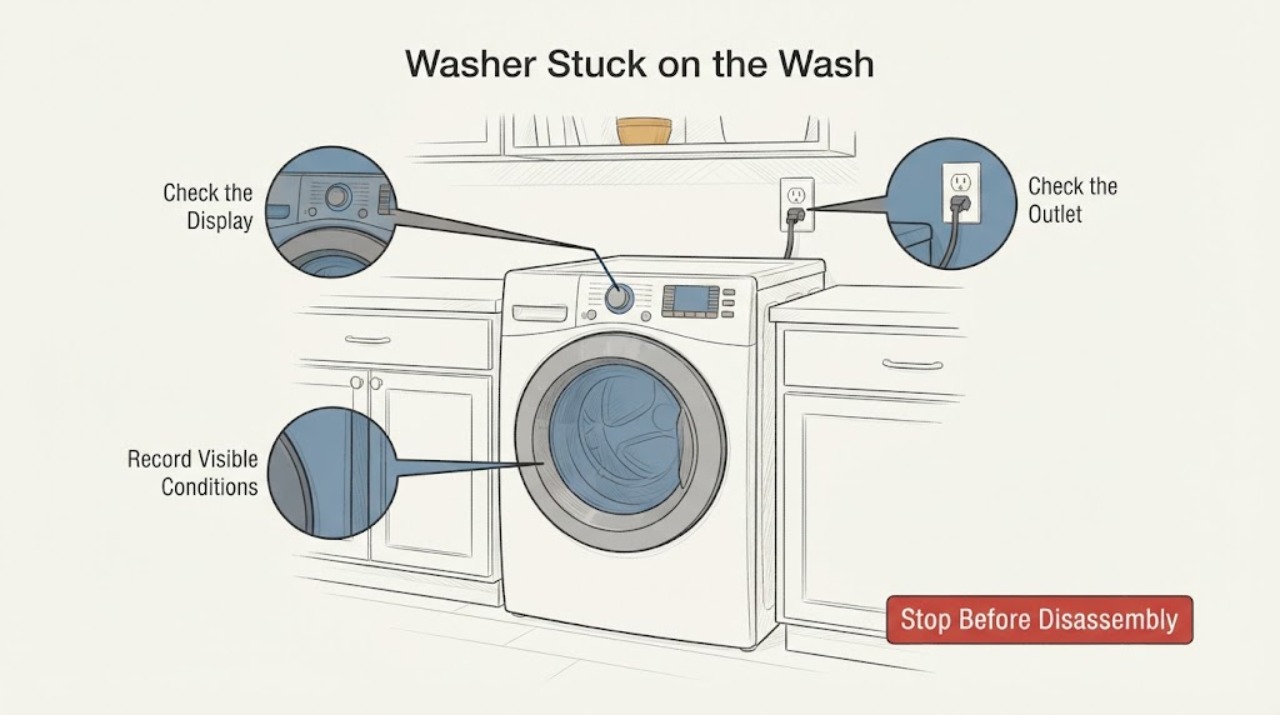
A washer that is stuck on a wash cycle and smells like burning should be stopped and left disconnected until the smell's source is checked safely. Do not keep restarting it, reach behind the machine, or pull a built-in washer out around water and electrical connections. With power off, look only at the accessible cord, plug, outlet, and surrounding closet for heat, discoloration, smoke, water, or a damaged cord; any warning sign requires qualified appliance or electrical service. If there is no electrical warning, record the display, water level, drum movement, and exact point where the cycle stopped. Use only the washer's own manual for a cancel or reset, and stop if the controls remain stuck or the smell returns.
Work through in order
Diagnostic checks
Use only checks that match the exact appliance or system and its official guide.
-
Check 1
Press the normal stop or pause control once if it responds, then disconnect the washer from its accessible plug or breaker without reaching behind a hot, wet, or damaged appliance. Do not restart it while a burning smell remains.
Expected result: The cycle stops safely, or the controls do not respond and the washer continues filling, tumbling, draining, or heating.
Next step: If power cannot be isolated safely, leave the area clear and arrange qualified service. Do not pull the machine from the kitchen closet or open a panel.
Why this matters
Why: A washer that cannot stop normally while producing a burning smell needs its power isolated before any diagnosis; the symptom does not establish a particular motor, pump, belt, or control failure.
-
Check 2
With power off and from outside the closet, inspect the visible cord, plug, outlet, washer cabinet, floor, and nearby materials for heat, discoloration, smoke, melted plastic, water, or a loose connection. Do not touch a hot or damaged part.
Expected result: The smell or damage is strongest at the outlet/cord, at the washer cabinet, around a water leak, or nowhere visible.
Next step: For any heat, smoke, darkening, melted material, water near electrical parts, or damaged cord, keep power off and call a qualified appliance technician or electrician. Do not restore power for another test.
Why this matters
Why: A damaged cord or electrical connection can be a fire or shock concern, while no visible mark does not rule out an internal fault. USFA specifically warns against damaged cords and extension-cord use on major appliances.
-
Check 3
Record the washer's make and full model, display or flashing lights, selected cycle, water level, whether the drum was moving, and whether the smell began during fill, wash, drain, or spin.
Expected result: The machine stopped at the same stage repeatedly, shows a code or flashing light, contains standing water, or has a wet/uneven load after a failed spin.
Next step: Give the complete model and recorded sequence to service. Do not copy a reset, error-code meaning, or part diagnosis from another washer brand.
Why this matters
Why: The stopping stage narrows the safe service report without proving a failed component. Manufacturer guidance gives different paths for interrupted controls, drainage, and out-of-balance spin behavior.
-
Check 4
If there is no odor, heat, water, cord damage, smoke, or other warning sign, check only accessible external conditions named by the exact owner's manual, such as a closed lid or door, open water taps, and a visible drain-hose kink.
Expected result: An accessible external condition is clearly wrong, or all visible conditions appear normal.
Next step: Correct only the clearly documented external condition. If the washer remains stuck or the smell returns, leave it disconnected and arrange service.
Why this matters
Why: A simple external condition may explain a stalled phase, but a clean external check does not prove the motor, pump, belt, heater, or control is healthy.
-
Check 5
Only after the safety inspection finds no warning sign, use the exact model manual's cancel or control-reset procedure once; do not guess a time interval or repeatedly cycle power.
Expected result: The controls recover and the washer remains odor-free, or the controls stay locked/stuck or the burning smell returns.
Next step: If the reset does not restore operation or the smell returns, stop using the washer and schedule qualified service with the model and recorded cycle state.
Why this matters
Why: GE notes that a pause or interruption can lock electronic controls, but the correct reset sequence varies by control design. A repeat odor or failed reset is not a normal software symptom to keep testing.
Use your observations
Decision map
Find the observation that best matches what you see, then follow the next safe action.
-
PATH 01Next step
What you see
There is smoke, heat, melted plastic, darkening, a damaged cord or outlet, water near electrical parts, or a burning smell that returns immediately.
Do this next
Keep the washer disconnected, do not touch hot or wet electrical parts, and request qualified appliance or electrical service. Do not restart it to identify the failed part.
Why this path and its safety boundary
Why it matters: This is an electrical, mechanical, or fire-safety concern rather than a routine stuck-cycle problem.
-
PATH 02Next step
What you see
The smell is gone, no external warning sign is visible, and the washer stopped after a power interruption or a button press.
Do this next
Use only the exact owner's manual's cancel/reset sequence once. If the controls remain stuck, arrange service instead of applying another brand's reset timing.
Why this path and its safety boundary
Why it matters: An interrupted control state is possible; GE describes this as one way electronic controls can lock, but its reset procedure is model-specific.
-
PATH 03Next step
What you see
The washer stopped as it entered spin and the load is visibly uneven, the basket shakes, or clothes remain very wet, with no burning smell or electrical warning.
Do this next
Follow the exact owner's manual for a safe load redistribution check. If the cycle still stops or any smell returns, stop and call service.
Why this path and its safety boundary
Why it matters: Whirlpool's top-load guidance identifies imbalance as one possible cause of noise, reduced spin, longer cycles, and stopping during spin; it does not establish that the unbranded washer has the same behavior.
-
PATH 04Next step
What you see
The machine remains stuck at wash, has standing water, repeats the failure, or the odor cannot be localized after accessible external checks.
Do this next
Leave power off, keep the closet and floor clear, and give service the model, display, cycle stage, water level, smell timing, and external observations. Do not open the cabinet or reach behind the washer.
Why this path and its safety boundary
Why it matters: The evidence does not distinguish a drain, drive, control, water, or electrical fault, and a kitchen-closet installation can make internal access unsafe.
Helpful context
Understand the symptom
Treat the burning smell as the priority
A cycle that appears stuck can be a control interruption, drain or load problem, but a burning smell changes the safe sequence. Leave the washer disconnected and inspect only what is visible from outside. USFA advises direct wall connection for washers, no extension cords, and replacement of damaged cords; it does not support opening a washer or continuing a cycle to identify an internal source.
The closet changes access, not the diagnosis
Because the washer is in a kitchen closet, do not squeeze behind it, move it across wet flooring, or reach around a hard-to-access outlet and water connections. Record whether the odor is strongest at the plug, wall outlet, washer cabinet, or nearby material without touching a hot or damaged surface. If the outlet, cord, cabinet, or closet shows heat, darkening, smoke, or water, stop and use an appliance technician or qualified electrician as appropriate.
Use the cycle state to guide service
An unbranded washer cannot be given a universal reset time or button sequence. GE notes that a pause or interruption can lock electronic controls and says service is needed if the reset does not restore operation. Whirlpool's top-load guidance separately describes imbalance signs during spin. Use those as examples of what to record, then follow the exact owner's manual rather than transferring another brand's code or procedure.
When checks do not resolve it
Need a professional?
Stop and arrange qualified appliance or electrical service if the burning smell persists or returns, there is heat, smoke, discoloration, melted material, a damaged cord or outlet, water near electrical parts, a tripped breaker, or the washer cannot be safely accessed in the kitchen closet. Service is also needed when the controls remain stuck after the exact model reset, the cycle repeatedly stops, or standing water remains. Do not open panels, bypass a lid/door lock, move the washer through wet flooring, or keep restarting it to find the failed component.
Common questions
FAQ
Should I keep running a washer that is stuck on wash and smells like burning?
No. Stop the cycle, isolate power safely, and inspect only visible external conditions. Do not restart it while the odor remains or if there is heat, smoke, discoloration, water near electrical parts, or cord damage.
Can I use a two-minute reset for an unbranded washer?
Do not copy a reset time from another brand. GE describes one model family in which an interrupted cycle can lock controls, but the correct buttons and timing are model-specific. Use the exact owner's manual once and call service if the controls remain stuck or the smell returns.
Could an uneven load make a washer appear stuck?
Possibly during spin. Whirlpool's top-load guidance links imbalance with noise, reduced spin, longer cycles, and stopping, but that behavior is not proof for an unbranded washer. Follow the exact manual only after the burning-smell safety check is clear.
Read the exact guide
Official sources
- Washer - Resetting the Electronic ControlsGE Appliances · Official GE washer guidance used only as a manufacturer example that interruptions can lock controls and that a failed model-appropriate reset should go to service. Its timing and button sequence are not transferred to an unbranded washer.
- Appliance and Electrical Fire SafetyU.S. Fire Administration · Official U.S. government fire-safety guidance used for washers as major appliances, direct wall connection, no extension cords, damaged-cord boundaries, and keeping combustibles away from lamps and appliances. It does not diagnose a washer component.
- Stops Mid Cycle- WasherWhirlpool Product Help · Official Whirlpool top-load guidance used conditionally as an example of how imbalance can affect spin and cycle completion. It is not treated as a code or component definition for the unbranded washer.
Community feedback
Share a repair observation
Share a plain-text repair observation. Accepted observations are published automatically; this page may take a moment to update.