
On this page
Start here
Quick answer
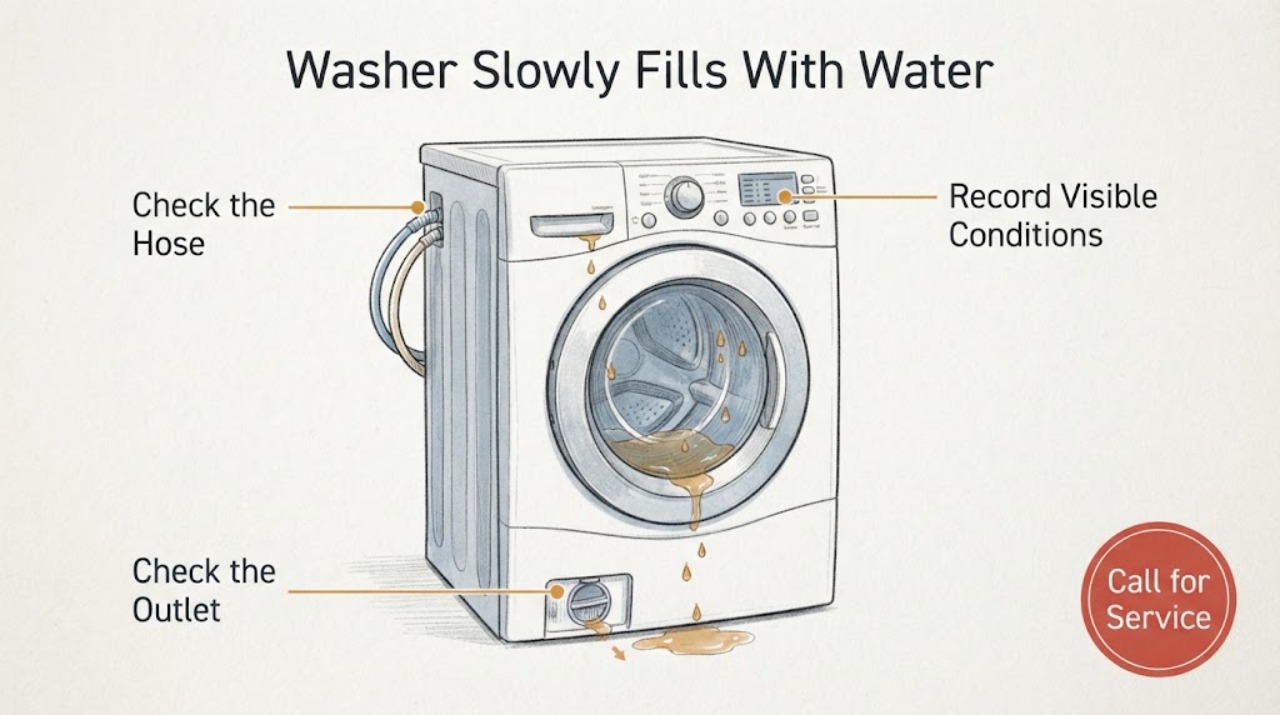
Close the washer's hot and cold water supply valves first so more water cannot enter while the appliance is unattended. A clean, gradually rising level with the supply open points toward water entering through the inlet side; dirty or soapy water, especially when another fixture drains, points toward drain-hose or standpipe backflow. GE says a washer that fills while off may have a failed water valve and needs repair, while Samsung's official guidance says to shut the water valves and request service for continuous filling. Keep the washer off if water reaches electrical parts, and use the exact model manual or qualified service for any internal valve, hose, or wiring work.
Work through in order
Diagnostic checks
Use only checks that match the exact appliance or system and its official guide.
-
Check 1
Turn both hot and cold washer supply valves fully closed before continuing, and keep the washer powered off if water is near the plug, cord, controls, or floor outlet. Do not reopen the valves just to see whether the level rises faster.
Expected result: The water stops increasing after the supply is closed, or it continues to appear despite the closed supply valves.
Next step: Leave the valves closed. If water continues or reaches electrical parts, stop using the washer and arrange qualified appliance/plumbing service rather than testing the washer with power on.
Why this matters
Why: Stopping after the valves close makes supply-side entry plausible; continued water can be residual water, drain backflow, a valve that is not actually isolated, or another plumbing source. The observation does not identify a part.
-
Check 2
After the washer is safe to view, note whether the water in the basket or tub is visibly clean and clear, or dirty, gray, or soapy. Record whether the level was already present immediately after a cycle or slowly appeared during idle time.
Expected result: The water is clean and gradually accumulates, or it is dirty/soapy or appears after another sink, dishwasher, or drain fixture discharges.
Next step: For clean gradual accumulation, keep the supply off and request appliance service. For dirty/soapy water or a fixture-linked recurrence, keep the washer off and have the drain-hose/standpipe connection checked against the exact installation instructions by a qualified person.
Why this matters
Why: Samsung explains that clean water is consistent with entry through the supply hose, while dirty or soapy water is consistent with water entering through the drain hose or connected plumbing. Residual water immediately after a cycle is not by itself proof of either fault.
-
Check 3
Inspect only accessible hose and plumbing points from outside: look for a kinked or crushed drain hose, an obvious loose connection, a hose pushed into a standpipe with an airtight seal, or water coming from a nearby sink trap or floor drain. Do not remove the washer cabinet, loosen a pressurized supply hose, or reach into standing water.
Expected result: A visible hose or drain connection is kinked, sealed, loose, or leaking, or all accessible connections look normal.
Next step: If the issue is outside the washer and can be made safe without disturbing a pressurized connection, arrange plumbing correction. If the connections look normal or the tub still fills with clean water, keep the supply closed and request appliance service.
Why this matters
Why: Samsung's water-fill guidance warns that drain-hose placement and an airtight standpipe connection can affect water behavior. A visible plumbing issue can be corrected only within the exact manual's installation limits; a normal-looking exterior does not clear an internal valve.
-
Check 4
Do not run another cycle while the source is unresolved. Document the model and serial label, whether the tub was empty before the event, water appearance, when the level changes, which supply valve was closed, and any leak or fixture activity for the technician.
Expected result: The tub remains empty with the supply closed, or water returns, the floor gets wet, the washer shows a leak, or the issue recurs after a cycle.
Next step: Keep the supply valves closed and arrange appliance service for recurrence or clean-water entry; arrange plumbing service for drain backflow or a building-drain issue. Do not order a valve or bypass a water or electrical safety based only on this symptom.
Why this matters
Why: A stable empty tub with the supply isolated supports monitoring while service is arranged; recurrence, floor water, or a leak raises the risk of property damage and requires a prompt inspection. The symptom alone does not prove an inlet valve failure.
Use your observations
Decision map
Find the observation that best matches what you see, then follow the next safe action.
-
PATH 01Next step
What you see
The water is clean, the tub slowly rises only when the supply valves are open, and it stops when those valves are closed.
Do this next
Keep both valves closed, do not energize the washer unnecessarily, and arrange qualified appliance service with the model and serial information.
Why this path and its safety boundary
Why it matters: This pattern is consistent with water entering from the washer supply side; GE identifies a failed water valve as a possible cause, but the exact washer and part are unknown.
-
PATH 02Next step
What you see
The water is dirty or soapy, or it appears after another fixture connected to the same drain is used.
Do this next
Keep the washer off and have the drain hose, standpipe, trap, and building drain checked against the exact installation instructions; do not seal or reposition a connection beyond the manual's limits.
Why this path and its safety boundary
Why it matters: Samsung describes this pattern as consistent with water entering through an incorrectly connected drain hose or connected plumbing rather than clean supply water.
-
PATH 03Next step
What you see
A small amount of water is seen immediately after a cycle but the level does not rise while the supply is closed and no new water appears during idle time.
Do this next
Follow the exact washer manual for normal residual water and monitor without opening panels. Escalate if the level increases, the floor gets wet, or the symptom returns between cycles.
Why this path and its safety boundary
Why it matters: This may be residual water from the completed cycle rather than an idle-fill fault; the observation alone does not justify a valve diagnosis.
-
PATH 04Next step
What you see
Water continues to appear with both supply valves closed, or water reaches electrical parts, the floor outlet, or a damaged cord.
Do this next
Do not power or test the washer. Keep people away from wet electrical areas, isolate water only if safe, and arrange qualified appliance/plumbing service or local emergency help for an immediate electrical hazard.
Why this path and its safety boundary
Why it matters: The water source is not safely explained by a normal fill check and may involve drain backflow, another plumbing source, or a hazardous leak.
Helpful context
Understand the symptom
Stop the water before diagnosing the source
Water appearing in an idle washer is not the same as a normal fill during a cycle. Close both accessible supply valves before leaving the appliance unattended. GE's official guidance says this prevents more water entering while the washer is not in use, and Samsung likewise directs owners to turn off the water valves when a washer continuously fills. Do not pull panels or reach into wet electrical areas to find a valve.
The water's appearance helps separate two paths
Samsung's official explanation describes two possible routes when water appears after a wash: clean water through the supply hose, or dirty/soapy water through the drain hose from the plumbing. This is a useful observation boundary for an unbranded washer, not a license to declare a failed inlet valve. Keep the supply closed while observing and use the exact installation manual for drain-hose geometry.
When checks do not resolve it
Need a professional?
Keep the washer's supply valves closed and arrange qualified service when clean water continues to enter while the washer is off, the level returns after isolation, the source is unclear, the floor or electrical area becomes wet, or the problem recurs. Arrange plumbing service when dirty/soapy water tracks to the drain connection or another fixture. Do not open the cabinet or replace an inlet valve from the symptom alone.
Common questions
FAQ
Why does a washer fill with water while it is turned off?
Clean water that slowly enters while the supply is open can be a supply-side problem; GE says a failed water valve may let water enter the tub while the washer is off. Dirty or soapy water may instead come through the drain connection. Close the supply valves first and do not infer a part without model-specific service.
Can I leave the washer's water valves open?
When a washer is filling while off or continuously filling, Samsung and GE advise closing the supply valves to prevent additional water entry while the issue is addressed. Keep them closed until the source is checked.
Does dirty water mean the washer's inlet valve is bad?
No. Samsung distinguishes clean supply water from dirty or soapy water entering through the drain hose or connected plumbing. Check the water path and drain installation with the exact manual or qualified plumbing help before naming a washer part.
Should I run a cycle to test the washer?
Do not run another cycle while water is accumulating, the source is unclear, or any electrical area is wet. Keep the supply isolated, document the symptom, and arrange appliance or plumbing service according to whether the evidence points to clean supply water or dirty drain backflow.
Read the exact guide
Official sources
- Washer - Drips or Fills When Not Turned OnGE Appliances · Used for the general symptom boundary: close the water supply valves when water enters while the washer is not in use, and have the appliance serviced when a water valve may be allowing water into the tub. It is not used to prove a failed valve on the unbranded washer.
- What to do if water enters the drum of a Samsung washing machine after washingSamsung Support Russia · Opened official Samsung page distinguishes clean water entering through the supply hose from dirty or soapy water entering through the drain hose, and directs service when the supply-side cause remains. Used as a diagnostic distinction only; the unbranded washer's exact installation and parts remain unresolved.
- Water fill issues with Samsung washing machinesSamsung Support US · Used for the manufacturer-level instruction to close water valves and request service when a washer continuously fills, plus the visible drain-hose/standpipe checks. Samsung's model-specific dimensions are not transferred as universal rules to this unbranded topic.
Community feedback
Share a repair observation
Share a plain-text repair observation. Accepted observations are published automatically; this page may take a moment to update.