
On this page
Start here
Quick answer
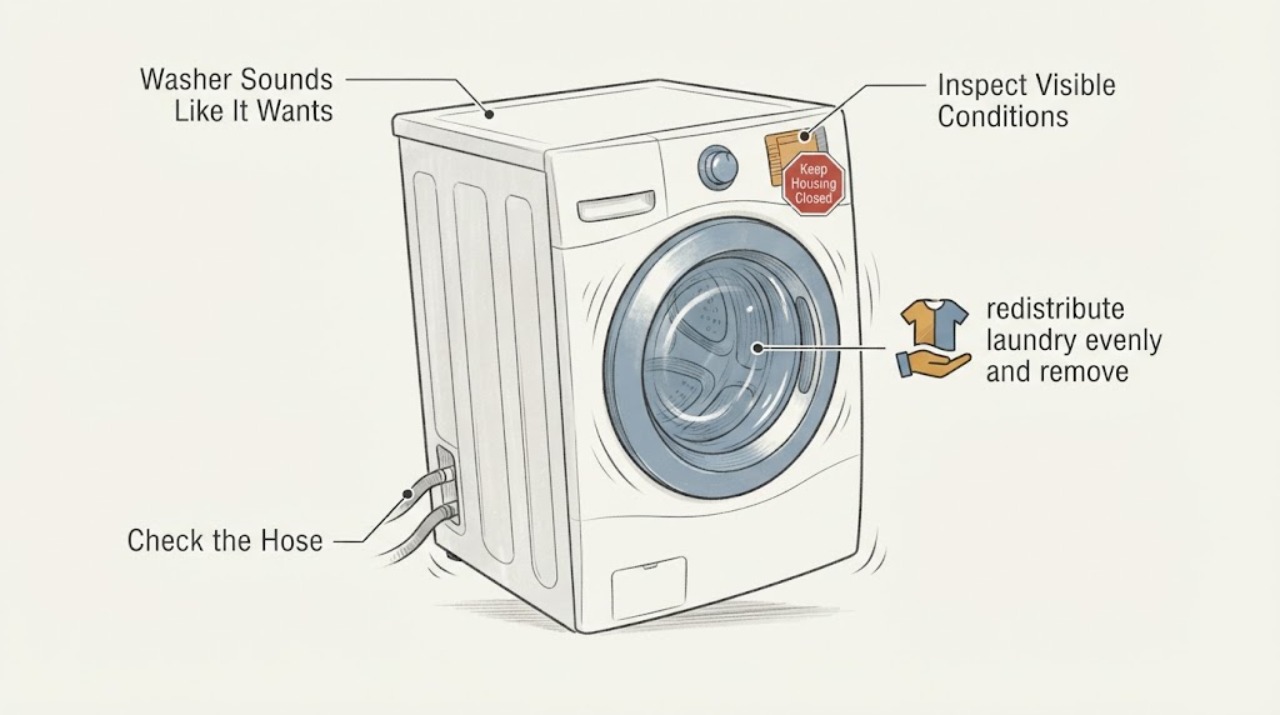
Pause the washer and keep clear if it is walking, striking the cabinet, or shaking violently. During spin, the first checks are load balance, bulky or single items, and whether the washer rocks on its feet. Official washer guidance links loud spin noise and movement to an uneven load or an unlevel installation, while also warning that a foreign object, shipping material, loose hose, or persistent empty-drum noise needs a different decision. Redistribute the load and check stability only from a safe, model-appropriate position; if the noise remains with an empty drum or the machine is unsafe to observe, leave it out of service and arrange a technician diagnosis.
Work through in order
Diagnostic checks
Use only checks that match the exact appliance or system and its official guide.
-
Check 1
Pause or cancel the spin cycle with the washer's normal control and stay clear until the basket or drum has stopped. Observe from outside whether the machine is walking, striking nearby cabinets, or leaking.
Expected result: The washer stops normally and remains stable, or it continues to move, strike the cabinet, leak, smoke, or produce a burning smell.
Next step: If an unsafe symptom is present, disconnect power only when safe, close the water supplies if there is a leak, and arrange service. Otherwise continue with the load check while the washer is stopped.
Why this matters
Why: Stable stopping permits a visual load and installation check. Violent movement, a leak, smoke, or burning smell is a stop condition and should not be tested repeatedly.
-
Check 2
With the drum stopped, redistribute laundry evenly and remove a single heavy or absorbent item, a bulky item, or an overloaded portion. Check the care label and the washer's own cycle guide before washing bulky goods again.
Expected result: The clothes were gathered on one side, the load was a single bulky item, or the tub was overfilled; or the load was already loose and within the documented limit.
Next step: Run only the model-approved cycle with a balanced load if the washer is otherwise stable. If the same noise returns, stop and move to the stability and service checks.
Why this matters
Why: Uneven or unsuitable loads can shift the center of gravity and cause loud spin noise, shaking, reduced speed, or a longer cycle. A correctly distributed load makes a load-balance explanation less likely but does not prove an internal fault.
-
Check 3
From outside the unplugged or stopped washer, check whether it rocks diagonally, whether all accessible feet are firmly supported, and whether a loose hose or nearby object can strike the cabinet. If the appliance was recently installed or moved, use its exact installation manual to check the shipping-bolt requirement.
Expected result: The cabinet rocks, a foot is not firmly supported, a hose or object contacts the cabinet, or shipping material may still be installed; or the installation is stable and clear.
Next step: Correct only the visible external issue or follow the exact model installation instructions. Do not remove panels or guess at bolt, suspension, or foot settings. Use service if the installation is stable but the noise persists.
Why this matters
Why: Official guidance links an unlevel or unstable installation, loose hoses, and retained transit hardware with excessive vibration or noise. A stable installation makes those explanations less likely but does not name an internal component.
-
Check 4
If the load and installation are stable, inspect only the user-accessible drum area for a coin, wire, or other foreign object, following the exact manual and keeping the washer disconnected. Do not reach behind the drum or remove a filter unless the model manual explicitly permits that user check.
Expected result: A foreign object is visibly accessible, or the drum is clear but the harsh sound remains.
Next step: Remove only an accessible object using the model's instructions. If the object is trapped, the drum rubs, or the sound remains with the drum clear, stop using the washer and arrange service.
Why this matters
Why: LG identifies foreign objects in the tub as a possible source of noise and says continued noise after the documented checks requires repair. A clear drum does not prove that a bearing, pulley, motor, or suspension part is bad.
-
Check 5
Record the full model number, loader type, cycle, load description, whether the washer moves, and whether the noise continues with an empty drum. Give those observations to the manufacturer or an authorized technician instead of ordering a part by sound.
Expected result: The noise disappears after load or stability correction, or it remains despite the permitted external checks.
Next step: Keep the washer out of service when the noise persists or the machine moves, and book a technician assessment. Do not open the cabinet, test live wiring, bypass a lock, or run repeated high-speed tests.
Why this matters
Why: A resolved symptom supports a load or installation adjustment. Persistent noise after those checks needs model-specific diagnosis; the public sources do not support naming a failed internal part from the phrase 'take off'.
Use your observations
Decision map
Find the observation that best matches what you see, then follow the next safe action.
-
PATH 01Next step
What you see
The washer stops safely, the laundry was piled on one side or was a single bulky item, and the machine is otherwise stable.
Do this next
Redistribute or remove the unsuitable load according to the exact manual and use a supervised model-approved cycle. Stop if the noise returns.
Why this path and its safety boundary
Why it matters: The pattern fits an out-of-balance load, which official guidance links to loud spin noise and vibration.
-
PATH 02Next step
What you see
The washer rocks, a foot is unsupported, the floor is unstable, a hose strikes the cabinet, or shipping bolts may remain after installation.
Do this next
Use the exact model installation instructions to correct the visible installation issue. Do not improvise hardware removal or open the cabinet.
Why this path and its safety boundary
Why it matters: The installation can amplify normal spin forces and create excessive noise or movement.
-
PATH 03Next step
What you see
The load is balanced and the installation is stable, but the same harsh noise occurs with the drum clear or during an empty permitted test.
Do this next
Leave the washer unplugged and arrange model-specific service. Do not diagnose or replace a bearing, pulley, suspension, motor, or control from sound alone.
Why this path and its safety boundary
Why it matters: A persistent empty-drum noise is not explained by load distribution alone, and the opened official guidance routes unresolved noise to service rather than a guessed part.
-
PATH 04Next step
What you see
The washer walks violently, strikes the cabinet, leaks, smokes, or smells burnt during spin.
Do this next
Stop the cycle, keep clear, disconnect power only when safe, close water supplies if needed, and arrange professional service without further spin tests.
Why this path and its safety boundary
Why it matters: The symptom presents a safety or damage risk beyond a routine load-balance adjustment.
Helpful context
Understand the symptom
Treat the movement as a safety observation first
A washer can make more sound as spin speed rises, but a machine that walks, hits the cabinet, or shakes violently should not be allowed to continue. Pause or cancel the cycle using the normal control and wait for movement to stop before opening the door or lid. Do not hold the cabinet, reach toward the basket, or keep restarting the cycle to reproduce the noise.
Load distribution is the first reversible check
Whirlpool and LG both describe clothing gathered on one side, bulky items, a single absorbent item, or an overloaded tub as causes of pounding, rattling, noise, and vibration during spin. With the washer stopped, spread the items evenly and remove a load that the exact manual does not permit. Do not add water to make the load settle, and do not keep running a badly unbalanced load.
Check stability and installation without opening the cabinet
Rocking feet, an uneven floor, loose hoses, or shipping bolts left in place after installation can amplify spin vibration. Check the washer from outside. Use the exact model installation instructions for any foot adjustment or shipping-bolt procedure; the absence of a model number does not justify borrowing a detailed adjustment from another washer family.
An empty-drum test changes the decision
If the washer is stable and the load has been redistributed, an exact-model manual may permit a brief empty or low-risk cycle observation. If the same harsh sound remains with no laundry, or if the drum makes the noise when rotated only as the manual permits, the public guidance does not identify a bearing, suspension, pulley, motor, or other part from sound alone. Stop and arrange service rather than dismantling the washer.
When checks do not resolve it
Need a professional?
Call a qualified technician when excessive noise or movement continues after the model-appropriate load and stability checks, when the noise remains with an empty drum, when a foreign object is trapped, or when the washer leaks, smokes, smells burnt, strikes the cabinet, or needs cabinet removal or live electrical testing.
Common questions
FAQ
Why does a washer sound like a jet or want to take off during spin?
The phrase describes a symptom rather than a confirmed part failure. An uneven load, bulky or single absorbent item, rocking installation, loose hose, or retained shipping material can create loud vibration. If the same sound remains with a stable empty drum, service is needed to identify the cause.
Should I let the washer finish if it is shaking violently?
No. Pause or cancel the cycle and wait for movement to stop. Keep clear and arrange service if it walks, strikes the cabinet, leaks, smokes, smells burnt, or resumes the same violent movement after a permitted load and stability check.
Does loud spin noise prove that the bearings or suspension are bad?
No. Official guidance supports checking the load, level, installation, hoses, and accessible foreign objects first. Persistent noise after those checks needs a model-specific technician diagnosis; do not order an internal part from the sound alone.
Read the exact guide
Official sources
- LG Washer - Troubleshooting Noises During the CycleLG USA Support · Opened official LG guidance used for broadly applicable external checks and the persistent-noise service boundary, not for an unidentified washer's internal parts.
- Whirling or Spinning Noise - Front Load WasherAmana Product Help · Opened official Amana family guidance. Its front-load branches are kept conditional because the assigned washer type and model are unknown.
- Vibration or Out of Balance loads - Product HelpWhirlpool Product Help · Opened official top-load guidance used for generic symptom decisions only; the assigned topic has no brand or model, so no Whirlpool control or part behavior is transferred.
- Washing Machine Noisy or Shaking During Spin Cycle?Zanussi Support · Opened official Zanussi support article used only for cross-family external checks and safety boundaries; it does not establish compatibility or a fault in the anonymous washer.
Community feedback
Share a repair observation
Share a plain-text repair observation. Accepted observations are published automatically; this page may take a moment to update.