
On this page
Start here
Quick answer
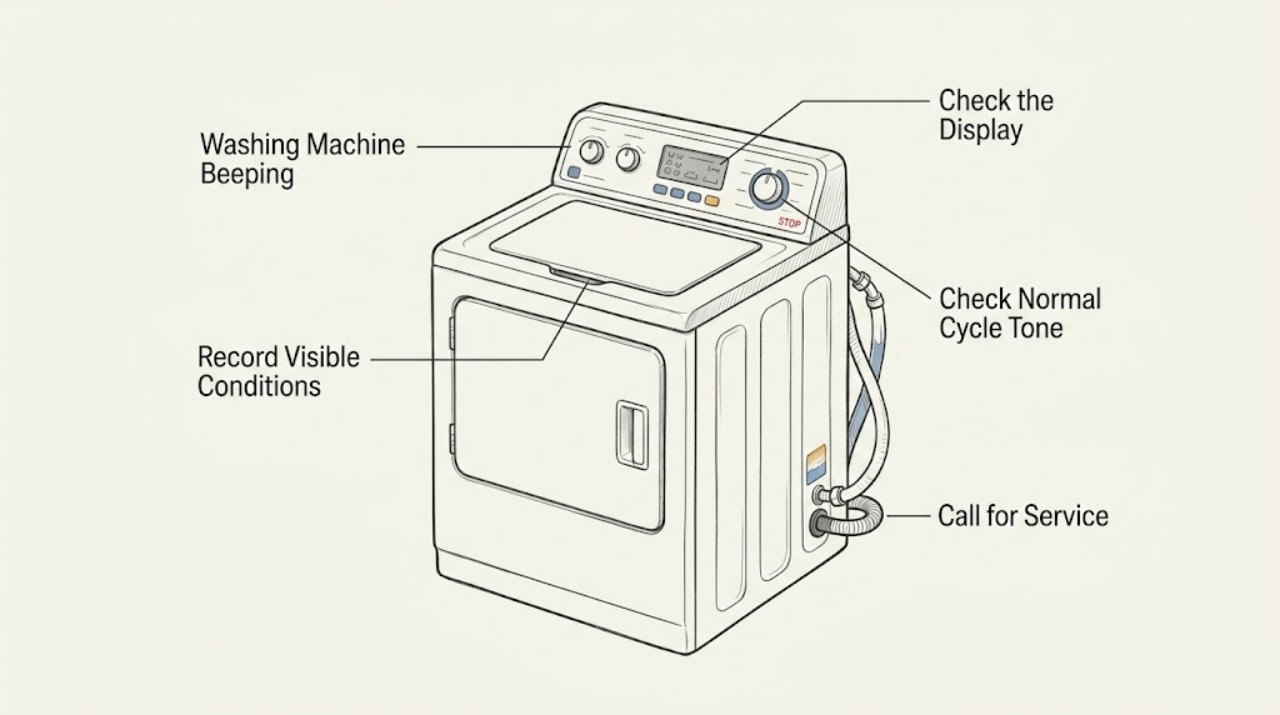
A washing machine beep is not automatically a failure. First record the rhythm, display symbol or exact code, programme stage, and whether the sound occurs when a button is pressed, at cycle end, during filling, during draining, or while the machine is stopped. Short confirmation or end-of-cycle tones can be normal on some models, while a repeated pattern with a flashing light or code may identify a door or lid lock, water supply, drain, foam, load, or control problem. Check only the visible door or lid closure, the load, the accessible water and drain path, and the model manual. If the machine is wet, leaking, shaking violently, smoking, hot, sparking, smells burnt, or trips the circuit, stop using it. After safe external checks, use no more than one model-approved reset; if the beeping returns or the code is unclear, arrange qualified appliance service rather than guessing from another brand's pattern.
Work through in order
Diagnostic checks
Use only checks that match the exact appliance or system and its official guide.
-
Check 1
From a safe position, observe without opening the machine whether the sound is one tone after a button, a short end-of-cycle signal, a repeating burst, a continuous alarm, or a tone paired with a flashing light. Record the exact display symbol or code, cycle stage, and whether the drum is moving, filling, or draining.
Expected result: The beep occurs only after input or at cycle end, repeats at a fixed rhythm, accompanies a symbol or code, or continues while the machine is idle.
Next step: Use the exact model manual to interpret the recorded pattern. If the sound is new, continuous, or paired with water, movement, heat, smoke, odor, or an electrical symptom, stop the machine and use the relevant safety branch.
Stop if: Stop immediately for smoke, burning smell, sparks, a hot cabinet or outlet, a leak, water near electrical equipment, violent movement, or a repeated circuit trip.
Why this matters
Why: A user setting or normal cycle signal is possible when timing is predictable, while a repeating tone with a display or stage-specific symptom is an alert. The same sound cannot be assigned one universal meaning across brands and models.
-
Check 2
If the washer beeps when Start is pressed, inspect the visible door or lid area without forcing it. Remove only an obvious small load obstruction, check that no fabric is caught in a front-loader seal, close the door or lid normally, and look for a padlock or control-lock symbol.
Expected result: The door or lid closes and locks normally, the lock symbol is active, laundry or an overloaded drum prevents closure, or the lock remains unconfirmed and the machine beeps.
Next step: Follow the exact manual once to release the control lock or select the correct Start input. If the door or lid will not latch normally, the glass, hinge, seal, or lock is damaged, or the beep returns, keep the washer off and request service.
Stop if: Do not force, tape, hold, or bypass a door or lid interlock; stop for broken glass, a torn seal, an active leak, or a door or lid that cannot close safely.
Why this matters
Why: A start interlock can produce a beep when the washer cannot verify a safe closed door or lid. Control Lock can also leave buttons unresponsive; a lock that will not engage can indicate a faulty lock or alignment issue.
-
Check 3
Compare the timing with the owner's manual without deliberately repeating the cycle: note whether the sound occurs only when a setting is touched, at the normal end signal, during a damp or reminder feature, or after a pause or cancel command.
Expected result: The tone is listed as a normal cycle signal or button response, or it is not listed and occurs with a fault light, an interrupted cycle, or no user input.
Next step: If the manual confirms a normal signal, adjust it only through the documented setting. If the sound is unlisted, continues while idle, or accompanies a fault, record it and continue with water, drain, and code checks instead of running repeated tests.
Stop if: Stop using the machine for a new continuous alarm, smoke, burning or electrical odor, heat, sparks, water, or repeated trip even if a normal-tone setting is available.
Why this matters
Why: Some manufacturers document end or cycle signal tones as normal and model-dependent. An unlisted or newly persistent beep, especially with a display indication, should be treated as an alert rather than muted or ignored.
-
Check 4
If the beep begins when filling or draining, inspect from a dry, stable position that the water tap is open, visible inlet and drain hoses are not kinked, and the household drain is not backing up. If the model permits a pump-filter check, isolate power and water first and follow that manual only; do not tilt or dismantle the appliance.
Expected result: The tap is closed, an inlet hose is kinked, the drain backs up, water remains in the drum, a model-approved accessible filter is blocked, or all visible water paths appear normal.
Next step: Correct only a clearly visible tap or hose position and perform no more than one model-approved test. Stop for leaks or retained water and arrange appliance or plumbing service when the alert returns.
Stop if: Stop for uncontrolled filling, an active leak, water near electrical equipment, sewage-contaminated water, a hot pump, or any need to open a sealed panel or work while powered.
Why this matters
Why: Water-flow and drainage faults can trigger a beep or prevent a cycle from advancing. A clear external path with a persistent alert points to a pump, valve, sensor, or control issue that cannot be identified from sound alone.
-
Check 5
If the beep occurs during sensing or spin, wait until the drum is stationary, then note whether the load is clumped, overloaded, or a single bulky item. Redistribute or remove a small amount only when the door or lid unlocks normally and there is no water or electrical hazard; do not reach into a moving drum.
Expected result: The beep stops after a safe load correction, an unbalanced-load light or code appears, the washer is violently shaking, or the machine beeps with a stable load and clear water path.
Next step: Use a suitable, balanced load once if the machine is stable and the manual permits it. If the alert returns, the machine cannot balance, or the stage remains stuck, stop and arrange service.
Stop if: Stop for violent shaking, walking, metal impact, a damaged cabinet, broken glass, smoke, burning odor, sparks, water, or repeated breaker operation.
Why this matters
Why: An imbalance can make a washer pause or signal before spin. A stable load with a repeated alert shifts attention to a lock, drain, motor, sensor, or control fault; violent movement is a safety boundary.
-
Check 6
Record every visible character, icon, flashing light count, and button response before consulting the manual for the exact model. Do not translate a code from another brand, and do not repeatedly press buttons to make the tone recur.
Expected result: The manual identifies the code as a door or lid, water, drain, foam, load, motor, or power condition, or the display shows an unlisted or changing code.
Next step: Follow only the model manual's low-risk correction, then stop after one documented attempt if the alert returns. Give the technician the code, stage, pattern, and observations.
Stop if: Do not bypass a lock, clear a code repeatedly, run the washer after an electrical or water warning, or continue for smoke, odor, sparks, overheating, leaks, or a trip.
Why this matters
Why: A code and its timing narrow the branch, but error-code families and button layouts are model-specific. An unlisted or returning code requires a service decision rather than a guessed part or generic reset.
-
Check 7
After the safe external checks, perform no more than one power reset using the exact owner's manual. If the manual gives no model-specific procedure, disconnect power from a dry, safe position, wait the documented interval, reconnect once, and start no more than one normal programme attempt.
Expected result: The beeping stops and the machine completes a normal start, or the same tone, code, lock state, water fault, or electrical symptom returns.
Next step: If the alert returns, leave the washer out of service and arrange qualified appliance service. Provide the model, exact pattern, display, cycle stage, water state, load, and power observations instead of attempting another reset.
Stop if: Do not reset repeatedly, reconnect a wet or damaged washer, bypass a safety device, or continue after smoke, burning smell, sparks, overheating, flooding, or a circuit trip.
Why this matters
Why: A reset can clear a transient electronic state but cannot prove that an interlock, pump, valve, motor, sensor, or control is sound. A returning alert is evidence for professional diagnosis.
Use your observations
Decision map
Find the observation that best matches what you see, then follow the next safe action.
-
PATH 01Next step
What you see
The beep occurs only after a button, at a documented cycle end, or as a model-listed reminder with no fault indication.
Do this next
Use the manual to adjust the sound setting if desired. If the pattern changes, continues while idle, or gains a code or warning, stop treating it as normal and request diagnosis.
-
PATH 02Next step
What you see
The machine beeps at Start, the door or lid does not lock, a lock symbol appears, or laundry prevents closure.
Do this next
Remove only an obvious load or seal obstruction and follow the exact lock procedure once. Do not force or bypass the interlock; a persistent issue needs appliance service.
-
PATH 03Next step
What you see
The beep starts during filling or draining, water remains, or a water or drain code or light appears.
Do this next
Check only the accessible tap, hose, household drain, and model-approved filter procedure after safe isolation. Stop for leaks or water near electricity and arrange service.
-
PATH 04Next step
What you see
The beep occurs during sensing or spin with an unbalanced-load, foam, or overload indication.
Do this next
Wait for the drum to stop and make one safe load or detergent correction if the manual permits it. Violent movement or a returning alert requires service.
-
PATH 05Next step
What you see
The washer is blank, the outlet fails, a cord or receptacle is hot or damaged, or a circuit trips.
Do this next
Leave the appliance disconnected and arrange qualified electrical or appliance service. Do not keep resetting the circuit or use an extension cable.
-
PATH 06Next step
What you see
The code or beep pattern is not listed for the exact model, returns after one documented correction or reset, or occurs with no obvious external cause.
Do this next
Stop testing and provide the exact model, code, pattern, stage, and safety observations to qualified appliance service.
Helpful context
Understand the symptom
The pattern matters more than the word beep
A single tone after a button press, an end-of-cycle signal, and a burst that repeats every few seconds are different observations. Whirlpool describes some front-load washer beeps as normal cycle signal tones, while a GE washer manual uses a repeated beep pattern with flashing indicators to identify a condition such as an unbalanced load or a water-supply state. These examples are not universal codes. Write down the exact rhythm, display, light, and programme stage before applying a reset.
Check the start interlocks without bypassing them
A washer may beep because it cannot confirm a closed door or lid, or because a control lock is active. A front-loader door can look closed while the lock is not engaged; overload or fabric caught in the seal can prevent closure. Use the exact manual for the lock or Start command, and never tape, hold, or bypass an interlock. If the lock does not engage normally, do not run the washer while troubleshooting it.
Water, drain, foam, and load conditions can all trigger alerts
A beep during or just after a start attempt may accompany a water or drain problem, excess foam, or an unbalanced load. Check the visible tap, hoses, drain route, load, and displayed code only as the model instructions permit. A water-related symptom with leakage or water near electrical equipment is a stop condition. Do not infer a pump, sensor, or motor failure from a beep alone; persistent alerts need model-specific service diagnosis.
Safety boundary
Stop conditions
- Stop and isolate water or power only from a safe, dry position for an active leak, uncontrolled filling, flooding, water near electrical equipment, or sewage-contaminated water.
- Stop for smoke, a burning or electrical smell, sparks, a hot or scorched plug or outlet, exposed wiring, or a repeated breaker or safety-switch trip; do not keep resetting the circuit.
- Stop for violent shaking, walking, metal impact, broken glass, a torn seal, or a door or lid that will not latch. Never bypass a door or lid interlock.
- Do not use an extension cable, tilt the appliance, perform live electrical tests, open sealed panels, reach into a moving drum, or apply another brand's code or reset sequence.
When checks do not resolve it
Need a professional?
Request qualified appliance service for a persistent or unexplained beep, an unlisted or returning code, failed door or lid detection, a stuck cycle, a repeated water or drain indication, or any internal lock, pump, valve, motor, sensor, wiring, or control diagnosis. Use an electrician or plumber when the fault is outside the appliance.
Have this ready
- Provide the machine model and serial information if safely visible, front- or top-loader layout, exact beep rhythm and count, flashing lights or display code, programme and stage, door or lid behavior, tub water level, load, socket result, hose observations, and safe external photos.
Common questions
FAQ
Why is my washing machine beeping but still running normally?
It may be a button, end-of-cycle, reminder, or other model-listed signal. Record when it occurs and compare it with the exact manual. If the beep is new, persistent, paired with a code, or accompanied by water, heat, odor, or movement, stop using the machine and request diagnosis.
Why does my washing machine beep when I press Start?
The machine may not detect a closed door or lid, a control lock may be active, a programme or delay may still be selected, or a water or drain condition may block the start. Check only visible conditions and the exact manual; never bypass the interlock.
What does a repeating washing-machine beep mean?
There is no universal meaning. A repeating pattern with a flashing light or code can indicate water, drain, load, foam, lock, or another model-specific condition. Record the rhythm and stage, then use the exact manual rather than another brand's code list.
Can a blocked drain make a washing machine beep?
Yes, some manufacturer guidance links beep or flash patterns with drainage conditions. From a safe position, check the visible drain hose and household drain, and follow the model manual before accessing any filter. Stop for retained water, leaks, or water near electrical equipment.
When should I stop using a beeping washing machine?
Stop for smoke, burning smell, sparks, a hot outlet, repeated trips, flooding, water near electrical equipment, violent shaking, broken glass, or a door or lid that will not latch. Isolate water or power only from a safe position and arrange the appropriate qualified service.
Read the exact guide
Official sources
- Washing Machine common error codes and troubleshooting tipsZanussi Support · Official Zanussi support used only as an example that error-code families and meanings are model-dependent; it is not a universal code table.
- Problem with power supplyZanussi Support · Official Zanussi household appliance power guidance applied to washer safety boundaries; local electrical requirements and exact model instructions control.
- How to Fix Washing Machine Error E10, E11 or C1 – Water Inlet & Drainage IssuesZanussi Support · Official Zanussi washing-machine and washer-dryer guidance used for general water and drain observation patterns; exact model instructions control.
- The washing machine door does not close properlyZanussi Support · Official Zanussi front-loader door guidance used for general lock and overload branches; top-loader lid behavior varies.
- Not Starting or Not Operating - Front Load WasherWhirlpool Product Help · Official Whirlpool front-load washer troubleshooting used for general decision branches; controls and error meanings vary by model.
- Washing Machine Not Working or Not Turning On – Troubleshooting GuideZanussi Support · Official Zanussi washing-machine and washer-dryer guidance used for general no-power and powered-no-start distinctions; exact model controls differ.
- Washing machine does not drain, displays error code E20, E21 or C2, emits 2 beeps / 2 flashesZanussi Support · Official Zanussi drain troubleshooting used for general safety-limited observations; filter access and installation details vary by model.
- Beeping and Audio Tones - Front Load WasherWhirlpool Product Help · Official Whirlpool front-load washer guidance used only to illustrate that some beeps are normal cycle signal tones; exact model documentation controls.
- Owner's Manual: WasherGE Appliances · Official GE washer manual used only to demonstrate why beep rhythm and flashing indicators matter; its codes and controls do not generalize to other models.
- LG Washer - Troubleshooting Unresponsive Washer ButtonsLG USA Support · Official LG washer guidance used as a manufacturer example that lock indicators and button combinations vary by model; it is not a code reference for other brands.
Community feedback
Share a repair observation
Share a plain-text repair observation. Accepted observations are published automatically; this page may take a moment to update.