
On this page
Start here
Quick answer
Stop the cycle and identify whether water remains in the tub, when the cycle stopped, and whether the pump is silent, humming, or moving water. If a hot cycle just ran, let the water cool. From a dry position, inspect the external drain hose for kinks, an airtight or incorrectly placed standpipe connection, and a backed-up sink or drain. A removable pump or debris filter is a front-load, model-specific check only; follow that model's manual and use its controlled drain path. Do not tilt the machine, force the door, remove a rear hose retainer, or open panels. If water is near electrical equipment, there is a leak, unusual pump noise, smoke, burning odor, or repeated error, stop and arrange qualified service.
Before you begin
Safety first
- This article permits only dry, external observations and a model-manual-authorized filter or drain procedure after hot water has cooled. It does not authorize tilting, cabinet removal, live electrical testing, door-lock bypass, pump disassembly, or work in standing water.
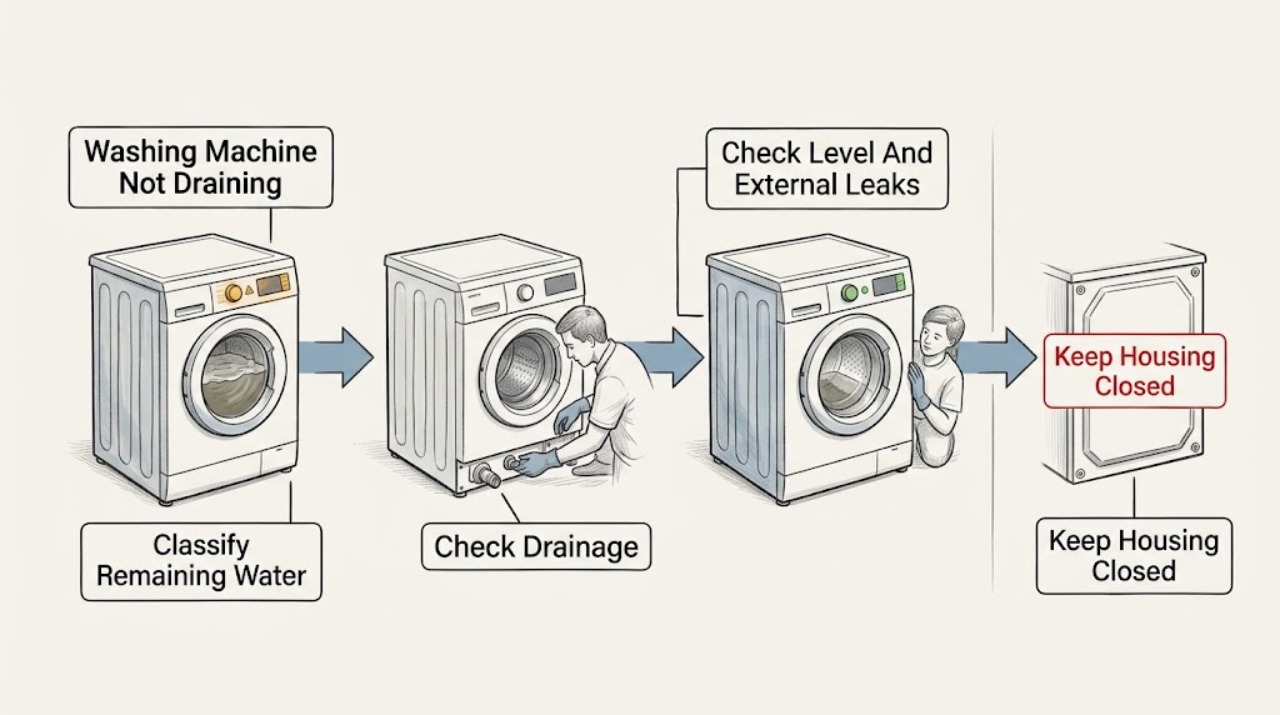
Work through in order
Diagnostic checks
Use only checks that match the exact appliance or system and its official guide.
-
Check 1
Pause or cancel the cycle according to the machine's controls and observe the tub, display, door or lid lock, and the point in the program where it stopped; keep hands out of the water.
Expected result: Record whether the tub is empty, partly full, or full; whether the display shows a drain or overflow message; and whether the pump is silent, humming, rattling, or moving water.
Next step: If the water may be hot, wait for it to cool before any model-authorized drain procedure; otherwise inspect only visible external plumbing next.
Stop if: Stop for scalding water, leaking water, water near the power connection, smoke, burning odor, exposed wiring, or a machine that moves violently.
Why this matters
Why: A full tub with no pump response suggests power, control, door-lock, pump, or blockage possibilities. A hum with no flow suggests a restricted drain path or pump obstruction. A slow stream points toward a partial blockage, hose problem, or downstream drain restriction.
-
Check 2
From a dry position, trace the visible drain hose from the washer to the standpipe, laundry tub, or sink without pulling the washer forward or removing its rear retainer.
Expected result: Look for a kink, pinch, crushed section, loose hose, hose inserted too deeply or too low, an airtight seal, a missing guide, or a sink and standpipe that cannot accept water.
Next step: Use the exact installation instructions to correct only a clearly visible, low-risk placement issue; if the household drain backs up or the hose is damaged, stop and call a plumber or appliance technician.
Stop if: Do not remove the hose screw or retainer, create an airtight seal, force a hose into a drain, pull a heavy washer across a wet floor, or disconnect a full hose without a controlled manual procedure.
Why this matters
Why: A visible installation fault can restrict flow or create siphoning and may explain a no-drain symptom without an internal repair. A damaged hose or inaccessible connection needs service or a qualified plumbing repair rather than a makeshift extension.
-
Check 3
Inspect the floor, drain connection, hose ends, and machine stance from outside the wet area; compare the washer to a stable, level position without tilting it.
Expected result: Note water at the hose connection, standpipe or sink, under the machine, or around a door; also note whether the cabinet rocks or has shifted and whether the downstream drain accepts water.
Next step: Keep the water isolated and call service for a leak, hidden water, a damaged hose, or a machine that cannot be safely stabilized; correct only an obvious external plumbing issue allowed by the manual.
Stop if: Do not stand in water while touching the washer, use an electrical appliance or pump near water, tilt the washer, or open its bottom or rear panels.
Why this matters
Why: A leak or backed-up standpipe can make a drain problem a flooding and electrical hazard. An unstable machine can interrupt a cycle or worsen vibration, but it does not prove the pump is clear. A dry, stable exterior moves the investigation toward the designated drain filter or service.
-
Check 4
Only if the exact model manual identifies a user-accessible pump or debris filter, disconnect or isolate power as the manual directs from a dry position, prepare towels and a container, and follow the designated controlled-drain procedure.
Expected result: Record whether the designated drain hose releases water, whether the filter contains lint or a foreign object, and whether the filter can be reseated without damage; top-loaders and some other models may have no removable filter.
Next step: Clean and refit only the named filter following the manual; if the washer still will not drain, request appliance service rather than removing panels or reaching into the pump.
Stop if: Do not improvise a filter location, force a cap, reach into a pump, drain hot water, tilt the machine, or touch the plug, controls, or wiring with wet hands or while standing on a wet surface.
Why this matters
Why: A clogged filter can reduce draining, but a filter that is absent, seized, damaged, or still leaves no flow indicates a model-specific pump or internal fault. A large amount of water, a damaged seal, or a sudden leak means the machine should remain out of service.
-
Check 5
Read the exact error code or blinking-light pattern and identify the cycle stage, load type, and whether the machine attempted drain before stopping; do not substitute a code from another model.
Expected result: Record the complete code or light sequence, time remaining, water level, pump sound, and whether the door remains locked because water is detected.
Next step: Provide the exact code and observations to the manufacturer or qualified technician; perform only one manual-authorized reset after the water and electrical area are safe.
Stop if: Do not force the door, bypass the lock, run repeated cycles with a full tub, or guess at an error-code repair.
Why this matters
Why: A no-drain indication may be a consequence of a hose, filter, pump, control, or downstream restriction. Door locking can be a safety response to residual water, not proof that the latch itself is defective. Codes and light patterns are model-specific and should be interpreted only from the manual.
-
Check 6
After a clearly corrected visible hose issue or a correctly reseated model-authorized filter, run only the shortest manual-approved drain or rinse-and-spin test with the area continuously attended.
Expected result: Watch whether water exits normally, backs up, leaks, remains in the tub, or produces a hum, grinding, burning smell, or error.
Next step: Stop the test, keep the machine off, and arrange appliance or plumbing service for any failed result; remove wet laundry safely without forcing a locked door.
Stop if: Do not run a test with standing water around the washer, leave the washer unattended, repeat a failed test, or operate after smoke, odor, arcing, or severe vibration.
Why this matters
Why: Normal flow without leakage supports an external installation or debris cause, but does not justify unattended operation. No flow, a repeat code, a leak, or abnormal sound indicates a pump, control, hose, or plumbing fault requiring service.
-
Check 7
Prepare the model and serial information, front-load or top-load type, cycle stage, water temperature, complete code, hose route, filter availability, pump sound, and first wet point for service.
Expected result: Confirm whether the problem is a full tub, slow drain, downstream backup, leak, locked door, repeated code, or no pump response, and whether any visible correction changed the symptom.
Next step: Call an appliance technician for an internal washer fault or a plumber for a blocked household drain, and keep water and power isolated as safely required until service.
Stop if: Do not tilt, dismantle, bypass, or continue operating the washer to gather more evidence once a safety or leak symptom is present.
Why this matters
Why: This record distinguishes a household drain or hose issue from a machine pump, control, lock, or wiring issue without unsafe disassembly. It also tells the technician whether water may still be trapped inside.
Use your observations
Decision map
Find the observation that best matches what you see, then follow the next safe action.
-
PATH 01Safety boundary
What you see
The tub contains recently heated water, water is leaking, or water is near the electrical connection.
Do this next
Stop the cycle, keep clear of the wet electrical area, and wait for safe cooling or contact qualified service from a safe position.
Why this path and its safety boundary
Why it matters: Scalding, flooding, and electric-shock risks take priority over drain diagnosis.
Safety stop: Do not open a filter, touch the plug or controls while wet, or reach into the tub or pump.
-
PATH 02Safety boundary
What you see
The visible hose is kinked, crushed, too deep, too low, airtight, loose, or the sink/standpipe backs up.
Do this next
Correct only a clearly visible placement issue using the exact manual; call a plumber or appliance service for damage, backup, or an inaccessible route.
Why this path and its safety boundary
Why it matters: The external drain route can restrict flow, siphon, spill, or reveal a household plumbing blockage.
Safety stop: Do not pull the washer across wet flooring, remove the rear retainer, or force a full hose connection.
-
PATH 03Safety boundary
What you see
The exact front-load model has a named, accessible pump or debris filter and the water is cool and safely isolated.
Do this next
Use the manual's controlled drain and filter-cleaning sequence once; request service if the filter is absent, damaged, seized, or the fault remains.
Why this path and its safety boundary
Why it matters: A blocked filter may explain slow or absent drainage, but the filter procedure is model-specific.
Safety stop: Do not invent an access point, reach into the pump, tilt the washer, or open panels.
-
PATH 04Safety boundary
What you see
The washer is top-load or the manual does not identify a user-removable pump filter.
Do this next
Limit checks to the visible hose, downstream drain, controls, and model-specific error guidance, then arrange service if it still will not drain.
Why this path and its safety boundary
Why it matters: A filter-cleaning instruction from another machine does not apply; remaining causes include hose, plumbing, pump, control, or lock faults.
Safety stop: Do not dismantle the cabinet or tilt the washer to reach an assumed pump filter.
-
PATH 05Safety boundary
What you see
The external route is clear, a permitted filter check did not restore flow, or the pump is silent, grinding, or repeatedly errors.
Do this next
Keep the washer out of service and request appliance-technician diagnosis; provide the exact code, sound, stage, and water level.
Why this path and its safety boundary
Why it matters: An internal pump, control, wiring, lock, or obstruction fault is more likely and cannot be safely confirmed by ordinary-user disassembly.
Safety stop: Do not run repeated cycles, bypass the door lock, or test energized wiring.
Helpful context
Understand the symptom
Start with the stage and the water level
A washer that stops before drain, leaves a full tub after wash, or drains slowly has different clues from one that pumps out but will not continue to spin. Note the remaining water level and whether the sound occurs only during the drain portion. If a hot or sanitizing cycle just finished, treat the water as scalding until it has cooled; do not open a filter or hose to release hot water.
The hose and standpipe are part of the drain system
A kinked hose, a hose pushed too far into a standpipe, an airtight connection, an incorrect height, or a blocked household drain can prevent draining or create siphoning. These installation dimensions are model- and plumbing-dependent, so use the washer manual and inspect the visible connection rather than assuming a universal measurement.
A pump filter is not on every washer
Many front-load designs provide a pump or debris filter, while top-load designs may not have a user-removable filter. Open or drain it only when the exact manual identifies the access point and safe sequence. A machine with no designated access should go to service; do not tilt it or remove hidden panels to reach a pump.
Safety boundary
Stop conditions
- Stop for hot water, a leak or overflow, water near the plug or controls, exposed wiring, smoke, burning odor, arcing, or severe walking and vibration.
- Do not touch electrical products, plugs, controls, or wiring with wet hands or while standing on a wet surface; do not use an electrical pump or appliance near standing water.
- Do not tilt the washer, remove cabinet or rear panels, remove a hose retainer, bypass a door or lid lock, or reach into a pump.
- Do not force the door, drain hot water, run repeated cycles, or leave a test cycle unattended while the cause is unresolved.
- Do not assume a pump filter exists or apply another model's error-code, drain-height, or emergency-release instructions.
When checks do not resolve it
Need a professional?
Call an appliance technician when the visible hose and household drain are clear but water remains, the pump is silent or abnormal, an error repeats, the door or lid remains locked, or the model has no safe user-accessible filter. Call a plumber for a backed-up standpipe, sink, or household drain. Treat leaks, hot water, electrical exposure, smoke, burning odor, severe vibration, and repeated tripping as stop conditions rather than further troubleshooting.
Safety scope: This article permits only dry, external observations and a model-manual-authorized filter or drain procedure after hot water has cooled. It does not authorize tilting, cabinet removal, live electrical testing, door-lock bypass, pump disassembly, or work in standing water.
Common questions
FAQ
Why does a washing machine stop before spin when it will not drain?
Many machines require the tub to drain before the high-speed spin stage. A kinked or badly positioned hose, downstream blockage, model-specific pump filter, pump fault, control issue, or residual-water lock can stop the cycle. Record the stage and exact code, then follow only the machine's manual.
Do all washing machines have a pump filter I can clean?
No. The filter is a model-dependent feature; Samsung's guidance specifically limits its removable pump-filter step to front-load models. If your manual does not identify an accessible filter, do not remove panels or tilt the washer to find one.
What should I do if the washer has hot water left inside?
Treat the water as hot until it cools. Do not open a filter, hose, or emergency drain path while the water may scald; follow the model manual after cooling or arrange service if the water cannot be safely controlled.
Can I force open a locked washer door to remove the laundry?
No. The lock may be holding because water is still detected. Do not force or bypass it. Use only the model's documented safe drain and unlock procedure after water is cool and the area is dry, or request service.
Read the exact guide
Official sources
- Ways to Protect Yourself and Others From Shock or ElectrocutionU.S. Consumer Product Safety Commission · General U.S. consumer electrical-safety guidance relevant to a leaking or flooded washer.
- Samsung washing machine does not spin at allSamsung Support · Samsung front-load filter example; do not apply to washers whose manuals do not provide this access.
- Install a Samsung washing machine in your homeSamsung Support · Samsung installation guidance used for model-dependent hose and test-cycle principles; verify another washer's manual.
- Samsung washing machine will not drainSamsung Support · Samsung washer troubleshooting used for model-dependent examples of common drain checks; other machines require their own manual.
- Samsung washing machine information and error codesSamsung Support · Samsung code guidance used to support recording exact codes rather than cross-model interpretation.
- Samsung washing machine is leakingSamsung Support · Samsung washer leak guidance used for external hose and post-correction observation principles.
Community feedback
Share a repair observation
Share a plain-text repair observation. Accepted observations are published automatically; this page may take a moment to update.