
On this page
Start here
Quick answer
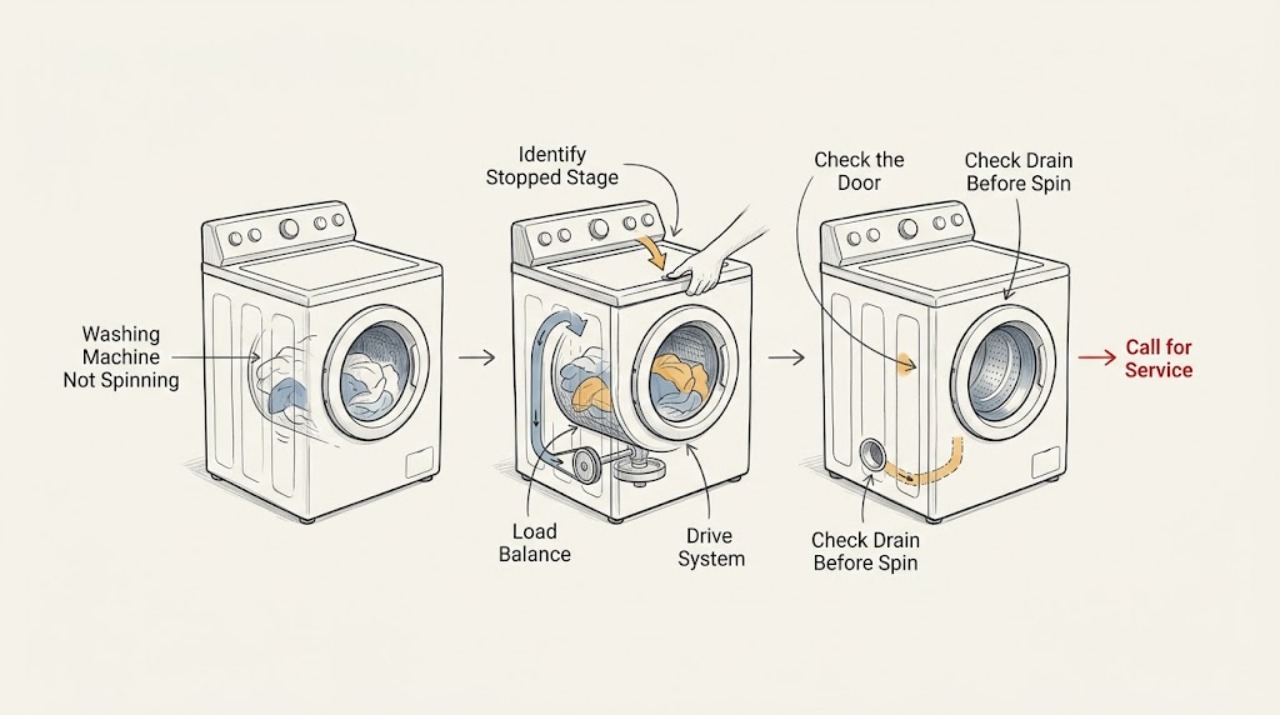
Start by noting where the washer stops and whether water remains inside. Many washers drain before they spin, so a blocked or kinked drain hose, a full pump filter on models that have one, or a household drain problem can prevent the spin step. A door or lid that is not detected as closed, a gentle or no-spin setting, excess suds, and an uneven or overloaded load can also stop or reduce spinning. With the washer off and safe to handle, redistribute the load and check only the visible drain hose, level, and controls that your model manual identifies. Front-load pump filters, calibration modes, shipping bolts, and service panels are model-specific; do not open them with water inside or power connected. Stop for leaking water near electricity, repeated breaker trips, smoke, burning odor, violent movement, or grinding, and arrange qualified appliance service if the washer still will not spin after these external checks.
Work through in order
Diagnostic checks
Use only checks that match the exact appliance or system and its official guide.
-
Check 1
Without opening the washer or forcing its door or lid, record whether it stops during filling, washing, rinsing, draining, or spin, whether water remains in the tub, whether the door or lid-lock indicator is active, and whether a code or unusual sound is shown.
Expected result: The tub is full or partly full; it is empty but never begins spin; it spins briefly then stops; or it spins slowly while leaving clothes wet.
Next step: Keep the washer off and continue to the safety, control, and visible-hose checks that match the stage. Do not force the door or run another cycle while water, heat, or a hazard remains.
Stop if: Stop for a locked door with unsafe heat or pressure, active leaking, standing water near electricity, smoke, burning odor, sparks, violent movement, grinding, or a repeated breaker trip.
Why this matters
Why: Water remaining points first to a drain or door-lock interlock condition. An empty tub with no spin request points toward cycle, lid or door sensing, control, or drive conditions. Brief or slow spinning favors balance, suds, selected speed, or a mechanical or motor issue.
-
Check 2
When the washer is stopped and safe, check that the selected program includes a spin, the spin speed is not set to no-spin or a deliberately gentle option, Start or Pause has been acknowledged as the model requires, and the door or lid is fully closed with no visible clothing or object in the latch area. Do not bypass the lock.
Expected result: The cycle intentionally has little or no spin; the door or lid is not detected as closed; an object blocks the latch; a lock or error indicator remains; or the correct spin program and closed interlock are present.
Next step: Correct only an obvious setting or remove a loose item from the accessible latch area, then follow the manual for one normal restart. If the latch, lock light, or control remains abnormal, stop and request service.
Stop if: Do not force a locked door or lid, insert a tool into the latch, bypass an interlock, reach into a moving drum, or keep restarting an error state.
Why this matters
Why: A setting or interlock can prevent the machine from safely starting a high-speed spin. A correct setting and apparently closed door or lid shift attention to drainage, load balance, power, or an internal fault.
-
Check 3
With power off and the washer stable, inspect the visible drain hose from the machine to the standpipe or sink for kinks, crushing, a loose connection, or an obvious obstruction. If the exact model has an accessible pump filter, use only the model manual's procedure and prepare for retained water; do not open a filter or pump with power connected or water at an unsafe temperature.
Expected result: The hose is kinked or pinched; the standpipe or sink is backing up; the washer retains water; the model has a manual-approved front-load filter that is visibly due for cleaning; or the visible drain path is clear and the tub empties normally.
Next step: Correct only an obvious external hose position issue and follow the manual for any model-approved filter access. If water remains, the drain backs up, the hose is damaged, or the path is clear but no spin follows, keep the washer off and arrange service.
Stop if: Do not open a filter with power connected, reach into a pump, handle hot or contaminated water, disconnect a pressurized hose, tilt the machine, or continue if water reaches an outlet or cord.
Why this matters
Why: A washer that cannot drain may never enter spin. A clear hose does not rule out a blocked household drain, pump, or internal path, and a filter is not present on every design. The absence of retained water shifts the next check toward load, setting, lock, or drive symptoms.
-
Check 4
After the tub is safe to open and the door or lid is unlocked, inspect the load without reaching under a moving drum. Separate tangled items, distribute the weight around the tub, remove an obvious overload, and note excessive suds or a very small single heavy item. Confirm that the chosen cycle and spin speed suit the load and detergent instructions.
Expected result: The load is clumped or overloaded; a single heavy item is off-center; excessive suds are present; a delicate or low-speed cycle was selected; or the load is balanced with normal suds and a suitable spin setting.
Next step: Redistribute or reduce the load and use the documented cycle once if the washer is otherwise dry and safe. If it still cannot spin, do not keep adding or removing loads; record the result and request service.
Stop if: Stop for water on the floor, a door or lid that will not latch, violent shaking, a metal-on-metal sound, smoke, burning odor, sparks, or a breaker trip.
Why this matters
Why: An imbalance, unsuitable load, excess suds, or intentionally low spin can make a washer slow, stop, or leave clothing wet without proving a motor failure. A balanced load and appropriate setting make a drain, lock, power, or drive fault more likely.
-
Check 5
With the washer empty, powered off, and not wet underneath, observe whether it rocks on a stable floor and whether it has visibly shifted into a wall or another appliance. Consult the exact installation manual for leveling feet, pedestal rules, and shipping-bolt requirements; do not tilt the washer or remove panels to inspect suspension or drive parts.
Expected result: The washer rocks, the floor is slippery or damaged, it has moved or contacts another object, shipping hardware may remain after installation, or it is firm and correctly positioned.
Next step: If the manual gives a safe external leveling procedure, follow it without lifting or tilting the machine. Suspected remaining shipping hardware, damaged feet, suspension, bearings, or drive components require qualified service or an installer.
Stop if: Do not crawl under or tilt a washer, remove shipping bolts without the model manual, loosen cabinet hardware, or run a test when it is walking, striking walls, leaking, or making grinding sounds.
Why this matters
Why: An unstable installation can trigger imbalance protection or violent movement. Shipping hardware and the number or adjustment of leveling feet differ by model, so a generic removal or adjustment instruction could cause damage.
-
Check 6
Only when the washer is dry, stable, free of hazard, and the drain and door or lid conditions are normal, use the model manual's single power reset or documented empty calibration/test procedure. Do not invent a button combination, run a loaded high-speed test, or repeat a test to reproduce noise.
Expected result: The documented reset or empty test completes and the tub rotates normally; it fails to rotate; an error returns; or the machine trips, shakes, leaks, smells hot, or makes a new abnormal sound.
Next step: If the test fails or a fault returns, keep the washer off and request qualified appliance service. Save the exact code, stage, sound, and test result; do not open the cabinet or test live wiring.
Stop if: Stop immediately for water, smoke, burning odor, sparks, electrical heat, violent movement, metal grinding, or a breaker trip; do not reset again.
Why this matters
Why: A successful model-approved test can clear a transient control or balance condition. A failed test or returning error points to service, while a hazard during the test is a reason to isolate the appliance rather than try again.
-
Check 7
Prepare service information without further testing: brand and full model, front-load or top-load design, stopped stage, water level, door or lid indicator, cycle and spin setting, load and suds condition, drain-hose observations, level or installation history, code, and any safe photos.
Expected result: The technician has a clear symptom sequence and no need for the homeowner to remove a panel, access a live circuit, force a lock, or run another high-speed cycle.
Next step: Keep the washer off or use only a documented safe mode until service reviews the information. Use a licensed electrician for a recurring circuit trip or wet electrical equipment.
Stop if: Stop documenting and leave the area for active flooding, smoke, burning odor, sparks, exposed wiring, violent movement, or an unstable floor or ceiling.
Why this matters
Why: The sequence distinguishes a drain or lock interlock from load protection, installation movement, and a motor, belt, bearing, pump, or control fault without guessing at a part.
Use your observations
Decision map
Find the observation that best matches what you see, then follow the next safe action.
-
PATH 01Next step
What you see
Water remains in the tub or the washer stops before or during draining.
Do this next
Keep the washer off. Check only the visible hose and model-approved filter path; if the hose, household drain, pump, or internal path is not clearly resolved, request service rather than forcing the door or opening the cabinet.
-
PATH 02Next step
What you see
The door or lid is not detected as closed, a lock indicator remains, or an object blocks the accessible latch.
Do this next
Wait for normal unlock conditions, remove only a loose visible obstruction, and follow the exact manual once. Do not bypass or force the interlock; persistent latch or lock faults need service.
-
PATH 03Next step
What you see
The washer is balanced poorly, overloaded, tangled, oversudsed, or set to a low or no-spin cycle.
Do this next
Redistribute or reduce the load, use the documented spin setting and detergent amount, and run one normal cycle only if the machine is dry and safe. Persistent failure needs service.
-
PATH 04Next step
What you see
The washer rocks, walks, contacts a wall, has a slippery or damaged floor, or shipping hardware may remain.
Do this next
Stop high-speed testing and follow the exact installation instructions or call an installer. Do not tilt the washer or remove cabinet or shipping hardware based on a generic guide.
-
PATH 05Next step
What you see
The washer drains, the door or lid is correctly detected, the load and setting are normal, but an empty documented test still does not rotate.
Do this next
Keep it off and request qualified appliance service to diagnose the model-specific control, motor, belt, coupling, suspension, bearing, or drive system. Do not replace a part from a symptom alone.
-
PATH 06Next step
What you see
There is leaking or standing water near electricity, a hot or damaged cord or outlet, a repeated breaker trip, smoke, burning odor, sparks, violent walking, or grinding.
Do this next
Stop using the washer, keep people away, and have an electrician isolate wet or faulty electrical equipment from a safe location. Arrange appliance service after the area is safe; do not reset or test again.
Helpful context
Understand the symptom
The stopped stage is the most useful clue
A washer that never starts the spin step is different from one that spins slowly, stops after a few turns, or leaves water in the drum. Record whether it stopped during filling, wash agitation, rinse, draining, or the high-speed spin, and whether the door or lid remains locked. A full drum after the cycle points toward drainage or a safety interlock before it points toward a belt or motor. Do not force the door or lid open; wait for the model's normal unlock behavior and follow its manual if water remains.
Drain, balance, and settings are separate checks
Whirlpool notes that an unbalanced or overloaded load can prevent draining and spinning, while a gentle, delicate, or handwash cycle may intentionally use a slower spin. Excess detergent can create suds that interfere with pumping. Check the cycle and load before assuming a failed drive. Then inspect the visible drain hose for a kink, pinching, or an obvious connection problem. A pump filter is not universal: Samsung's guidance says it is a front-load-only feature on the models that include one. Use the exact model manual before draining water or opening any filter access.
Keep moving, water, and electricity within safe limits
A washer that walks, bangs, grinds, leaks, smells hot, or trips a breaker should not be tested repeatedly. Check level and floor stability only from outside; leveling feet, shipping bolts, suspension, bearings, belts, and motors vary by model. Do not tilt a washer to reach underneath, remove a cabinet, or test live wiring. If water is near an outlet, cord, appliance, or other electrical equipment, keep away and have a qualified electrician isolate and inspect the affected equipment before power is restored.
Safety boundary
Stop conditions
- Stop for leaking or standing water near an outlet, cord, appliance, or electrical equipment; do not enter water to operate a switch or use an electric tool.
- Do not force or bypass a door or lid lock, reach into a moving drum, tilt the washer, crawl beneath it, or remove a cabinet or live electrical panel.
- Stop for violent walking, metal grinding, smoke, burning odor, sparks, a hot or damaged receptacle, or a repeated breaker trip; do not keep resetting or testing.
- Do not open a pump filter or drain hose with power connected, hot or contaminated water present, or the exact model procedure unknown; do not use a generic calibration button sequence.
When checks do not resolve it
Need a professional?
Request qualified appliance service for no spin after safe checks, retained water, a recurring lock or code, a failed model-approved test, or suspected internal pump, motor, belt, coupling, bearing, suspension, or control failure. Use an installer for shipping hardware or leveling and a licensed electrician for household power or wet electrical equipment.
Have this ready
- Provide the brand and full model, front-load or top-load type, stopped stage, water level, lock indicator, cycle and spin setting, load and suds condition, visible hose and drain observations, level or installation history, exact code, sounds, breaker events, and safe photos.
Common questions
FAQ
Why does my washing machine fill and wash but not spin?
The washer may be waiting for a drain, a closed door or lid interlock, a balanced load, or a suitable spin setting. Check the stopped stage, retained water, visible drain hose, lock indicator, load, and cycle. If those are normal and an empty model-approved test still does not spin, arrange service.
Can a clogged drain stop a washer from spinning?
Yes. Many washers try to drain before entering spin, so retained water, a kinked hose, a backed-up standpipe, or a model-specific pump-filter problem can stop the spin step. Check only the visible hose and the exact manual's filter procedure; do not open a filter with power connected or unsafe water present.
Can an unbalanced load make a washing machine stop spinning?
Yes. A tangled, overloaded, or single heavy item can collect on one side, so the washer may slow or stop to limit movement. When the machine is safe and unlocked, redistribute or reduce the load and select an appropriate spin. Violent walking or repeated failure needs service.
Should I run calibration mode when my washer will not spin?
Only if the exact model manual documents a calibration or test mode. Button combinations and calibration behavior are not universal. Run at most one empty documented test when the washer is dry, stable, and free of warning symptoms; if it fails or a code returns, keep the washer off and request service.
When should I stop using a washing machine that will not spin?
Stop for a leak or standing water near electricity, a door or lid that cannot be safely unlocked, violent shaking, grinding, smoke, burning odor, sparks, a hot or damaged receptacle, or a repeated breaker trip. Keep the washer off and arrange qualified appliance service; use an electrician for wet or recurring electrical faults.
Read the exact guide
Official sources
- What to Do to Protect Yourself From Electrical HazardsCenters for Disease Control and Prevention · Official CDC household electrical-safety guidance applied to washer leaks or wet electrical areas.
- Washer Not Draining or Spinning? Troubleshooting GuideWhirlpool Product Help · Official Whirlpool washer guidance used for general diagnostic categories; the user's exact model manual controls details.
- Samsung washing machine does not spin at allSamsung Support · Official Samsung guidance used for cross-brand diagnostic principles; exact features and procedures vary by washer model.
- Samsung washing machine spins poorlySamsung Support · Official Samsung guidance used for general spin-symptom distinctions; do not apply its button combinations or dimensions to another model.
Community feedback
Share a repair observation
Share a plain-text repair observation. Accepted observations are published automatically; this page may take a moment to update.