
On this page
Start here
Quick answer
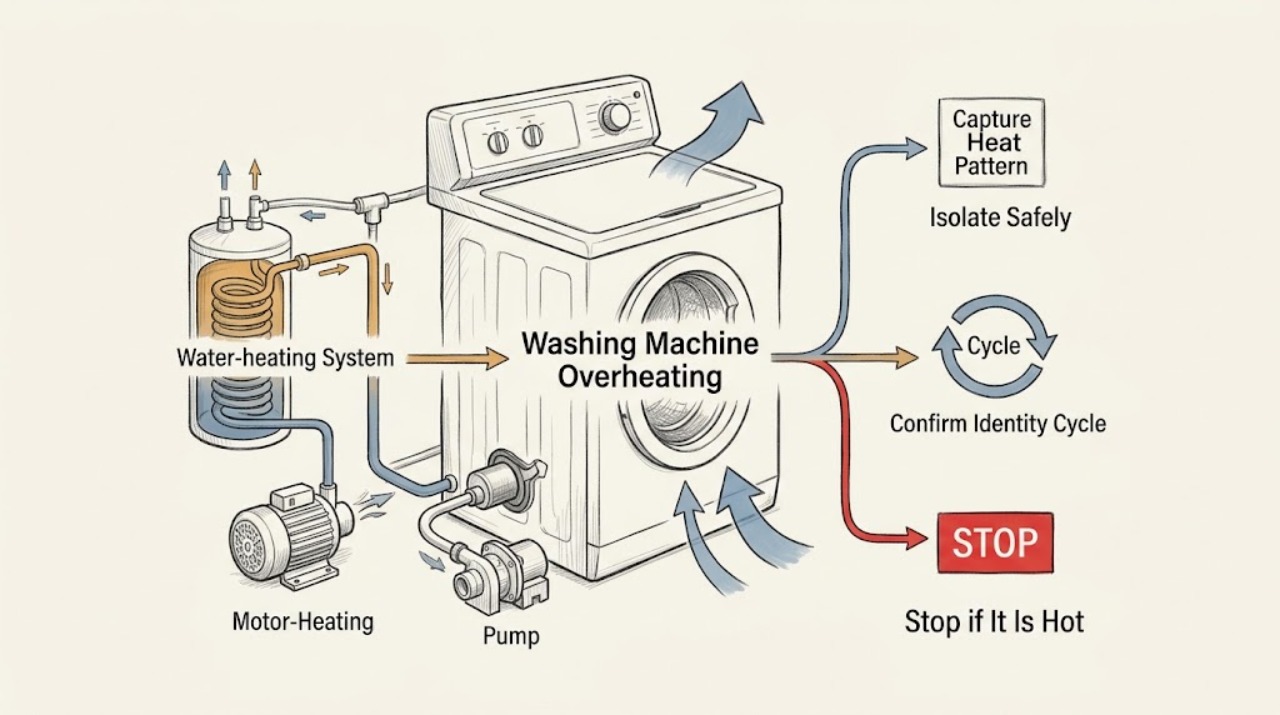
Treat a washing machine that is truly overheating as a safety issue until you know whether you are seeing normal warmth or steam from a high-temperature or washer-dryer cycle. Stop the cycle and keep clear if there is smoke, a sharp electrical or burning-rubber odor, sparking, a hot plug or outlet, a leaking machine near electricity, scalding water, or unusual heat from the cabinet. After it is cool and isolated, record the cycle, load, location of the heat, display message, and whether the machine drained. Only perform visible, model-appropriate checks: confirm the machine and cycle identity, look for lint or a foreign object at the gasket, review detergent and maintenance instructions, and inspect accessible water and drain conditions without opening the cabinet. A new-unit odor or mild warmth during a documented hot or sanitary cycle can have a different explanation from persistent odor or heat; recurring symptoms, a heater or temperature fault, poor draining, or any electrical symptom needs appliance service.
Work through in order
Diagnostic checks
Use only checks that match the exact appliance or system and its official guide.
-
Check 1
Stop the selected cycle, stay clear of hot water and surfaces, and record which part feels or appears hot only from a safe distance: door or gasket, side or rear cabinet, cord or outlet, drain area, or surrounding room.
Expected result: Record whether the heat appeared during fill, washing, draining, spinning, a sanitary or hot program, or drying on a washer-dryer combination; also record smoke, steam, odor, noise, leaks, display text, and whether the drum still turns.
Next step: Keep the machine out of use while it cools and use the recorded pattern to choose the matching branch below; do not restart merely to reproduce the symptom.
Stop if: Stop immediately and leave the area if there is smoke, sparking, a melting smell, visible damage, an electrical crackle, or a rapidly worsening temperature.
Why this matters
Why: Heat limited to a documented hot or sanitary operation can be expected on some models, while heat at the cord or outlet, smoke, a sharp odor, a leak, or heat during a cool cycle points away from ordinary program behavior.
-
Check 2
When it is safe to do so without reaching through water or touching a hot part, stop the controls and isolate the appliance using the normal user-accessible power control; close the water taps if water is continuing to enter or leak.
Expected result: Note whether the machine stops, whether water remains in the drum, whether a leak continues with the appliance idle, and whether the breaker or protective device has opened.
Next step: Keep people away from the wet area and arrange appliance service; if smoke or fire is present, leave and use the local emergency process from a safe location.
Stop if: Do not step into water to reach a plug, handle a hot door, remove a panel, reset a tripped protector repeatedly, or work on wiring.
Why this matters
Why: A continuing leak, trapped hot water, repeated protective-device trip, or heat that remains after the cycle stops is not a routine cleaning issue. The location of the water and the electrical symptom changes the urgency.
-
Check 3
After the appliance is cool, confirm from the rating label and manual whether it is a washer or washer-dryer combination, whether it has a heater or sanitary program, and which cycle and temperature option were selected.
Expected result: Write down the model identifier, cycle name, temperature choice, load type, recent installation or move, and any exact error message; do not infer a code meaning from a different model.
Next step: Use the manual for the exact model before any reset, cleaning cycle, filter access, or temperature-related interpretation.
Stop if: Stop if the label is missing, the manual does not cover the observed configuration, or the machine shows an unexplained heater, temperature, or electrical error.
Why this matters
Why: A hot or sanitary cycle, or a drying function on a combination unit, can explain controlled internal heat or steam on some designs. A cool cycle, unknown mode, or heater or temperature error needs model-specific service guidance.
-
Check 4
With power isolated and the machine cool, inspect only the visible door gasket, door glass, drum opening, and lint or debris collection points for a trapped cloth, rubber item, lint, or foreign object.
Expected result: Look for a small object rubbing the drum, debris pressed against the gasket, a torn or displaced seal, scorch marks, melted rubber, or residue; do not reach behind the drum or remove a cover.
Next step: Remove only loose debris that is plainly accessible without force, photograph damage, and stop for a damaged gasket, trapped object, or recurring odor.
Stop if: Do not pull a trapped item through a seal, rotate a hot or jammed drum, use a tool inside the opening, or continue if the object is melted or the seal is damaged.
Why this matters
Why: A visible foreign object or lint near a hot area can create odor when heated, while melted rubber, scorch marks, a damaged seal, or a repeating rubbing symptom indicates a service boundary rather than a safe user repair.
-
Check 5
From a dry, safe position, check visible supply hoses, the drain hose, the floor around the appliance, and the drum water level after the machine has stopped; use a drain-filter procedure only if the exact manual authorizes it and the water is cool.
Expected result: Record a supply-side drip, drain-hose leak, water left in the drum, slow draining, a blocked-looking visible filter area, or no water problem at all.
Next step: Close the water taps for a leak, keep the machine isolated, and provide the water-location and drain observation to appliance service; do not dismantle hoses or pumps.
Stop if: Stop for active or spreading water, water near a cord or outlet, hot water, a damaged hose, or any need to open the cabinet or work with the machine energized.
Why this matters
Why: Poor draining can leave hot water and residue in the drum, but a leak near electricity, hot water, or a filter that cannot be safely opened is a service issue. No water-path symptom keeps heater, motor, control, load, or electrical causes in scope.
-
Check 6
Compare the recent load and detergent use with the appliance manual: note overloading, a very small or heavy load, excess suds, non-approved detergent, residue, and whether routine gasket, dispenser, or tub maintenance was missed.
Expected result: Look for heavy foam, detergent buildup, lint, a damp odor, residue in the dispenser, or a load rubbing the gasket; do not add a cleaner while another chemical is present.
Next step: After service risk is ruled out, clean visible residue and run only the model-authorized tub-clean procedure with the stated product and dose; leave the door or lid open afterward when the manual permits.
Stop if: Stop cleaning and seek service for a sharp burning smell, smoke, melted material, persistent heat, a leak, or an odor that remains after the manual-authorized maintenance cycle.
Why this matters
Why: Residue, trapped moisture, and excess detergent can produce odor and poor draining, while a true burning or electrical smell is not explained away by detergent. The correct maintenance cycle and cleaner vary by model.
-
Check 7
From a dry position and without opening anything, visually inspect the accessible cord, plug, outlet face, breaker history, and cabinet for discoloration, melting, scorch marks, or moisture.
Expected result: Record a hot or discolored outlet, damaged plug, repeated trip, crackle, moisture, scorch mark, or no visible electrical damage; do not perform an energized meter check.
Next step: Keep the appliance isolated and request qualified appliance or electrical service, explaining whether the protective device tripped and which component was hot.
Stop if: Stop at once for smoke, arcing, a burning electrical odor, a hot outlet or plug, exposed conductors, moisture, or a repeated trip; do not keep restoring power.
Why this matters
Why: A cord, outlet, breaker, or wiring symptom can be the heat source and must not be treated as a washer-cleaning problem. No visible damage does not prove that internal wiring, a motor, heater, or control is sound.
-
Check 8
If there is no active leak, smoke, odor, scorch mark, unusual heat, or electrical symptom, apply at most one reset that the exact owner manual explicitly authorizes for the recorded error or cycle.
Expected result: Record whether the error clears and whether the appliance remains cool and behaves normally without odor, noise, leaking, or renewed overheating; a returning fault counts as a failure.
Next step: Leave the machine out of use and arrange appliance service if the symptom returns, the reset is not documented for the model, or the machine cannot complete a safe cycle.
Stop if: Do not repeat a reset, run an unattended test, bypass a door or thermal safety, open the cabinet, or continue after any stop symptom.
Why this matters
Why: A cleared display does not prove that an overheating cause is repaired. A heater or temperature error that returns, or any renewed heat or odor, needs inspection rather than repeated resets.
Use your observations
Decision map
Find the observation that best matches what you see, then follow the next safe action.
-
PATH 01Next step
What you see
Heat or steam occurs only during a documented hot, sanitary, or drying operation and there is no sharp odor, smoke, damage, leak, or electrical symptom.
Do this next
Follow the exact manual, keep hands away from hot water, and monitor only from a safe distance; service the machine if the pattern changes or persists outside that program.
Why this path and its safety boundary
Why it matters: Some models intentionally heat water or air and may warm the gasket or vent steam.
-
PATH 02Next step
What you see
A visible lint deposit, rubber item, residue, or gasket problem matches the smell location.
Do this next
Remove only loose accessible residue as the manual permits; stop and arrange service for damage, trapped material, or a smell that returns.
Why this path and its safety boundary
Why it matters: A foreign object or buildup may be heating, but melted or damaged material is not a routine cleaning fix.
-
PATH 03Next step
What you see
Water remains in the drum, draining is slow, or a hose or filter area is leaking.
Do this next
Close water taps for a leak, keep the area dry and isolated, and arrange appliance service for safe drain-path inspection.
Why this path and its safety boundary
Why it matters: A drain-path issue may leave hot water or residue, but active water near electricity raises a separate safety risk.
-
PATH 04Next step
What you see
Heat is at the plug, outlet, cord, or cabinet, or there is a persistent electrical or burning-rubber odor, smoke, arcing, repeated trip, or a heater or temperature fault.
Do this next
Keep the machine isolated and use qualified appliance service; involve an electrician when the outlet, cord, breaker, or house wiring appears affected.
Why this path and its safety boundary
Why it matters: The cause may be an internal heater, sensor, motor, control, wiring connection, or supply problem that cannot be safely diagnosed by continued consumer testing.
-
PATH 05Next step
What you see
The machine is not in a documented hot program, or the cause remains unclear after safe visible checks.
Do this next
Stop use, preserve the model, cycle, error, and symptom notes, and request model-specific appliance diagnosis.
Why this path and its safety boundary
Why it matters: An unexplained overheating pattern should not be normalized or repeatedly reproduced.
Helpful context
Understand the symptom
First separate normal cycle heat from a fault
Overheating is not established by a warm door or a brief cloud that appears when a hot cycle is opened. Some washer-dryer combinations and washers with sanitary programs intentionally heat water or circulate heated air. Steam can escape from the front or a designed vent and may look like smoke. It becomes a stop event when the vapor is accompanied by a sharp burning odor, actual smoke, sparking, a melting or hot-plastic smell, a hot cord or outlet, or heat that persists outside the selected cycle. Do not touch hot water, the door glass, or the cabinet to judge a temperature; use the display, cycle record, and safe visual observations instead.
Use the model manual for hot cycles and cleaning
Because the machine is not branded in this topic, treat high-temperature cycles, tub-clean instructions, drain-filter access, detergent type, and any reset sequence as model dependent. Confirm whether the appliance is a washer only or a washer-dryer combination and note the exact cycle. A new-machine odor can fade after normal cycles on some designs, but a repeated electrical or rubber odor is not a reason to keep testing. Follow the appliance manual for cleaner type and dosage; never mix cleaning chemicals or substitute a strong acid or chlorine product when the manual does not allow it.
Do not turn a symptom into a cabinet repair
A heater, temperature sensor, motor, pump, wiring connection, control, or gasket may be relevant only after the observed pattern points to that area. A washer can also feel hot because water is not draining, a load is rubbing, or a foreign object is being heated. These possibilities require different service decisions, so keep the machine isolated and give the technician the cycle, timing, smell location, error text, photos from a safe distance, and any history of a recent move or installation.
Only after diagnosis
Potential parts
- water heater or heating element
Consider only when the exact model supports internal water heating and a model-specific error or service diagnosis identifies the heater circuit.
Confirm the full model identifier and manufacturer fit information before any part decision; do not open the cabinet as a user test. - temperature sensor
Consider only when the exact model documentation or qualified diagnosis links the recurring heat or temperature fault to the sensor.
Sensor design and fit vary by model; a displayed code alone is not proof across brands. - drain pump or filter assembly
Consider only after a safe observation confirms poor draining and service diagnosis identifies a failed pump or damaged filter assembly.
Use the exact model and manual-approved access path; do not select a pump from symptom alone. - door gasket
Consider only when the visible seal is torn, displaced, melted, or confirmed by a model-specific service diagnosis.
Front-load and combination designs differ; confirm model fitment and service instructions.
When checks do not resolve it
Need a professional?
Stop using the machine and seek prompt qualified help for smoke, fire, sparking, a sharp electrical or burning-rubber odor, a hot or damaged plug or outlet, repeated protective-device trips, active leakage near electricity, scalding water, melted material, a damaged gasket, or heat that returns outside a documented hot program. Leave the area and use local emergency procedures for fire or an immediate electrical hazard.
Have this ready
- Give the service provider the model identifier, washer or combination type, selected cycle and temperature, load, first time and location of heat or odor, display text, water or drain observations, breaker history, and safe photos.
Common questions
FAQ
Can a washing machine feel warm during a hot cycle?
Yes, some washers and washer-dryer combinations heat water or air, and the door or gasket may feel warm. Steam may also escape during a hot or sanitary operation. Warmth alone is different from smoke, a sharp burning smell, sparking, damaged material, or abnormal cabinet or outlet heat.
Is a new washing machine burning smell always a failure?
Not always. A manufacturer support page describes new motor insulation odor that should stop after normal use on applicable models, and high-temperature operation can also warm rubber or expose lint to heat. If an electrical or burning-rubber smell persists, becomes stronger, or comes with smoke or heat at the cord or outlet, stop using the appliance and seek service.
Could detergent or buildup cause overheating?
Residue, excess suds, trapped moisture, and foreign objects can contribute to odor or poor draining, but they do not excuse a sharp electrical smell, smoke, melted rubber, or abnormal heat. Use only the cleaning method and product allowed by the exact manual, and never combine cleaning chemicals.
What does a heater or temperature error mean?
A displayed heater or temperature message is model dependent. On the cited LG guidance, a tE message is associated with a heater element or temperature sensor fault and calls for one documented power reset followed by service if the message remains. Do not apply that code meaning to an unconfirmed model.
Should I run the washer again to see whether it overheats?
No when there is smoke, burning odor, sparking, unusual cabinet or outlet heat, leakage near electricity, a repeated trip, or any visible damage. Preserve the observations and arrange qualified diagnosis. Only a manual-authorized single reset without active hazard is reasonable, and a returning symptom ends testing.
Read the exact guide
Official sources
- LG Frontload Washer - Sanitary Cycle Not WorkingLG USA Support · LG front-load washers; sanitary-cycle heat, burn caution, heater or temperature fault, detergent, and model-variation guidance
- [LG Front Load Washer] Why does the washer let out steam/smoke?LG USA Support · LG front-load washers and washer-dryer combinations; distinguishing steam from smoke during hot operation
- [LG Front Load Washer] Burning Smell During UseLG USA Support · LG front-load washers and washer-dryer combinations; high-temperature, drying, sanitary, gasket, lint, and tub-clean guidance
- LG Washer - Troubleshooting Odor / BuildupLG USA Support · LG washers; detergent residue, gasket, drain-pump-filter, tub-clean, and persistent-odor guidance
- LG Washer – Troubleshooting an Electrical or Burning Rubber SmellLG USA Support · LG washers and washer-dryer combinations; new-unit odor, visible debris, and persistent electrical or burning-rubber smell
Community feedback
Share a repair observation
Share a plain-text repair observation. Accepted observations are published automatically; this page may take a moment to update.