
On this page
Start here
Quick answer
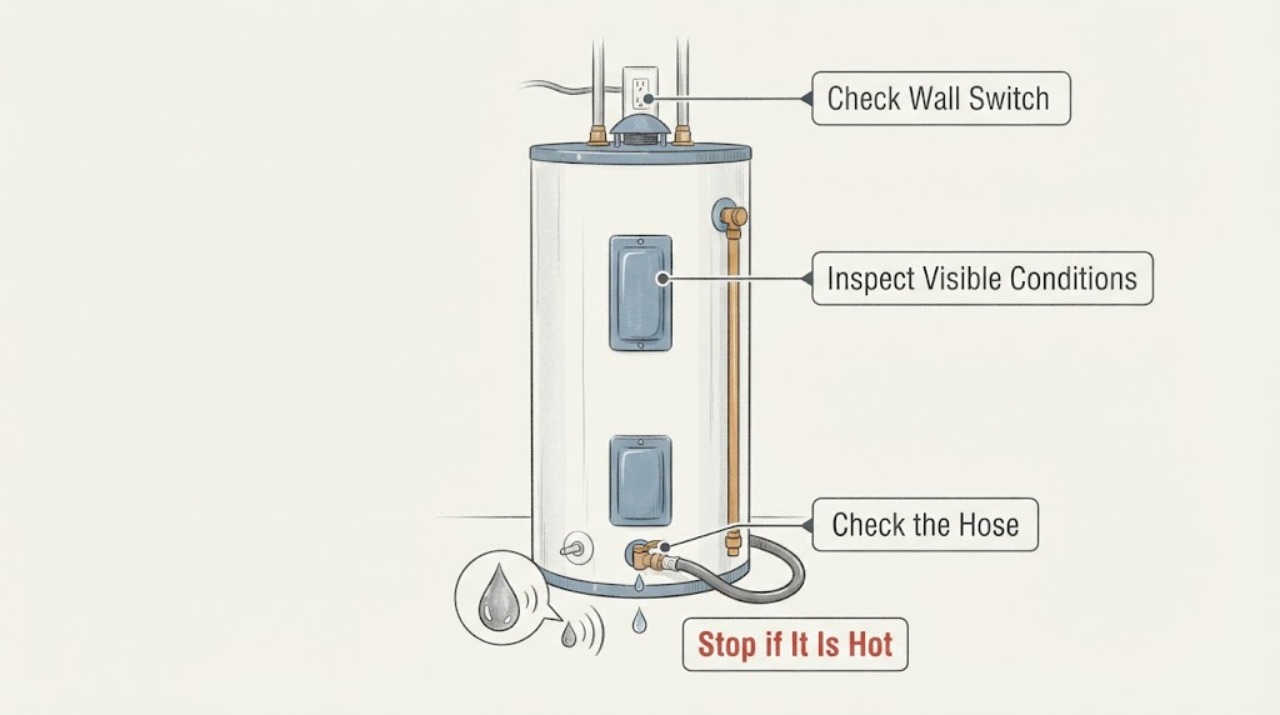
A dripping sound after a water heater was drained does not prove that the tank is refilling safely or that the leak has stopped. Treat the known pinhole leak as an active water-damage hazard: keep the heater out of service, keep people away from hot discharge, and isolate the water supply and energy source only through clearly identified accessible controls and only when the area is safe. If you smell gas, leave immediately and call the gas utility or emergency help without operating switches. Do not plug a relief valve, patch the pinhole, reopen the water supply, restore gas or electrical power, or relight the heater to test it. A qualified plumber or water-heater technician should identify the leak source and decide whether the unit can be repaired or must be replaced; a tank that has been drained must not be re-energized until the correct model procedure confirms it is full and safe.
Work through in order
Diagnostic checks
Use only checks that match the exact appliance or system and its official guide.
-
Check 1
Keep the water heater out of service and identify its energy source from a safe, dry position. If there is an accessible, clearly labeled water-heater disconnect and no water around the electrical equipment, isolate electrical power; for a gas unit, use only the appliance's clearly identified manual gas control if it can be reached without entering a gas-smelling area. If gas is smelled, do not operate switches or controls.
Expected result: Gas odor, hissing, smoke, sparking, wet electrical equipment, hot discharge or rapidly spreading water is present, or none of those signs is present.
Next step: For gas odor, leave the area and call the gas utility or emergency help from outside. For electrical or water hazards, stay clear and arrange qualified service; keep the heater isolated.
Stop if: Stop all handling immediately for gas odor, smoke, sparking, hot discharge or water near electrical equipment.
Why this matters
Why: Any gas, electrical or rapidly worsening water sign raises the risk beyond a dripping-noise question; no warning sign does not make a known pinhole leak safe to restart.
-
Check 2
From a dry, safe position, look for the actual water path without touching hot pipes, the relief discharge or the tank: note whether water is appearing at a top connection, drain/relief outlet, visible pipe, pan or the tank shell, and whether it is increasing, steady or stopping. Do not plug a relief outlet or patch a pinhole.
Expected result: Water continues at the known pinhole/tank area, comes from a relief or drain outlet, appears at a connection, or the source cannot be seen.
Next step: Keep the cold-water supply isolated if it can be identified safely, protect the area from water damage, and have a licensed plumber or qualified water-heater technician locate the source. Do not disassemble any valve or tank fitting.
Why this matters
Why: The noise cannot distinguish a leaking tank, connection, relief path or residual water; a continuing visible leak remains a plumbing failure regardless of its sound.
-
Check 3
Check only whether the accessible cold-water shutoff is fully closed and whether the drain hose or safe drain route is positioned as the model instructions require; do not reopen the supply or change pressure settings to see whether the dripping stops.
Expected result: The shutoff is not fully closed, water continues to enter, the drain route is unsafe, or the shutoff appears closed and the sound continues.
Next step: Leave the heater isolated and ask a plumber to verify the water isolation and leak source. Do not attempt to repair the shutoff, drain valve or tank yourself.
Why this matters
Why: Water can continue through a passing or misidentified shutoff, while sound after isolation still does not identify a safe restart condition.
-
Check 4
Record the heater's brand, model, fuel type, leak location, drain-down timing and whether water or gas isolation changed the sound, without opening the cabinet or relighting the appliance. Give this information to the service professional.
Expected result: The model and fuel type are readable, or the label is missing or cannot be reached safely.
Next step: Keep the unit isolated until qualified service confirms the leak repair and the correct full-tank/start-up condition. Do not restore power or gas merely because the dripping sound stops.
Why this matters
Why: Restart, refill and relief-device procedures are model and fuel dependent; an unidentified drained heater cannot be safely cleared by a generic test.
Use your observations
Decision map
Find the observation that best matches what you see, then follow the next safe action.
-
PATH 01Next step
What you see
Gas odor, hissing, smoke, sparking, wet electrical equipment or hot pressurized discharge is present.
Do this next
Leave the area for gas, smoke or active fire and call the utility or emergency services from outside. Keep people away and use qualified help for electrical or hot-water hazards.
Why this path and its safety boundary
Why it matters: The water heater may present an immediate fire, explosion, scald or electrical hazard; the dripping noise is not the priority diagnosis.
-
PATH 02Next step
What you see
Water visibly continues from the pinhole, tank shell, a connection, drain or relief path after the supply is isolated as safely as possible.
Do this next
Keep the water and energy sources isolated, protect the building from water damage, and have a qualified plumber identify the source. Do not plug a relief valve or apply a temporary patch.
Why this path and its safety boundary
Why it matters: The leak remains active or the isolation is not effective; the absence of a large puddle does not make the pressure vessel safe.
-
PATH 03Next step
What you see
The sound continues but no new water is visible and the heater is isolated after draining.
Do this next
Do not restore pressure, gas or power to test the theory. Have a professional verify the isolation, leak repair and full-tank/start-up requirements.
Why this path and its safety boundary
Why it matters: Residual water in connected piping or an imperfectly isolated path is possible, but sound alone cannot prove that the leak has stopped or that the tank is safe to refill.
-
PATH 04Next step
What you see
The dripping stops after isolation, but the pinhole leak or its source has not been repaired and the tank has been drained.
Do this next
Leave it out of service and provide the model, fuel type and leak location to a qualified service professional. Re-energization requires the correct model procedure and confirmation that the tank is full and safe.
Why this path and its safety boundary
Why it matters: A quiet heater is not a repaired heater; restoring heat to an empty or leaking unit can damage it or create a safety hazard.
Helpful context
Understand the symptom
After a drain-down, a drip or water sound can have more than one source: water may still be present in piping, water may be entering through an imperfect shutoff, or the original leak may still be active. The sound alone cannot establish which condition exists. Visible leak location, the rate of water entering a safe container or drain, and the heater's fuel type matter more than guessing from the noise.
This topic has no brand or model. Manufacturer manuals differ, and the opened American Water Heater document is used only for general safety boundaries, not for a repair or restart procedure on an unidentified heater. The safest endpoint is isolation and a qualified inspection, especially when a pinhole leak, gas appliance, electrical supply or hot discharge is involved.
When checks do not resolve it
Need a professional?
Call qualified service immediately for any active pinhole leak, relief-valve discharge, gas odor, electrical exposure, hot-water spray or uncertainty about isolation. Do not restore power or gas after draining until a qualified professional confirms the leak repair and the tank is full and safe.
Common questions
FAQ
Can dripping noise after draining be normal residual water?
Residual water in connected piping is one possibility, but the sound does not prove that the pinhole leak has stopped or that the water supply is isolated. Treat the known leak as active until a qualified person verifies the source and isolation.
Can I turn the heater back on after draining it?
Do not use a restart as a test. The Department of Energy warns that a drained water heater's power circuit must be shut off and that a water heater should never be turned on unless the tank is full. A qualified professional should confirm the leak repair and model-specific refill/start-up conditions.
What if the leak is at the temperature-and-pressure relief valve?
Do not plug or remove the valve. The opened manufacturer manual says a leaking relief valve must be handled by a qualified person because it is an explosion-safety device.
What should I do if I smell gas near the heater?
Leave immediately, do not operate switches or try to relight the appliance, and call the gas utility or emergency help from outside. CPSC says gas-control operation is not a do-it-yourself task.
Read the exact guide
Official sources
- 319407-002 AWHC-USCAmerican Water Heaters · Opened official manufacturer manual. It is used for general safety boundaries only; no model-specific procedure or part fit is transferred to this unidentified heater.
- CPSC Issues Winter Safety WarningU.S. Consumer Product Safety Commission · Opened CPSC safety warning. It supports gas-odor evacuation and qualified service boundaries; it is not a diagnosis of this unidentified heater or leak.
- NOVA Home Guide to Emergency PreparednessU.S. Department of Energy · Opened DOE emergency-preparedness PDF. It supports the boundary that a drained water heater's power circuit must be off and the unit must not be turned on until full; it does not diagnose this leak or authorize a restart.
Community feedback
Share a repair observation
Share a plain-text repair observation. Accepted observations are published automatically; this page may take a moment to update.