
On this page
Start here
Quick answer
The opened report is about a gas water heater whose pilot will not light and whose owner is unsure whether gas is reaching the burner. Do not diagnose a gas valve, thermocouple or pressure fault by smell, force or improvised testing. First stop if you smell gas, leave the area and call the gas utility or emergency service from outside. If there is no gas odor, read the lighting label on this exact water heater, confirm the external gas shutoff is on, and use only the label's pilot procedure while watching through the sight glass. If the pilot will not light, will not remain lit, the status indicator does not behave as the manual says, or the flue/venting looks blocked, stop and use a qualified gas-appliance professional. Do not hold a safety control down, open the gas valve, or remove the burner assembly.
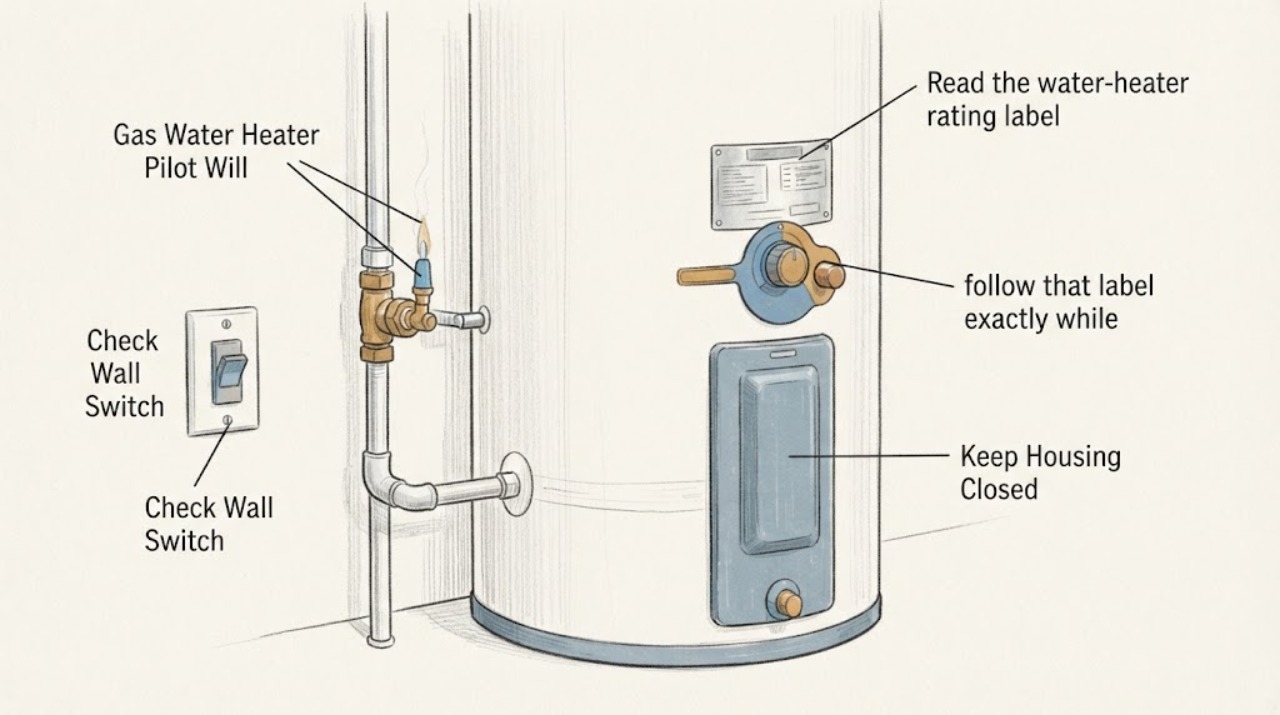
Work through in order
Diagnostic checks
Use only checks that match the exact appliance or system and its official guide.
-
Check 1
Before touching the control, stop and check for a gas odor, hissing, a damaged gas line, soot, scorching or a blocked-looking flue/vent. Do not create a spark, operate electrical switches near a suspected leak, or try to light the pilot.
Expected result: Gas odor or another leak/combustion warning is present, or there is no odor and no visible damage.
Next step: If gas is suspected, leave immediately and call the gas utility/emergency service from outside. If no warning is present, proceed only to the appliance-label and external-shutoff checks.
Why this matters
Why: A gas odor or combustion warning is an emergency boundary. No odor does not prove that gas flow, venting or combustion is safe.
-
Check 2
Read the water-heater rating label and lighting instructions, identify natural gas versus LP, and check only the accessible external gas shutoff position without using force or tools.
Expected result: The label/manual identifies a pilot procedure and the shutoff is in the instructed position, or the fuel type/model is unknown or the valve will not move normally.
Next step: Stop and obtain the exact manual or a qualified gas-appliance professional. Do not apply a generic lighting sequence to an unidentified unit.
Why this matters
Why: CPSC requires the proper appliance procedure and warns against forcing or altering gas safety controls. An unknown fuel type or abnormal shutoff is not a DIY diagnosis.
-
Check 3
If the label permits a homeowner relight, follow that label exactly while viewing only through the provided sight glass or observation opening; keep hands and face away from the burner area and do not remove combustion covers beyond the label's explicit instruction.
Expected result: A pilot flame appears and remains stable while the control is held as instructed, the pilot never appears, or the flame goes out when the control is released.
Next step: Follow the label's single permitted completion step only if the flame remains stable. If it never lights or will not stay lit, turn the control to the instructed safe position and call a qualified professional.
Why this matters
Why: A visible pilot response distinguishes the lighting observation from a complete no-ignition observation, but neither proves a thermocouple, gas valve or pressure fault. Repeated extinction is a service condition.
-
Check 4
Observe the status indicator or error light only as described in the exact manual, and record whether the main burner ignites when hot-water demand occurs. Do not interpret an unlisted flash pattern or remove the control assembly.
Expected result: The indicator matches the manual and the burner heats normally, or the indicator is absent/abnormal and the burner does not light.
Next step: If the expected sequence is not met, stop operating the heater and provide the model, fuel type, indicator behavior and pilot observations to service.
Why this matters
Why: Manufacturer guidance is model-specific; an indicator pattern is evidence only when decoded by the exact manual. A nonworking indicator or absent burner does not identify which gas or ignition part failed.
-
Check 5
After one unsuccessful label-directed attempt, stop rather than repeatedly cycling the control; check only from outside whether the flue/vent path has an obvious obstruction and whether other gas appliances have also lost supply, without opening gas fittings.
Expected result: Other gas appliances are also out, the flue appears obstructed, or the water heater alone fails while the external checks look normal.
Next step: Contact the gas utility for a supply concern or a qualified gas-appliance professional for the heater/venting concern. Do not bypass the safety valve or continue lighting attempts.
Why this matters
Why: A broader supply problem or venting concern needs utility/professional attention; an isolated failure still does not prove a replaceable thermocouple or valve.
Use your observations
Decision map
Find the observation that best matches what you see, then follow the next safe action.
-
PATH 01Next step
What you see
You smell gas, hear a suspected leak, see soot/scorching, or the flue/venting appears unsafe.
Do this next
Leave the area, avoid switches/flames, call the gas utility or emergency service from outside, and do not relight the appliance.
Why this path and its safety boundary
Why it matters: This is a gas or combustion safety event, not a pilot-light troubleshooting step.
-
PATH 02Next step
What you see
The unit has no gas odor, its label clearly permits relighting, the shutoff is in the instructed position, and the pilot appears through the sight glass.
Do this next
Complete only the label's hold/release sequence. Stop if the pilot goes out, the indicator is abnormal or the burner does not operate as documented.
Why this path and its safety boundary
Why it matters: A single label-directed relight attempt may be within the owner's safe operating instructions, but the exact control sequence remains model-specific.
-
PATH 03Next step
What you see
The pilot never lights, will not remain lit, or the indicator/burner behavior does not match the exact manual.
Do this next
Turn the control to its instructed safe position, stop repeated attempts and call a qualified contractor or gas utility for the appropriate part and combustion diagnosis.
Why this path and its safety boundary
Why it matters: The opened evidence does not support naming a gas valve, thermocouple, or pressure failure from this observation alone.
-
PATH 04Next step
What you see
Other gas appliances also fail, or a utility confirms a supply interruption while the water heater has no separate visible damage.
Do this next
Have the gas utility restore/verify supply, then follow the exact water-heater label or arrange service; do not alter the meter or appliance valve.
Why this path and its safety boundary
Why it matters: The problem may be upstream of the water heater, so replacing an internal part would be premature.
Helpful context
Understand the symptom
Gas odor changes the procedure immediately
A failed ignition attempt is not a reason to keep clicking or to prove gas flow by waiting for a smell. CPSC says not to relight a pilot if gas is smelled, and to leave the area and seek help. Carbon monoxide has no smell, color or taste, so a CO alarm is a separate life-safety device; it does not make a malfunctioning water heater safe to operate.
Use the appliance label, not a generic pilot sequence
Pilot controls and status indicators vary. The opened Whirlpool water-heater guide says its web instructions supplement the printed instructions, checks the status light, verifies the gas valve is on and uses the sight glass. Those details cannot be transferred to an unidentified water heater unless its own label/manual shows the same controls.
When checks do not resolve it
Need a professional?
Leave immediately and call the gas utility or emergency service from outside for a gas odor or suspected leak. Call qualified service for a pilot that will not light or remain lit, abnormal status lights, soot/scorching, suspected venting problems, or any need to open the gas control/burner assembly.
Common questions
FAQ
Does “not getting gas” prove the gas valve is bad?
No. The opened report has no model-specific diagnosis. Gas odor, pilot procedure, supply status, venting and safety-control behavior must be separated before a professional names a part.
Can I keep holding the pilot button until gas comes out?
Use only the exact label's instructed hold time and stop if the pilot does not light or remain lit. Never force or alter a safety control; CPSC directs service when a pilot will not remain lit.
What should I do if I smell gas while trying to light the pilot?
Do not attempt to light it. Leave the area immediately and call the gas supplier, utility or emergency service from outside. Do not operate switches or use flames near the suspected leak.
Read the exact guide
Official sources
- What to do if You Have NO Hot WaterWhirlpool Water Heaters / American Water Heater · Opened manufacturer guidance that explicitly says its web steps supplement the printed heater instructions. It illustrates external gas-valve, status-light and sight-glass checks but is not transferred to unidentified heater models.
- Carbon Monoxide AlarmsU.S. Consumer Product Safety Commission · Opened CPSC CO guidance. It states that CO has no smell, color or taste and identifies gas water heaters as potential CO sources; it supports the separate CO-alarm and evacuation boundary.
- CPSC Issues Winter Safety WarningU.S. Consumer Product Safety Commission · Opened CPSC safety warning covering natural- and LP-gas appliances including water heaters. It says not to relight when gas is smelled, not to force/alter controls and to call the utility or qualified contractor for a pilot that will not remain lit.
- Water heater not getting gasReddit r/Appliances · Opened/search-retrieved exact post entry. It asks why gas is not reaching the pilot while lighting a gas water heater and contains no confirmed brand/model or repair outcome.
Community feedback
Share a repair observation
Share a plain-text repair observation. Accepted observations are published automatically; this page may take a moment to update.