
On this page
Start here
Quick answer
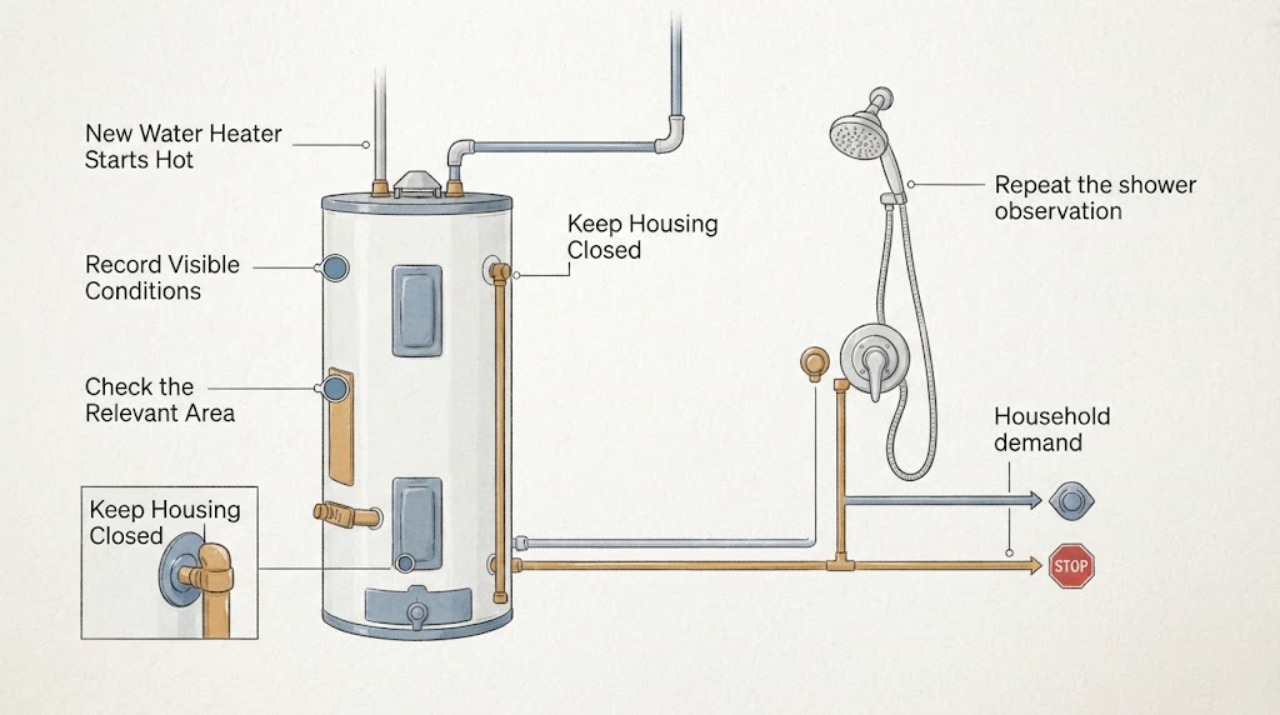
A new water heater that starts hot and then settles at an unusually low shower temperature should be measured and scoped before anyone changes a thermostat or blames a heating element or mixing valve. Record whether the heater is electric, gas, tankless, or another type, the model, the time the shower stays hot, and whether a nearby hot faucet shows the same temperature pattern. Use a thermometer at a safe faucet or container rather than your hand, and stop if water is scalding, there is a gas smell, a leak, damaged wiring, or a venting concern. Rheem identifies several non-equivalent causes: a shower can react to pressure changes when another fixture runs, while a heater can run out of stored hot water, recover slowly, or have sediment or aging components. If only the shower changes, the fixture or pressure-balancing path may be involved; if every hot outlet cools, the water-heating system or its demand/recovery needs qualified service. Do not open the heater, adjust gas controls, expose electrical terminals, or change a mixing valve setting from this symptom alone.
Work through in order
Diagnostic checks
Use only checks that match the exact appliance or system and its official guide.
-
Check 1
Read the heater's rating label and record the brand, complete model, fuel or technology type, installation date, displayed status, and any visible leak, fault message, venting issue, or electrical damage. Do not remove access panels or insulation to find the label.
Expected result: The heater is identified as electric, gas, tankless, storage, heat-pump, or another type, or the type/model cannot be confirmed.
Next step: Use the exact manual or a qualified installer/service provider for the identified type. If the type is unknown, stay with external observations and do not adjust a thermostat, gas control, mixing valve, or breaker as a diagnostic shortcut.
Why this matters
Why: Water heaters use different heating, recovery, combustion, and control systems. The missing fuel/model identity prevents transferring an electric element check, gas-control procedure, or tankless flow rule to this installation.
-
Check 2
When the water is safe to handle, measure the temperature from a nearby hot faucet into a suitable container with a thermometer, and separately record the shower's temperature pattern without placing a hand under very hot water. Note the initial reading or relative heat, the time until it falls, and whether the nearby faucet follows the same change.
Expected result: The nearby faucet stays hot while the shower cools, both outlets cool, or the temperature is too hot to test safely.
Next step: Stop the test if water is scalding or unstable. Use the pattern and measured values for a plumber or water-heater technician; do not infer a mixing valve, dip tube, thermostat, element, burner, or control failure from the comparison alone.
Why this matters
Why: A shower-only change points toward the fixture, pressure balance, flow restriction, or local mixing path; a matching drop at multiple outlets points toward hot-water supply, demand, recovery, or heater-side behavior. A scalding reading is a safety condition, not a reason to lower a setting blindly.
-
Check 3
Repeat the shower observation with no sink, toilet, dishwasher, laundry, or other water use if that can be done safely, and note whether the problem occurs only during peak demand or after another shower. Do not run appliances or alter valves to create a failure.
Expected result: The shower cools only when another fixture runs, only after repeated use, or even when the shower is the only water draw.
Next step: If another fixture changes the temperature, arrange plumbing evaluation of pressure balance and the shower path. If the whole system cools after demand or fails to recover, provide the usage timing to a qualified water-heater professional rather than increasing the setpoint by guesswork.
Why this matters
Why: Rheem says shared hot/cold pressure changes can make a shower turn cold or hot, while high demand can deplete stored hot water before recovery. Persistence with one shower and no competing demand needs a more specific plumbing/heater assessment.
-
Check 4
Check only external, dry conditions: visible water leaks, the showerhead or faucet flow becoming weak, and whether the heater shows a normal status or an alert. Do not open a gas compartment, combustion chamber, electrical access panel, element cover, or mixing-valve body.
Expected result: There is a leak, gas odor, soot or venting concern, damaged electrical equipment, a heater alert, weak shower flow, or no visible external problem.
Next step: For gas odor, combustion/venting concern, leak near equipment, or damaged electrical parts, stop using the system and obtain qualified emergency/service help. For weak shower flow without a hazard, report the flow and temperature pattern to a plumber; do not dismantle the fixture while guessing.
Why this matters
Why: Leaks, combustion/electrical warnings, and scalding or unstable water are safety and service conditions. A local flow restriction can change a shower's pressure and temperature, but a visual check cannot identify an internal valve or heater component.
-
Check 5
Prepare a service record with the exact model and fuel type, measured faucet and shower temperatures, time to the drop, which outlets were tested, other water use at the time, recent installation or plumbing changes, and any leak or alarm. Request a fuel- and model-specific diagnosis.
Expected result: The issue is reproducible at one shower, at multiple outlets, only under demand, or not reproducible after recovery time.
Next step: Keep the temperature at a safe setting and arrange the appropriate plumber or water-heater technician. Do not operate with access doors or insulation removed, bypass safety devices, or continue showering through scalding swings.
Why this matters
Why: The decision between fixture pressure balance, demand/recovery, distribution, and heater-side service depends on the pattern and installation details; the symptom alone cannot select an element, burner, thermostat, dip tube, or mixing valve.
Use your observations
Decision map
Find the observation that best matches what you see, then follow the next safe action.
-
PATH 01Next step
What you see
The shower cools when a sink, toilet, dishwasher, laundry appliance, or another shower uses water, but nearby hot faucets are otherwise stable.
Do this next
Limit simultaneous use while documenting the pattern and have a plumber evaluate the shower's pressure-balancing or thermostatic path and flow restrictions.
Why this path and its safety boundary
Why it matters: Rheem says shared pressure changes and a shower valve without adequate pressure-balancing protection can change the hot/cold mix; this does not prove the heater is defective.
-
PATH 02Next step
What you see
The shower and a nearby hot faucet both start hot and then cool after repeated or simultaneous hot-water use.
Do this next
Record the demand and recovery timing and request qualified water-heater service. Do not raise the temperature blindly or replace an element, burner, thermostat, or dip tube from the symptom alone.
Why this path and its safety boundary
Why it matters: The pattern is consistent with demand exceeding available stored hot water or recovery, although Rheem also lists sediment, dip-tube, and aging-component possibilities that cannot be distinguished here.
-
PATH 03Next step
What you see
Only the shower becomes lukewarm while a nearby hot faucet remains consistently hot with no other water use.
Do this next
Have a plumber inspect the shower path and compare its flow/temperature safely. Do not adjust or replace a mixing valve or cartridge without the exact model and installation information.
Why this path and its safety boundary
Why it matters: The fault may be in the shower's flow, pressure balance, thermostatic mixing, or local piping rather than the heater, but a shower-only observation does not identify the valve part.
-
PATH 04Next step
What you see
Water becomes scalding or swings sharply, there is a gas smell or combustion/venting concern, a leak reaches equipment, or electrical components are wet or damaged.
Do this next
Stop using the shower/heater, keep people away from hot water or gas hazards, and contact qualified emergency or water-heater service. Do not open panels, relight or adjust gas controls, or reset internal safety devices.
Why this path and its safety boundary
Why it matters: This is an immediate burn, gas, water, or electrical safety condition beyond a user temperature test.
Helpful context
Understand the symptom
Confirm what is getting colder before diagnosing the heater
The reported shower behavior starts hot and then becomes unusually lukewarm, but the topic does not establish the heater's fuel type or a measured outlet temperature. A shower can change because another fixture changes pressure or because its own mixing control is limiting the hot side; a tank heater can also run out of stored hot water or need recovery time. Compare the shower with a nearby hot faucet and record the timing instead of changing a thermostat or naming a failed element.
Use safe, repeatable observations and leave internal work to the right professional
Measure water from a stable hot faucet into a suitable container with a thermometer, without touching potentially scalding water. Repeat the observation when no other fixture is running, then note whether the whole home changes or only the shower. A. O. Smith's electric bulletin demonstrates the value of faucet-level measurement but is not a universal procedure for this unbranded, untyped heater; fuel-specific panels, controls, elements, burners, and valves require the exact manual and a qualified person.
When checks do not resolve it
Need a professional?
Request a plumber or qualified water-heater technician when the temperature falls at multiple outlets, the shower-only issue persists with no competing demand, the heater cannot recover, a new installation has never maintained the expected temperature, or there is any leak, gas/venting warning, wet electrical part, scalding swing, or need to access internal controls.
Common questions
FAQ
Why does a new water heater start hot and then turn lukewarm in the shower?
The heater may be meeting an initial demand and then losing the shower's hot/cold pressure balance, exhausting available hot water, or recovering more slowly than the demand. Rheem also lists sediment and aging components as possibilities. Compare another hot faucet before blaming a specific heater part.
Does this prove the mixing valve or heating element is bad?
No. A shower-only change can be in the shower pressure-balancing or mixing path, while a whole-house drop can involve demand, recovery, distribution, or the heater. The exact fuel, model, measured temperatures, and usage pattern are needed before part-level diagnosis.
How should I check the temperature without getting burned?
Use a thermometer with water collected from a stable faucet or container, keep hands out of potentially scalding water, and stop if the temperature is unsafe or unstable. Record the timing and compare the shower with another hot outlet instead of changing the heater setting blindly.
What if the shower gets cold when another faucet runs?
Rheem says shared hot/cold pressure can change the shower mix, especially where pressure-balancing protection is absent or worn. Have a plumber evaluate the shower valve and flow path; do not assume the water heater itself needs replacement.
Read the exact guide
Official sources
- Technical Bulletin 36: Not Enough Hot Water - ElectricA. O. Smith · Used only to support faucet-level flow/thermometer observation and the instruction to use a service person if uncomfortable. Its electric-specific thermostat, element, capacity, and timing procedure is not transferred to this untyped heater and is not reproduced as a DIY internal test.
- Why Hot Water Feels Inconsistent Throughout the DayRheem Manufacturing Company · Used for demand/recovery timing, sediment and aging-component possibilities, and the distinction between fixture-only pressure changes and whole-system inconsistency. It is not used to infer a specific failure on this unidentified installation.
- Best Management Practice #7: Faucets and ShowerheadsU.S. Department of Energy · Used for the external safety distinction that properly designed pressure-balancing or thermostatic mixing can reduce shower temperature fluctuation and thermal-shock/scald risk. It is not used to specify a replacement valve for this installation.
- Why Does My Shower Get Cold When Someone Uses Another Faucet?Rheem Manufacturing Company · Used for the distinction between shared-pressure/shower-valve temperature changes and heater-side demand, recovery, sediment, or dip-tube possibilities. It is not used to diagnose the unbranded heater or select a component.
Community feedback
Share a repair observation
Share a plain-text repair observation. Accepted observations are published automatically; this page may take a moment to update.